Podcast
EP. 261
Paying Cash is Costing You Millions (Ep. 261)
Mar 19, 2026 ·
22 min
0:00 / 22:27
EPISODE OVERVIEW
ABOUT THIS EPISODE
Paying cash feels responsible. It feels safe. But what if paying cash is actually costing you millions of dollars over your lifetime?
Using a simple long-term example, Tarisa compares two financial environments over a 50-year period:
- Saving and paying cash from a traditional savings account
- Using a properly structured whole life insurance policy as a banking system
The difference is dramatic.
By walking through the numbers step-by-step, she shows how the same inputs can lead to drastically different financial outcomes simply by changing where money is stored and how it flows.
This episode is especially for those who believe in the “pay cash for everything” philosophy. Tarisa shares her own journey from being a strict pay-cash advocate to understanding the power of uninterrupted compound interest and ownership.
If you've ever wondered why Infinite Banking challenges the traditional “pay cash” mindset, this episode explains the math behind it.
Key Takeaways
- Why paying cash interrupts your money's compounding potential
- The concept of opportunity cost and how it impacts long-term wealth
- How banks profit from storing, lending, and financing money
- The difference between being a bank customer vs. a bank owner
- Why uninterrupted compound interest changes the outcome
- How the same financial behavior can produce dramatically different results depending on the environment
📅 Want help structuring your own banking system? Buy the book, read it, and then schedule a strategy call with our team today.
📘 Read the chapter. Run the numbers. Don't overcomplicate it.
Links Mentioned
CHAPTER TIMESTAMPS
- 00:00Introduction
- 01:00Why paying cash may not be the best strategy
- 03:00The 50-year financial example explained
- 06:30Savings account vs. whole life policy comparison
- 09:00Financing purchases and the role of interest
- 12:00Understanding opportunity cost
- 16:00Why paying cash interrupts compounding
- 19:00Ownership vs. being a customer
- 21:00How banks make their profits
- 22:30Final thoughts
YOUTUBE EPISODE
TRANSCRIPTION
"So let's go over what banks do. Facts are, we have to store money somewhere. We have to spend money pretty much every day. And number three is we typically use financing for large purchases. So the banks know this and they essentially have a monopoly on all three of these activities. But if we could take a step back and realize that we are able to do these same actions, these same basic three actions inside of a properly structured whole life insurance policy, then we get to participate in the benefits of ownership. Does that mean we have more accountability, more responsibility? Absolutely. But if you're a person that doesn't like to be told what to do or have to ask for permission, that's probably your jam."
Hello, hello, and welcome to the podcast. We're doing something new today. So I'm going to be recording this solo. So give me some grace, guys. Hopefully it's palatable. But I am going to be doing my best because I think this is going to be a really interesting topic. And I'm going to show you with math that by paying cash, you're losing out on over $2 million over the course of 50 years.
And I think that this is such an interesting idea because I used to be the pay cash person. I was always like, you know, I don't want to go into debt. I don't want to owe anyone money. I would pay cash for everything. I paid cash and worked two full time jobs for my college education. So no, I was not the party girl. I was the go to bed early, cook dinner at home and be at work in the morning type of person. And although I'm grateful for that, I really do wish that I had known about infinite banking prior to me just giving ASU all my money at the time.
All right. So let's get into it. I'm going to show you these numbers. So if you are listening, I will do my best to walk you through it. And if you are able to watch this on video, hopefully it'll make more sense because I will be sharing my screen with you guys today.
All right. So I wanted to base this off of a 50 year old because I think a lot of times people are like, you know, it's too late for me, or maybe I should just get a policy started on my kids. And although that is a great idea, it is important to realize who's passing the legacy on. So this is going to show you that even if you're, you know, in your 50s, 60s, this concept still works, right? We have to pay for things every single day. So until that changes, this idea works out.
Okay, so let me share this with you. So like I said, this is based off someone who is 50 and we are just going to do something simple and show them financing vehicles. Now, obviously, that's probably the least efficient way to use this policy or concept, but I think it's just something that we all drive every single day.
Okay, so this person is 50 years old and they are going to be putting in roughly $50,000 every single year for 50 years. This person is, you know, setting aside this money for whatever. Maybe it's business profits. Maybe it's for real estate investing. Whatever the case is, they are just going to put it in a high yield saving account. They're just going to put it in a savings account. And we're going to be assuming a few things just to kind of draw context around this.
So I like to look at things as inputs and outputs. And I know that for a lot of people, this concept makes sense. But I think sometimes in order for people to feel comfortable with putting large amounts of premiums in policies, it's good to see the math behind it. And so that's why I wanted to do something a little bit different today and mix it up for you guys.
So this person, over the course of 50 years, is putting $2,575,000 inside of a savings account. They're earning 1% on that money and then they're at a 25% tax bracket. So essentially, if this person just left that money in that account for 50 years and did not touch it, that's how much they put in. And then at the end of that, they would have $3,151,332. So obviously, way better than the $2.5 million.
But here's the caveat to that is this is life, right? So we're going to have to use that money. But just for the sake of looking at the big picture, I think that this is important.
Now, I'm going to load my policy data in here. And this was based off of someone who is 50. And we are going to take the taxes out of it because we do not want the IRS in our infinite banking business. No, but it predates the IRS tax code. Predates that. So you don't have to pay taxes inside of the earnings of your policy as long as you don't cross the MEC limit.
Okay. So if you're listening, just hold on. So $2,575,000 is going in the system, right? So we looked at what it would look like if we put that in cash. If we put that same exact amount of money inside of a properly structured whole life insurance policy over the same amount of time, you would end up with $5,598,094.
So let's look at the difference here. And again, this is if we're not touching it, just changing the environment. That's all we're doing. We're just saying, hey, we know for a fact that we need to save money. We need to spend money. And we need to have access to money. All we're doing is aggregating all of those three things inside of a different environment. That's all that's happening.
So if we just let this money sit, we didn't touch it, that would be a difference of over $2,000,000 in your lifetime. So $2,446,762. That's the difference between just having it in a savings account, paying taxes on it, versus putting it in a whole life insurance policy that's properly structured.
So although it's easy to understand conceptually, like, hey, you're constantly interrupting your money when you're paying cash — and that's kind of what made it click for me. But I still had to orient my thinking around, how does this actually work? How does it make sense? And so when you can kind of look at the math behind it, it's like, oh, okay, that's the difference of ownership. Really, that's what it is.
Because if you have your money sitting inside of just a regular checking or savings account, you are not earning money as a shareholder. You are not earning money as the owner of that bank. Whereas in your whole life insurance policy, it's with a mutually owned company. So you are receiving uninterrupted compound interest. You're also receiving a dividend. Or not you, but your family is receiving an income tax-free death benefit.
So if you're looking at environments and a great place to store money, that is it, right? That's a huge difference over someone's lifetime. I mean, that could be a lot more vacations with your family. That could be purchasing a business. That could be commercial real estate deal. Whatever it is that's exciting to you, I don't think anyone is going to be upset over a difference of over $2 million. I mean, I wouldn't be. But everyone's different. You never know. Maybe someone would be upset by that.
Okay. So now that we've covered that, same amount of money going in, different environment, different outcomes. We are going to say, okay, Tarisa, well, what if we put that interest back into our savings account? Just like you're teaching us to do with the policy, right? Because we all know banking is a profitable activity.
So we are going to say, we are going to finance 10 cars with our savings account system. We are going to pay that amount of money back with interest over the course of these 50 years. So here's what that looks like.
I'm going to put my savings account information back in here. And we're going to say, hey, you know, we like nice vehicles. So let's do a $50,000 car, 10 times. So every five years, basically. So we are going to withdraw that cash, go purchase the vehicle. And then we are going to make an amortization schedule, loan repayment schedule back to our savings account. And we are going to charge ourselves 10% interest, right?
So we're saying, hey, banking is profitable. I want to finance this for myself. And I want to be disciplined and make sure that money is there again in five years and then some to go repeat the same activity.
So here's what that looks like over the course of 50 years with 10 cars. So you're at $3,330,326. Now, that's still a lot better than where you ended up with just letting it sit and not touching it, right? Because we're putting the money back into the system.
So let's see the difference here. It's over a couple hundred thousand dollars. So over that course of time, you paid $159,494 in interest. And I think this is where people get a little hung up because they're like, well, I could just not pay that $159,000 roughly. I could just pay cash.
And although that is true, a lot of people will elect to not pay the $159,000 to miss out on over $2,000,000. And that's why I want to record this podcast, because I want to kind of disprove this idea with math. You know, as a business owner, it's important to know your numbers. In terms of making a financial decision, it's good to know what the outcome is.
All right. So we are going to, again, take the same activity and say, well, what if we did this activity through our properly structured whole life insurance policy? So I'm going to put this back in here again.
So over that same course of time, we're still paying $159,000 roughly in interest. But the outcome is astronomically different. So same situation, same inputs. We are still putting in the amount of premium of $2,575,000 over the course of 50 years. We are purchasing vehicles. So 10 vehicles over 50 years. And we're paying those loans in five years. And if we did that inside of a properly structured whole life insurance policy, we would be at $5,770,757. And we still paid the $159,494 in interest.
Now, here is where I think people get a little bit lost is that you are charged from the life insurance company a rate of interest. That's roughly around 5% at the moment. And then that 5% is going back into your policy as additional premium. So in the earlier example, the pay cash person is putting 10% total back inside of their just regular bank account, essentially. But inside of the policy, that 10% is divided up by going to the life insurance company for 5% and then 5% as additional premium.
Or, like, let's say, for example, you are charging yourself 7%. 2% would be going back into your policy, 5% would be going to the life insurance company. So whatever way you want to look at that, essentially, that's kind of the difference between the two, is that 10% isn't all going to one place. So you're still paying $159,494 in interest in both cases. But the difference in outcome is pretty awesome if you look at it.
And so this is coming from a previous pay cash person, guys. I have evolved. I just want to let you know that. Like, this took me such a long time to wrap my head around. And I just couldn't understand why is this better than paying cash?
And the reason is because when you pay cash, you are interrupting your money's earning potential. So if I take that money and I withdraw it, I am losing momentum on that $50,000. And maybe that's your payroll. Maybe that's your down payment money. Whatever the case is, you're reducing that money's earning potential to go purchase XYZ. And then what happens is you're earning on less money because you took it out of an environment where it was earning money.
So that difference in between the savings account person and the policy person is really just opportunity cost. What could that money have earned you if you didn't ever have to interrupt its momentum? Right. I think it's like a science thing. Objects in motion stay in motion. Right. So we're never losing energy inside of this policy. And you're actually never losing energy inside of your savings account. But you are when you withdraw it. I mean, that money is going to do other things in motion elsewhere. But you don't get to profit off of that, essentially, is what I'm saying.
So I hope that that kind of helps you understand the difference. And it helps my pay cash people look at what they're essentially losing out on by trying to get out of paying the $159,000 in interest. It's like, are you willing to pay that to get access to the difference in opportunity cost? I am personally. But I also love infinite banking. I love the numbers behind it. I love how it works.
Okay, so we're going to go over this one more time just so that I can kind of put a nice bow on it. And then for my conceptual people, we're going to go over this just in terms of ideas, because I kind of want to wrap all this together for you guys in a nice way to understand. Because if you're not a numbers person, you might be like, Tarisa, please, for the love of all that is holy, please shut your mouth. And I can't, guys, because I'm the only one on this podcast. So you're stuck with me for a little bit. Sorry to say.
You know, so if you have other ideas for me, other questions, I would love to go over them. Like I said, my goal is to just provide value and to, you know, spice things up a little bit. You know, just something new, something refreshing.
Okay, so let's look at the total inputs. I like to look at things as inputs and outputs. Okay, so let's look at our total inputs together. This person put $2,575,000 in basically a savings account or premium, whatever way you want to look at that. They paid $500,000 in total for vehicles plus $159,494 in interest. So total all in for both scenarios is $3,234,494. So that's the total input for both situations.
All right, now let's look at outputs. Savings account with banking. So withdrawing the money, paying it back over the course of five years with principal and interest is $3.3 million, roughly. I'll just not bore you guys with the rest of the numbers. If you did that same thing, but with a policy, you would end up at $5.7 million. So you're at a total difference of $2.4 million.
Now, I think you're like, okay, Tarisa, how is that possible? So I'm going to walk you guys through this over some different ideas so that we can kind of compare what's happening and how this is able to work.
All right. So I'm going to pull up my other sheet for you all. And if you are in your car, please do not look at your phone, because I do not want to be liable for texting while driving. Okay. That's what Siri is for.
Okay. So let's go over these two ideas. How is this possible? The pay cash person, number one, they're taxed on the earnings inside of the savings account. So I don't know if you guys have ever received your bank statement. If you have like a sizable amount of money in there and you look at how much you earned for depositing your hard-earned dollars there, there's also an amount that you're taxed on that. So that also kind of erodes what's happening inside of a savings account, even if you're earning money.
Number two is your earning is interrupted by paying cash and withdrawing the money. So I want you to think about, for just the sake of having a visual, if you're going on a road trip and let's say you've got kids in the car. So you want to get there as fast as humanly possible with as much napping as possible and probably motion sickness medicine.
This is probably an aside, but we went up north for my birthday and Christmas and my son, he just always gets car sick and I should just be prepared. So anyways, my baby is like screaming. My daughter is obviously telling everyone what to do because she's the oldest and she's in charge, or so she thinks. And then my other son is just yakking away in the front seat.
So all that to say, imagine that's your circumstance and you're having to get to a destination. You want to get there quickly. But now imagine you had to stop every five miles or every 10 and the trip is 500 miles long. That's going to be a terrible car ride. But what's happening is we're doing that with our money, even though we don't realize it. And it's because we've never been taught a different way. So your earning is constantly interrupted. You're constantly having to stop because you have to withdraw that money and then go put it elsewhere.
Number three, you're not receiving a dividend as a customer because you don't have ownership over this environment. Right. So Nelson talks a lot about that, like the difference in what you can make inside of your policy versus just a regular account or even a CD is ownership.
Number four, there is no income tax free death benefit.
Number five, which is a pro, is obviously you have a flexible repayment schedule because no one's knocking on your door, because you're essentially just self financing with your own cash. And like Mary Jo says, you could do this with a shoebox. You could do this with a mattress.
Number six is you're losing out on the opportunity cost by paying cash. Now, opportunity cost was a really big thing for me personally to wrap my head around. And so essentially what that means is what could that money have earned you if you didn't have to interrupt it? And that's essentially what we just went over. The difference is over two million dollars. That's what you're losing out on by not wanting to pay the interest cost.
All right. So whole life insurance policy. What's the difference?
One, you're not taxed on the earnings inside of the policy. And obviously that's if it doesn't reach the MEC limit, which we designed them to not MEC.
Number two is you're earning uninterrupted compound interest. So remember that terrible road trip story I just told you guys that actually happened. We're all so happy to get back home. Now, imagine those same circumstances. But you have to start out slow, right? You're starting at zero miles per hour. But every single mile you drove, you picked up momentum and you didn't have to stop. And you could increase your speed along the way. That is exactly what's happening inside of these policies.
It's not a get rich quick thing. It's not. You have to be disciplined. You have to have a long range view. But it is a get rich slow thing. Because if you can constantly be picking up momentum and you're not interrupting your original amount of money, you're going to be so much further ahead than most people.
Number three, you receive a dividend as a policyholder. So you are part owner of that company, which means you get to participate in the profits. Yay.
Number four, you have an income tax-free death benefit for your family. So that's awesome. We didn't even really get into death benefit that much. But that is definitely the cherry on top.
Five, flexible repayment schedule. So same thing as using your mattress or toolbox or shoebox, whatever type of box.
Number six, and this is really key here, is not losing out on opportunity cost. So it's kind of hard to quantify what amount of opportunity cost there is because no one has ever taught you to look at these things as a great place to store money and a great place to access money.
So let's go over what banks do and the facts. Facts are we have to store money somewhere. We have to spend money pretty much every day. And number three is we typically use financing for large purchases. So the banks know this and they essentially have a monopoly on all three of these activities.
But if we could take a step back and realize that we are able to do these same actions, these same basic three actions inside of a properly structured whole life insurance policy, then we get to participate in the benefits of ownership. Does that mean we have more accountability, more responsibility? Absolutely. Right. But if you're a person that doesn't like to be told what to do or have to ask for permission, then that's probably your jam. Right. I mean, that's mine.
The reason I found this whole concept is because I was so tired of people telling me what I could and couldn't do with my money, or to see it happen to my parents. Like you get penalized for accessing your own money that you're setting aside for retirement. I just don't believe in that. I'm fully against it.
So the difference is the owner and shareholders always make the profit. The customer, which is the depositor, is who makes it all possible. So no matter what, you can either elect to help make that profit for someone else, or the other option is you get to participate in it. And I don't know about you, but I am not a fan of leaving money on the table.
So if I can elect to just change the environment and where I store money, I spend money, and I have financing for large purchases, and I get to have the benefits of ownership and not miss out on over $2 million over my lifetime, I'm 100% going to take that option.
And like I said, I'm recording this for my pay cash people, because I was a diehard pay cash person. I hated debt. And I think that it's important when you're looking at the inputs and outputs, how much you're actually leaving on the table, because we somehow can't get over this idea of we hate owing someone else money.
So I hope that this was really helpful and informative for you all. And I'm going to be doing a lot more of these. So if you have any other suggestions or things that you want me to go over — they're not always going to be numbers based, but I thought I would just mix it up a little bit for you guys today.
All right. Well, I hope that you all have a fantastic rest of your day, as Mary Jo always says, and I will see you soon. Thank you so much. Bye.
View MoreHello, hello, and welcome to the podcast. We're doing something new today. So I'm going to be recording this solo. So give me some grace, guys. Hopefully it's palatable. But I am going to be doing my best because I think this is going to be a really interesting topic. And I'm going to show you with math that by paying cash, you're losing out on over $2 million over the course of 50 years.
And I think that this is such an interesting idea because I used to be the pay cash person. I was always like, you know, I don't want to go into debt. I don't want to owe anyone money. I would pay cash for everything. I paid cash and worked two full time jobs for my college education. So no, I was not the party girl. I was the go to bed early, cook dinner at home and be at work in the morning type of person. And although I'm grateful for that, I really do wish that I had known about infinite banking prior to me just giving ASU all my money at the time.
All right. So let's get into it. I'm going to show you these numbers. So if you are listening, I will do my best to walk you through it. And if you are able to watch this on video, hopefully it'll make more sense because I will be sharing my screen with you guys today.
All right. So I wanted to base this off of a 50 year old because I think a lot of times people are like, you know, it's too late for me, or maybe I should just get a policy started on my kids. And although that is a great idea, it is important to realize who's passing the legacy on. So this is going to show you that even if you're, you know, in your 50s, 60s, this concept still works, right? We have to pay for things every single day. So until that changes, this idea works out.
Okay, so let me share this with you. So like I said, this is based off someone who is 50 and we are just going to do something simple and show them financing vehicles. Now, obviously, that's probably the least efficient way to use this policy or concept, but I think it's just something that we all drive every single day.
Okay, so this person is 50 years old and they are going to be putting in roughly $50,000 every single year for 50 years. This person is, you know, setting aside this money for whatever. Maybe it's business profits. Maybe it's for real estate investing. Whatever the case is, they are just going to put it in a high yield saving account. They're just going to put it in a savings account. And we're going to be assuming a few things just to kind of draw context around this.
So I like to look at things as inputs and outputs. And I know that for a lot of people, this concept makes sense. But I think sometimes in order for people to feel comfortable with putting large amounts of premiums in policies, it's good to see the math behind it. And so that's why I wanted to do something a little bit different today and mix it up for you guys.
So this person, over the course of 50 years, is putting $2,575,000 inside of a savings account. They're earning 1% on that money and then they're at a 25% tax bracket. So essentially, if this person just left that money in that account for 50 years and did not touch it, that's how much they put in. And then at the end of that, they would have $3,151,332. So obviously, way better than the $2.5 million.
But here's the caveat to that is this is life, right? So we're going to have to use that money. But just for the sake of looking at the big picture, I think that this is important.
Now, I'm going to load my policy data in here. And this was based off of someone who is 50. And we are going to take the taxes out of it because we do not want the IRS in our infinite banking business. No, but it predates the IRS tax code. Predates that. So you don't have to pay taxes inside of the earnings of your policy as long as you don't cross the MEC limit.
Okay. So if you're listening, just hold on. So $2,575,000 is going in the system, right? So we looked at what it would look like if we put that in cash. If we put that same exact amount of money inside of a properly structured whole life insurance policy over the same amount of time, you would end up with $5,598,094.
So let's look at the difference here. And again, this is if we're not touching it, just changing the environment. That's all we're doing. We're just saying, hey, we know for a fact that we need to save money. We need to spend money. And we need to have access to money. All we're doing is aggregating all of those three things inside of a different environment. That's all that's happening.
So if we just let this money sit, we didn't touch it, that would be a difference of over $2,000,000 in your lifetime. So $2,446,762. That's the difference between just having it in a savings account, paying taxes on it, versus putting it in a whole life insurance policy that's properly structured.
So although it's easy to understand conceptually, like, hey, you're constantly interrupting your money when you're paying cash — and that's kind of what made it click for me. But I still had to orient my thinking around, how does this actually work? How does it make sense? And so when you can kind of look at the math behind it, it's like, oh, okay, that's the difference of ownership. Really, that's what it is.
Because if you have your money sitting inside of just a regular checking or savings account, you are not earning money as a shareholder. You are not earning money as the owner of that bank. Whereas in your whole life insurance policy, it's with a mutually owned company. So you are receiving uninterrupted compound interest. You're also receiving a dividend. Or not you, but your family is receiving an income tax-free death benefit.
So if you're looking at environments and a great place to store money, that is it, right? That's a huge difference over someone's lifetime. I mean, that could be a lot more vacations with your family. That could be purchasing a business. That could be commercial real estate deal. Whatever it is that's exciting to you, I don't think anyone is going to be upset over a difference of over $2 million. I mean, I wouldn't be. But everyone's different. You never know. Maybe someone would be upset by that.
Okay. So now that we've covered that, same amount of money going in, different environment, different outcomes. We are going to say, okay, Tarisa, well, what if we put that interest back into our savings account? Just like you're teaching us to do with the policy, right? Because we all know banking is a profitable activity.
So we are going to say, we are going to finance 10 cars with our savings account system. We are going to pay that amount of money back with interest over the course of these 50 years. So here's what that looks like.
I'm going to put my savings account information back in here. And we're going to say, hey, you know, we like nice vehicles. So let's do a $50,000 car, 10 times. So every five years, basically. So we are going to withdraw that cash, go purchase the vehicle. And then we are going to make an amortization schedule, loan repayment schedule back to our savings account. And we are going to charge ourselves 10% interest, right?
So we're saying, hey, banking is profitable. I want to finance this for myself. And I want to be disciplined and make sure that money is there again in five years and then some to go repeat the same activity.
So here's what that looks like over the course of 50 years with 10 cars. So you're at $3,330,326. Now, that's still a lot better than where you ended up with just letting it sit and not touching it, right? Because we're putting the money back into the system.
So let's see the difference here. It's over a couple hundred thousand dollars. So over that course of time, you paid $159,494 in interest. And I think this is where people get a little hung up because they're like, well, I could just not pay that $159,000 roughly. I could just pay cash.
And although that is true, a lot of people will elect to not pay the $159,000 to miss out on over $2,000,000. And that's why I want to record this podcast, because I want to kind of disprove this idea with math. You know, as a business owner, it's important to know your numbers. In terms of making a financial decision, it's good to know what the outcome is.
All right. So we are going to, again, take the same activity and say, well, what if we did this activity through our properly structured whole life insurance policy? So I'm going to put this back in here again.
So over that same course of time, we're still paying $159,000 roughly in interest. But the outcome is astronomically different. So same situation, same inputs. We are still putting in the amount of premium of $2,575,000 over the course of 50 years. We are purchasing vehicles. So 10 vehicles over 50 years. And we're paying those loans in five years. And if we did that inside of a properly structured whole life insurance policy, we would be at $5,770,757. And we still paid the $159,494 in interest.
Now, here is where I think people get a little bit lost is that you are charged from the life insurance company a rate of interest. That's roughly around 5% at the moment. And then that 5% is going back into your policy as additional premium. So in the earlier example, the pay cash person is putting 10% total back inside of their just regular bank account, essentially. But inside of the policy, that 10% is divided up by going to the life insurance company for 5% and then 5% as additional premium.
Or, like, let's say, for example, you are charging yourself 7%. 2% would be going back into your policy, 5% would be going to the life insurance company. So whatever way you want to look at that, essentially, that's kind of the difference between the two, is that 10% isn't all going to one place. So you're still paying $159,494 in interest in both cases. But the difference in outcome is pretty awesome if you look at it.
And so this is coming from a previous pay cash person, guys. I have evolved. I just want to let you know that. Like, this took me such a long time to wrap my head around. And I just couldn't understand why is this better than paying cash?
And the reason is because when you pay cash, you are interrupting your money's earning potential. So if I take that money and I withdraw it, I am losing momentum on that $50,000. And maybe that's your payroll. Maybe that's your down payment money. Whatever the case is, you're reducing that money's earning potential to go purchase XYZ. And then what happens is you're earning on less money because you took it out of an environment where it was earning money.
So that difference in between the savings account person and the policy person is really just opportunity cost. What could that money have earned you if you didn't ever have to interrupt its momentum? Right. I think it's like a science thing. Objects in motion stay in motion. Right. So we're never losing energy inside of this policy. And you're actually never losing energy inside of your savings account. But you are when you withdraw it. I mean, that money is going to do other things in motion elsewhere. But you don't get to profit off of that, essentially, is what I'm saying.
So I hope that that kind of helps you understand the difference. And it helps my pay cash people look at what they're essentially losing out on by trying to get out of paying the $159,000 in interest. It's like, are you willing to pay that to get access to the difference in opportunity cost? I am personally. But I also love infinite banking. I love the numbers behind it. I love how it works.
Okay, so we're going to go over this one more time just so that I can kind of put a nice bow on it. And then for my conceptual people, we're going to go over this just in terms of ideas, because I kind of want to wrap all this together for you guys in a nice way to understand. Because if you're not a numbers person, you might be like, Tarisa, please, for the love of all that is holy, please shut your mouth. And I can't, guys, because I'm the only one on this podcast. So you're stuck with me for a little bit. Sorry to say.
You know, so if you have other ideas for me, other questions, I would love to go over them. Like I said, my goal is to just provide value and to, you know, spice things up a little bit. You know, just something new, something refreshing.
Okay, so let's look at the total inputs. I like to look at things as inputs and outputs. Okay, so let's look at our total inputs together. This person put $2,575,000 in basically a savings account or premium, whatever way you want to look at that. They paid $500,000 in total for vehicles plus $159,494 in interest. So total all in for both scenarios is $3,234,494. So that's the total input for both situations.
All right, now let's look at outputs. Savings account with banking. So withdrawing the money, paying it back over the course of five years with principal and interest is $3.3 million, roughly. I'll just not bore you guys with the rest of the numbers. If you did that same thing, but with a policy, you would end up at $5.7 million. So you're at a total difference of $2.4 million.
Now, I think you're like, okay, Tarisa, how is that possible? So I'm going to walk you guys through this over some different ideas so that we can kind of compare what's happening and how this is able to work.
All right. So I'm going to pull up my other sheet for you all. And if you are in your car, please do not look at your phone, because I do not want to be liable for texting while driving. Okay. That's what Siri is for.
Okay. So let's go over these two ideas. How is this possible? The pay cash person, number one, they're taxed on the earnings inside of the savings account. So I don't know if you guys have ever received your bank statement. If you have like a sizable amount of money in there and you look at how much you earned for depositing your hard-earned dollars there, there's also an amount that you're taxed on that. So that also kind of erodes what's happening inside of a savings account, even if you're earning money.
Number two is your earning is interrupted by paying cash and withdrawing the money. So I want you to think about, for just the sake of having a visual, if you're going on a road trip and let's say you've got kids in the car. So you want to get there as fast as humanly possible with as much napping as possible and probably motion sickness medicine.
This is probably an aside, but we went up north for my birthday and Christmas and my son, he just always gets car sick and I should just be prepared. So anyways, my baby is like screaming. My daughter is obviously telling everyone what to do because she's the oldest and she's in charge, or so she thinks. And then my other son is just yakking away in the front seat.
So all that to say, imagine that's your circumstance and you're having to get to a destination. You want to get there quickly. But now imagine you had to stop every five miles or every 10 and the trip is 500 miles long. That's going to be a terrible car ride. But what's happening is we're doing that with our money, even though we don't realize it. And it's because we've never been taught a different way. So your earning is constantly interrupted. You're constantly having to stop because you have to withdraw that money and then go put it elsewhere.
Number three, you're not receiving a dividend as a customer because you don't have ownership over this environment. Right. So Nelson talks a lot about that, like the difference in what you can make inside of your policy versus just a regular account or even a CD is ownership.
Number four, there is no income tax free death benefit.
Number five, which is a pro, is obviously you have a flexible repayment schedule because no one's knocking on your door, because you're essentially just self financing with your own cash. And like Mary Jo says, you could do this with a shoebox. You could do this with a mattress.
Number six is you're losing out on the opportunity cost by paying cash. Now, opportunity cost was a really big thing for me personally to wrap my head around. And so essentially what that means is what could that money have earned you if you didn't have to interrupt it? And that's essentially what we just went over. The difference is over two million dollars. That's what you're losing out on by not wanting to pay the interest cost.
All right. So whole life insurance policy. What's the difference?
One, you're not taxed on the earnings inside of the policy. And obviously that's if it doesn't reach the MEC limit, which we designed them to not MEC.
Number two is you're earning uninterrupted compound interest. So remember that terrible road trip story I just told you guys that actually happened. We're all so happy to get back home. Now, imagine those same circumstances. But you have to start out slow, right? You're starting at zero miles per hour. But every single mile you drove, you picked up momentum and you didn't have to stop. And you could increase your speed along the way. That is exactly what's happening inside of these policies.
It's not a get rich quick thing. It's not. You have to be disciplined. You have to have a long range view. But it is a get rich slow thing. Because if you can constantly be picking up momentum and you're not interrupting your original amount of money, you're going to be so much further ahead than most people.
Number three, you receive a dividend as a policyholder. So you are part owner of that company, which means you get to participate in the profits. Yay.
Number four, you have an income tax-free death benefit for your family. So that's awesome. We didn't even really get into death benefit that much. But that is definitely the cherry on top.
Five, flexible repayment schedule. So same thing as using your mattress or toolbox or shoebox, whatever type of box.
Number six, and this is really key here, is not losing out on opportunity cost. So it's kind of hard to quantify what amount of opportunity cost there is because no one has ever taught you to look at these things as a great place to store money and a great place to access money.
So let's go over what banks do and the facts. Facts are we have to store money somewhere. We have to spend money pretty much every day. And number three is we typically use financing for large purchases. So the banks know this and they essentially have a monopoly on all three of these activities.
But if we could take a step back and realize that we are able to do these same actions, these same basic three actions inside of a properly structured whole life insurance policy, then we get to participate in the benefits of ownership. Does that mean we have more accountability, more responsibility? Absolutely. Right. But if you're a person that doesn't like to be told what to do or have to ask for permission, then that's probably your jam. Right. I mean, that's mine.
The reason I found this whole concept is because I was so tired of people telling me what I could and couldn't do with my money, or to see it happen to my parents. Like you get penalized for accessing your own money that you're setting aside for retirement. I just don't believe in that. I'm fully against it.
So the difference is the owner and shareholders always make the profit. The customer, which is the depositor, is who makes it all possible. So no matter what, you can either elect to help make that profit for someone else, or the other option is you get to participate in it. And I don't know about you, but I am not a fan of leaving money on the table.
So if I can elect to just change the environment and where I store money, I spend money, and I have financing for large purchases, and I get to have the benefits of ownership and not miss out on over $2 million over my lifetime, I'm 100% going to take that option.
And like I said, I'm recording this for my pay cash people, because I was a diehard pay cash person. I hated debt. And I think that it's important when you're looking at the inputs and outputs, how much you're actually leaving on the table, because we somehow can't get over this idea of we hate owing someone else money.
So I hope that this was really helpful and informative for you all. And I'm going to be doing a lot more of these. So if you have any other suggestions or things that you want me to go over — they're not always going to be numbers based, but I thought I would just mix it up a little bit for you guys today.
All right. Well, I hope that you all have a fantastic rest of your day, as Mary Jo always says, and I will see you soon. Thank you so much. Bye.



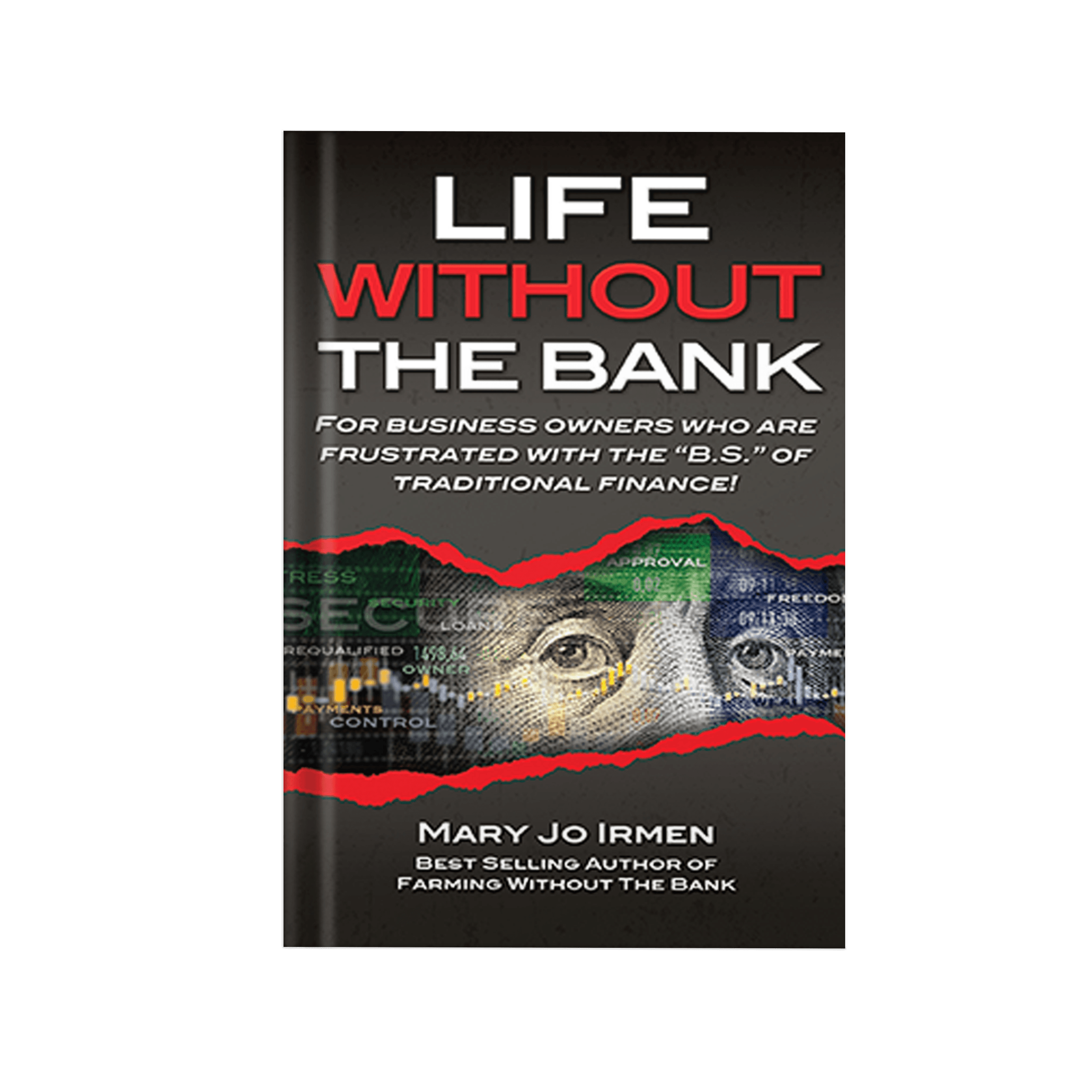
ready to start?
Your financial independence starts with one book.
Only one of three Americans can retire. Part of the fault is the conditioned belief that you must give up the use of your money when you’re young so you can have it later, assuming the stock market doesn’t collapse.