Podcast
EP. 283
The Real Numbers Behind Infinite Banking (It’s Not What You Think) (Ep. 283)
Aug 20, 2026 ·
18 min
0:00 / 18:19
EPISODE OVERVIEW
ABOUT THIS EPISODE
Has your accountant "never heard of" infinite banking and your financial advisor calls whole life insurance a "scam"?
In this episode, Mary Jo Irmen pulls up the actual policy numbers and breaks down why they're wrong — and how structure changes everything.
⚠️ Warning: this episode comes with a dose of German passion. Mary Jo walks through the real numbers behind three policy structures — traditional whole life, 10-pay, and paid-up-at-65 — and shows exactly what a policy built for infinite banking does differently.
$20,000 in premium can mean $0 cash value in year one… or $14,000 of access in 10 days. The difference is the paid-up additions rider, and if your advisor can't explain that, you have a problem.
Mary Jo also breaks down why a 200-year-old, insurance-commissioner-approved product can't be "a scam" — and why you need to educate yourself before paying for advice from someone who hasn't done the reading.
- 📩 Questions? Ideas for the show? Reach out: maryjo@withoutthebank.com
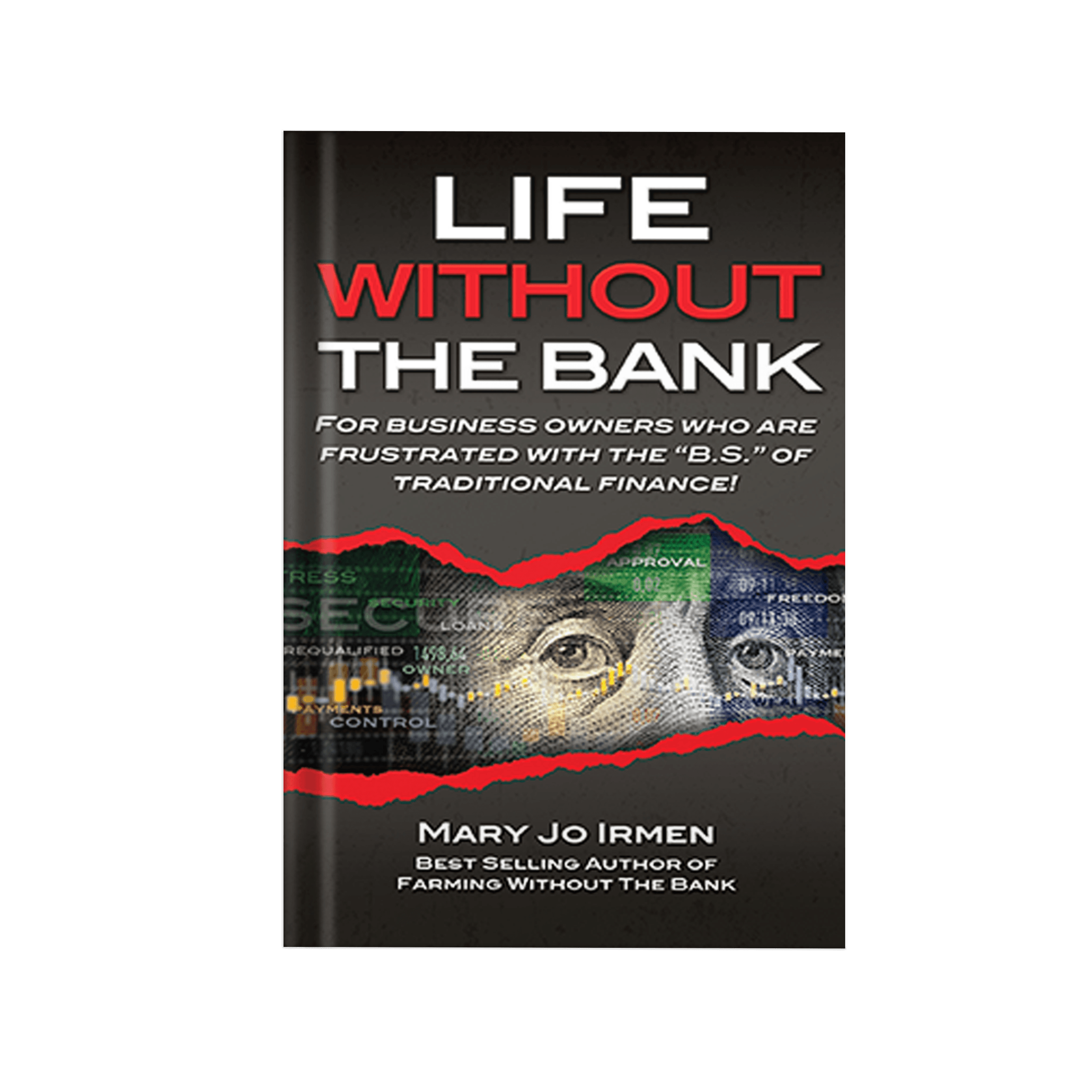
- 📘 Grab the Life Without the Bank book and your BYOB book
- 🎤️ Know someone Mary Jo should interview? Send it her way!
- ▶️ Subscribe on YouTube
Audio production by Podsworth Media.
CHAPTER TIMESTAMPS
- 0:00Intro & the warning (German passion incoming)
- 0:45"My advisor said it's a scam"
- 1:32Traditional whole life: the real numbers
- 5:44How infinite banking policies are structured
- 7:04The 10-pay policy trap
- 8:51Paid up at 65
- 11:00Why it can't be a scam
- 11:35The crab in the box
- 13:15Your job: educate yourself
- 16:45Closing & book your appointment
YOUTUBE EPISODE
TRANSCRIPTION
"In today's world with all the information we need at our fingertips, there is zero reason to be ignorant. Zero. There's zero reason to say, 'Oh, I don't know. I can't look into that.' Mm-mm. Nope. Everything is there for you to be educated. You're the one deciding that you don't want to be educated, and then you get to decide if those are the people you're working with, if you want to continue working with them."
Hello, hello, hello, and welcome back to the podcast. Thank you very much for being here. Warning — this podcast is gonna come with a warning and some German passion. Because I am thoroughly irritated by people who are ignorant, and they can't do some due diligence for their clients.
So I had a potential client this morning who we were going over numbers, and they had a lot of questions, which is totally normal. And I said, "I'm sure you're getting beaten up by other people that you're talking to about this." And they said, "Oh yeah, our accountant said that he had never heard about it, and our financial advisor said it's a scam."
Really? It's a scam. It's a 200-year-old product, but because you chose to not say, "That's interesting. Where would I get a book? Who would I talk to? How would I educate myself on this?" One of the two — I think it was the accountant — said, "You would have to put in so much money every single year that you would not be able to afford it to be able to have cash value to borrow against."
So let's look at the actual numbers of traditional, what I call old-fashioned whole life, to whole life that we use for infinite banking. Because you don't get access to cash right away, depending on how you are sold that policy.
So was the accountant 100% wrong? No. Was he wrong? Yes, because he is not educating himself. So when we are looking at professionals to give us advice, we need to understand that if I'm an accountant, life insurance is not my forte. I don't eat, sleep, and breathe life insurance.
You guys know I don't sell long-term care. I send you to Michelle for long-term care. Why do I send you to Michelle? Because I don't know long-term care. Because I can't know it inside and out. Because there are multiple companies that sell it. There are multiple ways to sell it. So what do I do? I reach out to the expert and say, "Hey, why don't you go to Michelle for long-term care?"
I am the expert in life insurance, and so as I know enough about accounting to be dangerous, and I know enough about legal to be dangerous, I'm going to send you there and say, "Hey, you know what? This is what my accountant says. This is my experience with accounting, but you're gonna wanna talk to your accountant on accounting." Or I'm gonna educate myself so that, geez, maybe I do know a little bit more about it. You know, like buy a course or something, or read a book. You know, there's a — there's a thought.
Okay, I'm gonna share my screen so we can go over what you guys are looking at and what your accountant or your financial advisor or your banker is talking about when they talk about, "Oh, whole life is expensive, and whole life isn't gonna give you any cash value right away." They do not understand how we are structuring a policy. So let me share my screen so that you guys can see this, because this is important even if you're going to be sold life insurance. This is super important.
Let's start out with just your traditional whole life policy. The accountant is correct, the financial advisor's correct, e— everybody understands this. If I sell you traditional whole life where all the money goes to buy whole life death benefit, then if we look in year one, you're going to see cash value is big fat zero.
In this example, we have paid $20,000 of premium, but your cash value is zero. Year two, we did it again. We paid the $20,000 of premium. Cash value is zero. Are they wrong in the essence that it takes a long time to build cash value? Sort of. They're wrong that you give up liquidity of money right away in the first couple of years, because there's zero dollars.
Year three, there's $11,000. Year five, there's $50,000. So you've got 50% of your money by year five, okay? Year 10, you've paid in $200,000 and you have access to $164,000, okay? That's not so bad in 10 years.
Let's just compare the capitalization. People want access to this money right away. You put money into your 401(k), or you put money into an IRA, you put money into a bond, you put money into a Roth, you put money into a CD, you got access to nothing. Absolutely zero, zilcho. You don't even have death benefit. You just have whatever's in there. I could put $20,000 in an IRA today and lose 50% of it, and they would still tell me that's a better idea. I didn't have access to anything. Nothing. Zero. Zilcho. Why is the liquidity of this so much different than the liquidity of something else? I digress.
Okay, so that is a policy, traditional whole life. If you are being sold life insurance, you can look and go, "Oh yeah, that's not a policy set up for infinite banking," because if it was a policy set up for infinite banking, we would see this. We would pay $20,000 in premium, and we would have access to $14,000 in 10 days.
Hmm. Oh, what do you mean this is too expensive? We're never gonna have access to our money. Oh, you mean you didn't read a book, and you didn't educate yourself?
Year two, we pay $20,000. We now have access to $30,000. By year five, we have access to $91,000. By year 10, we have access to $215,000. The traditional policy, we had access to $200,000. Now we have access to $215,000. Where'd that extra $15,000 come from? Compound interest and dividends.
So everything in this policy, we're breaking even by year s— eight. Everything is happening faster because we've put that paid-up additions rider on. This is important to understand how these policies are structured.
Now, another thing that might happen is you might get sold a policy that is a 10-pay, for example. "Oh, we're only gonna pay for 10 years. Look at how fast my cash value grows." Another thing that might happen is you might get sold a policy that's traditional whole life, but it's a 10-pay. And so somebody's gonna say, "Oh, look at how fast that grows." Well, let's look at that.
What a 10-pay policy is, is we're only paying this thing for 10 years, and so everything happens faster. So I see this a lot. When you go to another life insurance agent, they're gonna say, "Oh, I can do what Mary Jo does. I can break even by year 10," and you do. See how you're only paying premium for 10 years, and then it goes to $0 after that.
At year 10, you did break even, and it's because, again, everything is shortened up, and you do have access to $7,400 right away. Great, fantastic. But is it the 75% of your premium that I showed you earlier? No, it's not.
If we look at a 10-pay structured for infinite banking, we have access to $15,000 right away, almost 16. Why? Again, it's short, but we put on that paid-up additions rider, and we can get all of that extra cash in there. And so now at year 10, we've got $222,000.
So a lot of times, the other thing I see are people coming to me and saying, "Well, I have cash value right away." And I'll say, "How much?" I immediately know if it's a 10-pay or even a paid-up at 65. I ran one of those for you as well.
A traditional whole life paid-up at 65, you pay $20,000 and guess what? Zero cash value right away. Because you've got 65 years, or in this case 30, 30 years that we have to pay this thing. So it's not going to be as fast as a 10-pay when it's traditional whole life, but it will be faster because year two we've got $15,000 of cash value.
But what if this was set up for infinite banking? That was the case, we're gonna have access to $13,000 right away, not zero on a paid-up at 65.
And so we have to look at what is the structure of the policy? What are these people trying to do? What is the financial advisor seeing? What is the banker seeing? What is the accountant seeing? They're seeing old-fashioned traditional whole life.
They are not educating themselves on other ways that policies can be structured. Like I said, this is not something new. Not all companies have paid-up additions riders. Not all companies can put as much money to paid-up additions riders. Not all companies can structure policies the same. I'm not selling some sort of illegal product, for God's sake.
All these products I'm selling have to go through the insurance commissioners. You know, there commissions that those have to go through. They have to get things approved. They can't just do whatever they want. And so we have to understand that. Some financial advisor can't just sell some arbitrage product of IRAs or 401(k)s or whatever. That all has to go through the SEC.
And so we have to think logically about this. How can I literally be a scammer? How can I be a scammer when I have to be licensed and I can only sell a product the insurance company says I can sell? Now, I could even sell an IUL and not be a scammer because it's a legit product. The way I sell it, I could be a scammer, but there is no way to sell a whole life insurance policy and be a scammer. It is a guaranteed product. It has a guaranteed side to the illustration. The only thing that is non-guaranteed is the dividend, which they've paid for 150 years. So gee, that could be a scam, I guess.
Really, people? This is what drives me the most crazy about this, is that we are all trying to advance ourselves in life, right? Picture you as a crab in a box trying to crawl out of the box, and then the very people you go to for advice on how to get out of that box pull you back down. "Nope, you can't do that. That's a scam." Pull you back down.
The very people you pay for advice, you look at as a professional because they have some fancy-ass college degree, is the one pulling you down because they can't go to Farming Without the Bank, they can't go to withoutthebank.com, they can't go to infinitebanking.org and order a book, or even Amazon for that matter.
You're too lazy to read because you think that you learned everything you needed to know in college, and now everything else is a scam? Are you shitting me? Excuse the French today, but this is extremely annoying to me.
Now, it is less annoying, believe it or not, 16 years in because now there are so many books, there are so many podcasts, there are so many websites, so many people teaching infinite banking. When I started 16 years ago, there was nothing. There was zero education on this, and so it was… I could understand more why people would be skeptical. But in today's world, with so much education, so many podcasts, so many books, I have a hard time understanding why a professional charging people would say that that is a scam.
I have a client that messaged me last week that said, "Hey, Mary Jo, I saw this person on social media. What do you think of this?" And I said, "You know, I've not seen that individual, so let me go look." Sometimes you have to be careful with some of these things out there — whatever subject, I'm not even gonna say, whatever subject he was talking to me about. Like, sometimes you do have to be careful. I know people in prison 'cause of that. But I will check it out, and I will let you know.
So I checked it out, and I said, "Hey, I'm gonna follow this guy for a while just to see what he's saying, if it's accurate, if it's not accurate, and then I will let you know." And thus far, it looks to be 100% legit. The guy looks to be honest. He's providing education. It's amazing, absolutely amazing.
But it is my job as this guy's — I don't wanna say coach, but I'm sort of… I love to… Like, for this particular client, I would consider myself more of a coach because he calls all the time. We talk about stuff all the time. He's very much a big thinker. I am not pulling him down.
Do I have a degree in business? Yes, absolutely. Does it matter? No, absolutely not. Who cares? Because if I would've went to business school and then done everything that they told me to do in business school, I wouldn't be where I'm at today. Instead, I went and coached with multi-multi-multi-multi-million dollar business owners, that got me where I am today. Because everything I learned outside of school is what is making people money, not the stuff we learned inside of school.
We can go to these people, and we can pay them, but if they can't go buy the book on their own, you should be questioning what they're doing and the advice they're giving. Because… And I mean, buy the book. Don't go buy these books, okay? You're gonna go and buy the bundle. Don't go buy this bundle of books and then give it to them. Uh-uh. No, no, no, no, no, no, no. You bought your books for yourself. If they want to educate themselves, they will go buy their own books.
I don't ask anybody to give me a book. I don't ask anybody to give me access to a course. I will go buy that myself, and I will educate myself on it. Oh, 20 bucks and I didn't learn anything. Okay, big deal, right? You've probably spent $20 on a couple of beers, and you didn't complain about that.
Don't be giving them things. They're not going to read it. If you make them buy it and give them a little bit of a — make it a little bit hard for them. Have them go out and get it. Because if they go out and do it on their own, that means they're even more serious about helping you. If they can't go f— find the book, if they can't listen to the podcast, if they can't read the book, and you've done all the research, you're the expert, not them.
Why are you asking somebody for advice on a subject they don't know anything about but you know more? Is it now your job to educate your accountant and your financial advisor? Are you charging them for that education? Really?
I had to ask my accountant about stuff, and I shared some stuff with him that now makes me question how much he knows. Because if I know more than you, that's alarming to me. Very alarming. I'm not here to educate you. I pay you, so you should be educating me. Scary, scary.
Grab your books, listen to the podcast as you are, educate yourself, and then when somebody tells you, "Oh, that's a scam, you're gonna have to put a ton of money into that to even get anywhere," hmm, you're gonna have to put money in, and you will get somewhere.
That traditional policy, I forgot to go over that, but that broke even at year 13. Traditional whole life. That just means you had to give up access to money in the first couple of years. That, to me, is not a long time, even with traditional whole life. Why are they acting like it's the end of the world? Put it into perspective, because they're not doing that.
All right, you guys, it's Monday. I'm tired. That was my first meeting of the day, and it got me going. Oh, it's just, in today's world with all the information we need at our fingertips, there is zero reason to be ignorant. Zero. There's zero reason to say, "Oh, I don't know. I can't look into that." Mm-mm. Nope. Everything is there for you to be educated. You're the one deciding that you don't want to be educated, and then you get to decide if those are the people you're working with, if you want to continue working with them.
All right, you guys, you know the routine. maryjo@withoutthebank.com or john@withoutthebank.com. Set up your appointment with us so we can go through everything. We're happy to look at what you already have for life insurance. If it's great, keep it. If it's not great, again, we'll educate you on it, and then you get to decide what you wanna do.
But if you don't set up your appointment with us, nothing's gonna change. You're gonna be the same spot you were three years back. What has changed from three years ago to today? Nothing. If you set up your appointment with us, you're three years in, your policy's cash flowing, everything is absolutely fantastic, you are well on your way.
We are not down here pulling crabs down and not letting you get ahead. We want you to get ahead. We want to see you succeed. And so schedule your appointment, and then just let us know how we can help. But you have a fantastic rest of your day.
View MoreHello, hello, hello, and welcome back to the podcast. Thank you very much for being here. Warning — this podcast is gonna come with a warning and some German passion. Because I am thoroughly irritated by people who are ignorant, and they can't do some due diligence for their clients.
So I had a potential client this morning who we were going over numbers, and they had a lot of questions, which is totally normal. And I said, "I'm sure you're getting beaten up by other people that you're talking to about this." And they said, "Oh yeah, our accountant said that he had never heard about it, and our financial advisor said it's a scam."
Really? It's a scam. It's a 200-year-old product, but because you chose to not say, "That's interesting. Where would I get a book? Who would I talk to? How would I educate myself on this?" One of the two — I think it was the accountant — said, "You would have to put in so much money every single year that you would not be able to afford it to be able to have cash value to borrow against."
So let's look at the actual numbers of traditional, what I call old-fashioned whole life, to whole life that we use for infinite banking. Because you don't get access to cash right away, depending on how you are sold that policy.
So was the accountant 100% wrong? No. Was he wrong? Yes, because he is not educating himself. So when we are looking at professionals to give us advice, we need to understand that if I'm an accountant, life insurance is not my forte. I don't eat, sleep, and breathe life insurance.
You guys know I don't sell long-term care. I send you to Michelle for long-term care. Why do I send you to Michelle? Because I don't know long-term care. Because I can't know it inside and out. Because there are multiple companies that sell it. There are multiple ways to sell it. So what do I do? I reach out to the expert and say, "Hey, why don't you go to Michelle for long-term care?"
I am the expert in life insurance, and so as I know enough about accounting to be dangerous, and I know enough about legal to be dangerous, I'm going to send you there and say, "Hey, you know what? This is what my accountant says. This is my experience with accounting, but you're gonna wanna talk to your accountant on accounting." Or I'm gonna educate myself so that, geez, maybe I do know a little bit more about it. You know, like buy a course or something, or read a book. You know, there's a — there's a thought.
Okay, I'm gonna share my screen so we can go over what you guys are looking at and what your accountant or your financial advisor or your banker is talking about when they talk about, "Oh, whole life is expensive, and whole life isn't gonna give you any cash value right away." They do not understand how we are structuring a policy. So let me share my screen so that you guys can see this, because this is important even if you're going to be sold life insurance. This is super important.
Let's start out with just your traditional whole life policy. The accountant is correct, the financial advisor's correct, e— everybody understands this. If I sell you traditional whole life where all the money goes to buy whole life death benefit, then if we look in year one, you're going to see cash value is big fat zero.
In this example, we have paid $20,000 of premium, but your cash value is zero. Year two, we did it again. We paid the $20,000 of premium. Cash value is zero. Are they wrong in the essence that it takes a long time to build cash value? Sort of. They're wrong that you give up liquidity of money right away in the first couple of years, because there's zero dollars.
Year three, there's $11,000. Year five, there's $50,000. So you've got 50% of your money by year five, okay? Year 10, you've paid in $200,000 and you have access to $164,000, okay? That's not so bad in 10 years.
Let's just compare the capitalization. People want access to this money right away. You put money into your 401(k), or you put money into an IRA, you put money into a bond, you put money into a Roth, you put money into a CD, you got access to nothing. Absolutely zero, zilcho. You don't even have death benefit. You just have whatever's in there. I could put $20,000 in an IRA today and lose 50% of it, and they would still tell me that's a better idea. I didn't have access to anything. Nothing. Zero. Zilcho. Why is the liquidity of this so much different than the liquidity of something else? I digress.
Okay, so that is a policy, traditional whole life. If you are being sold life insurance, you can look and go, "Oh yeah, that's not a policy set up for infinite banking," because if it was a policy set up for infinite banking, we would see this. We would pay $20,000 in premium, and we would have access to $14,000 in 10 days.
Hmm. Oh, what do you mean this is too expensive? We're never gonna have access to our money. Oh, you mean you didn't read a book, and you didn't educate yourself?
Year two, we pay $20,000. We now have access to $30,000. By year five, we have access to $91,000. By year 10, we have access to $215,000. The traditional policy, we had access to $200,000. Now we have access to $215,000. Where'd that extra $15,000 come from? Compound interest and dividends.
So everything in this policy, we're breaking even by year s— eight. Everything is happening faster because we've put that paid-up additions rider on. This is important to understand how these policies are structured.
Now, another thing that might happen is you might get sold a policy that is a 10-pay, for example. "Oh, we're only gonna pay for 10 years. Look at how fast my cash value grows." Another thing that might happen is you might get sold a policy that's traditional whole life, but it's a 10-pay. And so somebody's gonna say, "Oh, look at how fast that grows." Well, let's look at that.
What a 10-pay policy is, is we're only paying this thing for 10 years, and so everything happens faster. So I see this a lot. When you go to another life insurance agent, they're gonna say, "Oh, I can do what Mary Jo does. I can break even by year 10," and you do. See how you're only paying premium for 10 years, and then it goes to $0 after that.
At year 10, you did break even, and it's because, again, everything is shortened up, and you do have access to $7,400 right away. Great, fantastic. But is it the 75% of your premium that I showed you earlier? No, it's not.
If we look at a 10-pay structured for infinite banking, we have access to $15,000 right away, almost 16. Why? Again, it's short, but we put on that paid-up additions rider, and we can get all of that extra cash in there. And so now at year 10, we've got $222,000.
So a lot of times, the other thing I see are people coming to me and saying, "Well, I have cash value right away." And I'll say, "How much?" I immediately know if it's a 10-pay or even a paid-up at 65. I ran one of those for you as well.
A traditional whole life paid-up at 65, you pay $20,000 and guess what? Zero cash value right away. Because you've got 65 years, or in this case 30, 30 years that we have to pay this thing. So it's not going to be as fast as a 10-pay when it's traditional whole life, but it will be faster because year two we've got $15,000 of cash value.
But what if this was set up for infinite banking? That was the case, we're gonna have access to $13,000 right away, not zero on a paid-up at 65.
And so we have to look at what is the structure of the policy? What are these people trying to do? What is the financial advisor seeing? What is the banker seeing? What is the accountant seeing? They're seeing old-fashioned traditional whole life.
They are not educating themselves on other ways that policies can be structured. Like I said, this is not something new. Not all companies have paid-up additions riders. Not all companies can put as much money to paid-up additions riders. Not all companies can structure policies the same. I'm not selling some sort of illegal product, for God's sake.
All these products I'm selling have to go through the insurance commissioners. You know, there commissions that those have to go through. They have to get things approved. They can't just do whatever they want. And so we have to understand that. Some financial advisor can't just sell some arbitrage product of IRAs or 401(k)s or whatever. That all has to go through the SEC.
And so we have to think logically about this. How can I literally be a scammer? How can I be a scammer when I have to be licensed and I can only sell a product the insurance company says I can sell? Now, I could even sell an IUL and not be a scammer because it's a legit product. The way I sell it, I could be a scammer, but there is no way to sell a whole life insurance policy and be a scammer. It is a guaranteed product. It has a guaranteed side to the illustration. The only thing that is non-guaranteed is the dividend, which they've paid for 150 years. So gee, that could be a scam, I guess.
Really, people? This is what drives me the most crazy about this, is that we are all trying to advance ourselves in life, right? Picture you as a crab in a box trying to crawl out of the box, and then the very people you go to for advice on how to get out of that box pull you back down. "Nope, you can't do that. That's a scam." Pull you back down.
The very people you pay for advice, you look at as a professional because they have some fancy-ass college degree, is the one pulling you down because they can't go to Farming Without the Bank, they can't go to withoutthebank.com, they can't go to infinitebanking.org and order a book, or even Amazon for that matter.
You're too lazy to read because you think that you learned everything you needed to know in college, and now everything else is a scam? Are you shitting me? Excuse the French today, but this is extremely annoying to me.
Now, it is less annoying, believe it or not, 16 years in because now there are so many books, there are so many podcasts, there are so many websites, so many people teaching infinite banking. When I started 16 years ago, there was nothing. There was zero education on this, and so it was… I could understand more why people would be skeptical. But in today's world, with so much education, so many podcasts, so many books, I have a hard time understanding why a professional charging people would say that that is a scam.
I have a client that messaged me last week that said, "Hey, Mary Jo, I saw this person on social media. What do you think of this?" And I said, "You know, I've not seen that individual, so let me go look." Sometimes you have to be careful with some of these things out there — whatever subject, I'm not even gonna say, whatever subject he was talking to me about. Like, sometimes you do have to be careful. I know people in prison 'cause of that. But I will check it out, and I will let you know.
So I checked it out, and I said, "Hey, I'm gonna follow this guy for a while just to see what he's saying, if it's accurate, if it's not accurate, and then I will let you know." And thus far, it looks to be 100% legit. The guy looks to be honest. He's providing education. It's amazing, absolutely amazing.
But it is my job as this guy's — I don't wanna say coach, but I'm sort of… I love to… Like, for this particular client, I would consider myself more of a coach because he calls all the time. We talk about stuff all the time. He's very much a big thinker. I am not pulling him down.
Do I have a degree in business? Yes, absolutely. Does it matter? No, absolutely not. Who cares? Because if I would've went to business school and then done everything that they told me to do in business school, I wouldn't be where I'm at today. Instead, I went and coached with multi-multi-multi-multi-million dollar business owners, that got me where I am today. Because everything I learned outside of school is what is making people money, not the stuff we learned inside of school.
We can go to these people, and we can pay them, but if they can't go buy the book on their own, you should be questioning what they're doing and the advice they're giving. Because… And I mean, buy the book. Don't go buy these books, okay? You're gonna go and buy the bundle. Don't go buy this bundle of books and then give it to them. Uh-uh. No, no, no, no, no, no, no. You bought your books for yourself. If they want to educate themselves, they will go buy their own books.
I don't ask anybody to give me a book. I don't ask anybody to give me access to a course. I will go buy that myself, and I will educate myself on it. Oh, 20 bucks and I didn't learn anything. Okay, big deal, right? You've probably spent $20 on a couple of beers, and you didn't complain about that.
Don't be giving them things. They're not going to read it. If you make them buy it and give them a little bit of a — make it a little bit hard for them. Have them go out and get it. Because if they go out and do it on their own, that means they're even more serious about helping you. If they can't go f— find the book, if they can't listen to the podcast, if they can't read the book, and you've done all the research, you're the expert, not them.
Why are you asking somebody for advice on a subject they don't know anything about but you know more? Is it now your job to educate your accountant and your financial advisor? Are you charging them for that education? Really?
I had to ask my accountant about stuff, and I shared some stuff with him that now makes me question how much he knows. Because if I know more than you, that's alarming to me. Very alarming. I'm not here to educate you. I pay you, so you should be educating me. Scary, scary.
Grab your books, listen to the podcast as you are, educate yourself, and then when somebody tells you, "Oh, that's a scam, you're gonna have to put a ton of money into that to even get anywhere," hmm, you're gonna have to put money in, and you will get somewhere.
That traditional policy, I forgot to go over that, but that broke even at year 13. Traditional whole life. That just means you had to give up access to money in the first couple of years. That, to me, is not a long time, even with traditional whole life. Why are they acting like it's the end of the world? Put it into perspective, because they're not doing that.
All right, you guys, it's Monday. I'm tired. That was my first meeting of the day, and it got me going. Oh, it's just, in today's world with all the information we need at our fingertips, there is zero reason to be ignorant. Zero. There's zero reason to say, "Oh, I don't know. I can't look into that." Mm-mm. Nope. Everything is there for you to be educated. You're the one deciding that you don't want to be educated, and then you get to decide if those are the people you're working with, if you want to continue working with them.
All right, you guys, you know the routine. maryjo@withoutthebank.com or john@withoutthebank.com. Set up your appointment with us so we can go through everything. We're happy to look at what you already have for life insurance. If it's great, keep it. If it's not great, again, we'll educate you on it, and then you get to decide what you wanna do.
But if you don't set up your appointment with us, nothing's gonna change. You're gonna be the same spot you were three years back. What has changed from three years ago to today? Nothing. If you set up your appointment with us, you're three years in, your policy's cash flowing, everything is absolutely fantastic, you are well on your way.
We are not down here pulling crabs down and not letting you get ahead. We want you to get ahead. We want to see you succeed. And so schedule your appointment, and then just let us know how we can help. But you have a fantastic rest of your day.



ready to start?
Your financial independence starts with one book.
Only one of three Americans can retire. Part of the fault is the conditioned belief that you must give up the use of your money when you’re young so you can have it later, assuming the stock market doesn’t collapse.