GET THE BOOK
Podcast
EP. 289
The Shocking Truth About the Federal Reserve’s Impact on Your Money (Ep. 289)
Oct 1, 2026 ·
19 min
0:00 / 19:21
EPISODE OVERVIEW
ABOUT THIS EPISODE
Mary Jo recaps two big things: a must-read book for understanding our money system, and her refresher training in Houston on the Truth Concepts calculators.
If you’ve read Becoming Your Own Banker and gone down the rabbit hole of fractional reserve banking, The Creature from Jekyll Island by G. Edward Griffin is the next step — how $1 in the bank lets the system borrow $10, why that devalues our dollar, and who met on Jekyll Island to pass the Federal Reserve Act.
Mary Jo also breaks down why crypto is not the answer for her, what really happens to a whole life insurance infinite banking policy if the dollar crashes, and how she’d use policy loans to buy land, drill wells, and buy real assets instead of holding paper dollars.
Then the Houston part: Todd Langford created his calculators to prove Nelson wrong on the infinite banking concept — and got proven wrong. Mary Jo shares the refresher on qualified plans / 401(k)s for business owners, future requirements ($10–30M in tomorrow’s dollars), taxes vs. rate of return, and the unseen rate of return when you borrow to create cash flow externally.
Bottom line: don’t just park money. Use it entrepreneurially to make more money.
📧 Email Mary Jo: maryjo@withoutthebank.com
Audio Production by Podsworth Media – podsworth.com
CHAPTER TIMESTAMPS
- 00:00Money Is to Be Used, Not Sit Idle
- 01:13Welcome
- 01:44Fractional Reserve Banking and Nelson's Rabbit Hole
- 02:30Creature from Jekyll Island: 600 Pages, Fed 10-to-1, Oreos Example
- 04:01Why Crypto Is Not the Answer
- 06:14What Happens to Your Policy If the Dollar Crashes?
- 07:28Prepper Strategy: Borrow to Buy Land, Wells and Real Assets
- 08:13Stepping Out of the Noise: Gold Hype, Stocks and Manipulation
- 09:54The Fed Is 100% Private Company + YouTube / Cliff Notes Option
- 10:09Why I Bought This Book for My Dad Years Ago
- 11:35Houston Truth Concepts Training With Todd Langford
- 12:45401(k)s for Business Owners: Tax Write-Off vs. Usable Growth
- 13:39Future Requirements and Inflation Truth
- 15:32The Unseen Rate of Return and Interruptions
- 16:15Stop Just Saving, Start Creating Cash Flow
- 19:03Financial Advisor Gets Infinite Banking Wrong
- 20:08Grab Your Book and Schedule With John or Mary Jo
YOUTUBE EPISODE
TRANSCRIPTION
“The concept is that you can go and access that money, and now you can be entrepreneurial with it. That money is to be used, not to sit idle.
When we look at future requirements of what you’re gonna need, we can’t save you into that. In today’s world where everything is so expensive, how are you saving 12 to 15% of your income? Most people are not because they don’t want to give up things, and we don’t have to when we know how to use the policy correctly. It’s just crazy to me to see that that is a conversation most agents are having is, ‘Hey, use this as a savings tool,’ and the conversation that I’m having is, ‘Hey, how can we make more money? What business can we start with for you? What is interesting to you? Do you wanna be a private lender? If you don’t wanna start a business, do you want a business that’s hands-off?’ Like, how can we create more cash flow for you, not just save? Because in order to save, that means you had to give something up today, and that’s great.
You might have to beat Parkinson’s Law to some extent, but if we’re going to beat Parkinson’s Law to put money in the policy, the money in the policy should be used to create more cash flow.”
Hello, hello, and welcome back to the podcast. Thank you very much for being here. Today, we’re gonna recap a couple of things. One, I have another book for y’all. It’s so little. Like, look at it. And two, I wanna talk a little bit about just to let you know that I was at a calculator training and how that went and some refreshers from me.
First of all, if you guys are, you know… You read my Life Without the Bank book. Maybe you’ve read the farming book. Maybe you’ve read Nelson’s book, Becoming Your Own Banker, and you’re like, “What are you talking about, fractional reserve banking?” Like, you go down a rabbit hole.
And so Nelson’s book especially, I keep it out of my book, but Nelson’s book especially kind of takes you down the rabbit hole of government involvement in our money. And some people start to look at fractional reserve banking because Nelson talks about the fact that the bank turns our money 10 to one.
And so if you are new to fractional reserve banking, if you are new to Federal Reserve stuff and you are looking for information, The Creature from Jekyll Island is a good start. Now, this book is what? 600 pages long? Let me look here. Let me get through this piece of it. Yeah, it’s almost 600 pages. It’s like 580, 590, something like that.
And so when I first heard about Becoming Your Own Banker, I did not know anything about fractional reserve banking. I did not know that the feds are turning money. And so what happens is when you put a dollar into the bank, they can go to the Federal Reserve and borrow $10, and then they can lend it out.
And so that is devaluing our dollar, essentially. Then it takes more dollars to buy your Oreos is how I like to explain it, and a lot of people don’t know that that happened. And so this book goes over all of that and how all of these people, the Rockefellers, the Rothschilds, JP Morgan, all of these people met on Jekyll Island in the middle of the night to pass the Federal Reserve Act. So we did not have… This was not a thing. People fought it, they renamed it, and then all of a sudden we can inflate the dollar, and then we come off the gold standard. And so many things happened during this period that got us to where we are today with our financial system. A lot of people think crypto is going to be the end all of this fractional reserve banking.
What can’t be inflated, there’s only so much crypto that’s printed. If you guys have listened to me at all on either one of my podcasts, then you know I am not a believer in cryptocurrency. I just think it’s another ploy for a stock market. It’s just another up and down. It’s just another guess on what’s gonna happen.
I don’t think it’s gonna replace our dollar. Should we go back to a gold standard? Sure. Absolutely. Are we going to lose our dollar? Maybe. But if you stop listening to the doomsdayers, you also understand that we are still the strongest economy in the world. Can we be surpassed? Yes. Do we have to pay attention to what’s happening?
Yes. Should we know what’s happening with the Federal Reserve and all the crap that they pulled? Yes. Is crypto the answer for me? No. Absolutely not. Because I truly believe that in order for you to get any kind of movement on stuff, 10% of the population is going to have to understand it. And guess what?
10% of the population does not look at their finances. Maybe one to 2% of the population does. And there are so many scams around crypto-type currencies, not crypto itself, but around these currencies. Just locally, I know two people… I don’t know them, I know of two people that have been scammed and completely lost their farm due to trying to make high rates of return in some sort of a crypto-type currency.
It’s not even coming to the top of my head right now what the actual name of it is, but whatever. It’s a scam. You have to be aware of that. Also, when crypto started, it was, “Oh, the government’s gonna leave their fingers out of it,” and now they have their fingers in all of it. And so how is that any different than our current currency?
They got their fingers in it. They’re gonna control it just like they control our dollar, or our note, as some of you would call it. And so we have to kind of look big-term on that. Some people will say, “Well, Mary Jo,” I see this a lot on Facebook when I’m running an ad or a post or something, somebody will say, “Well, what’s gonna happen to the life insurance policy if the dollar crashes?”
I’m going to say, if the dollar crashes, we have more to be concerned about than our life insurance policy. Because think about it, if the dollar crashes, how are you gonna get your dollar out of the banking system? You’re not. Any easier than you may get it out of a life insurance policy, because it still has to go to the bank.
Okay? So if you are that doomsdayer, then let me ask you this. What happens when our dollar crashes and you have dollars? I have an uncle that came over here from Germany, and his dad had suitcases of money. Guess what it was worth? Nothing. Nothing. If our dollar crashes and it’s not worth anything, we need to be more concerned about food, water, shelter, guns, ammo, all the things. It’s gonna go back to a barter system. If your dollar’s not worth anything, are you going to be able to barter your dollar? No. But what I’m going to do is I’m going to put my money into the life insurance policy, and then I’m going to borrow against that money to buy land and to maybe drill wells, do things that can get me through the doomsday.
And so you can be a prepper, and you can still have a life insurance policy and think that the world is going to end, but so many people are saying, “No, I don’t want this.” Well, what happens if it doesn’t end? A lot of this stuff happened in 1931, and so here we are in 2026, and we are still repeating the same stuff they’ve been repeating for years. Sometimes I will look back, and you guys, some of you aren’t gonna like this, and that’s fine.
Sometimes I will look back, just step back from it for a minute. Get out of the noise, as Nelson would say. Turn off the news. The gold guys are telling you, “You need to buy gold. The market’s down. You need to buy gold.” When the market’s up, then gold’s not worth as much, and then you hear how much money you should be putting in the market.
Sometimes I wonder if those two people are in bed together. Are we creating an urgency to go buy gold because we want to sell more gold? So we’re gonna talk about how bad the economy is so that we can sell more gold and prop up our gold prices and make more money on gold. No different than saying, “Hey, I’m gonna sell some stocks for XYZ company, and this is gonna be the best stock ever,” right?
They’re gonna prop that up so everybody goes and buys stock. Maybe it’s in Tesla, anything Elon related. Oh, we’re gonna go buy stock in that. ChatGPT, any kind of AI stuff. We’re gonna prop it up. Everybody’s gonna buy into it, and then maybe it will or won’t go anywhere. We’re following the noise instead of stepping back and going, “Hmm, is that a good buy? Do I really buy gold when everybody else is buying gold at the highest, or do I just be patient and wait?” So everything has kind of been manipulated, and it’s all been manipulated by the Rockefellers. The Rothschilds did it, JP Morgan. It is so interesting who actually started the Federal Reserve, and to know that it is not federal.
It is not government-owned. It is 100% private company. And so if you don’t like to read, apparently this is on the YouTube as well, and you can listen to it. I’m sure you can get, like, a CliffsNotes version of it, whatever. I bought this book for my dad, way before I even started Infinite Banking, because the guy that wrote this book is G. Edward Griffin. He also wrote a book, Vitamin B17: The Cancer Cure, and I read that book because I am a crazy all-natural cancer person, and I like to do a lot of natural cancer research. And so I read that book, and in the back of that book, it said, “Oh, this guy also wrote The Creature from Jekyll Island.” I had no idea what it was.
I didn’t pay attention to it. I just knew, hey, my dad liked this book. He’ll probably like The Creature from Jekyll Island too. So I bought him this for Christmas years ago, and I’ve since stole it back so that I can have it on my shelf. So, have I read it myself? No, I read the CliffsNotes because it’s 600 pages, okay?
I have a lot of friends that have read it. You can actually go to Jekyll Island, and there’s, like, Federal Reserve stuff there. I’ve never made it over there yet, but I do have friends that have done that as well. So there you go. If you’re looking for a book read, 600 pages. Might take you a little bit of time.
Depends how fast you read. This would probably take me 10 years, ’cause I like short books, not long books. That’s why my books are only 100 pages or less. So that is The Creature from Jekyll Island. The other thing to visit about is I was in Houston last week for training on the Truth Concepts calculators that I use, and those calculators are all financial calculators.
I do that training, I try to do it every year. Haven’t been there for a while, so it was a lot because he’s changed the calculators, he’s added a bunch of stuff. It was just such a good refresher as to why whole life is a better tool than most out there. Anything out there. It’s not the end-all, it’s not the be-all.
You use it in conjunction with other things. But it’s fun because the guy that created the calculators, Todd Langford, he created these calculators to prove Nelson wrong. He heard about infinite banking and what Nelson was doing with life insurance, and he said, “Yeah, that’s not possible. There’s no way you’re making money and it’s better than an IRA or a 401(k) or an annuity or a bond or whatever.” And he got proven wrong. And so he is a huge proponent now of using whole life insurance as a tool. But there’s a couple of calculators that I use, and one of them is for qualified plans, 401(k)s.
And it was really good to have a refresher on that and just be proven by numbers that if you put money into a life insurance policy, it may be a better option for you, especially if you’re a business owner. You’re putting your money in, and you’re putting the company’s money in, which is your money. So you’re putting all of your money into this 401(k), so you can maybe get this tax write-off, when in fact, why are you not putting it somewhere where you can use it to grow the business?
You can use it for, you know, leave inheritance, all of these other things. By the time you get done with taxes, this so-called amazing rate of return is not so amazing. And so it’s fun to see those calculators at work. You guys have heard me talk about the future requirements of what our younger generation is going to need, and it’s a lot of money. You’re anywhere between $10 to $30 million in tomorrow’s dollars, which is going to be $2 to $4 million in today’s dollars with inflation. People get pissed off at me every single time I talk about that. And I do not understand what we don’t understand about inflation. Okay? Our dollar is worth less.
We have a devaluing dollar because of this, and yet we know that our Oreos cost more for less Oreos. We’re mad at Walmart, but we don’t wanna understand the cause of that. The future requirements of that are really proven in this calculator. Todd, that has created those, is very much an all-around thinker, and that is why it is a lot to take in, because he is thinking of all aspects, and then he’s teaching people, and those people are coming back with yeah-buts. And so he is having to justify and make sure that he has thought of all of that. He is like AI on steroids, okay? He’s amazing. Absolutely amazing.
But for me, it is imperative that I can say, without a doubt, whole life is going to be a fantastic answer to part of your finances, that most people are not talking about. Because they just want to look at some kind of rate of return, and then you’re giving up money in exchange for what? An IRA, a 401(k), a Roth.
You don’t have access to that money. And so the one thing that we did not talk about a lot in that meeting was the unseen portion of everything. Okay, here’s the seen, here’s your rates of return compared to X, Y, and Z, but what is the unseen rate of return? What are you able to use that money for in a life insurance policy?
When you borrow against it, what can you use it for externally to even get a better rate of return, which will even be better than what we’re doing in the market? And then, interruptions and how interruptions affect everything. All the stuff that I talk to you guys about normally, I got to have a refresher.
It is interesting how a lot of my colleagues, as I was there, I learned that a lot of my colleagues are talking about saving money in these policies. And that drives me a little bit crazy because I am not talking about that, right? I don’t want your money sitting idle inside of a policy. If it does, great, fantastic.
Great savings tool. But that is not what it is meant to be doing. The concept is that you can go and access that money, and now you can be entrepreneurial with it. You can go, you know, maybe pay for the kids’ sports, maybe put the money in there and pay for the kids’ college. That money is to be used, not to sit idle.
When we look at future requirements of what you’re gonna need, we can’t save you into that. In today’s world where everything is so expensive, how are you saving 12 to 15% of your income? Most people are not because they don’t want to give up things, and we don’t have to when we know how to use the policy correctly. It’s just crazy to me to see that that is a conversation most agents are having is, “Hey, use this as a savings tool,” and the conversation that I’m having is, “Hey, how can we make more money? What business can we start with for you? What is interesting to you? Do you wanna be a private lender? If you don’t wanna start a business, do you want a business that’s hands-off?” Like, how can we create more cash flow for you, not just save? Because in order to save, that means you had to give something up today, and that’s great.
You might have to beat Parkinson’s Law to some extent, but if we’re going to beat Parkinson’s Law to put money in the policy, the money in the policy should be used to create more cash flow. It’s just that simple, in my opinion, and that is not what most agents are teaching you that are IBC practitioners.
I’m seeing it more and more and more that we are just teaching you how to put money in the policy and then maybe pay for sports or buy cars or whatever. No, I want you to be entrepreneurial. If you’re not entrepreneurial, I’m kind of stuck. I don’t know where to go with you because that’s not my world.
My world is let’s start a business of some j… some kind. I don’t know what it is, but you need to put your business hat on, and we’re gonna be business owners together. That’s not for everybody, but that’s how my mind works. So anyway, that is just a little short of where I was last week, what I learned.
I never stop learning either because I wanna make sure that I can always provide you guys the best information and strategies and all that sort of thing. So I didn’t just learn it and then quit and start selling policies. It’s a constant learning thing for me as well. So grab your book. If you are hesitant and don’t know, “Hey, I don’t know about this. Somebody said that this is a scam, yada, yada.” Okay. Well, did they go to calculator training? Did they actually sit down and figure it out? I even ran into a guy there that said he was a financial advisor, and he was sitting beside me, and he was telling somebody that infinite banking is taking your life insurance policy to the bank and using it as collateral to a bank loan.
What? You clearly don’t know what infinite banking is. Say less that you’ve not read the book. Like, are you absolutely kid… I should be given an award for keeping my mouth shut. I really should be. Unbelievable. Maybe he changed his mind by the end of the training. I don’t know. Frankly care.
But that’s the kind of crap that’s out there, people that absolutely have no idea what they’re talking about, but yet they are talking. People say that about me too, so I just… Oh, this one was so wrong, so wrong. All right, you guys, grab the book, schedule your appointment with John or I. Either one of us are super happy to help you, give you the strategies, give you more information, and help you get started.
You can email me, maryjo@withoutthebank.com. You can email John, john@withoutthebank.com. Go to withoutthebank.com, grab your book, and then let us know how we can help. You have a fantastic rest of your day.
View MoreWhen we look at future requirements of what you’re gonna need, we can’t save you into that. In today’s world where everything is so expensive, how are you saving 12 to 15% of your income? Most people are not because they don’t want to give up things, and we don’t have to when we know how to use the policy correctly. It’s just crazy to me to see that that is a conversation most agents are having is, ‘Hey, use this as a savings tool,’ and the conversation that I’m having is, ‘Hey, how can we make more money? What business can we start with for you? What is interesting to you? Do you wanna be a private lender? If you don’t wanna start a business, do you want a business that’s hands-off?’ Like, how can we create more cash flow for you, not just save? Because in order to save, that means you had to give something up today, and that’s great.
You might have to beat Parkinson’s Law to some extent, but if we’re going to beat Parkinson’s Law to put money in the policy, the money in the policy should be used to create more cash flow.”
Hello, hello, and welcome back to the podcast. Thank you very much for being here. Today, we’re gonna recap a couple of things. One, I have another book for y’all. It’s so little. Like, look at it. And two, I wanna talk a little bit about just to let you know that I was at a calculator training and how that went and some refreshers from me.
First of all, if you guys are, you know… You read my Life Without the Bank book. Maybe you’ve read the farming book. Maybe you’ve read Nelson’s book, Becoming Your Own Banker, and you’re like, “What are you talking about, fractional reserve banking?” Like, you go down a rabbit hole.
And so Nelson’s book especially, I keep it out of my book, but Nelson’s book especially kind of takes you down the rabbit hole of government involvement in our money. And some people start to look at fractional reserve banking because Nelson talks about the fact that the bank turns our money 10 to one.
And so if you are new to fractional reserve banking, if you are new to Federal Reserve stuff and you are looking for information, The Creature from Jekyll Island is a good start. Now, this book is what? 600 pages long? Let me look here. Let me get through this piece of it. Yeah, it’s almost 600 pages. It’s like 580, 590, something like that.
And so when I first heard about Becoming Your Own Banker, I did not know anything about fractional reserve banking. I did not know that the feds are turning money. And so what happens is when you put a dollar into the bank, they can go to the Federal Reserve and borrow $10, and then they can lend it out.
And so that is devaluing our dollar, essentially. Then it takes more dollars to buy your Oreos is how I like to explain it, and a lot of people don’t know that that happened. And so this book goes over all of that and how all of these people, the Rockefellers, the Rothschilds, JP Morgan, all of these people met on Jekyll Island in the middle of the night to pass the Federal Reserve Act. So we did not have… This was not a thing. People fought it, they renamed it, and then all of a sudden we can inflate the dollar, and then we come off the gold standard. And so many things happened during this period that got us to where we are today with our financial system. A lot of people think crypto is going to be the end all of this fractional reserve banking.
What can’t be inflated, there’s only so much crypto that’s printed. If you guys have listened to me at all on either one of my podcasts, then you know I am not a believer in cryptocurrency. I just think it’s another ploy for a stock market. It’s just another up and down. It’s just another guess on what’s gonna happen.
I don’t think it’s gonna replace our dollar. Should we go back to a gold standard? Sure. Absolutely. Are we going to lose our dollar? Maybe. But if you stop listening to the doomsdayers, you also understand that we are still the strongest economy in the world. Can we be surpassed? Yes. Do we have to pay attention to what’s happening?
Yes. Should we know what’s happening with the Federal Reserve and all the crap that they pulled? Yes. Is crypto the answer for me? No. Absolutely not. Because I truly believe that in order for you to get any kind of movement on stuff, 10% of the population is going to have to understand it. And guess what?
10% of the population does not look at their finances. Maybe one to 2% of the population does. And there are so many scams around crypto-type currencies, not crypto itself, but around these currencies. Just locally, I know two people… I don’t know them, I know of two people that have been scammed and completely lost their farm due to trying to make high rates of return in some sort of a crypto-type currency.
It’s not even coming to the top of my head right now what the actual name of it is, but whatever. It’s a scam. You have to be aware of that. Also, when crypto started, it was, “Oh, the government’s gonna leave their fingers out of it,” and now they have their fingers in all of it. And so how is that any different than our current currency?
They got their fingers in it. They’re gonna control it just like they control our dollar, or our note, as some of you would call it. And so we have to kind of look big-term on that. Some people will say, “Well, Mary Jo,” I see this a lot on Facebook when I’m running an ad or a post or something, somebody will say, “Well, what’s gonna happen to the life insurance policy if the dollar crashes?”
I’m going to say, if the dollar crashes, we have more to be concerned about than our life insurance policy. Because think about it, if the dollar crashes, how are you gonna get your dollar out of the banking system? You’re not. Any easier than you may get it out of a life insurance policy, because it still has to go to the bank.
Okay? So if you are that doomsdayer, then let me ask you this. What happens when our dollar crashes and you have dollars? I have an uncle that came over here from Germany, and his dad had suitcases of money. Guess what it was worth? Nothing. Nothing. If our dollar crashes and it’s not worth anything, we need to be more concerned about food, water, shelter, guns, ammo, all the things. It’s gonna go back to a barter system. If your dollar’s not worth anything, are you going to be able to barter your dollar? No. But what I’m going to do is I’m going to put my money into the life insurance policy, and then I’m going to borrow against that money to buy land and to maybe drill wells, do things that can get me through the doomsday.
And so you can be a prepper, and you can still have a life insurance policy and think that the world is going to end, but so many people are saying, “No, I don’t want this.” Well, what happens if it doesn’t end? A lot of this stuff happened in 1931, and so here we are in 2026, and we are still repeating the same stuff they’ve been repeating for years. Sometimes I will look back, and you guys, some of you aren’t gonna like this, and that’s fine.
Sometimes I will look back, just step back from it for a minute. Get out of the noise, as Nelson would say. Turn off the news. The gold guys are telling you, “You need to buy gold. The market’s down. You need to buy gold.” When the market’s up, then gold’s not worth as much, and then you hear how much money you should be putting in the market.
Sometimes I wonder if those two people are in bed together. Are we creating an urgency to go buy gold because we want to sell more gold? So we’re gonna talk about how bad the economy is so that we can sell more gold and prop up our gold prices and make more money on gold. No different than saying, “Hey, I’m gonna sell some stocks for XYZ company, and this is gonna be the best stock ever,” right?
They’re gonna prop that up so everybody goes and buys stock. Maybe it’s in Tesla, anything Elon related. Oh, we’re gonna go buy stock in that. ChatGPT, any kind of AI stuff. We’re gonna prop it up. Everybody’s gonna buy into it, and then maybe it will or won’t go anywhere. We’re following the noise instead of stepping back and going, “Hmm, is that a good buy? Do I really buy gold when everybody else is buying gold at the highest, or do I just be patient and wait?” So everything has kind of been manipulated, and it’s all been manipulated by the Rockefellers. The Rothschilds did it, JP Morgan. It is so interesting who actually started the Federal Reserve, and to know that it is not federal.
It is not government-owned. It is 100% private company. And so if you don’t like to read, apparently this is on the YouTube as well, and you can listen to it. I’m sure you can get, like, a CliffsNotes version of it, whatever. I bought this book for my dad, way before I even started Infinite Banking, because the guy that wrote this book is G. Edward Griffin. He also wrote a book, Vitamin B17: The Cancer Cure, and I read that book because I am a crazy all-natural cancer person, and I like to do a lot of natural cancer research. And so I read that book, and in the back of that book, it said, “Oh, this guy also wrote The Creature from Jekyll Island.” I had no idea what it was.
I didn’t pay attention to it. I just knew, hey, my dad liked this book. He’ll probably like The Creature from Jekyll Island too. So I bought him this for Christmas years ago, and I’ve since stole it back so that I can have it on my shelf. So, have I read it myself? No, I read the CliffsNotes because it’s 600 pages, okay?
I have a lot of friends that have read it. You can actually go to Jekyll Island, and there’s, like, Federal Reserve stuff there. I’ve never made it over there yet, but I do have friends that have done that as well. So there you go. If you’re looking for a book read, 600 pages. Might take you a little bit of time.
Depends how fast you read. This would probably take me 10 years, ’cause I like short books, not long books. That’s why my books are only 100 pages or less. So that is The Creature from Jekyll Island. The other thing to visit about is I was in Houston last week for training on the Truth Concepts calculators that I use, and those calculators are all financial calculators.
I do that training, I try to do it every year. Haven’t been there for a while, so it was a lot because he’s changed the calculators, he’s added a bunch of stuff. It was just such a good refresher as to why whole life is a better tool than most out there. Anything out there. It’s not the end-all, it’s not the be-all.
You use it in conjunction with other things. But it’s fun because the guy that created the calculators, Todd Langford, he created these calculators to prove Nelson wrong. He heard about infinite banking and what Nelson was doing with life insurance, and he said, “Yeah, that’s not possible. There’s no way you’re making money and it’s better than an IRA or a 401(k) or an annuity or a bond or whatever.” And he got proven wrong. And so he is a huge proponent now of using whole life insurance as a tool. But there’s a couple of calculators that I use, and one of them is for qualified plans, 401(k)s.
And it was really good to have a refresher on that and just be proven by numbers that if you put money into a life insurance policy, it may be a better option for you, especially if you’re a business owner. You’re putting your money in, and you’re putting the company’s money in, which is your money. So you’re putting all of your money into this 401(k), so you can maybe get this tax write-off, when in fact, why are you not putting it somewhere where you can use it to grow the business?
You can use it for, you know, leave inheritance, all of these other things. By the time you get done with taxes, this so-called amazing rate of return is not so amazing. And so it’s fun to see those calculators at work. You guys have heard me talk about the future requirements of what our younger generation is going to need, and it’s a lot of money. You’re anywhere between $10 to $30 million in tomorrow’s dollars, which is going to be $2 to $4 million in today’s dollars with inflation. People get pissed off at me every single time I talk about that. And I do not understand what we don’t understand about inflation. Okay? Our dollar is worth less.
We have a devaluing dollar because of this, and yet we know that our Oreos cost more for less Oreos. We’re mad at Walmart, but we don’t wanna understand the cause of that. The future requirements of that are really proven in this calculator. Todd, that has created those, is very much an all-around thinker, and that is why it is a lot to take in, because he is thinking of all aspects, and then he’s teaching people, and those people are coming back with yeah-buts. And so he is having to justify and make sure that he has thought of all of that. He is like AI on steroids, okay? He’s amazing. Absolutely amazing.
But for me, it is imperative that I can say, without a doubt, whole life is going to be a fantastic answer to part of your finances, that most people are not talking about. Because they just want to look at some kind of rate of return, and then you’re giving up money in exchange for what? An IRA, a 401(k), a Roth.
You don’t have access to that money. And so the one thing that we did not talk about a lot in that meeting was the unseen portion of everything. Okay, here’s the seen, here’s your rates of return compared to X, Y, and Z, but what is the unseen rate of return? What are you able to use that money for in a life insurance policy?
When you borrow against it, what can you use it for externally to even get a better rate of return, which will even be better than what we’re doing in the market? And then, interruptions and how interruptions affect everything. All the stuff that I talk to you guys about normally, I got to have a refresher.
It is interesting how a lot of my colleagues, as I was there, I learned that a lot of my colleagues are talking about saving money in these policies. And that drives me a little bit crazy because I am not talking about that, right? I don’t want your money sitting idle inside of a policy. If it does, great, fantastic.
Great savings tool. But that is not what it is meant to be doing. The concept is that you can go and access that money, and now you can be entrepreneurial with it. You can go, you know, maybe pay for the kids’ sports, maybe put the money in there and pay for the kids’ college. That money is to be used, not to sit idle.
When we look at future requirements of what you’re gonna need, we can’t save you into that. In today’s world where everything is so expensive, how are you saving 12 to 15% of your income? Most people are not because they don’t want to give up things, and we don’t have to when we know how to use the policy correctly. It’s just crazy to me to see that that is a conversation most agents are having is, “Hey, use this as a savings tool,” and the conversation that I’m having is, “Hey, how can we make more money? What business can we start with for you? What is interesting to you? Do you wanna be a private lender? If you don’t wanna start a business, do you want a business that’s hands-off?” Like, how can we create more cash flow for you, not just save? Because in order to save, that means you had to give something up today, and that’s great.
You might have to beat Parkinson’s Law to some extent, but if we’re going to beat Parkinson’s Law to put money in the policy, the money in the policy should be used to create more cash flow. It’s just that simple, in my opinion, and that is not what most agents are teaching you that are IBC practitioners.
I’m seeing it more and more and more that we are just teaching you how to put money in the policy and then maybe pay for sports or buy cars or whatever. No, I want you to be entrepreneurial. If you’re not entrepreneurial, I’m kind of stuck. I don’t know where to go with you because that’s not my world.
My world is let’s start a business of some j… some kind. I don’t know what it is, but you need to put your business hat on, and we’re gonna be business owners together. That’s not for everybody, but that’s how my mind works. So anyway, that is just a little short of where I was last week, what I learned.
I never stop learning either because I wanna make sure that I can always provide you guys the best information and strategies and all that sort of thing. So I didn’t just learn it and then quit and start selling policies. It’s a constant learning thing for me as well. So grab your book. If you are hesitant and don’t know, “Hey, I don’t know about this. Somebody said that this is a scam, yada, yada.” Okay. Well, did they go to calculator training? Did they actually sit down and figure it out? I even ran into a guy there that said he was a financial advisor, and he was sitting beside me, and he was telling somebody that infinite banking is taking your life insurance policy to the bank and using it as collateral to a bank loan.
What? You clearly don’t know what infinite banking is. Say less that you’ve not read the book. Like, are you absolutely kid… I should be given an award for keeping my mouth shut. I really should be. Unbelievable. Maybe he changed his mind by the end of the training. I don’t know. Frankly care.
But that’s the kind of crap that’s out there, people that absolutely have no idea what they’re talking about, but yet they are talking. People say that about me too, so I just… Oh, this one was so wrong, so wrong. All right, you guys, grab the book, schedule your appointment with John or I. Either one of us are super happy to help you, give you the strategies, give you more information, and help you get started.
You can email me, maryjo@withoutthebank.com. You can email John, john@withoutthebank.com. Go to withoutthebank.com, grab your book, and then let us know how we can help. You have a fantastic rest of your day.



ready to start?
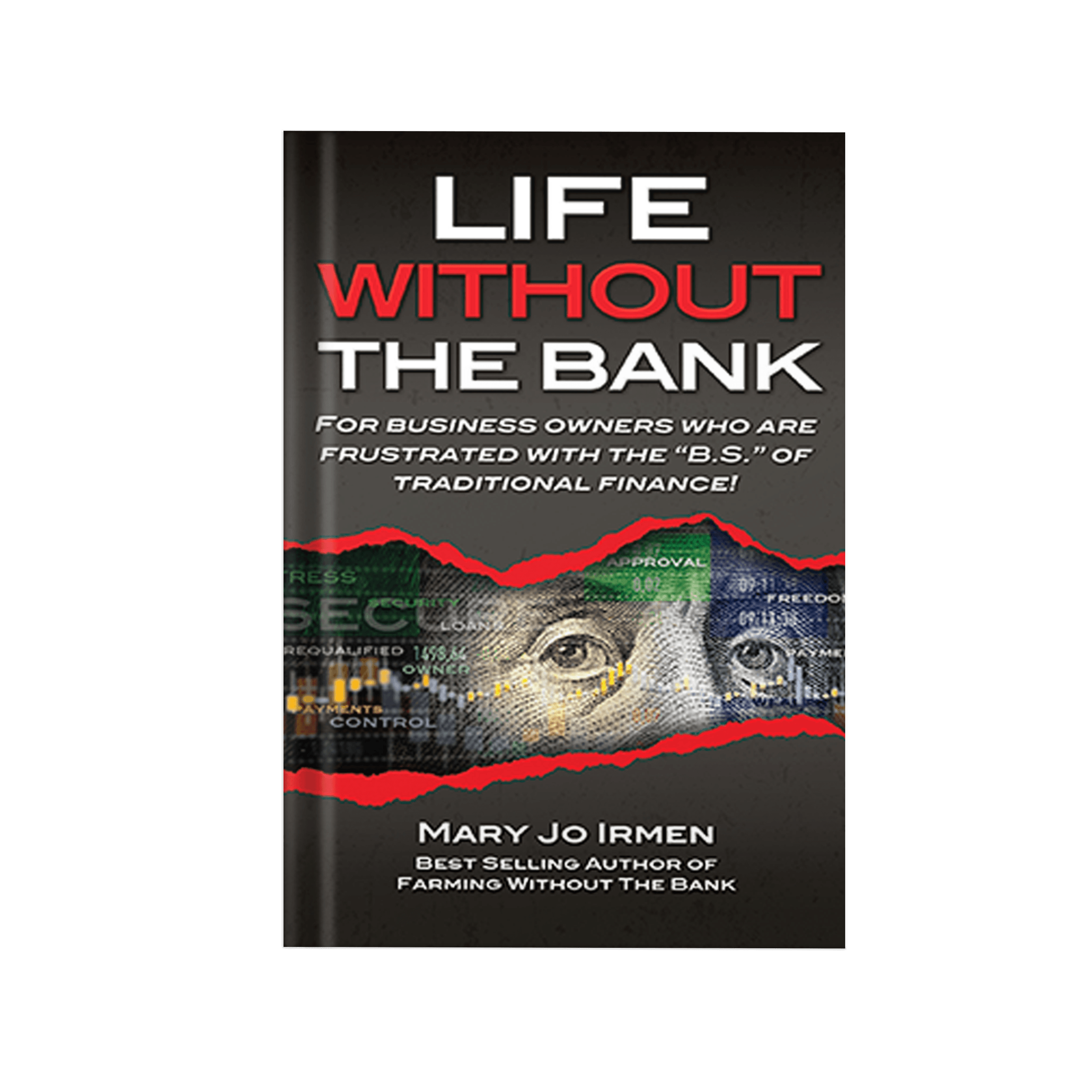
Your financial independence starts with one book.
Only one of three Americans can retire. Part of the fault is the conditioned belief that you must give up the use of your money when you’re young so you can have it later, assuming the stock market doesn’t collapse.