Podcast
EP. 293
What Everyone Gets Wrong About Nelson Nash’s “Becoming Your Own Banker” Book (Ep. 293)
Oct 29, 2026 ·
12 min
0:00 / 12:00
EPISODE OVERVIEW
ABOUT THIS EPISODE
Infinite banking has a reading problem, not a math problem. In this episode I clear up what people get wrong after reading Nelson Nash’s Becoming Your Own Banker, starting with the idea that you can only fund a policy for four years.
If you’ve read the book and came away thinking dividends can pay your premium, or that paying extra interest on a policy loan counts as paying the loan back, this is the episode you need. We’re talking about how infinite banking actually works, what Nash was illustrating versus what he was instructing, and why the difference matters before you structure a policy.
What’s Covered
- Why you cannot fund a policy for four years and walk away, and what Nash actually wrote in that chapter
- The “honest banker” instruction, and why your extra payment is a premium payment, not a loan repayment
- When extra premium triggers a MEC, and where that money should go instead
- Why Nash ended up with 49 life insurance policies
- Premium makes you money. Loans do not.
- The existing client who thought the interest was coming back to her
- The one thing you cannot make money on: the act of borrowing
- Why reading the book fast is as risky as not reading it at all
- 📚 Becoming Your Own Banker by R. Nelson Nash
- Email Mary Jo: maryjo@withoutthebank.com
Audio Production by Podsworth Media
CHAPTER TIMESTAMPS
- 00:00Blue Collar Built America
- 00:59Welcome and Black Sheep Summit
- 01:38Today's Two Topics
- 01:57The "Scam" Comment
- 04:37Real Client Example: $20K Premium, $10K Cash Value
- 06:44Whole Life Is Not an Investment
- 08:03The Blue Collar vs. White Collar Clip
- 09:08Blue Collar Wealth and the Hospital Example
- 10:37Education vs. On-the-Job Expertise
- 13:23We Need Each Other, But...
- 14:11The Doctor Who Can't Change a Tire
- 16:34What Skilled Trades Are Really Worth
- 17:23The Plumber and the Garage Sink
- 19:56Worth Twice Their Weight in Gold
- 20:31Final Thoughts
YOUTUBE EPISODE
TRANSCRIPTION
Hello, hello, and welcome back to the podcast. Thank you very much for being here. We’re gonna talk about something pretty simple today, and that is Nelson’s book and a few things that are misunderstood in Nelson’s book, and things that just need to be cleared up real quick. First is I’ve had a lot of people reading the book and then coming back and asking me or emailing me and saying, “Hey, I want a premium that I only need to pay for four years.”
You can’t do that, okay? Nelson used that as an illustration. Now, about a year ago, and if we can find it, we can link it in the show notes. But about a year ago, Tarisa and I did a whole study on Nelson’s book. Every chapter has its own podcast. So go back and look at those podcasts.
If you are reading Nelson’s book, you truly need to understand that he was illustrating stuff and he was getting you to think. What he has in that book is not cut and dry, “This is how it’s done.” And so in the chapter that he has that we’re only funding a policy for four years, and then we’re gonna buy semis, he didn’t actually only fund the policy for four years. He had dividends paying for the base premium. But if you even look further, he says, “I would not recommend doing that. If you’re going to buy a policy, keep paying out of pocket for it.” So don’t read that and then say, “Well, Mary Jo, I want a policy where the dividends will pay for the premium going forward.” That’s not gonna happen in year five. You’re going to have to pay out of pocket. He wants to illustrate how it works.
Okay? In that same chapter, and the next question I get, is what do I do when we pay extra? I say it in my book, which I wish I would have never said, and Nelson says it in his book, “Be an honest banker and pay extra interest.” So people think based on Nelson’s book and the illustration, ’cause I didn’t do it in my book, based on Nelson’s book and the illustration, that when we borrow $10,000, for example, and we pay back an extra thousand, that that thousand went in as a loan repayment.
The thousand did not go in as a loan repayment. It can’t go in as a loan repayment. If you’ve borrowed $10,000, you can only put back $10,000, right? You can only repay $10,000, plus the interest that the insurance company is charging you, but that goes to them. So if you said, “I want to pay an extra thousand,” the insurance company says, “But your loan’s paid in full. So that extra thousand, do you want to put it in as premium?” And if your policy is set up where it can handle extra premium without it MECing and becoming taxable, great, fantastic, put it in that policy. Most policies are not going to be structured that way if they’re structured correctly for infinite banking.
And so now you can’t put it in because it would MEC, so you’re going to start another policy with that $1,000, or maybe you’re going to put it in a savings account that you can start a policy with later. If you’re going to put it in a savings account, then my suggestion is to use that savings account like you would a policy and take the $1,000 out and put it back plus interest. Is it earning uninterrupted compound interest and dividends? No. But if you can’t or don’t want to start a policy for $1,000 a year, then we have to wait till you have enough money to start the next policy. But if you’ve paid attention to my stuff, you know that we can do extra year one. So if we do extra premium year one, and we’ve saved for a couple of years, maybe we have the extra to put in when we can afford the next premium.
I was explaining this to a guy yesterday and he’s like, “Oh, now I get it.” I said, “This is why Nelson had 49 life insurance policies,” because he kept starting new policies because he was an honest banker, and he kept paying himself back with extra interest. All of his loans, I think he paid all of his loans back at like 10% interest. So that’s great. That’s fantastic. You are an honest banker. But that extra money is not a loan repayment. It is a premium payment, which then brings me to the conversation that I have had over and over and over and over, and that is premium makes you money, loans do not. So you will hear people out there saying, “Oh, you can make money buying cars.”
Okay? The act of taking the loan is not making you money. The fact that you paid premium, that’s earning uninterrupted compound interest and dividends, that’s making you money. The fact that we have death benefit, that’s making your heirs money. Not you, because you’re gonna be dead, but that’s gonna make your heirs money. What’s making you money buying a car is that you paid extra interest. So if you were gonna pay the bank 7% and the insurance company’s charging you 5, you pay 7, that extra 3% goes back into a policy, because that’s what Nelson was talking about. Some people believe then when they hear that, that the process of taking loans makes you money.
So I have an existing client that just needed a refresher, and she said, “Oh, that’s disappointing. I was really hoping… I thought the interest was coming back to me.” And she had just forgotten. I draw it out. When I meet with new people, if you’re a client, you know that, I draw out how loans work, so we never have that misconception, because it is such a huge misconception when people read Nelson’s book. I just had to refresh her and say, “No, you’re not. You are paying interest to the insurance company, but you are earning uninterrupted compound interest and dividends on your money,” ’cause it never actually left the account. So the thing here is that we have to understand how the loans work.
We have to understand how premiums work, what are premiums doing. That premiums are like adding more money to a savings account. Now, it’s not a savings account, okay? It is not an account at the bank. But in order to get people to think of it, I compare it to that, ’cause it acts like one. If I’m gonna put $10,000 in my savings account, that $10,000 is earning me interest. If I’m gonna put $10,000 in an IRA, that $10,000 is hopefully earning me interest. If I’m gonna put $10,000 in a CD, that $10,000 is earning me interest. The more money we put in a CD, the more interest we earn. We can’t borrow against a CD and make money on the act of borrowing. On the act of borrowing.
Now, if we borrow against our life insurance policy and we use that money for a cash flowing asset, now we have cash flow. We have more money that we’re making outside of the policy. If we put $10,000 in a CD and we go to the lender’s office and borrow against that $10,000 CD to start a business that’s a cash flowing asset, now we have more money outside of the CD. Our money is making us more money. It’s the same thing. It’s just a different tool, because the banks don’t pay a dividend. The life insurance companies pay a dividend. So when we understand exactly how that’s working, that it’s two different things… You can’t take everything in Nelson’s book exactly and say, “This is what I want.”
Somebody just emailed me recently and said, “Mary Jo, can you run illustrations? This is what I want.” No, absolutely not. I’m not running illustrations based on an email. Set up a meeting. Read the books. I don’t know if I’m the only one that’s responded to him, but I was pretty blunt in the email back to him, and he responded again and said, “What books do I read?” What books do you read? You want me to do an infinite banking policy, or a policy for infinite banking. You want me to do that, but you don’t even know what books to read? Like, I’m out. How come you didn’t do your research? You’re telling me that it’s important to research, but you’re just researching the numbers. You don’t even understand the concept.
There’s problems not reading the book, and there’s problems reading the book, is the moral of today’s story. When you read Nelson’s book… I told somebody this yesterday, too, because this was a big aha moment for him. He said, “Yeah, Nelson’s book is a lot of fluff.” And I said, “Nelson’s book is actually not fluff. Nelson uses analogies to get his point across, and stories to get his point across.” I said, “When you read Nelson’s book, you should be reading it very slow and paragraph by paragraph. So if you want to read the chapter, great, fantastic. But if you want to truly get every single thing Nelson is saying, you need to actually read that book paragraph by paragraph, slow, and understand what he’s saying.”
Because if we read the footnotes, and if we read it slow, we would understand you don’t pay premium for four years. You don’t let dividends pay premium. You continue to pay it out of pocket. He was trying to make it simple, and instead we’re taking it verbatim because we have blinders on, and we don’t understand infinite thinking. Nelson was an infinite thinker, so he was always thinking big. But when you are new to this, you don’t even know that you can think big. Take what he says with a grain of salt as far as how to pay premium, because he’s just giving you an example. Can you do that? No, you cannot do that. So hopefully that helps.
I’m not gonna go any further and keep talking, because I don’t want to muddy the waters here. I will end with this. If you’re a client and you want to come to the Black Sheep Summit, get registered so that we can get you on the list, because I only have a limited amount of seats. So get registered. Hope to see you there. If you are not a client, you’re not invited. Sorry. This is for clients only, because I want all of my clients in a room where they can talk to like-minded people, see what everybody’s doing, how are they using their policies. This is not a conference where we’re gonna debate, is infinite banking better than what the investment guy has to say? That’s not gonna be up for debate. Is it better than ULs and IULs? That’s not up for debate. Everybody in the room is participating in infinite banking. We’re learning more about infinite banking. We’re learning more about just business in general, all the things that the speakers are gonna bring, and so it is not, “Hey, let me teach you infinite banking.” No, that is not what this is.
So anyway, if you’re not registered, get registered. We’re excited to see you there. If you guys have comments, questions, concerns, let me know, maryjo@withoutthebank.com. Grab your book, schedule your appointment with John and I, and we are excited to talk to you. You have a fantastic rest of your day.
View MoreYou can’t do that, okay? Nelson used that as an illustration. Now, about a year ago, and if we can find it, we can link it in the show notes. But about a year ago, Tarisa and I did a whole study on Nelson’s book. Every chapter has its own podcast. So go back and look at those podcasts.
If you are reading Nelson’s book, you truly need to understand that he was illustrating stuff and he was getting you to think. What he has in that book is not cut and dry, “This is how it’s done.” And so in the chapter that he has that we’re only funding a policy for four years, and then we’re gonna buy semis, he didn’t actually only fund the policy for four years. He had dividends paying for the base premium. But if you even look further, he says, “I would not recommend doing that. If you’re going to buy a policy, keep paying out of pocket for it.” So don’t read that and then say, “Well, Mary Jo, I want a policy where the dividends will pay for the premium going forward.” That’s not gonna happen in year five. You’re going to have to pay out of pocket. He wants to illustrate how it works.
Okay? In that same chapter, and the next question I get, is what do I do when we pay extra? I say it in my book, which I wish I would have never said, and Nelson says it in his book, “Be an honest banker and pay extra interest.” So people think based on Nelson’s book and the illustration, ’cause I didn’t do it in my book, based on Nelson’s book and the illustration, that when we borrow $10,000, for example, and we pay back an extra thousand, that that thousand went in as a loan repayment.
The thousand did not go in as a loan repayment. It can’t go in as a loan repayment. If you’ve borrowed $10,000, you can only put back $10,000, right? You can only repay $10,000, plus the interest that the insurance company is charging you, but that goes to them. So if you said, “I want to pay an extra thousand,” the insurance company says, “But your loan’s paid in full. So that extra thousand, do you want to put it in as premium?” And if your policy is set up where it can handle extra premium without it MECing and becoming taxable, great, fantastic, put it in that policy. Most policies are not going to be structured that way if they’re structured correctly for infinite banking.
And so now you can’t put it in because it would MEC, so you’re going to start another policy with that $1,000, or maybe you’re going to put it in a savings account that you can start a policy with later. If you’re going to put it in a savings account, then my suggestion is to use that savings account like you would a policy and take the $1,000 out and put it back plus interest. Is it earning uninterrupted compound interest and dividends? No. But if you can’t or don’t want to start a policy for $1,000 a year, then we have to wait till you have enough money to start the next policy. But if you’ve paid attention to my stuff, you know that we can do extra year one. So if we do extra premium year one, and we’ve saved for a couple of years, maybe we have the extra to put in when we can afford the next premium.
I was explaining this to a guy yesterday and he’s like, “Oh, now I get it.” I said, “This is why Nelson had 49 life insurance policies,” because he kept starting new policies because he was an honest banker, and he kept paying himself back with extra interest. All of his loans, I think he paid all of his loans back at like 10% interest. So that’s great. That’s fantastic. You are an honest banker. But that extra money is not a loan repayment. It is a premium payment, which then brings me to the conversation that I have had over and over and over and over, and that is premium makes you money, loans do not. So you will hear people out there saying, “Oh, you can make money buying cars.”
Okay? The act of taking the loan is not making you money. The fact that you paid premium, that’s earning uninterrupted compound interest and dividends, that’s making you money. The fact that we have death benefit, that’s making your heirs money. Not you, because you’re gonna be dead, but that’s gonna make your heirs money. What’s making you money buying a car is that you paid extra interest. So if you were gonna pay the bank 7% and the insurance company’s charging you 5, you pay 7, that extra 3% goes back into a policy, because that’s what Nelson was talking about. Some people believe then when they hear that, that the process of taking loans makes you money.
So I have an existing client that just needed a refresher, and she said, “Oh, that’s disappointing. I was really hoping… I thought the interest was coming back to me.” And she had just forgotten. I draw it out. When I meet with new people, if you’re a client, you know that, I draw out how loans work, so we never have that misconception, because it is such a huge misconception when people read Nelson’s book. I just had to refresh her and say, “No, you’re not. You are paying interest to the insurance company, but you are earning uninterrupted compound interest and dividends on your money,” ’cause it never actually left the account. So the thing here is that we have to understand how the loans work.
We have to understand how premiums work, what are premiums doing. That premiums are like adding more money to a savings account. Now, it’s not a savings account, okay? It is not an account at the bank. But in order to get people to think of it, I compare it to that, ’cause it acts like one. If I’m gonna put $10,000 in my savings account, that $10,000 is earning me interest. If I’m gonna put $10,000 in an IRA, that $10,000 is hopefully earning me interest. If I’m gonna put $10,000 in a CD, that $10,000 is earning me interest. The more money we put in a CD, the more interest we earn. We can’t borrow against a CD and make money on the act of borrowing. On the act of borrowing.
Now, if we borrow against our life insurance policy and we use that money for a cash flowing asset, now we have cash flow. We have more money that we’re making outside of the policy. If we put $10,000 in a CD and we go to the lender’s office and borrow against that $10,000 CD to start a business that’s a cash flowing asset, now we have more money outside of the CD. Our money is making us more money. It’s the same thing. It’s just a different tool, because the banks don’t pay a dividend. The life insurance companies pay a dividend. So when we understand exactly how that’s working, that it’s two different things… You can’t take everything in Nelson’s book exactly and say, “This is what I want.”
Somebody just emailed me recently and said, “Mary Jo, can you run illustrations? This is what I want.” No, absolutely not. I’m not running illustrations based on an email. Set up a meeting. Read the books. I don’t know if I’m the only one that’s responded to him, but I was pretty blunt in the email back to him, and he responded again and said, “What books do I read?” What books do you read? You want me to do an infinite banking policy, or a policy for infinite banking. You want me to do that, but you don’t even know what books to read? Like, I’m out. How come you didn’t do your research? You’re telling me that it’s important to research, but you’re just researching the numbers. You don’t even understand the concept.
There’s problems not reading the book, and there’s problems reading the book, is the moral of today’s story. When you read Nelson’s book… I told somebody this yesterday, too, because this was a big aha moment for him. He said, “Yeah, Nelson’s book is a lot of fluff.” And I said, “Nelson’s book is actually not fluff. Nelson uses analogies to get his point across, and stories to get his point across.” I said, “When you read Nelson’s book, you should be reading it very slow and paragraph by paragraph. So if you want to read the chapter, great, fantastic. But if you want to truly get every single thing Nelson is saying, you need to actually read that book paragraph by paragraph, slow, and understand what he’s saying.”
Because if we read the footnotes, and if we read it slow, we would understand you don’t pay premium for four years. You don’t let dividends pay premium. You continue to pay it out of pocket. He was trying to make it simple, and instead we’re taking it verbatim because we have blinders on, and we don’t understand infinite thinking. Nelson was an infinite thinker, so he was always thinking big. But when you are new to this, you don’t even know that you can think big. Take what he says with a grain of salt as far as how to pay premium, because he’s just giving you an example. Can you do that? No, you cannot do that. So hopefully that helps.
I’m not gonna go any further and keep talking, because I don’t want to muddy the waters here. I will end with this. If you’re a client and you want to come to the Black Sheep Summit, get registered so that we can get you on the list, because I only have a limited amount of seats. So get registered. Hope to see you there. If you are not a client, you’re not invited. Sorry. This is for clients only, because I want all of my clients in a room where they can talk to like-minded people, see what everybody’s doing, how are they using their policies. This is not a conference where we’re gonna debate, is infinite banking better than what the investment guy has to say? That’s not gonna be up for debate. Is it better than ULs and IULs? That’s not up for debate. Everybody in the room is participating in infinite banking. We’re learning more about infinite banking. We’re learning more about just business in general, all the things that the speakers are gonna bring, and so it is not, “Hey, let me teach you infinite banking.” No, that is not what this is.
So anyway, if you’re not registered, get registered. We’re excited to see you there. If you guys have comments, questions, concerns, let me know, maryjo@withoutthebank.com. Grab your book, schedule your appointment with John and I, and we are excited to talk to you. You have a fantastic rest of your day.



ready to start?
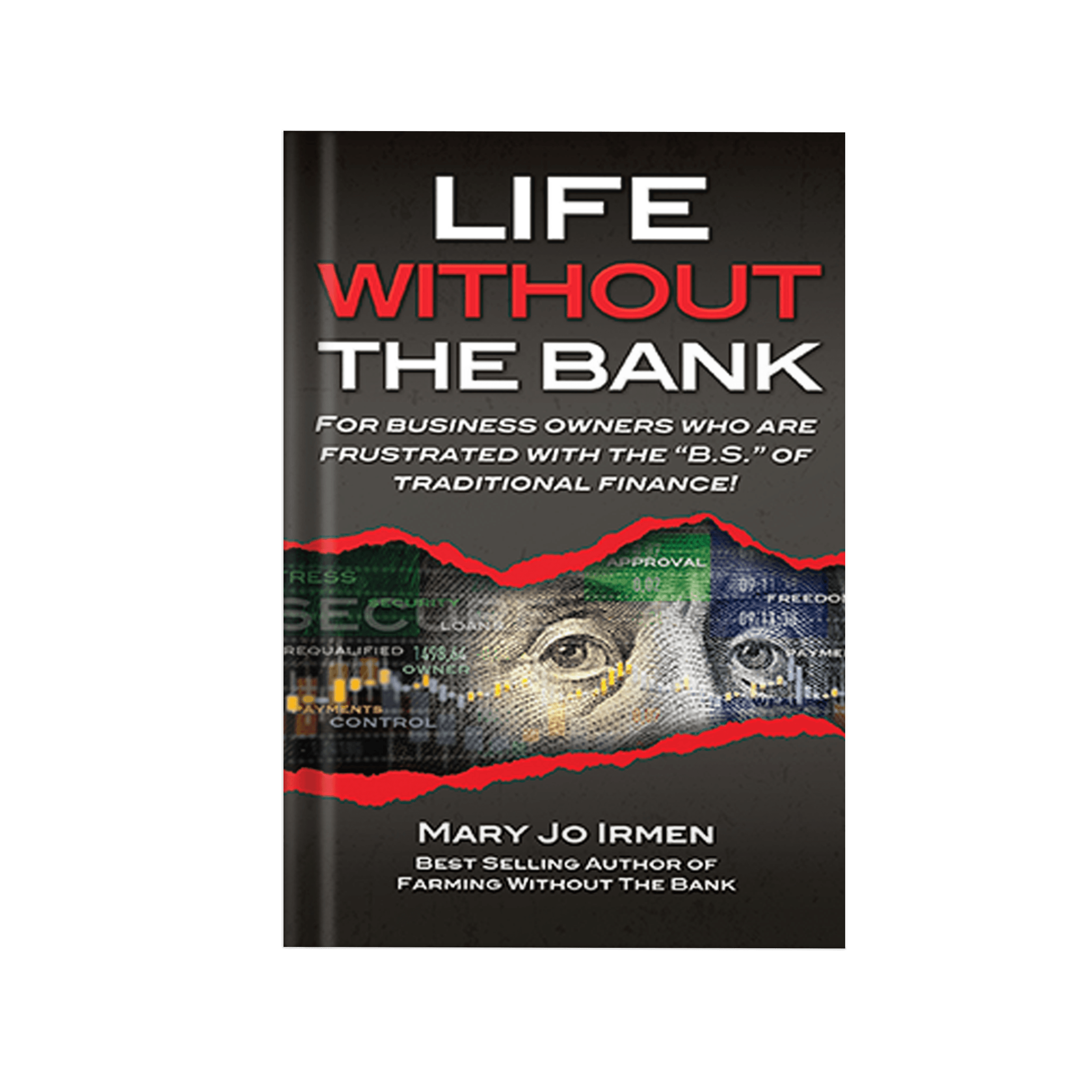
Your financial independence starts with one book.
Only one of three Americans can retire. Part of the fault is the conditioned belief that you must give up the use of your money when you’re young so you can have it later, assuming the stock market doesn’t collapse.