Podcast
EP. 284
Why Infinite Banking ‘Didn’t Click’ (And How to Fix It) (Ep. 284)
Aug 27, 2026 ·
15 min
0:00 / 15:22
EPISODE OVERVIEW
ABOUT THIS EPISODE
Infinite banking "didn't click" the first time? You're not alone. In this episode Mary Jo breaks down the exact misconceptions that hold people back — and the one question that unlocks everything.
If you've met with us and walked away without starting a policy, this is for you. We cover the three things most people miss: uninterrupted compound interest (why you still earn on the FULL $20,000 even after you borrow $15,000), the "premiums forever" myth (your premium drops — and your dividends can pay it), and the difference between cash value and cash flow.
The lesson? Ask the question. The shortest distance to your answer is asking.
🔗 Resources
CHAPTER TIMESTAMPS
- 0:00The Sales Question I'll Never Ask
- 0:42Why Infinite Banking "Didn't Click"
- 2:12Uninterrupted Compound Interest Explained
- 4:15Do You Have to Pay Premiums Forever?
- 6:33Cash Flow, Not Just Cash Value
- 9:03The Questions You Should Be Asking
- 12:28Come Prepared (Read the Books First)
- 14:17Ask the Question, Get Your Answer
- 15:31Book Your Appointment & Let's Chat
YOUTUBE EPISODE
TRANSCRIPTION
"Here's the thing I don't do. Like a good salesman would do, I don't do this. I don't say at the end of the meeting, 'On a scale of 1 to 10, how sure are you that you're gonna move forward with this?' And then you say, 'Oh, I'm at about a six.' And I say, 'Well, why? What would stop you from moving forward?' Man, if you're selling me something and you ask me that question, I am out, gone, done. Don't care if I need whatever you're selling as a means of survival. I am out. I cannot stand when people do that. So I don't do that. I expect that you set up a meeting, and that you're going to be honest with us in that meeting, and that if there is anything that you have a question on, you're gonna ask the question."
Hello, hello, hello, and welcome back to the podcast. Thank you very much for being here. Today, we're gonna talk about some of the things that are holding people back, and I've had a lot — probably three to five meetings, that's a lot for me — of people since January that have met with me in the past, but for some reason it just didn't click, and they didn't start a policy right away, and now they're waiting.
Or now they're start… They're wanting to start a policy now. And it wasn't due to not having money. I've had several of those meetings as well, but that's different, right? They got it, they understood it, but now they're gonna start a policy 'cause they have money. These people are different.
These people are… They met with us, John or I, and they just couldn't quite figure it out, or something was missing, or it just didn't click. And Nelson has always said, "This is caught, not taught." And you have to catch some of the things that traditional finance is not teaching you.
And in this particular meeting that I had yesterday, there were a lot of things that he talked about, and he said, "It's not that you didn't talk about them, 'cause you went over them. It's just that as I keep listening to Nelson's book, I keep picking things up and understanding things that I did not understand in our first couple of meetings."
And we had had a couple meetings. I think we had two or three meetings to talk about everything, and one of the big things that he missed was the uninterrupted compound interest. He said that he was thinking, "Okay, well if I have $20,000 of cash value and I borrow $15,000, I'm only earning interest on the five that's still in there," which is not accurate.
That's the whole reason we're using dividend paying whole life, is that when we borrow $15,000 and we have $20,000 of cash value, we're still earning interest on the full $20,000. We're earning interest and dividends on that money. So when I talk about uninterrupted compound interest, that's what I mean. I guess my mistake is I assume that people know what that means.
Because it's not being interrupted. Where if he had $20,000 in a savings account and he took $15,000 out, he would only be earning interest on five. That's gonna happen in anything you do. Nothing allows you to earn interest on the full 20 if you're going to borrow against it outside of a CD. And so he was missing that piece of it, and he said, "I don't know why I didn't quite get that."
But I think it's because we're just throwing so many different thought processes and uses and terminology around money that we've never been taught before. Our brain kind of gets stuck on one thing, and if we're not super versed with how money works, we're gonna get stuck on one thing, and we're gonna — we're not gonna see the rest of it, right?
We're almost gonna have blinders on. Or if I find somebody that has a big rate of return mindset, and they really wanna see what's happening with rate of return, rate of return, rate of return. And this guy was kind of a rate of return guy too. Like he said, "I was just looking at the numbers, and I wasn't looking at the concept and thinking about the concept."
Because the numbers are one thing. The concept is a whole different ball game.
The other concern he had — and maybe you guys have these, this is why I'm talking about it — but the other concern he had was, "I'm gonna have to pay this premium forever." And he's like, "Yeah, I can pay $12,000 a year now. That's not a big deal. But what happens when I close my business?" And I'm retired. Then I can't pay $12,000 a year.
He sort of missed the piece of the policy where you can't pay $12,000 the rest of your life. You can pay three, because that premium is gonna drop down to $3,000 in this example.
But he was even concerned about, "Well, how am I gonna pay the three?" And then when he listened to Nelson's book, Nelson talks about having the dividend pay for that policy, and you can do that. You can — in worst case scenario, you're retired, you can have the dividend pay for a policy. Is that ideal? No. Did Nelson say that was ideal? No.
He was showing you options of what you can do to get you over the hurdles. But he also wants you to understand, why would you quit feeding an animal? And in twenty-five, thirty years from now, what is $3,000 going to feel like? To this individual, $3,000 today is pocket change. In thirty years with inflation, it's definitely gonna be pocket change.
We have to remember, Nelson could barely afford his very first premium, and if I remember correctly, it was like $388 a year or something. A year, and he could barely afford that. He struggled. Well, when he died a few years ago, $388, that probably didn't even buy him groceries for the month.
People don't — when they think long-term, they think, "At retirement, I'm not gonna have any money, so I'm not gonna be able to pay this premium, so I'm never gonna start this policy."
Well, you can have the dividends pay for that. You can do a reduced paid-up on your policy, and you can stop premium if you need to. There are options. But ideally, let's think about this. If we're going to start a policy, ideally, we want to use the cash value so that we can create cash flow with that money.
Are we gonna buy short-term rentals? Are we gonna buy farm ground? Are we going to buy a business? Are we going to start a business and sell a business? Are we gonna be part owners of a business? What are we going to do with that money that's going to create cash flow?
If we are thinking about cash flow and how that's going to affect us at retirement, and we're using this policy just as a pool of money that we can grab for retirement, we have a broken thought process.
I can put money into a policy all day long for you, and unless you put tons and tons and tons of money in a policy, I am not going to provide an unlimited amount of cash during retirement. It's just not gonna happen in these policies. And many of you are 40, 50 years old. It's too late. What we need to do is be taking your cash and creating cash flow.
That's not what a lot of people that are doing infinite banking talk about. A lot of people that are doing infinite banking are talking about buying cars. "Oh, you can go buy a car with this." And I know that you guys see some of that stuff, and that's great. Is that car creating cash flow?
That's all I care about. Because even with the amount of money that I put into policies, I will have a fair amount to retire on, but I don't want just that amount to retire on. I want to make sure that I have cash flow coming from other things — rental property, farm ground rent, maybe I sell some farm ground, maybe I sell some rental properties. I don't know, maybe I sell a business. I'm still selling books.
Like, I'm wanting to create an avenue of cash flow so that during retirement years, or when I slow down, I don't have to worry about changing my living. I wanna live the same way I'm living today. So you can stop paying premium. It's an option, but do we want that option?
And that is one thing that I talk a lot about in meetings is cash flow. How are we using the cash value to create more income?
The other thing he mentioned was just that there were just so many things he didn't understand. He didn't understand what portion of the policy was buying whole life death benefit. He didn't understand what portion was going to cash value. He forgot that he could add extra money year one.
There were a lot of things that we talk about in a meeting, and I try really hard to make sure that I'm reading body language, and I'm reading your face, and I'm answering questions. I just obviously missed it with him that there were a lot of things he wasn't getting.
And so it is important when we have a meeting, and you're in the meeting, to make sure you're asking questions, to make sure that… Because here's the thing I don't do. I don't say at the end of the meeting, like a good salesman would do, I don't do this. "On a scale of 1 to 10, how sure are you that you're gonna move forward with this?" You say, "Oh, I'm at about a six." And I say, "Well, why? What would stop you from moving forward?"
Man, if you're selling me something and you ask me that question, I am out, gone, done. Don't care if I need whatever you're selling as a means of survival. I am out. I cannot stand when people do that. So I don't do that. I expect that you set up a meeting, and that you're going to be honest with us in that meeting, and that if there is anything that you have a question on, you're gonna ask the question.
Because I will ask the question. If I'm sitting in a meeting and I have a question, I'm gonna ask the question. I am not going to leave that meeting without understanding everything. And so I kind of expect all of you to be doing the same thing when you meet with us.
And I get some people are scared of me. They think I'm mean. I am not mean in a meeting. Am I more mean on a podcast? Yes. Because I want you guys to understand what I'm gonna need when you come into the meeting. I need you to have these things. I need you to have them ready. If I was nice and said, "Oh, you didn't have to do that, that's okay," I would prefer… You would never have that crap ready, and I need you to have it ready.
So I want you to ask questions. I had a meeting yesterday with somebody that she said, "I'm gonna make you mad, but I'm gonna ask this question." And I said, "As long as you don't ask me about a rate of return, you're not gonna make me mad."
And she goes, "That's what I'm gonna ask about." And I said, "We've already gone over this. There is no set rate of return in this policy. It is a formula. Everybody's is going to grow differently." I'm not gonna answer the question any differently. So that's about the only question that you can ask that makes me mad, and some people will do it just to make me mad because I've gone over this a million times.
It's not about a rate of return. And even the client that I had yesterday that had come back, he was talking about a rate of return, and I said, "Okay, well, you've listened to Nelson's book enough now that he's talked about the seen and the unseen. And so what are you gonna do with that money when you borrow against it? What are you gonna do with that money on the unseen portion? Are you going to add on to your business? Are you gonna add on to the farm? What are you going to do that's going to create a bigger rate of return? And don't forget to figure in the death benefit."
So there's a lot — we just cover a lot in a meeting. And I do send the video of that meeting now so that people can rewatch it because I kind of open up a fire hose. But you should have read the book, if not once, twice, three times. You could have read Nelson's book once, twice, three times before we even met.
This is what I find. The people that read my book one to three times, read Nelson's book one to three times, and listen to all of my podcasts, they come into the meeting in a mindset that they are understanding things because I'm pretty fast-paced in our meeting.
I want to start solving problems. Am I gonna educate you? Yes. Do I wanna go over how things work? Yes. But I do have over 500 podcasts, and so there is a lot of information here for people. There's a lot of information in the book. Nelson's book is not a reading book. It is a study guide, and we should be studying it.
It's no different than people who read my books, and they're like, "Oh, man, when I read that the second or third time, I got it." This is what I've been told by everybody, it's not something that I'm missing in the meetings. It's stuff that I've said. It's things that their brain just needs time to process and get around because it is such a different mindset.
So if you have had your meeting with us and you've not done anything because you don't quite get it, then listen again. Keep listening to the podcast, listen to Nelson's book, reread stuff. Even if you have to set up another meeting just to have another conversation and ask the questions and ask the concerns that are holding you back.
That's what we're here for. If you don't ever ask the question, if you don't know the answer to your own problem, then how are you supposed to solve it without guidance? You just think it's gonna miraculously appear? If you just ask the question, that's the shortest distance to get your answer.
Ask the question, get your answer. It's quite that simple. People are gonna make that harder, maybe because you don't wanna sound stupid, or you think you're gonna sound stupid. That's why we're infinite banking practitioners, so that we can help you with that stuff.
So let us know. If you've met with us, if you haven't met with us, come prepared. Read a couple of things, read a couple of times over, but come prepared that we're gonna take off right away.
But there are some concerns like, "Am I gonna have to pay premium forever?" No, you won't. But is that premium even gonna matter forever? It's gonna be super, super small. So what are we concerned about? How does cash value actually work? When we're borrowing against it, it's still earn — it's all in there earning interest and dividends. And so there's a lot of things that just as not normal to regular finance that need to be answered.
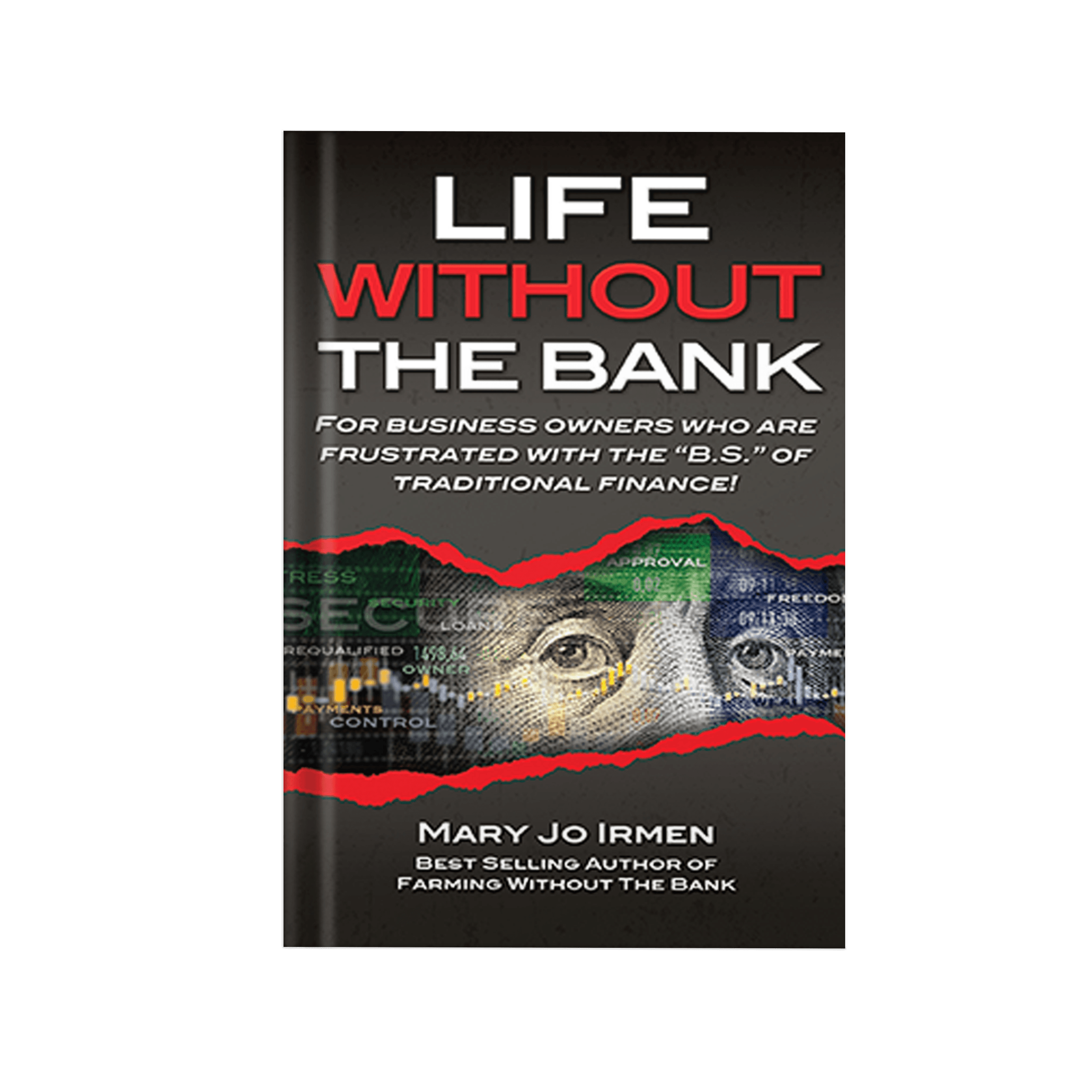
Anyway, let me know if you have questions on anything. maryjo@withoutthebank.com. Grab your Life Without the Bank book, Nelson's book, set up your appointment, and let's have a chit-chat. All right, you have a fantastic rest of your day.
View MoreHello, hello, hello, and welcome back to the podcast. Thank you very much for being here. Today, we're gonna talk about some of the things that are holding people back, and I've had a lot — probably three to five meetings, that's a lot for me — of people since January that have met with me in the past, but for some reason it just didn't click, and they didn't start a policy right away, and now they're waiting.
Or now they're start… They're wanting to start a policy now. And it wasn't due to not having money. I've had several of those meetings as well, but that's different, right? They got it, they understood it, but now they're gonna start a policy 'cause they have money. These people are different.
These people are… They met with us, John or I, and they just couldn't quite figure it out, or something was missing, or it just didn't click. And Nelson has always said, "This is caught, not taught." And you have to catch some of the things that traditional finance is not teaching you.
And in this particular meeting that I had yesterday, there were a lot of things that he talked about, and he said, "It's not that you didn't talk about them, 'cause you went over them. It's just that as I keep listening to Nelson's book, I keep picking things up and understanding things that I did not understand in our first couple of meetings."
And we had had a couple meetings. I think we had two or three meetings to talk about everything, and one of the big things that he missed was the uninterrupted compound interest. He said that he was thinking, "Okay, well if I have $20,000 of cash value and I borrow $15,000, I'm only earning interest on the five that's still in there," which is not accurate.
That's the whole reason we're using dividend paying whole life, is that when we borrow $15,000 and we have $20,000 of cash value, we're still earning interest on the full $20,000. We're earning interest and dividends on that money. So when I talk about uninterrupted compound interest, that's what I mean. I guess my mistake is I assume that people know what that means.
Because it's not being interrupted. Where if he had $20,000 in a savings account and he took $15,000 out, he would only be earning interest on five. That's gonna happen in anything you do. Nothing allows you to earn interest on the full 20 if you're going to borrow against it outside of a CD. And so he was missing that piece of it, and he said, "I don't know why I didn't quite get that."
But I think it's because we're just throwing so many different thought processes and uses and terminology around money that we've never been taught before. Our brain kind of gets stuck on one thing, and if we're not super versed with how money works, we're gonna get stuck on one thing, and we're gonna — we're not gonna see the rest of it, right?
We're almost gonna have blinders on. Or if I find somebody that has a big rate of return mindset, and they really wanna see what's happening with rate of return, rate of return, rate of return. And this guy was kind of a rate of return guy too. Like he said, "I was just looking at the numbers, and I wasn't looking at the concept and thinking about the concept."
Because the numbers are one thing. The concept is a whole different ball game.
The other concern he had — and maybe you guys have these, this is why I'm talking about it — but the other concern he had was, "I'm gonna have to pay this premium forever." And he's like, "Yeah, I can pay $12,000 a year now. That's not a big deal. But what happens when I close my business?" And I'm retired. Then I can't pay $12,000 a year.
He sort of missed the piece of the policy where you can't pay $12,000 the rest of your life. You can pay three, because that premium is gonna drop down to $3,000 in this example.
But he was even concerned about, "Well, how am I gonna pay the three?" And then when he listened to Nelson's book, Nelson talks about having the dividend pay for that policy, and you can do that. You can — in worst case scenario, you're retired, you can have the dividend pay for a policy. Is that ideal? No. Did Nelson say that was ideal? No.
He was showing you options of what you can do to get you over the hurdles. But he also wants you to understand, why would you quit feeding an animal? And in twenty-five, thirty years from now, what is $3,000 going to feel like? To this individual, $3,000 today is pocket change. In thirty years with inflation, it's definitely gonna be pocket change.
We have to remember, Nelson could barely afford his very first premium, and if I remember correctly, it was like $388 a year or something. A year, and he could barely afford that. He struggled. Well, when he died a few years ago, $388, that probably didn't even buy him groceries for the month.
People don't — when they think long-term, they think, "At retirement, I'm not gonna have any money, so I'm not gonna be able to pay this premium, so I'm never gonna start this policy."
Well, you can have the dividends pay for that. You can do a reduced paid-up on your policy, and you can stop premium if you need to. There are options. But ideally, let's think about this. If we're going to start a policy, ideally, we want to use the cash value so that we can create cash flow with that money.
Are we gonna buy short-term rentals? Are we gonna buy farm ground? Are we going to buy a business? Are we going to start a business and sell a business? Are we gonna be part owners of a business? What are we going to do with that money that's going to create cash flow?
If we are thinking about cash flow and how that's going to affect us at retirement, and we're using this policy just as a pool of money that we can grab for retirement, we have a broken thought process.
I can put money into a policy all day long for you, and unless you put tons and tons and tons of money in a policy, I am not going to provide an unlimited amount of cash during retirement. It's just not gonna happen in these policies. And many of you are 40, 50 years old. It's too late. What we need to do is be taking your cash and creating cash flow.
That's not what a lot of people that are doing infinite banking talk about. A lot of people that are doing infinite banking are talking about buying cars. "Oh, you can go buy a car with this." And I know that you guys see some of that stuff, and that's great. Is that car creating cash flow?
That's all I care about. Because even with the amount of money that I put into policies, I will have a fair amount to retire on, but I don't want just that amount to retire on. I want to make sure that I have cash flow coming from other things — rental property, farm ground rent, maybe I sell some farm ground, maybe I sell some rental properties. I don't know, maybe I sell a business. I'm still selling books.
Like, I'm wanting to create an avenue of cash flow so that during retirement years, or when I slow down, I don't have to worry about changing my living. I wanna live the same way I'm living today. So you can stop paying premium. It's an option, but do we want that option?
And that is one thing that I talk a lot about in meetings is cash flow. How are we using the cash value to create more income?
The other thing he mentioned was just that there were just so many things he didn't understand. He didn't understand what portion of the policy was buying whole life death benefit. He didn't understand what portion was going to cash value. He forgot that he could add extra money year one.
There were a lot of things that we talk about in a meeting, and I try really hard to make sure that I'm reading body language, and I'm reading your face, and I'm answering questions. I just obviously missed it with him that there were a lot of things he wasn't getting.
And so it is important when we have a meeting, and you're in the meeting, to make sure you're asking questions, to make sure that… Because here's the thing I don't do. I don't say at the end of the meeting, like a good salesman would do, I don't do this. "On a scale of 1 to 10, how sure are you that you're gonna move forward with this?" You say, "Oh, I'm at about a six." And I say, "Well, why? What would stop you from moving forward?"
Man, if you're selling me something and you ask me that question, I am out, gone, done. Don't care if I need whatever you're selling as a means of survival. I am out. I cannot stand when people do that. So I don't do that. I expect that you set up a meeting, and that you're going to be honest with us in that meeting, and that if there is anything that you have a question on, you're gonna ask the question.
Because I will ask the question. If I'm sitting in a meeting and I have a question, I'm gonna ask the question. I am not going to leave that meeting without understanding everything. And so I kind of expect all of you to be doing the same thing when you meet with us.
And I get some people are scared of me. They think I'm mean. I am not mean in a meeting. Am I more mean on a podcast? Yes. Because I want you guys to understand what I'm gonna need when you come into the meeting. I need you to have these things. I need you to have them ready. If I was nice and said, "Oh, you didn't have to do that, that's okay," I would prefer… You would never have that crap ready, and I need you to have it ready.
So I want you to ask questions. I had a meeting yesterday with somebody that she said, "I'm gonna make you mad, but I'm gonna ask this question." And I said, "As long as you don't ask me about a rate of return, you're not gonna make me mad."
And she goes, "That's what I'm gonna ask about." And I said, "We've already gone over this. There is no set rate of return in this policy. It is a formula. Everybody's is going to grow differently." I'm not gonna answer the question any differently. So that's about the only question that you can ask that makes me mad, and some people will do it just to make me mad because I've gone over this a million times.
It's not about a rate of return. And even the client that I had yesterday that had come back, he was talking about a rate of return, and I said, "Okay, well, you've listened to Nelson's book enough now that he's talked about the seen and the unseen. And so what are you gonna do with that money when you borrow against it? What are you gonna do with that money on the unseen portion? Are you going to add on to your business? Are you gonna add on to the farm? What are you going to do that's going to create a bigger rate of return? And don't forget to figure in the death benefit."
So there's a lot — we just cover a lot in a meeting. And I do send the video of that meeting now so that people can rewatch it because I kind of open up a fire hose. But you should have read the book, if not once, twice, three times. You could have read Nelson's book once, twice, three times before we even met.
This is what I find. The people that read my book one to three times, read Nelson's book one to three times, and listen to all of my podcasts, they come into the meeting in a mindset that they are understanding things because I'm pretty fast-paced in our meeting.
I want to start solving problems. Am I gonna educate you? Yes. Do I wanna go over how things work? Yes. But I do have over 500 podcasts, and so there is a lot of information here for people. There's a lot of information in the book. Nelson's book is not a reading book. It is a study guide, and we should be studying it.
It's no different than people who read my books, and they're like, "Oh, man, when I read that the second or third time, I got it." This is what I've been told by everybody, it's not something that I'm missing in the meetings. It's stuff that I've said. It's things that their brain just needs time to process and get around because it is such a different mindset.
So if you have had your meeting with us and you've not done anything because you don't quite get it, then listen again. Keep listening to the podcast, listen to Nelson's book, reread stuff. Even if you have to set up another meeting just to have another conversation and ask the questions and ask the concerns that are holding you back.
That's what we're here for. If you don't ever ask the question, if you don't know the answer to your own problem, then how are you supposed to solve it without guidance? You just think it's gonna miraculously appear? If you just ask the question, that's the shortest distance to get your answer.
Ask the question, get your answer. It's quite that simple. People are gonna make that harder, maybe because you don't wanna sound stupid, or you think you're gonna sound stupid. That's why we're infinite banking practitioners, so that we can help you with that stuff.
So let us know. If you've met with us, if you haven't met with us, come prepared. Read a couple of things, read a couple of times over, but come prepared that we're gonna take off right away.
But there are some concerns like, "Am I gonna have to pay premium forever?" No, you won't. But is that premium even gonna matter forever? It's gonna be super, super small. So what are we concerned about? How does cash value actually work? When we're borrowing against it, it's still earn — it's all in there earning interest and dividends. And so there's a lot of things that just as not normal to regular finance that need to be answered.
Anyway, let me know if you have questions on anything. maryjo@withoutthebank.com. Grab your Life Without the Bank book, Nelson's book, set up your appointment, and let's have a chit-chat. All right, you have a fantastic rest of your day.



ready to start?
Your financial independence starts with one book.
Only one of three Americans can retire. Part of the fault is the conditioned belief that you must give up the use of your money when you’re young so you can have it later, assuming the stock market doesn’t collapse.