GET THE BOOK
Podcast
EP. 286
How to Build a Brand That Actually Lasts (Ep. 286)
Sep 10, 2026 ·
145 min
0:00 / 2:24:33
EPISODE OVERVIEW
ABOUT THIS EPISODE
Struggling with marketing that never seems to pay off? In Ep. 286 of the Without the Bank podcast, host Mary Jo Irmen sits down with her longtime marketing partner Mike Brevik of Cyberdogz Marketing to break down what actually grows a business.
From naming and logos to websites, AI, and content, Mike and MJ share 7+ years of lessons on building a brand that lasts — whether you're starting from scratch or fixing 20 years of messy marketing.
In This Episode
- Why you should never build your business on rented ground (social only) — and why your website is your hub
- The foundation of branding for small business: name, logo, colors, and style guide done right the first time
- Why traditional networking rarely works and what to do instead
- Marketing strategy as a long-term investment: think fitness plan, not lottery ticket
- The "Frankenstein Effect" that happens when branding is pieced together over years
- How to hire the right agency, what $7,500–$12,000 to start right really covers, and why you need to be uncomfortable with your budget
- AI, short-form video, YouTube, and why Gen X creators are hot for UGC right now
- Vanity metrics vs. sales: likes don't pay bills
- How to build a brand that evolves and levels up without starting over
Connect with Mike Brevik & Cyberdogz Marketing
Ready to Get Started?
- 📘 Buy the book
- 📧 Email Mary Jo: maryjo@withoutthebank.com
- ▶️ Subscribe on YouTube
CHAPTER TIMESTAMPS
- 00:00Why Networking Fails
- 00:34Marketing Episode Kickoff
- 02:06Mike Brevik Background
- 04:48Big Clients Big Branding
- 05:59Why Orange Works
- 06:44Naming Your Business
- 13:53Avoid Generic Logos
- 21:40Logo Done Right
- 25:52Style Guides Ownership
- 29:35Define Ideal Customer
- 33:04Ads Budget Strategy
- 33:42Website Credibility Hub
- 41:41Marketing Relationship Matters
- 43:52Budgeting for a Strong Launch
- 46:50Commitment Beats Quick ROI
- 51:20Content Creation and Confidence
- 01:02:50Fixing Brand Frankenstein
- 01:06:51Own Your Digital Assets
- 01:14:51Scaling with Creative and AI
- 01:18:12Staying Involved Without Micromanaging
- 01:24:05Keeping Up With Marketing Trends
- 01:25:13Track TikTok Impact
- 01:26:19Professionalism Signals Trust
- 01:27:25Marketing Meetings That Matter
- 01:29:10Do You Need A Team
- 01:32:16Big Brands Still Outsource
- 01:35:05Choosing The Right Agency
- 01:39:08Specialists Beat Generalists
- 01:42:05When To Hire An Agency
- 01:45:03Consistency Over Myths
- 01:48:58Podcasting Builds Credibility
- 01:56:07Owner Brand Exit Strategy
- 02:01:52Legacy Without Nostalgia
- 02:04:38Trusting Next Gen Leaders
- 02:06:23Winning Over Boards
- 02:11:25YouTube Monetization Playbook
- 02:18:17Personal Brand Storytelling
- 02:20:46Brand Weakness Signals
- 02:26:31Vanity Metrics vs Sales
- 02:31:40Modernizing Old Businesses
- 02:33:31Rebrand Without Backsliding
- 02:37:20Where to Find Mike
- 02:37:54Final Takeaways and Wrap
YOUTUBE EPISODE
TRANSCRIPTION
"I am not a fan of the traditional networking method because you are just… That's all you're doing is coffee, beers, and lunches, and nobody refers. It is the most asinine type of marketing I've ever seen because your local people do not think you're the expert. It is getting better that I have clients in North Dakota, and I have quite a few now. But I've had to prove myself for 16 years that I deserve business in my own state. Your own family thinks that you're an idiot because you're dressed in orange all the time. They don't get it, right?"
Hello, hello, hello, and welcome back to the podcast. Thank you very much for being here. Today, we are gonna talk about marketing, and so many of you that listen to this channel, I'm talking about business all the time, I'm talking about money all the time, but so many clients are starting businesses, and I talk to you guys all about cash flow all the time. But you get stuck on how to get that business started, and a lot of that is marketing. So Mike Brevik is here from Cyberdogz Marketing, and you guys have heard of… You've heard Mike before. He's been on other podcasts. He is my marketing guy. How long?
Five-ish years
Now. Five, six years Hmm. I think it's longer than that.
Is it? 2019-
Well, I don't know, you keep track…
Seven.
Okay. Seven years. Seven years. And so we've started from here, and we've accomplished a few things in seven years.
Yeah.
But I just wanted to have Mike come in and interview him because I, w- I wanna break this down for you, where we're going from zero to about five years, and we're just starting in business, and then we're kind of in that middle range, and then we've got some long-term stuff. Kinda where you should be, what you should expect, all that kind of stuff. So I really want this to be educational 'cause not everybody needs to be working with a marketing guy. Not everybody is in the position to do that. Not everybody understands what they should be doing for marketing. So I wanna break it down today.
Yeah. I'm ready.
All right. I don't usually start with people telling us about, like, who they are and all that kind of stuff, but you got, as I say, you're not the best at bragging about yourself. And so tell me a little bit about, or tell everybody a little bit about kinda where you started and who you've worked for, and-
Yeah
Your resume a bit, Mike.
Yeah. Well, after, so I started at a small ad agency right out of school. I was there for a couple years, and then- Hmm… I spent 10 years in printing, so, which was huge because I learned all the, backend stuff. Mm-hmm. All the stuff that goes into actually designing stuff the right way for print and kind of seeing it through to the actual output, which was a huge education. And then from there, I, started at Scheels, where we built out basically their e-commerce social media departments, and that's really where I learned a lot about branding, but also the difference between branding for somebody like Nike versus branding something a, a lot smaller and kind of everything in between.
What all goes into that, connecting all the dots, the strategies, all those different things. When I left Scheels, I spent an- about another year at Acme Tool, which is another big retailer in the Midwest, kind of doing the same thing, and I guess at that point in my process, I'd, I just had kinda come to realize that I wanted to do something bigger, and I wanted to do something that possibly left a bigger impact for the people I was working with. And I started s- my own business in 2015, and my, whole goal was to go out and do creative things, do marketing, and, and kind of make impact with business, but I wanted to do it from a relationship standpoint, and I wanted to build a brand of my own along the way.
Yeah. What's interesting is when you'll, like when I did my second book, Life Without the Bank, you're like, "Yeah, I know how to do that." I'm like, "What do you mean you know?" "I, I publish books." I'm like, "What? Like how do you know how to do that?" There's, you have such a resume of everything you've done. Can you share kind of some of your bigger clients that you serve as well? 'Cause I think that that is important for people to know.
Yeah. To your first point, I just wanna mention that like I just got really lucky. Like I got into a agency out of the gate, and most kids out of school, they have to kinda, kinda earn their stripes. And, lot of times they're doing black and white ads and all those different things. And not that I was too good for that, but I got thrown into the deep end of the pool immediately. So I got, to work on all the good stuff right away, which really accelerated my process, and then from there learning all about printing, and then all of a sudden doing a lot bigger things. It just, expedited the whole process for me, and it made my resume kinda unique in a way. Mm-hmm. But it was just, I don't know if it was luck or right place, right time, or whatever it was, but it kinda worked out.
Yeah.
And now, yeah, I mean, it's interesting that when I first started Cyberdogz, I got to work with House of Harley-Davidson out of Milwaukee. I've worked with Milwaukee Tool. We've done things with Blaze Pizza and Five Guys, locally with Space Aliens. I've… So, like, we're working with everybody from, you know, the lawyer, the dentist, the, the construction outfit all the way up to some major brands. Mm-hmm. And, and doing really wild things like- Mm-hmm… you know, the collaboration we did with Janice Motorcycles and Milwaukee Tool a few years ago where we actually went out and built custom bikes, which was crazy. But-
Mm-hmm…
You just kinda pull on that string, and you follow it.
Mm-hmm. And if you guys notice, he's very good at branding. I don't know if you can see his shoes on camera, but they're orange to match the rest of his branding. If your marketing guy doesn't know how to brand himself, well, you know.
Yeah. Right. And-
Everything, Mike has orange cars.
Yeah.
Mike has orange motorcycles.
And that was like, when I first started the business, that was something, like, I mean, I like branding, too, but it was something, it was a commitment.
Mm-hmm.
Like if I'm doing this, I'm going all in, and I'm gonna wear my own brand, and I'm gonna, like I'm gonna drink my own Kool-Aid with two hands. And like that was- Yeah… the whole commitment. And-
Why orange?
Well, um, I looked at a lot of- I've
Never asked you that question. I'm genuinely curious. Why orange?
You know, when I, kinda did the discovery process for my own business, I wanted a color or something that exuded optimism, 'cause I left the corporate space, and I just, I kinda wanted to move away from-
Mm…
Corporate-y. So I found a color palette that kinda broke down colors from a, from kind of a feeling type standpoint. Oh, yeah. And orange just kind of reeked of optimism, so that was kinda my first kinda decision is I really wanna chase that direction. And then when I really got into the colors of orange-
Mm-hmm…
The most recognizable orange in the world is Harley Davidson. So that's the orange I picked, and I just stuck with it.
So let's talk about that. That's very that leads us into the first question of I'm a new business, and I did not come to you as a new business. I was already established. I already had Farming Without the Bank stuff. You've obviously reworked my logos. You did the Life Without the Bank cover. You've done a lot of stuff, but I already came in and had some momentum. However, I know that you have worked with friends of mine starting businesses, and Mike is not the cheapest person in town, okay? So I look at some of your prices and go, "What? He's charging that to get a business name?" But then when they come back with the business name and all the options, the amount of time and effort you put into a business name, the meaning of the name, the strength of the name, the font, the colors.
Like, if I'm a new business, and I think that we, like, wanna name our business after ourselves, which is the biggest mistake ever, but what goes into all of that? Like, I'm a, I just wanna start a business, and I don't even know where to start. But why is the name and the logo and the colors, like, what do we need to do there?
This is one of my favorite parts of the process, but it's also kind of like one of the frustrating ones because everybody coming in, they wanna minimize it, simplify it. They-- It's almost like, "What's the absolute least we can do?"
Mm-hmm.
And for me, that's the frustrating part 'cause it's like, guys, like between your wife and your kids and your house and your family and whatever, your career and what you're building is a major asset. It's a major life event, and you wanna put all the work into trimming it down to be the most minimalist approach you can, which makes no sense. So you have to invest and take the time to stand out 'cause that's the whole point.
Mm-hmm.
If you just get quick, follow your neighbor or, you know, kinda take on this monkey see, monkey do approach, you're white noise the day you open your doors.
Mm.
As you know, when you start your own business and, you know, phone's not ringing and you're checking your bank account, it's like, "I need to drum up some business. I need…" So why not use that opportunity to create as much leverage for yourself as possible?
Mm-hmm.
So it does- it doesn't have to cost the moon either, but Right out of the gate, you need to focus on how do I stand out? How do I lean into my superpower, so to speak, and how do I make sure there's a distinction between me and everybody else?
So when we're picking a business name-
Yeah…
Like, let's get that basic. We're gonna pick a name to our business. Are there certain things we should be looking for?
I look at different things, like- Like,
What if I'm a plumber?
Yeah, so I look at different things that, first of all, what names are out there, what's common, what's recognizable? Not necessarily that I wanna follow that, but I want to avoid certain things, and then I also wanna lean into, like, the customer behavior because if there's, like, a, if there's a schematic or a way that they kind of name businesses within an industry, I wanna take that into consideration, and I might factor that into my business name. But I just want awareness of who all is doing what, so that when I go searching for names or I try to create a name- Mm-hmm… that it actually makes sense.
Mm-hmm.
And the other thing is, you want it to be easy to spell. You want it to be unique. You want it to be something you can build on. So, like, one of the things I do a lot with my customers is I take them through a discovery process where we talk about, you know, if they were an animal, what would it be? What's your attitude like? So that we can extract pieces of them. So if there is a mascot or an animal or something that can come to the surface, well, then that's obvious, because then that connects the dots to who you are and how you're gonna operate your business.
Mm-hmm. So, like, I go through this whole thing to try to find pieces of uniqueness that I can bring to the surface so that when, even when I do, like, the name generations, I can come back with something that, A, they never heard of, but, B, something that's uniquely gonna stand out in the industry that they're in. Because I'm with you, like, you have to have a pretty cool name or a pretty unique name, an easy-to-spell name if we're gonna put your name in the business. Otherwise, it's just a liability.
Mm-hmm. And you want words like my real business name is FiscalBridge.
Yeah.
Everybody thinks I say Cisco, and so we spell it all the time.
Yeah.
F as in Frank, I-S as in Sam, C as in Cat. Like, nobody knows how to spell Fiscal. They don't know what it means. It's a horrid business name.
Yeah.
But I just, I knew I didn't want it to be my name, but I just didn't put… Like, I put some thought into it, but I didn't think either about How it's gonna lay out when it's stitched on a jacket.
Yeah.
I didn't think about the horizontal, the vertical of what it looks like as a logo. Yeah. So as you have it, or what if it's initials? Yeah. Can I initial it? Like, there's so much, and if your business is new, you can still change your name. Like, that's not a problem, right? But my business is so old, there's no changing the name. Like, it just is what it is at this point, and you just deal with it.
Yes.
But if you're, if it's new and you're trying to figure that out on a dime because you don't have any money, you don't know if the business is gonna be successful, and so you just throw something out there That's not good either. Where do I put my money? Do I put it into having somebody help me figure out what my business name is? Or, like, there's only so much money to go around when I'm a new business.
Yeah. I mean, I think one of the priorities when you're starting a business, one of the first priorities, and, and it does-- you don't have to spend the moon, but where you need to invest is coming up with a name, a logo, and kind of a, the foundational pieces of your brand so that you get off on the right foot. Because the worst thing that could happen is you pick some name, and you think it's gonna be a temporary thing, and maybe I'll just change it later. Well, if you come out of the gates successful, now you've gotta rebrand, you've gotta backtrack, you've gotta reteach people. You run the risk of the confusion. You possibly have to rebuild and rename a website. Possibly the URL that you wished you had is now not available. It's a lot more work five years later than- Yeah… it is to just do it right up front.
But AI can do it for me, Mike.
Well, it can, but it's a dangerous thing with AI too, because it's not going to factor in all the things that you need to factor in. And again, you're running that risk of somewhere along the line, there's probably more businesses or AI didn't do a thorough enough search for you, that you're gonna put yourself in a bad position. I mean, I've seen it with clients where maybe they came in with a, a semi-generic name that they came up with on the fly to get the business started, and three years after the fact, they got a cease and desist from some other company that's been that for 20 years.
Mm-hmm.
And now all of a sudden, they're legally bound to change their name.
Mm-hmm.
Which is not a good position to be in.
Right. Yeah. You actually looked up, a business name for an agent that works with me, and I was surprised to see that there were so many businesses with that name, 'cause I had never heard it in the Western industry. I'm like, "That's crazy." But I would have not even thought to just look that up because I'm like, "Oh, I haven't heard about it. I'm in this industry. There's no reason to look it up." But you come across that a lot. Or I've seen you work with clients where the logo is very similar to several other logos, and it's like somebody gets stuck, or I don't know how you end up with the same logos all the time, but You know, if your business name has certain letters, people wanna do kind of the same logos, and you really have to look at that stuff
Most people migrate towards cheap and easy, and a lot of times that's Canva templates, it's something off- Mm Fiverr. It could be stock logos, you know, that they pull from iStock, things like that. And the problem is, is if you're doing it, so is a million other people, and somewhere along the lines, whether it's y- the acronym of your business name, or maybe it's just the name of your business that you didn't thoroughly research, you're gonna overlap and intersect, and all of a sudden you're in a bad spot. And not only in a bad spot from a copyright infringement standpoint, but a bad spot in the sense that you want your brand, again, to be unique and not whitewashed into what everybody else is doing.
Mm-hmm.
Standing out's the goal. Mm. That's the goal.
How crazy do we need to get to stand out, though? Like, I see people with just terrible business names. They wanna stand out so bad, their business name is so outrageous that you're not gonna remember it.
Yeah. That's where the logic, like… That's where, like, it, it has to be easy to spell. Yeah, it has to be easy to pronounce. It's gotta- Mm… there's gotta be some logic, and it's gotta make sense. It can't
Be too long for the URL either.
Yeah.
Like-
Yeah… But that's why, like, when I do it, that's why I do the full… And you don't have to do it my way, but, like, that backstory and how we get there, that's all foundational to tell then the brand story after the fact.
Mm-hmm.
So if I come up with a name for a business that ties back to Like, we did one a few years ago that tied back to, I don't know how we got there at the moment, but it tied back to a, a Komodo dragon. And with the backstory that this person gave me and how they, how we got there, it not only made for a really unique brand in an inter- in an industry that didn't have names like that-
Mm-hmm
But it laid down the foundation for her brand- Mm… story, and the attributes of a, you know, Komodo dragon and all this different stuff baked into it. Mm. And like, it, made for a, a story that made sense. So when she actually went out and branded herself and told her story, people could go, "That makes sense. That's so you." Mm. And the minute they say that, it's like you, you know you did it right.
Yeah. I think it's important, too, to have the right person going through that, because just with my Farming Without the Bank, Life Without the Bank, like I have a, coaching program. Like, you've tied all of that in together, even the next book for, you know, our blue collar people. Like, that will all be tied in with the same colors, kinda the same theme, and it's… Like, I don't know how to do it, I'm not a creative individual. I'm creative business-wise. Like, I can think of a business for you to start in about five seconds, and why you should start it, and how big it's gonna be, and how to run it.
But I can't think of the prettiness of making things look good and cohesive and those sort of things, and it's important. Like, I've used chat, and I've gone in and asked it questions and, and that's great, but then I have to bring that back to you and say, "Okay, this is what chat told me. What are our thoughts around that?" Right? So you still need the human factor for some of that stuff.
Yeah. What AI- Mm… ChatGPT, Claude, what it's missing out of the gate is the context.
Mm-hmm.
So it can do amazing things, I'm not saying it can't, but if it doesn't have the context, it's not gonna be able to fill in the gaps in the same way. Mm. And I always look at, like take, you know, your businesses. I always look at those businesses not only from a creative lens, but from an entrepreneurial lens in the sense that if you're creating a, universe of brands and you're creating a collection of assets that maybe someday you wanna sell or you wanna franchise or you wanna, like, do more with, the more dialed in, the more connected, the more consistent you are amongst those brands, the stronger that ad- Your, your asking price is gonna be even higher.
Mm-hmm.
You know?
That's so interesting, 'cause you're looking out… I think as a new business owner, you're just hoping you make some money, and we're coming in, you from the creative side, me from the business side, and going, "Well, it's gonna be successful. Why wouldn't it be?" Like, we don't have any doubt that it's gonna be successful, and they're doubting it, so they don't wanna put a bunch of money and time and thought into it until it's successful, but you're already doubting your own success. Yeah. So why would you be successful if you're doubting your own success? You jumped in all orange, and I mean all orange. Like, rarely do I see you without orange.
It's, well, it's crazy. Like, this… And, and I am embarrassed to say this a little bit-… but I've been wearing my own brand every day for over a decade. Like, there's not a day that goes by that I'm not… And I, and part of it is, you know, I like my own brand and, and whatnot, but-
What happens if you have to go to a wedding? Do you have something that's not orange?
Yes, but I'll sometimes find a way to like, I'll wear an orange tie or I'll even throw a hat in my truck or whatever. But for me, it's like, it's a reminder 'cause even when I'm not working to look in the mirror and see my own logo and stuff, it's like, "Oh, yeah." Like, it's really just a… it's me kind of, brainwashing myself or gaslighting myself- Yeah to focus, you know?
Yeah. That's so interesting. And I find due, too, that, like, I don't do that. Like, I'm not, obviously, I wear something different all the time. Little
OCD.
It is. But I think it is a and you and I have talked about this before. I find that a little bit easier for men to brand with clothing than it is for women. Like, what am I supposed to wear, a man's polo shirt with a logo on it? Like, it just, it's harder that way. Yeah. And so I tend to do the earrings or the whatever, you know. Like, you kinda make a statement one way or another. But if I was really amazing at branding, I would have Farming Without the Bank logoed earrings and- Yeah you know.
But I always, but I tell all my clients, like, even what you do with the book placement and the different things in your office, those things are representative of, representing who you are.
Mm-hmm.
Like, the books on, your shelf and stuff, they say something about you- Yeah… which is kind of a low-key branding thing. Yeah. And it's, people need to think about that. Like, I, go into clients with, into client meetings sometimes where, you know, they're doing it from a rental office, or they're doing it from somewhere that con- contains no-
Personality…
Personality or remnants of their brand. Which is, fine. We all gotta start somewhere. But as you continue to cultivate your own brand, you have to start bringing those pe- those pieces in because it's a subliminal thing.
Mm-hmm.
People might not notice it right away, but you keep doing it over time, they're gonna start to associate, you know, maybe the color orange with Cyber Ducks.
Mm-hmm.
Which is a huge compliment when they do.
Mm-hmm. So if I'm a new business, I've picked out my business name, we've talked about the branding. What is the w- where does the logo fall into all of that? Because people are out there on Fiverr trying to get logos. Like, I've tried Fiverr. I've never gotten anything good out of Fiverr. But people do. People use it. And so, or now they're really using ChatGPT a lot to kinda figure out a logo, and I think chat's a great spot to start.
Mm-hmm.
Like, I used it for my new book cover, and then I'm like, "Oh, that's pretty good. Mike can tweak that." Right? So I know that this is… Like, I can just… You and I w- would like to kill one another when we do anything together design-wise, 'cause I don't know what I want. You have ideas. I don't even know how to tell you what I want or what looks good 'cause I have zero creativity. So it's nice for me to go to chat, kinda figure out, "Hey, that looks pretty good. Can you just tweak that and make it more-" Aligned with a brand. But people try to do the cheapest logo. I did, and I've redone it so many times that it's cost me more in the end than if I would have just hired somebody correctly to begin with. So we've got the business name. Maybe we've got the color down. Now what do we do with the logo?
Yeah. I mean, I think using chat or something like that to brainstorm the concept to get it closer, at least to the direction you wanna go is, is a good first step. But I think the logo itself is one of the most important pieces because it's foundational to your brand, and how you're gonna make that first introduction. Like, people-- Pe- everybody knows that, you know, the first introduction's the most important, that first impression, all those things. You need to do that for your business too, and you need to invest in it so that it's done the right way. Personally and kinda psychologically, I think you have to love your brand coming out of the gate because that's the gas that keeps you fired up about it.
Mm-hmm.
Like, whenever I meet people that are like, "Yeah, this is my-- This was the logo I went with to start with. I don't love it." And to me, I'm like, "Then why did you use it?" Because you're, you're starting off on the wrong foot- Mm… and you're going out there and marketing something you don't even really love.
Mm-hmm.
That energy and when you-- They can tell.
Mm-hmm.
You know? So if you're fired up about your brand and you're committed to your brand and you're, you're fired up about your own logo because you're wearing it and… That's a confidence thing. Mm-hmm. People can sense it.
But I think understanding-- Here's what I've experienced from the logo side, is if the logo's not done correctly, it can't be embroidered.
Mm-hmm.
It can only be printed at specific sizes. My very first Farming Without The Bank was a beautiful logo. It, like, meant a lot to me. It had our brand in it. But the row crops, I couldn't get it small enough. Everything had to be super, super large. The files that it was sent, like the first time I had mine done, the person that didn't have the files correct. So when I sent it off to be digitized for embroidery, it wasn't done correctly to be digitized. And the layers or whatever, however she had built it was not correct. And so I don't think that people truly understand that piece of it either.
I don't think they think through… Like, like we talked about. You, talked about, like When I sit down and I think about your business or even other clients' businesses, I'm always thinking through of What if she wants to sell this someday? How do we connect these assets, all these different things? You need to think five, 10 years beyond where you're at.
Mm-hmm.
So to make sure you're thinking about, "How do I build this correctly for the long term?" Yeah. It's the same for logos. So even when we do logo lockups anymore, everything's mocked up on a vehicle wrap, a billboard, the side of a building. And I do get clients that are like, "Well, I'm never gonna wrap my vehicle." It's like, that's not the point. The point is, is that we've created something that's so versatile that it works on any application- Yep you can think of, and look how cool it looks.
Right. Yep.
Like, that's, We're trying to get you fired up about it and show you how flexible it is.
And I think the other thing that's key is when you guys do a logo, then I get a whole sheet that shows all that, but I also get a sheet that, I forget what you call it, that's, like, I get all my colors.
Yeah.
And I get all the numbers for the colors, and I can take that anywhere and have anything printed, and the color is on there. When you do something with somebody else that you got the logo, you also need to understand that when you get your logo, you may not own that logo. There are some designers out there- Mm-hmm that will say, "I'm sorry, but I own that 'cause that was my creative brain."
Yeah.
You what? I paid you for that. And so I think that as we're starting too, we need to understand, like, we need the colors. We need the logo. It needs to be set up correctly. You need to be working with somebody that knows that when you, if you wanna go someplace else and do something else, you own that logo. It's yours.
Yeah.
You can get the file and go to Vistia and print your own business cards if you want.
Yep, and I learned that early on, first of all, that, like- If you just sh- ship your logo off to different places to whether do an embroidery or printing, or maybe you took out an ad in some local publication, if you don't have a brand style guide, which is what we're talking about, that completely maps out the right colors, the right tones, somebody's gonna get it wrong along the way, and then that's damage to your, brand's integrity, and it's always just a problem.
Mm-hmm.
So to just peace of mind, if you have that brand style guide, and that can just accompany whenever your logo gets sent out, it makes your life a lot easier, and anybody who gets that bry- brand style guide, they love it.
Mm-hmm. '
Cause it's clarity. It's like, man, these guys are dialed in. So that was something even early on, we used to kinda offer it, but everybody would opt out of it, because they didn't want, they didn't know what it was, so they didn't wanna pay for it. And now it's just we're doing it whether you want it or not, because I know you're gonna need it, so you're welcome.
Yeah.
And that's just the way I do it now. And what you had mentioned too about the intellectual property thing, yeah, that's not even something I truly understand, because I think it's so ridiculous, but there are creatives out there that maintain ownership, because it's their intellectual property. They believe that it's still theirs, and they can, they themselves can send you the cease and desist even though you paid them to create it.
Mm-hmm.
Where, you know, with anything we do, it's like, anything you pay me to do is yours. I don't need it. Like, what would I do with your logo anyway? Mm-hmm. If, if for some reason we weren't working together.
Mm-hmm.
So you gotta watch out for that kind of stuff, and really ask those questions going into any relationship with a creative to make sure that what you're paying for is yours.
Mm-hmm.
That's huge.
And make sure people… And here's the thing though, Mike, people will say, "Oh yeah, that's yours when you leave. That's…" And then they'll hold it.
Yeah.
Right. And so make sure you have something in writing when you start working with somebody that says that's yours when you leave.
Yeah, and even accesses. Mm.
You
Know, whether it's to a Dropbox folder or your Facebook page or whatever it is, make sure those tangible assets are in your possession, but also any access that you need to get your stuff if, if something happens.
Mm-hmm.
I mean, we've had a death on the team.
Mm.
In the same, you know, nobody did anything intentionally, but it was still a process to get accesses- Mm-hmm… and get everything figured out.
Yep. Yep. Okay. Let's see what we else we got here. If somebody is… So now I've got my… So much. There's so much to start a business. There's a lot. And now I've got my branding, I've got the logo. Now, who is my ideal customer? How important is that to figure out who the ideal customer is, and why is that important?
I think finding, I mean, at least having a sense of is, paramount in the whole process because you need to know what you're chasing and who you're going after. I think most people out of the gate, it's like if your money's green, you're probably an ideal customer.
Mm-hmm.
And it's like, I get that to a point because when you're first starting out, you have to get the, the machine rolling forward, but you also have to, over time, start to dial in who the right people are. Not only financially, but who really needs your service, understands your service, appreciates your service, because those things put you in the position to benefit them.
Mm-hmm.
And then that's how you have success stories, you get referrals, all those different things. So having
A- And who do you want to work with?
Well, that's a huge part of it, too, and being honest with yourself about it.
Right.
You know, like-
But then it's… But the, here's what people I guess here's kinda what I'm trying to lead up to is people want to just serve anybody that can fog up a mirror.
Mm-hmm.
Right? You're breathing, I can serve you. But then how do I market to you? So even people within the infinite banking community, they just don't… I mean, for the most part, they're not listening to the advice I'm giving them, but they want to be at the success level I'm at. But they are not niching down, and they just can't quite figure out why they're having such a hard time finding clients. Well, you're having a hard time finding clients because it's hard to market to the masses when you don't know exactly who your clientele is. So figure it out from day one. Are you gonna be starving?
Yeah, you will. It's part of entrepreneurship. Yeah. Like, there are really good days, and then there are a lot of really bad days, and then there are days you don't know how you're gonna buy groceries. Yeah. Like, it is part of the game. But if you know who you're talking to, that marketing message is so much easier.
Mm-hmm. '
Cause one of the questions I have is, "Okay, if I have $1,000, where do I start marketing?" Well, that $1,000 is gonna get spread over this many people, or it's gonna get spread over this many people. Where do you think it's gonna be more effective?
Yeah. I always use the analogy with people, like, so they understand the impact that if you set out today, like, "I'm gonna start going to the gym," and you just go to the gym every day and you have no plan and you don't focus on muscle groups, and you just, one day you're there an hour, the next day you're there three hours, you're gonna get 90 days in, see no results, and, and wanna quit.
Mm-hmm.
If you go there with a plan, and you focus on certain muscle, groups certain days, and you really plan it out so it's measurable, not only will you be able to measure and see your progress after 90 days, but you'll be able to know where to apply pressure or where to, you know, ease off on something.
Mm-hmm.
And that's, that clarity is huge, especially from a business owner's standpoint. Mm-hmm. But from a business that's starting a brand from scratch, like you said, where do I put that first thousand?
Mm-hmm.
Well, it totally depends on where you're at in the process, but be intentional with it.
Mm-hmm.
If you're intentional with it, you can measure it, and if you can measure it, you can track it. And if you can track it, you can- Mm-hmm… leverage it and do something with it.
Mm-hmm. Do I need to be I'm a brand new business. Do I need to be paying for ads on Facebook or Instagram or TikTok or whatever?
In most cases, no, because you don't have all the foundational pieces in place to run successful ads. If you don't have all the foundational pieces in place and you choose to run ads, you're fishing in a bigger pond and just hoping to catch something. And then your ROI is not good, and that, I mean, the metrics themselves will tell you that it was unsuccessful, and you're not gonna know why
How much should I spend on a website? Should I build the website myself? How nice does the website have to be? Like, we've talked about the marketing piece, right? We've talked about all the other stuff. Like, what about the website?
The whole website game has changed a lot in the last few years, and I get clients at different levels that ask different questions about it. But for one, it's about where do you see yourself in 5 or 10 years? So, so you're, again, building out that foundation for the future, but also where do you stand, or where do you plan to put your efforts? Like I've had clients come to me saying, "Do I really need a website? I've got Facebook." And it's like, well, then how active are you on Facebook? And you better be good at Facebook, 'cause if you're act- if you're expecting Facebook to do what your website could, then you need to approach it that way.
Mm-hmm.
Or if you're in an industry where, need to do some kind of lead capture or there's some kind of a a downloadable or whatever that you use to get them in your funnel, then where are you planning to do that? 'Cause Instagram can't do that, TikTok can't do that. You know, you need to look at that as well. Or who's your target market? Are you looking for 50-year-olds or 40-year-olds or 30-year-olds, or what is it? So really where you position your brand, website versus social media, whatever, you need to answer those questions first.
I don't think it's even a question. I'm surprised by your answer because you are building- I, I- I always tell people, "Don't build your business on rented ground." Mm-hmm. And Facebook, Instagram, all social media platforms, YouTube is all rented ground. They can shut you down.
Yeah.
Your website you own. That c- that y- that's not rented ground. You should be getting as many people off of social media onto the website as possible. Yeah. But what people don't understand on the website piece is they're like, "Oh, I can build that. I can buy whatever program and build it." Okay, you could, but do you understand the SEO, the retargeting pixels, all the stuff that you're going to need? Like when I came to you guys, there were so many things I did not have in place. I was already paying for Facebook ads, but I didn't have any of that stuff in place to start following people around and maximize my dollars.
And so- building and being legit. I had a guy yesterday that posted on one of my ads and he said, "Oh, so here's another person that's just gonna be around for six months and then disappear And so I responded and said, you know, like, "I've been around for 16 years. We have people answering the phones. I have thousands of, or I have hundreds of podcasts." Like, he's like, "Well," I, he said something about, I don't remember what he said, and I'm like, "There's a link to the website. Like, go do the due diligence." But we're in a world where so many people are scammers, and people have gotten scammed once off of Facebook or social media, and they don't think you're a legit business.
Right. And now you've got AI doing all the crap, and you don't even know. Like I can tell that's an AI ad. That's not a real human being. That's not a real person. That's AI. So now you don't trust it because of AI. You have to have the website.
Yes. I always explain that first part first, because nobody has, that stuff built out to even argue the point of the website. So I always-
Mm…
Kind of explain that first, 'cause that's where they wanna go because it's free.
Mm-hmm.
Like, why would I build a website when I have Facebook? And I'm like, "Because, well, you don't have any foundation there. It's a credibility thing." Like, there's a lot of- Right… reasons why you should.
Right.
But then when we get to the, the point of, well, what do I need then for a website, you need something that represents your brand, that you'd be kinda proud to put your name behind because we're all kinda creepers in a way, where when you meet somebody, you're gonna go look 'em up.
Yeah.
And when they land on that website, it needs to be a credible representation of who you are as a business, because if it isn't, then that's the impression they're gonna get, and they're gonna bounce on you.
And if-
Or if they can't find you, then that even looks sketchy. Yeah.
And if it, if the website looks like crap, that is a representation of how you're going to do the job for me.
Yeah.
It's like, I always talk about this, and I'm gonna get heat for this, but if you're a trucker, and you own a trucking business, and your trucks are dirty all the time-
Mm-hmm
I just judged you by your semi. Why is your semi filthy? Uh, that guy driving down the road with the shiniest sh- semi, and his chrome is, like, reflecting, I'm like, that guy takes his business of driving very, very seriously, right? You can't… Your website is 100% representation. You don't go to work in your pajamas hoping that Like, you're not an attorney going to work in pajamas hoping that somebody takes you seriously. It's the same level.
Yeah. I think, couple things. I think the m- the milk, eggs, and bread of what do I need to get my brand rolling I definitely think you need a website of some level. You need to get your hands on the, the social platforms that you'll choose to be engaging on so that feeding, like you said, your website, and then how you build that can now be Framed up with what your budget is, what you're trying to do, all those things. 'Cause on the website side, everybody thinks, you know, they jumped to, what was it, 20, 30, 40,000. It's like, well, it doesn't have to be, but it depends on what your functionality requests are.
Mm-hmm.
Now, you can get by with a Wix site or a Squarespace site or a Shopify site, or if you need something more complex, then we gotta take you to Webflow, WordPress, or maybe even something custom.
Mm-hmm.
But it's all, it all is depending on what you're trying to do with that website. But-
And it should be built from the beginning to be added onto.
Correct.
And so if we don't understand really where we're going and that, the big vision of the business, are we gonna have affiliate links? Are we gonna sell stuff? Are we gonna have a storefront? Like, storefronts are a huge animal.
Mm-hmm.
And people don't truly understand that, but like in my industry, they say, "Oh, well, how am I gonna sell Nelson's book?" Well, you're gonna send those people to Amazon, or you're gonna send them to infinitebanking.org instead of fulfilling that book order yourself and capturing that person's name, so you can be building a list. So when Facebook turns you down, or when YouTube shuts you off, you have a list of people, email addresses, names- Yeah… that you can send cards to. You can do post office or, you know, postcards. You can email them. You can call them, whatever. You've just completely given up access to any of that information, which is why I don't even like to sell books on Amazon- Yeah because I lose those contacts. Are my books on Amazon? Yes. Would I prefer you not buy them there? Yes.
Yeah. To do it properly- Mm-hmm… yeah, I mean, your website should be the hub Of your whole kind of your ecosystem of your business. Mm-hmm. It should be collecting leads. It should be, you know, there should be website traffic and analytics that you can pull from. It should be promoting other things in the business. Mm. And that's, kind of the part at the beginning I was getting to with the clients, is that you need to know what it is, so you don't have to rebuild it every three to five years. Right. 'Cause if you start out with the raw and you don't think it through and you just try to be cheap, you're probably gonna have to redo it in three to five years, which is another brand and business setback that you don't need.
Mm-hmm. It's just another expense.
Right. If you do it right, you can progressionally- Mm-hmm… add on, bolt on, and keep it going down the same path- Mm… without extra expense. Yep. It's just evolution at that point.
Yep. But you have to have somebody that thinks that far in advance that you're working with, and Chad's not thinking, "Where do I need to be?" Right. And all these other places aren't thinking that. You know? Yeah. Again, is your, are you, do you really think your business is gonna fail, or do you think it's gonna be successful?
Right.
Like…
And you mentioned it earlier, but like, the stuff you don't think of as well, the SEO, the ADO- Mm-hmm… all the different things, even building out a, Google Business profile.
Mm-hmm.
All those little things that don't seem like a big deal,
But they're- A business, a Google Business profile is enough to put you in the insane asylum.
Yeah.
Like, it is awful. And here is the thing that people, some people maybe don't understand either, is like you walk me through all that stuff and you kind of hold my hand, 'cause you know I don't have patience for it, right? Like, I could hire somebody else and go do… But are they gonna do that? Probably not. Like, understanding, having that relationship when you do get to the point, and we'll get there, but I'm gonna say it now, having that relationship with your marketing guy-
Yeah…
To understand that is key. Like, you have to be committed to that person for a while as well. Yeah. Like, you have to under- You can't just like start and stop marketing people all the time, because you th- you don't like they did this one thing wrong, or they did that one thing wrong. I get people don't mesh. I 100% understand that, and then you have to move on. But when you understand somebody's personality, it just makes it so much easier. Like, you just knew when I went on TikTok, I'm not dancing. Like, you know the limits of what you can ask me to do for my marketing. I don't have to explain it.
Yeah.
You know?
Well, and, and that's, those are all leverage points as well. Like, the more you get to know that client and better understand what they don't do, what their superpower is, what they're not good at, that just helps you fill in all the blanks and, find the gaps of what we then need to do with that person. And that then steers into their uniqueness. Because my thing is if you just did all the TikTok dances, would run out of steam. Mm-hmm. And we'd be starting over all the time. Yep. Instead of building layer by layer. Mm-hmm. Which is kind of what we've done in seven years, and we just keep leveling up.
Here's something I thought of that I had not thought to ask. I'm a brand new business. We've gone over all this stuff, and people will start with, they wanna start with no money. But ideally, let's say I ideally, I listen to this and I wanna start a business. How much money should I plan to spend to do it right from the get-go with the, with a marketing individual? I'm gonna, I'm gonna pay you to go through the website and to do the website correctly. I'm gonna pay you for the na- help me with the name. I'm gonna pay you to set up the SEO stuff, to do the logo correctly, to pick the colors correctly based on feelings, because that's like a real thing,
Right?
So what if I am somebody listening to this and I'm saying, "Okay, that's great, Mary Jo and Mike, but how much do I need if I don't wanna do it all myself, but I want it done correctly 'cause I know I'm gonna be successful?"
I'm gonna give you a couple answers there. The one thing I always tell people, 'cause to me it's like, when you donate money, right? If you donate money to your church or your local nonprofit, and you give an amount that you didn't even notice, then you didn't give enough, and it's the same when you invest in your marketing. If I say, "What's your budget?" And you tell me it's $2,000 a month, I need you to be uncomfortable with the number, not just 'cause I want your money, but it's because I need you to be in on this, and I need you to understand that it's an investment, and I need you to wanna do it because it matters.
Mm-hmm.
If you just give me the number that is a throwaway number, and you won't feel it, then I know you're not that committed to the whole thing anyway.
Mm.
So I do a couple things. When I work with clients, I try to help them understand the broad strokes of, based on what you're telling me, I think the logo might be, these are made-up numbers, but the logo process might be 3,000. The, the website might be 10,000, and I'll kinda give them the broad strokes, but then I'll reverse that and say, "Now what's your timeline?" Because all this stuff is progressional. Like, we can take it project by project, or we could take the lump sum and spread it out over 12 months 'cause it's probably gonna take that long anyway. I'll work with them to try to not necessarily sell them on the idea but to help them digest that it's a process. Nothing we do is a light switch.
Mm-hmm.
So when I give you the logo, that doesn't mean your phone's gonna ring. When we launch your Facebook page, I'm not responsible for what you do or don't do with it. Like, I need you to understand it's a process. So that's kinda how we break it down for people to help them understand, and I would say just to even answer it further, the average, you gotta have somewhere between, I'd say s- $7,500 and 12,000 to get started to do it right, which to me is an easy lift if you're starting a business.
Mm-hmm. And that is in-
That's really nothing.
No, and it, it- If we start with nothing be- you can do it that way, but it's going to still cost you that amount of money or more in the end
Eventually, yep
So, so we can have all that money, and we can get all that started, but then, this is what drives me crazy. We're never gonna post on social media. We're never even gonna tell anybody we have a business. We're not gonna put a logo on our car. We are going to do nothing. Because you have the business, but you're so scared to actually tell an- You're, you're scared to walk around in orange, okay? What you… Building… Here's what I see. People will build the website. They'll start the Facebook page. They'll do all the things, but then they stop, and then they're mad that they're not winning and that they're not successful
Yeah
It's like you just said, you could stick $12,000 into it and you're gonna throw that money away, or you stick $12,000 into it and you're committed, as my friend Marilyn says, "You're committed, not interested" in the fact that we're gonna do this. But you're not the one, and I think that new people don't understand this. You are not the one doing Mary Jo's videos. You are not the one thinking of topics for Mary Jo to do. I am doing all of that stuff on the back end, and we may, in a meeting, you may say, "Hey, you know what? You might wanna do this," or the marketing team might look at something and say, "This performed really good.
Do more of those type of things." But you… And you might give me an idea here and there, but you do not know infinite banking. You don't know life insurance. You are not a life insurance agent. Yep. So I can't expect you to come up with content. That is 100% on me. Then the content goes to you, and it's your job to post it, deliver it, snip it, clip it. Whatever the heck happens to it after that is yours. I'm gonna create it, but then you go do your thing.
Yep, and that's the big thing. I agree with you, but, like, there's a lot of things we can do without the client's involvement, but it's way better if they're involved and they participate. But I also can't close the deals without the client.
Right.
So holding marketing responsible for the ROI is like, "Well, but you're not closing the deals."
Right.
And I have clients that I know… You know, like, I do marketing and those kinds of things, but as an entrepreneur, I know where they're at.
Mm-hmm.
And I have a lot of conversations with clients about, "Well, what did you do today? Did you network? Did you…" Like, 'cause if you're not out there chasing leads and trying to close deals or even working on how you tell your story and your pitch, then you're not doing enough. Mm. Because that's part of it.
Right.
Knowing who you are and how to kind of sell it, that's part of the process.
Mm-hmm.
So if they're not committed to that, that's a red flag because- It's just not gonna work out the way they thought it would.
Right, 'cause it's not,
It- 'Cause marketing does a lot, but it, can't close the deal.
Right. And why aren't you wrapping your vehicle? Yeah. I mean, I don't have my vehicle wrapped, but that's 'cause I'm a honker, and I don't, you know.
And you don't have to.
I'm a good driver, but I like to honk at people that aren't. Yeah. And so therefore, I don't want myself logoed. Howe- Yeah. If I would just be a better driver, I'd logo it.
And I would
Say people- Because you should.
Yeah. People need to find their version of whether it's a vehicle wrap or whatever, they need to find their version of how they celebrate their brand. But,
But it takes time.
It does.
The awareness takes time. The, the thing that I find with new business owners is they think they're going, the marketing is going to make them rich overnight, and it does not matter. Any successful business did not happen overnight. If you happen overnight, you might only live overnight. You're, you might have a short-lived business. And for those things to live long-term is extremely rare. Mm-hmm. So if you are the average business, you need to expect that five years of posting consistently, teaching, giving, providing value in your marketing. Like so many people, and I see this, they're, you know, they're a new business owner, and maybe they're sharing a meme, or they're not, like, sharing their backstory.
They're not building up their credibility to why you should be doing business with them. We need to know that you're not a scam. Yeah. And so you need to provide content I mean, I just have the gift to gab, so I'm okay providing content. But somebody that doesn't talk a lot, somebody that's shy in front of the camera, what do we do? How do we get them to create content that can build their brand?
And I think for those who are naturally, they're okay being in front of the camera, they got the gift of gab, it's like that's a superpower that these people need to leverage, and they just need to steer into it. And for those who don't have it, you gotta figure it out. Whatever version it is that you have, you gotta get over the fear or the embarrassment or whatever. 'Cause I'll be honest, when I first started doing podcasts and stuff, I'm like, "Oh my God. My friends are gonna make fun of me. My brothers are…" Like-… I just felt like an idiot, and I eventually had to get to the point where if I'm doing this for my business, do I care? If I'm doing this for my family, do, does it matter? Like, I need to do what I need to do, and it'll just figure itself out.
It gets more comfortable. It g- I, the first time- It
Does
The first time, I mean, I was on Facebook. I was doing Facebook Lives. I was extremely active in social media for years, a decade before I went into TikTok. And my first couple TikToks, I was like, "I don't know what I'm doing. This is so weird." Like, it just, I didn't know where I was at. And like you, you kinda, I just had to push through. I had to do three to five of them, and then pretty soon people are talking to you, and then you have… And then it gets to be more and more comfortable.
Yeah.
Um-
And you need to recognize what it is-
But you don't always have to be on camera either.
No.
Like, there are so many things you can do outside of being… Eventually, you will have to be on camera, but there are things that you can do to be outside of that that work as well. If it's voiceover or whatever, it's just more editing.
Yeah
I truly believe as a new business owner, you need to learn to maybe edit some of your own video. You need to take some of your own video and just, it's just an iPhone or a Samsung or whatever. I do everything on my phone.
Yeah.
I don't think it's bad to learn that stuff. Go into CapCut, learn it, because I do think that, and I've seen other business owners that don't have the patience with their marketing people because they think things should be done faster.
Yeah.
Ben that edits all of my stuff, I don't question how long it takes him because he's doing it for quality, but I also understand when I go to do it, I wanna kill somebody. There are times where I'm like, "I'm just gonna make this meme," 'cause I want it right now, and it's gonna take Mike's team, like, a couple days to get it back to me, and I want it now. Oh my gosh, it maybe took me two hours to do it, and then I am kindly reminded of why I pay you and your team, because it takes a long time. And then I don't know what I want for a picture, and I'm not creative, so it takes me much, much longer. And I, so I think that there is some value to people doing some things on their own to begin with so they understand that, you know, this isn't just that easy.
I mean, I think it's great when people have a perspective of, at least generally speaking, how it works. But yeah, I mean- And, and I say this kind of as a joke, but it's also 100% true. I have never had a client say, "Take your time." Everybody wants it yesterday. That, that's just the way it is, and I get that. So yeah, we, flip everything, and I'm sure Ben does too, or whoever, but everybody's trying to flip it as fast as they can, but still trying to layer in all the pieces we know matter to the client.
Mm-hmm.
Whether it's quality or branding or whatever it is, 'cause that's, the piece that, again, subliminally kind of pulls that together.
Mm-hmm. There… Like, we've spent a lot of time, we've spent an hour just talking about starting a business, and we've maybe made it sound… It- it's maybe sounded a little bit harder than it needs to be, 'cause I don't think it's that hard. But at the end of the day, if you don't do any of these things, and you do them wrong, and your business is success- successful, then you're back to square one, which is what I did. I did it all wrong, and then I had to come back, and I redid it, and then I met you, and I had to redo it again.
And so now we're on a path of just adding to it, and everything's going smoothly. But even before I met you, my branding was just, I was doing all my own memes. I did everything myself. And it was funny because once I hired you, everything started to look very cohesive, very more professional. The website was getting all redone. And people were commenting that, oh, everything has start- everything, it looks really good lately. I didn't think I sucked that bad, but apparently I did. But it is, people notice it.
Oh, yeah.
It… and you just don't think it's that big of a deal. Even- But it's a big deal…
Even if they don't speak to it, there's something that's happening in the brain where they're subliminally buying into it, or it's becoming second nature to, to them to be able to identify that person's brand without even reading a word, and that's why that matters so much. I agree with you. I think- I don't think building a business or doing a lot of these things, I don't think it's that hard. The hard part is the commitment of it. It's the getting out of your own way piece-
Mm-hmm…
That most people struggle with, and I'm guilty of it, so I'm a huge hypocrite sitting here talking about it, but I know that because I've done it myself. And then when I finally hand something over, then I feel like an idiot for not having done it sooner.
Mm-hmm.
Happens all the time. Yeah.
Yep, it is a financial commitment.
Mm-hmm.
And we're so scared of saying, "Okay, we have to have this financial commitment for marketing," but because how are we gonna pay them? Well, go mar- go put, post more videos. Get more work. Like, go hustle. Like, I don't ever question, how am I gonna pay Mike? Because at the end of the day, and Kevin used to say this when, Kevin is our, other marketing guy that you guys saw years ago, but he passed away, and Kevin used to say, "Yeah, I can market all the… I can do all the Facebook ads for you, but if you can't close the business, then it's not my fault, because I'm giving you the leads, but you can't close the business."
Mm-hmm.
And that's very true. Like, people are like, "Well, it's too expensive." Well, figure out how you're gonna pay for it.
But you gotta- Like,
You're asking the wrong questions
Right, and you gotta think through, I mean, I'll, I'll just tell you this story, 'cause this actually happened to me in the last 30 days We've been working on some new lead generation stuff for my own business, and man, they're, they're kinda spendy. So I'm out there talking to companies, and I'm trying to figure out who I wanna partner with, and this one's $3,000, this one's 5,000, this one's 6,000. And as I'm kind of having a woe is me moment to a degree, 'cause I'm like, "I don't really wanna spend all this money," I start thinking about, well, what's my average cost per client, and what does that look like? Yeah. And by the time I crunched the numbers, I'm like, "I did all three." Yeah. 'Cause I'm like, "This makes no sense."
Yep.
Like, by the time I crunched the numbers, I realized to myself that if I do all three and walk away with one client, it completely offsets- Yep the cost. And now I just moved my business forward, I made my pipe bigger. I did a lot of different things that created positive impact for long-term results.
But that money is not gonna come f- that, that new client may not come for six months down the road. Right. It might not be a year, but the knowledge and the expertise you're gaining is gonna be able to per- is gonna, you're gonna be able to service somebody new that's going to pay for that. Right. I think we, we want this, and I learned this very early on from my friend Mary Jo, who sold marketing, and she said to me, "This is, you're not basically getting an ROI on this paper ad I was doing." She's like, "You're just not. It's going to be awareness. You're building awareness." For whatever reason, that stuck in my brain, and it lowered my expectations because I never got an ROI A, a, a physical value of an ROI from those ads
Yeah
However, she also told me she wa- she was selling, like, radio and paper ads at the time, 'cause, you know, this was 16 years ago, and, she did ads for one of the casinos here in North Dakota, and she said, "People, I will ask people, 'When was the last time you heard that ad?' And they'll be like, 'Oh, just the other day.'" And she's like, "We haven't ran that ad in six months." And they thought it was just the other day because when they were running ads it was so hot and heavy that people thought that. So she's like, "You are building awareness." And I am not kidding you, two years ago somebody said, "Oh, I just saw you in a publication."
Yeah.
I'm like, "I haven't done a paper ad in 15, 14, 15 years." What? Or, "I heard you on a radio." I haven't done a radio ad in probably 10 years. Yeah. And yet that is exactly what we have to understand. Like, the more you're posting on Facebook, the more that you are putting yourself out there and people are seeing you, I don't care if you post on Facebook five times a day. Because if they don't like it, they can unfollow you. Like, it's free. So post, give information, and make it worth somebody's while to do that. But to say, "Hey, Mike, I want you to build that website, and what's my ROI on that in six months?" Is ridiculous.
Yeah. But it's a lack of understanding as to how it works, because, like, that ad that you just mentioned, that was just the first breadcrumb.
Yep.
It wasn't the breadcrumb that, you know, what's my ROI on that breadcrumb? Well, probably nothing. But it was the first breadcrumb in the 50,000 that came after that, that's what led to the all these- Mm-hmm… people kind of knowing who you are.
So do you think that's, like, the biggest… I feel like that's the biggest mistake people have with marketing, or the biggest misunderstanding people have with marketing, is they think that everything they do is gonna turn into dollars right now, instantly.
Yeah. It, well, for one, it's, yes, it's a lack of understanding of how it works and what, kind of how those things connect, but it's also the way it's sold. So, like, if you're on Facebook and Instagram, you'll see all these people promising this- Mm-hmm… and promising that, a- and all they're really doing is promising you the one piece that doesn't convert.
Mm-hmm.
Like, I can promise you 10 million likes or 10 million views on a video. Okay, that's great, but how many of those can you promise me will convert?
Mm-hmm.
The answer every time will be, "Well, none."
Mm-hmm.
Well, then, what's it worth? And you have to be able to read through that and be able to see it for what it is. I'm not saying all those deals are bad, but- What does it mean for your business and how is it going to convert? That's what matters.
Mm-hmm.
And like you said, it might-- we might build something that takes two or three years to mature, but if on that second or third year, the client or the project that you land offsets everything we did leading up to that point, then that was worth it
So what about the people that have been in business, let's say five to 10 years? They don't have the best website. It's the Mary Jo coming to you when I came to you, 'cause I was probably in about five years. So where do-- what, what happens?
I mean, in those scenarios, like I certainly wanna be sensitive to how, they got there, what part matters, what, you know, what aspects of that brand or that business are pivotal in the whole thing. So like I'm learning and kinda doing my own discovery to figure out where I wanna put my suggestions. But then at a certain point in that process, I-- that's what I call like a brand calibration, and I try to pick what the lowest hanging fruit to a degree. Like, let's start with this and trickle it into these areas 'cause I know it's gonna be a process anyway. I don't try to sell them the whole thing off the, off, you know, off the get-go because I just know that's gonna be a lot for them to digest. And sometimes it's like, you know, it's kinda like they're giving up one of their kids when you start poking and changing things about something that they're, you know- Well, '
Cause we might start with a new logo.
Right.
We might change color.
Yep. So I pitch it as a process, and I, I-- it's a calibration of how do we then-- how do we get these things back in alignment, or how do we, you know, explore the areas that were maybe just completely ignored for years? Because a lot of times, and I, do see this a lot, where- they as a business think maybe that marketing task or whatever, that is can be handled by anybody. So they have the gal at the front desk do it, or they start just bringing in interns or maybe somebody's kid's going to school for marketing, so they let them do it. And over the course of a decade, you've got six, six, seven, eight people involved in this thing, and now it's a mess. Mm. And by the time you get to that eighth, ninth person, it's like, well, I don't even know where to start because this is all over the place.
Mm-hmm.
That's why that calibration needs to happen, 'cause we need to kinda clean up what years of, you know, neglect and almost, different people jumping in has done. I, I call it a Frankenstein effect because that's what it technically is. 'Cause you just keep bolting on and adding on with different reasons and, different purposes that by the time you get to that, say, 10-year mark, you've got a Frankenstein's monster on your hands, and you don't know how to get it back into control.
Mm-hmm.
So you gotta start somewhere.
So, so I got Frankenstein.
Yeah.
How long is it gonna take to fix Frankenstein? 'Cause my thought is, is these people are coming in and going, "Okay, I'm at this five-year mark. I'm ready to roll. Like, we've made some money. I know we're successful. We're gonna be around. We've got employees now maybe. But now I'm ready to roll, and I want this stuff done overnight." And I know what that process looks like, but now what? What should, what are their expectations of timeframe here? I
Mean, I'll, I'll just kinda think about a, kind of a worst case scenario.
Yeah.
I would say we could re-skin and, and realign visually inside of 90 days But then
A- 90 days is a long time to people
It is. Yeah. But after that 90 days, we need to take it in 30, 60, 90-day chunks. And
That's 90 days if they are- Yeah… let's clarify, I think. That's 90 days if the owner of the business is on top of it- Yeah… helping you pull apart Frankenstein and put them back together as it should be.
Communication's clicking, everybody's doing their part, like it's an efficient machine.
Yeah.
I would say at least 90 days.
Yeah.
You know, and then after that, then it's kind of assessing it 30, 60, 90 days at a time to really, where are we making inroads in this whole thing- Mm-hmm… based off of your goals?
Mm-hmm.
So what, easily it, it's a 12-month process. For us to truly evaluate the changes that we made, it's a 12-month process. Mm-hmm.
I didn't have problems with it, but I've heard you talk about clients that they don't even own their website. They don't know how to get control of their website. Now we have to rebuild it from scratch.
Yep.
That's gonna take a super long time. And so they came in thinking, "Oh great, I'm gonna hire this marketing guy, and this is all gonna be fantastic." Yep. "And I'm, all gonna look like Mary Jo," for example. "I'm just gonna look exactly like Mary Jo, and we're gonna be up and rolling." And it is so not like that. It,
Yeah, and these are, like, kinda client nightmare stories. But, like, it happens all the time where the previous employee or somebody was the one who registered the domain, or maybe they were the only one with access to the website. Mm-hmm. And they left, or for whatever reason they're not on good terms, and then all the files are gone. Like, once we get in there and start to kinda deconstruct, well, where's this, how do we get access to this? If the owner of the business or the person we're dealing with has no knowledge of or no kinda control over those things, then it's a different thing. 'Cause now, and that's really, like, it's not the business I'm in, but we help them figure it out.
Yeah. "
Well, here's where I'd look, and if, go here, ask here. Talk to these guys."
Yep.
So we help them try to get control back. And I'll tell all my clients that, no matter who you work with, you need to have control over your stuff.
Yes. Oh my gosh.
Don't, don't let anybody tell you-
I totally forgot when I came to you I didn't own my Farm Innert without the Bank Facebook page. Yeah. Because the gal that was helping me at the time doing my marketing, she made herself the owner, and I was not paying attention to it because I said, "I'm not, I am not a micromanager. I am not a control freak and it- this is not my territory. Mike has my business by, like, you just, you control it at the moment. If something happened and you wanted, I have the two code authoriz- Like, everything's under my email addresses, and I have the two code authorizations, whatever." But still.
Yeah. Like, we learned even with Kevin's passing that there was stuff he was doing that he was using my email address, but it would go to his phone for the authorization 'cause he didn't wanna wait, and those sort of things, but she was holding that hostage 'cause she was mad that I left. Well, I had to go to Facebook, and thank God I trademarked everything, and-
Yeah
It was insane.
And as crazy as that is, it happens all the time.
All the time. You have more horror stories? I don't, I've never heard a good story of when people come over five years in or whatever, three years in, and now we wanna really do the right thing. Again, how much is it costing you in a headache and time? Time is valuable. And now it gets drug out for you to fix it because they're trying to run their business. They're trying to fix this. They're frustrated that they don't own anything. But as a business owner that doesn't micromanage, we don't want to- Yeah… micromanage that either, because we need to make sure we own it. Well, that's the worst thing that we can do is trust somebody, because we need to make sure we own it.
Yep. We need to make sure those two code authorizations come to us. I don't care if it's, if you're sharing, you know, we use password shares and all that kind of stuff, but it is… You're very good about making sure that that ownership stays with me, but it's a nightmare.
Yeah. And it's, you know, it, I, and I get it. Why do marketing agencies get a bad rap sometimes? It's 'cause of stuff like this.
Yeah.
So as much as we deal with it and see other businesses that operate that way, it's just a good reminder for us to be like, "Let's position these clients to be okay without us and make sure they have everything," partially 'cause I don't want the responsibility either, but-
Right
But I also don't want them to feel like that. I mean, a quick story, we had one just a few months ago where for whatever reason, they had parted ways with their current marketing company, and that co- that marketing company had set up and created everything, so they had all their social medias, they had their, DNS and URL access, they had ownership of the website, and they came to me saying, "Hey, we wanna work with you, but how do I get all this stuff back?" And I'm like, "Well, are you on good terms with them?" And whatever, and they're like, "No." I'm like, "Well, hate to say it, but you might have to get a lawyer."
Mm-hmm. '
Cause that's where it's at.
Mm-hmm.
And unfortunately, yeah, that's what, that's what ended up happening, and I don't know how it all turned out at this point, but it was crazy because- Mm this other agency had kinda commandeered everything from the beginning.
Mm-hmm
As a control measure, and which- Mm-hmm… is bizarre, but.
And to think that business relationship is gonna be good forever is silly. Because it's very, like I've, I left her, those were not good terms 'cause she was upset, but my very first marketing guy, he's amazing. And he's like until just, I don't know, probably in the last couple years, he'd be like, "Hey, your website, something was going on with your website." He was getting notifications or whatever, and he was super- Yeah… super, super amazing. But that is not always the case. And so, you know, people may say, people that are gonna jump from one marketing place to another, you're gonna have this mess every single time you go.
It ultimately doesn't matter. If I left you, even though I own everything, I would still kinda have a mess. I'd be like, "Mike, well, what about this? Well, what about this?" And it might take you a year to find everything. Well, after a year, you're sick and tired of me. You left me a year ago. I'm not making any money off of you. Why should I still be answering your questions? You know, it's like somebody calling me and saying, "Hey, I went, I read your book, went to another life insurance agent, bought a policy. Can you help me use it now?" Why didn't you just come to me to begin with and do it right from the get-go?
Yeah. You know? And so I think that people, like, back to even what we were just talking about, do you wanna spend the $12,000 or $15,000 or whatever it takes to do it right from the beginning and then follow the steps that you have to build your own self? Like, you know, I started my business with nothing. Horrible idea. But if we're coming out of a situation where we have a 401or we have an IRA that's got $100,000 in it, take the $20,000… Now, this is not financial advice. I'm not a financial advisor, okay? But if it were my 401, I built and then figure… dollars, and I would stick it into that and have everything built, and then figure out the free stuff on the back end, which is video content.
Mm-hmm.
Which is, like, that is all free. It's not the case when you and I s- You don't have to pay for that stuff. Like, that was not the case when you and I s- world. That was not the case- Yeah… years ago. All that, it was not that easy to just record. You needed to have a big fancy camera. You needed, you couldn't, you needed to have the editing software. You needed to do all those things. And so I think that, like, it's just, to me, it's not rocket science. Just do it right from the beginning ' Cause you do it wrong, and you don't even own your stuff.
And it's, you know, it's like what, what would you be willing to give in trade for, say, a million dollars? 'Cause everybody wants to build a million-dollar business, but they're not willing to trade what it would take to build that.
Mm-hmm.
And what you should… I mean, the answer should be 100,000, 200,000, like, it's a huge ask.
Mm-hmm.
So invest in it, and make sure that you're putting that effort forth because either you're getting yourself off on the wrong foot, and it's gonna cost you more later, or you're just delaying the success of your business, which neither one's a good thing.
Mm-hmm. Okay, so we're five, 10 years in the business, and we're at, you know, maybe we're making $300,000 a year. Maybe we're netting 100,000. The mar- Like, we've done all… Got some money to put behind some marketing. The website's all good. The mar- Like, we've done all the branding stuff. We've got all that down. Now, where do we go? Like, what do, what should we expect for marketing? Where do we go? How do we expand our business on the marketing side?
I think anymore the goal is still to stand out in your industry and amongst your competitors. Mm-hmm. I think you have to do that through your creative. I think you have to do that through, obviously right now, short-form video. You have to look at AI as a, huge potential opportunity, and just to kind of run the math there, most people don't realize that Google owns YouTube. Mm-hmm. And YouTube also owns Gemini. So these dots are being connected whether you choose to participate or not. Mm-hmm. So to spend money and invest and to really pay attention to that piece as part of your business- Mm-hmm is huge.
Mm-hmm.
And then I also think you should invest in things that are completely unique to you, like things that other people aren't gonna do because they're not you.
Mm-hmm.
You know, it was like when we built the Acme tools or the Milwaukee tool motorcycle, like, well, isn't that kind of a waste of money? Build motorcycles, and- Mm-hmm… they're, it's kind of a, like, well, isn't that kind of a waste of money? Depends on how you look at it.
Mm-hmm.
For the investment that social media credibility and everything that we got as part of that graphic and the social media credibility and everything that we got as part of that process-
Mm-hmm
It was worth every nickel. Mm-hmm. Absolutely. And I think businesses should think that big. They should think that broad because those are the kinds of things that are gonna make them stand out. Mm-hmm. It's gonna make you look more fun, it's gonna make you look more credible- Mm-hmm… and it's gonna make people wanna work with you because you're an outside-the-box thinker.
Mm-hmm. Do we year five, at year 10, at year 15, are we sort of reinventing our business?
To me it's always an evolution. I think you have to, you know, as a business owner, you have to be logical and manage budgets and do what you can within your means, and there's always like a little ceiling that you're gonna run into.
Mm-hmm.
But as your business grows, you gotta kinda keep that wide-eyed optimism going and saying, "You know, when I hit this point, I'm gonna do this, and when I hit this point…" So you keep pushing that ceiling up and doing more fun things. 'Cause I think, based on the, general business format, and if you were to just Google basic marketing, there's all these practical ways to do these different things, but to me, that's just the foundational, that's the stuff that everybody knows. How do you take that and make it your own and add this layer of, you know, customized to you on top of it so that you can do something that, again, stands out and pops? Mm-hmm. Like, for you, your voice and how you sell and how your personal brand is every bit as much of the brand of Farming Without the Manc or Without the Manc, not everybody has that, but why?
Mm-hmm.
Because they didn't explore it, they didn't push for it. Like, whatever we can do to kind of pull these leverage points out of ourself to add layers on top of it, that's what I would focus on.
How much does a business owner need to always be involved in the marketing?
I think they need to be aware. I think they need to-
Or be creative about adding those things
I don't know if you want a percentage, but I think they need to be on top of it from the sense of at least once a week, every other week, they need to be briefed on what's happening and why, so that they're dialed in and they're aligning their f- their vision of things to what's actually happening.
But how often, how do you… How much do you think they need to have the vision? 'Cause I feel like business owners that are, you know, "Oh, we're 10 years in, we're 15 years in, we're just coasting. We think we're doing okay. We don't think we need to worry about competition." Like, I think we get lazy.
Mm-hmm. I think they need, I think they need to have a vision as it pertains to the numbers so that analytically they've got kind of got a sense of where it's going. But I also think they need to have a vision of at minimum of what they like and don't like. So if they have a creative team that's saying, "What about this, or what about this?" They need to have a sense of what they like and don't like so that we can pair those things together.
Mm-hmm.
Like, I don't necessarily expect every client to be super creative, but they have to know what it, what they like and don't like-
Mm-hmm
So that they can participate or ask questions.
Mm-hmm. I just feel like eventually you just get… Like, you see the… This is just what comes to my mind, but you see the painter Who has a really good painting business Mm-hmm And he hasn't rewrapped it, he hasn't put new logos on it, he hasn't gotten a new van. So he wrapped it, he hasn't put new logos on it, he hasn't gotten a new van. So he might have the experience, and he might be good at what he does, but he quit trying 20… He quit trying the second he got busy, and that happens a lot with business owners. Mm. I just quit trying.
I don't wanna advertise. I'm busy. And this, as you know, 'cause you hear me, we meet every Friday, so Mike gets a glimpse of what I've been irritated about that week or whatever. But you get these blue collar business owners that they don't have the secretary. They're busy, and they're happy just being busy, but we quit advancing our business. We quit trying to be better. We're just content.
Yeah, because they… I mean, I see this all the time with businesses that they kinda think, well, A, I'm already making this money, which I'm happy with, so why bother? Or they're at their capacity from a time and resources perspective, and they think, well, there's, nowhere left to go.
Yeah.
And then what happens is you'll see one of the sons, one of the sons will take over the business, they'll rewrap all the vans, they'll build a new website, and all of a sudden they're growing again.
Yeah.
They, they've done exponentially better than the years before because they did all the things that Dad wouldn't do.
Mm-hmm. But-
And you see it all the time.
Yeah, and I feel like business owners don't want to learn marketing. Like, I listen to, even though I have your team, I'm listening to marketing podcasts all the time. It's either a business podcast or a marketing podcast, and then I'm bringing that stuff back to you guys, which you already know 99.9% of the time. But I have to hear it as well because we're looking, every week when we meet, we're looking at my numbers and what are we doing and how can we change this, and I'm trying to feed you guys information. And I think this is important for people to understand. We've been working together seven years, and I am still feeding you information on a weekly basis of this is the client I talked to, this is what we covered, this was a question they asked.
I've never thought about that. Maybe we should do content on that. Like, I am always extremely aware of when I'm talking to a client, what, oh, they asked that. We've never covered that. Or should we maybe do a PDF of that? Or should we do a video of that? And I'm bringing that information back. It, I… Marketing is It's a very high majority of my week, and I feel like business owners get complacent the longer we have business that they just think, "Oh, it's okay. It's just marketing. I'll just keep doing what I'm doing." Or, "I don't need more than just my marketing person in the office.
We don't need a team of Mike's people to do it because we have two people, or we have one person that's doing it, and they're doing a fine job."
Yeah, you're kind of rare in this scenario because your marketing IQ, not that you have the skill set to execute all these things, but your marketing IQ and your awareness is super high because you've been through a lot of it. You're digesting content on your own time, plus we're having conversations on a weekly basis. There's probably not much out there that you haven't heard of, or like, again, whether you could execute it or not doesn't matter, but you've got a wherewithal of, what this all means and how it connects, and the value of it. And then there's the guy who says, like, "I got a marketing guy for that." Well, then my answer to that is, "Well, then you better trust him." Mm-hmm. Because if you're not gonna keep up with it and you don't wanna be knowledgeable about it, or you don't wanna participate, then you have to trust the guy that's doing it or you're, or he's set up to fail too.
Yeah, but how are you as the marketing guy supposed to even market that guy if all he does is trust you? You can't provide his content, or you can't- Oh… you can't create his content. Limited. You can create a meme, yeah, but if I'm not doing it and I'm not paying attention to what people are doing, to have the IQ, what are you doing as a business owner?
Yeah. You're slowing down the growth of your business and making it that much harder to succeed. So like, and
That- That surprises me…
And, and it happens a lot because marketing, a- again, I think marketing gets a bad rap a lot of the time, but it's because most people don't understand how it works or, or really how it's changed over the last decade even. You know, it used to be you'd buy a few radio ads, or you'd throw a couple ads in the local publications or maybe a billboard. That was really as crazy as it ever got, and then websites happened, social media happened, paid a- paid ads happened. Going viral became a thing. Trends are now a thing. There's so many layers in there, and again, I, think people should try to keep up with it, but I don't think they did. So their mindset is- But then you
Have the opposite, too.
Mm-hmm.
Where you have everybody jumping on every bandwagon. Like, "Oh, we can advertise on TikTok. We can now advertise on AI. You're on ChatGPT, right? So we can advertise there, but if we don't know what we're doing there, we're just wasting our money as well
Or effort.
Yeah. '
Cause we, 'cause we see both extremes. A lot of times, you know, somebody, and it's, great that they're involved, but like you said, they're the other extreme. They're flossing on TikTok, and they're, they're doing the craziest things, and it's like, well, that's great, but what's it doing for your business?
Mm-hmm.
Are you tracking it? Have you looked at the analytics? Are you even hitting the right people?
Mm-hmm.
And again, not everything's gonna be a one-to-one ROI, but the intent should align.
Mm-hmm I feel like if you're a business owner and you don't look at everything as a marketing, as marketing genius or not genius, what are you doing? Like, should you even be a business owner? I mean, it does not matter. You and I were just talking about me looking for an Airbnb that's luxury, and everything I look, I'm like, "Those pictures are terrible." From a marketing standpoint, why didn't you hire somebody with… Why are you taking your own pictures for your Airbnb? What is your lighting? Like, every single thing I look at I can't look at a semi driving down the road and not think, "Boy, you're marketing your business well today." You know? Or not, or whatever. You know, the trucker that tries to run you off the road. That's you marketing your business.
The idea of good enough is a huge problem for businesses that don't understand marketing or think it's not that big of a deal. And again, it, Whether you can add it up and show the score or not, it's definitely having a negative impact on your business, or at least, again, slowing down the growth of. Because you mentioned even the, the over-the-road trucker that doesn't bother to wash his truck. Like, I don't know that I could compute the math on how that's hurting him, but it certainly is.
Mm-hmm. Well, I look at it as competition.
Mm-hmm.
Like if I were the plumber or the painter, whatever, that's been in business for a really long time, and my van looks like crap, but now this young kid comes in that doesn't have the experience, but he looks more professional, I am always… Like, I don't have a lot of competition in this space of farming.
Yeah.
Right? There's a lot of competition on this side of it with infinite banking as far as, like, just the general public of who I deal with, whatever. There's some competition on that side. But I'm not ever watching my competition, because I'm always trying to get better on a daily basis, and even with our marketing. It is a constant… Like, we spend so much time in our meetings just, Mark that does our Facebook ads now is amazing, but between you and I and Mark, we spend so much time talking about how did the ad perform, how much money was spent, how much was it per ad, what, what words could be changed, how long did the ad run?
Like, all of those things. It's just constant. Like, "Mark, what else do you need me to do for a video?" Which then I don't get done, 'cause I'm usually the, the holdup of the funnel But it's like if you're not looking at those things, you are going to stall out
I mean, this is just kinda what I believe, but 'Cause I'm like you, I don't, not that I don't come across them from time to time, but I don't sit and study the competition because I'm, focusing on who we are uniquely and what- Right… our offering is, what we're doing. So I'm in my own little bubble trying to refine my own uniqueness to a degree, which is what we do with, like, your stuff as well, so Dialing it in and kind of looking in the mirror and challenging ourselves is what's evolving things, and it's what's moving the ball forward, not trying to chase trends or be like everybody else where perhaps those things are completely unproven, so why would we chase them? Whether that's the thing right now on TikTok or not, why would you waste money or effort there?
It's so interesting, 'cause it's like you, you've, you gotta figure out how to get started well.
Mm-hmm.
And then you better figure out how to just constantly be bettering yourself. And without the right marketing people, how do you do that, you know? And I, do, I'm a huge Caleb Ralston fan, and you know, he was a Gary Vee guy, the Alex Hormozi, like I really like his content and I listen to a lot of it, and he is very adamant that at a certain amount of dollars and years in business, you don't need a marketing team. And so I just wanna talk about that for a minute, because I don't agree with him on that.
Mm-hmm.
And I could very easily be like, "Oh, well, I hit all those metrics that Caleb is talking about, and I don't need Mike and his team." Oh, you and I have talked about this in great length, because you have to, like just my stuff, how many people do you have on your team touching just my stuff?
We have an evolving- '
Cause we got a website guy. Yeah. You've got you managing it. Yeah. You've got somebody managing the projects so that they get done. You've got somebody posting on social media for me.
Mm-hmm.
We've got Ben doing clips. We've got Chris doing podcasts. We've got Mark doing ads. That's seven people.
And you could probably go-
That's not all of them. Yeah. I know
That's not- Probably go eight to 10 on any given day.
Okay. Eight to 10 people just helping do my stuff. Yeah. If I had to hire… If I had to… If I hired in-house, I would have those same eight to 10 people. And then I-ble. Mm-hmm… a manager to manage all of those people. Mm-hmm. So I would need you anyway, because I don't want to learn marketing. I want to know it, but I don't want to learn it, to the point of I'm eat, sleep. I don't, want to know how to do SEO. I don't know how, I don't wanna know how… Like I used to build websites back in the day, so I am a little more knowledgeable I guess, but I don't wanna have to put the backend HTML crap in there.
I don't wanna have to do all that stuff. So you still need somebody managing all of those other seven people to make sure that all of these things get done. Is there a bonus to me that I have somebody doing just my business? Oh, yeah, 100%. But at the end of the day, the expense of that would be so massive.
Yeah. That's not even the worst part. The worst part is that it's ever evolving. So you have to evolve and change and keep up with it.
Mm-hmm.
Like my team 10 years ago doesn't look the same as it does today- Right… because of everything that's happened with social media and AI and all these different things. So you have to also evolve that team. So like to Caleb, I don't know Caleb, but to think you don't need that support is to say, "Well, my business is done evolving. Flat lined. It, it is what it's gonna be."
Well, he's saying you hire them all in t- in house.
But even that is, like I said, you still have to keep up with it.
Well, right. You have to have someone like you anyway managing all of it.
Mm-hmm.
So you can answer this or not answer this, but you work with companies like Milwaukee and, you know, those big companies like that. Do they have in-house marketing, or are they using your agency as a- Both. Okay. So still, I'm a nobody compared to Milwaukee Tools. So you, you look at even a company like that is still combining. You're obviously meeting with their marketing people, and they're still combining that to some extent.
Yeah, I mean, if I think back to my retail experience and whatnot, from Nike to Under Armour to Browning to Columbia to North Face to Milwaukee Tool to DeWalt to Like, you can line up the biggest of the big. A lot of them have internal marketing departments, but all of them outsource marketing stuff as well, from consulting to development to… Like, not one of those places has every box checked, 'cause insane. You'd never be able to keep up with it. And it'd be, it'd take too many people, like too many resources. And I think brands like that are really good at knowing what they're good at. Like, we're gonna bring in in-house people that covers this much because our focus is building tools, for example.
Mm-hmm.
Social me- Like, we're only gonna go so far in some of these areas- Mm-hmm… 'cause that's not what we're good at.
Mm-hmm.
And I think that's a huge distinction when you start thinking about brands over a million dollars versus those who are s- you know, kind of still trying to get started.
Mm-hmm. '
Cause once you figure that out, I think it, it, the resources and your overall pipe size expands.
Mm-hmm. That is so interesting. 'Cause I, I think that when you have that more advanced business, and how do I get to the next level, and I think that that next level, that business owner that's been in business five, 10, 15 plus years, they've all experienced an ad agency, marketing agency that sucks.
Yep.
And they don't And there's… It's not, nobody's perfect There's not a marketing agency out there that's, perfect. I mean, I have my frustrations. You have your frustrations with your own team. Like, it happens, because at the end of the day, you still have to hire people to help you, and not all those hires are gonna be 100%. And so either I hired them and fired them, or you hired them and fired them, and I'd prefer you do it, not me.
Yeah.
And so it's just a matter of that communication, but there are agencies out there that suck, and that all they wanna do is charge you to be in meetings all day talking about everything they wanna do for you, and then nothing gets implemented, and then you have to pay on that front. So if somebody is looking for an agency, because we are into the portion of our long enough in our business, we have enough money we wanna spend on the marketing, what are we-- what should we be looking for to make sure we're hiring the right agency with the right people?
I might get blasted for this, but like my, my biggest beef-
It's okay. I get blasted all the time.
My biggest beef- It's how
You go viral, Mike.
Is that right? My biggest beef with traditional agencies is that the relationship is all based, it's all transactional. It's all about the sale, it's all about billable hours, it's all about… And the gap that's not being filled there is the relationship part that is the long-term vision of the business. And most companies, or at least the ones I experienced in my career, they're flipping over agencies anywhere from every six months to at least every three years. Your ability to be with a company past three years is incredibly rare because they're flipping companies to get to the next price, the cheaper price, they're leveling up to an agency that maybe has a skill set that your previous agency didn't, and there's just a lot of turnover.
And when… That was one of the things that I observed in my career. People think, "If I'm gonna do this, I wanna do it in a way that just, I wanna stay with these people for a long time because I know the success is going to be better. I know that as long as I can get inside their business, I can evolve. I can keep up with them." So-
But they're having to flip because the agency isn't evolving.
Well-
So in order to stay with the same agency, the agency also has to evolve.
Correct, or they've kind of, they've kind of become okay with the idea of, "We'll just get a new one every three years." But the problem with that is, is it's a total setback to the beginning because now you gotta get to know new people, a new team, a new agency, a new… They have to get to know you. It's a whole new process. So to your question, like, my thing is, find an agency that thinks long-term. Find an agency that carries as much importance on, like, basically creative as they do strategy, as they do follow-up, as they do, like, they should be systematic as well.
Mm-hmm.
You know, a lot of creatives aren't organized. A lot of creatives don't have that analytical brain. You need an organization that does both because, yes, we can be highly creative, and we can be a little woo-woo when, when it fits, but at the end of the day, it's gotta convert to numbers.
Mm-hmm.
It's gotta work.
Mm-hmm.
And then I would say you have to have an agency that's willing to get to know you because a lot of brands, or I should say a lot of agencies, don't spend the time that it takes to get to know their clients because it's a transactional experience, where I don't think you get the best results in that transactional experience if you don't know them.
Mm-hmm.
Getting to know them is a huge part of it.
Mm-hmm.
Probably the most important part of it.
Mm-hmm. Well, it's very Like, it just makes sense, right? Like, you guys very much know my personality, so you know where you can go for suggestions of where we need to market, what we need to do, ideas on things.
Freeing to push back.
Yeah.
You know, a lot of times, yeah, it's good to know what the client likes so that we can do those things, but sometimes it's like, wait a minute, that's not what you said last week.
Mm-hmm.
Let's talk about that. Mm-hmm. So you can help the client evolve.
Right. Right. Like, there are certain things, like I don't like circles.
True.
So
And there, and there was a short time there where you didn't like red either.
I have never not liked red.
That was a thing. That
Was a thing. We will go down disagreeing on that, but I don't know where I didn't like red. But yes, like having to know how to advance to the next… I've just never thought of it that way, that an agency is I just know people leave them. I've never worked with one outside of you. Like, I've always had to… I've tried. I tried early on to just hire people to do everything, and not everybody can do anything, and I think let's talk about that for a minute too, that I tried to hire somebody to do the website, do the Facebook, do the TikTok, do all the things, but what I am finding out is they are such big animals on their own that you need one person for each platform-
Yes
Almost.
Yeah, I mean, we get that all the time where a client will say, you know, "Hey, my neighbor's kid at the lake is going to school for marketing. I'm gonna bring her in and have her do nine different things. And it's like, hey, marketing's a pretty vague term. What is she going to school for? Because she might only be going, you know, to school for mass communications or something like that. And yeah, she might carry some social media skills because she uses it, you know, on her own time, but that doesn't make her a website developer. It doesn't make her a strategist. It doesn't make her… And I think a lot of people fall in that trap because marketing is so generalized.
Mm-hmm.
But if you want somebody to be good at something, you gotta narrow down these niches and these, pieces. I mean, we just hired two new people that are specifically, yes, they fall under the umbrella of social media, but they're UGC creators. They're creating quick-hitting content for YouTube Shorts, TikTok Instagram Reels, because that's their superpower.
Mm-hmm.
Now, I know they're smart enough and more capable than that, that they could do other things, but that's not where they're gonna shine.
Mm-hmm.
And I think that's what's important. If you're gonna, if you're gonna look to hire some of these positions out, you have to find their superpowers and maybe, maybe one or two skill sets.
Mm.
But if you're bringing them in to check all the marketing boxes, you're just asking for way too much.
That is true. A lot of people will say, "Oh, my friend's son," or, "The neighbor kid," or whatever, "is going to marketing." And I have, like, it does, I have yet to know anybody that's gone to school for marketing that can do marketing. Yeah. I don't know what they're teaching in college, but it's not marketing in the sense of what I'm doing with my business.
I always explain it to people like, maybe my brother's a musician. That doesn't mean he can play every instrument.
No.
His instrument of choice might be guitar, and he can, you know, fumble around a little bit on the violin or fumble around on a piano, but I wouldn't put him in a concert setting on either one of those instruments. Mm-hmm. Marketing's the same way, where it's like, yes, somebody who, coming in, that kid going to college might be able to come in and fumble through some of these other things, but it's your business.
Mm-hmm.
You're trying to measure it. You're trying to keep score. You're trying to grow. Like, why would you do that to yourself or that kid? Mm-hmm. And again, it's about that commitment level again.
Mm-hmm.
And I know you can't do everything at once, but you, you at least have to have that awareness so that you can align your expectations and be realistic about it.
So we know what to look for in an agency When do we s- like, is there a time to start using an agency?
I think when the, cost of the agency, like, like you said, like if I was to go and hire these people, it would cost X, Y, and Z as a business Does the cost of that agency make it more convenient or realistic? Does it kind of wash away this need for me to s- to hire these people and have to deal with them all? And are they able to grow with maybe where I'm at from a budget perspective?
Mm-hmm. '
Cause that's important, too. Like, if the agency's super transactional, they're just gonna keep selling you stuff.
Mm-hmm.
Now you want this, and now you want this, and by the time you get six months into it, you're gonna be like, "Okay, now I've spent $20,000 and I haven't seen anything."
Mm-hmm.
That's what you want to avoid. So you want, you wanna connect those dots and find an agency that's looking for partnerships. They wanna work with you.
Mm-hmm. '
Cause I was,
I- So you don't, you don't work with everybody.
No.
And so not everybody listening to this podcast can call Mike and be like, "Hey, I wanna work with you." Because you're very particular about who you work with, just like I'm very particular about who I work with. And so they're going to have to get to a point where if they wanna work with you and they're just beginning, they're gonna have to get to a point where maybe they have to learn to do some of that stuff on their own, or they're gonna have to work with some other people along the way.
Mm-hmm.
But, you know, I don't the, I don't know that there's a direct stepping stone path of how to get there.
You know what, I'm always open to have conversations with people, and I, and I do often, but it's really to set them up for here's what you need to do in the next 12 months, 18 months, and start putting the pieces of the foundation in place so that when you're ready, you can invest in it, and you can call an agency like Cyberdogz and, and actually level up at that point. 'Cause that's the whole point.
Mm-hmm.
If I'm gonna go from doing it myself to bringing in a Cyberdogz, wouldn't I wanna level up? Exactly, but you have to put those foundation pieces in place.
Yeah, and I think it was good for me to be doing it on my own because I appreciated when I did come over and we did level up, I appreciated that and knew the work behind it. Yeah. Like, I want for me. I know that I can just send over a whole list of memes and, "Hey, this is what I want for memes," and they get built, but I know how long that takes. Some people don't if they never do it on their own.
Right. And unfortunately, there's a lot of noise out there now, too. Like, it's easy to listen to Alex Hormozzi or Gary Vee or, I mean, there's lots of content out there. It's easy to listen to all that and think, "Well, that's, what I should be doing." When it's like- Mm-hmm… well, you're not there yet. Right. Start here.
Yeah.
Be sensible about it, and just get your arms around this thing slowly.
Yeah, and I think the biggest thing that people don't do is consistency.
Mm-hmm.
Like, eventually, they just stop posting, or their content is not correct. Like, your content, in my opinion Your content should be educational, and depending, I guess, on what you're selling, but no matter what you're selling really. Like, let's just say I'm gonna buy a tonneau cover for a pickup, it's not just showing me a picture of a tonneau cover. Why should I buy that one? Like, I want the educa- funny video. Yeah, you can make it funny, but I don't want a funny… I don't necessarily want a funny video. Yeah, you can make it funny, but I see all these people that are like, "Oh, hook 'em, and you gotta do this, and you gotta do that." And yes, to some extent, those sort of things are important in marketing.
Yeah. But it has to be a more natural type thing, not every… If you're just making stupid videos, then great, fantastic, that works great. I'm not gonna be able to sell infinite banking off of a stupid video.
Right.
Like, it might be funny, but it's not… It needs to be educational. There's so much stuff that you need to understand your person. You need to understand who you're trying to sell to, and then deliver that, but be consistent about it. My gosh, don't just be like, "I, I posted for two weeks and nothing happened. I posted for a month and nothing happened." Okay, post for a year, and then talk to me. Right.
Like, I think getting started and consistency go in one bucket, but that's like the biggest piece to the puzzle, and the other thing I would say is people have to stop listening to the marketing myths of the world. I mean, we hear it all the time when people are like, "Well, Facebook's dead."
Yeah.
You know? Or, and I'm like, "Oh yeah? Well, Mary Jo's killing it on Facebook all the time."
Yeah.
You know? And- Where
Do your people hang out?
Yeah, it… You have to
Start- My daughter has a bread business, and I'm like, everybody with money is a Gen Xer or, older, or an old millennial, they're on Facebook. Mm-hmm. So regardless as a Gen Z, you don't wanna use Facebook and you wanna use Snapchat? Too bad. Your people are on Facebook.
Yeah. But people, you know, you get bought into these different marketing myths, and they, go forward as though they're absolute truths, and they need to stop buying into that and do what's right for their business, like you said, and find their people.
Mm-hmm. Yeah, and it just, it's, to me, it's just consistency. I see so many people who, and I'll beat this horse, I just see so many people who quit posting.
Mm-hmm.
Why? Like, I mean, I'm not, I'm to the point where I'm not 100% consistent with it, but personally, but you guys are creating content on a daily basis that something is being put out. It is never, there's not a day that goes by that something is not posted on a channel. Now, I will put content here and there, because let's be honest, social media is the cesspool of ignorance. Mm. And I sometimes just have to walk away from my own sanity and be like, "You know, I just can't take stupid any longer, and so I, I can't, I just need a break."
Yeah.
I just n- or I got nothing to say that's worthwhile, so I'm not gonna post to say nothing.
Yeah. But-
But something needs to be posted…
Something needs to be posted, but, like, because you're, and anybody who tracks this, but week over week, month over month, the analytics tell you that people are paying attention, and that's, the metric that matters, and that's what people need to f- they find, need to find their channel, they need to find their people, and they need to find something that moves their business forward and understand why.
Mm-hmm.
You know, the other myth, and, and I only say this 'cause I know you have both, is that people talk about podcasts, and everybody and their uncle's got a podcast. Why would I do that? And it's like, well, 'cause they work, first of all, and second of all, it gives you a brand voice. It gives you a vehicle in which to kick off all your other content that derives from that. And what most people don't understand is, yeah, there's a lot of podcasts out there, but, and I don't have the percentage in front of me, but a high percentage of them are abandoned.
Yep. So- Very few of them are consistent. Yeah, they quit And they stay longer than a year.
Yep. So then now when you pare it down-
But it also gives you the ability to have people understand your personality outside of a clip on social media.
They can get to know you, right? Yep On the podcast.
Yeah. There's a podcast that I, I started listening to, and I'll probably stop, but, The content of the podcast should be amazing, and it is pretty good. The sub- okay, the subject-
You're not talking to a brand director, are you?
No. The subject of the podcast is amazing. The, the co- what they're trying to do is amazing. The two people hosting the podcast, one of them is so miserable to listen to. Like, some people think I'm miserable to listen to, so they're not gonna… I, I get it. Like, it's who we… Right. But this individual is so immature, and I can't listen. I'm like, I want so badly to have the content when there is something intelligent to say, but I can't listen through all the other unintelligent conversation that's happening that it is actually ruining their credibility.
Mm-hmm.
Because I'm like, you're talking about something fairly serious that I'm pretty passionate about, but I absolutely cannot take you serious that you know what you're doing because you are… You won't shut up. You keep interrupting people. Oh. Like, uh-
Yeah…
But it gives people an opportunity to get to know you. So yeah, people will say, "Well, I can't, you know… Oh, Facebook is too hard." Is it? Or is it just that you've not… You gotta try harder. Yes, it's gonna be harder than when I started 16 years ago. You just gotta try harder. I don't know what to tell you. Yeah.
When I- Like-… when I first started my business, and, and it was what it was, and I went through it, but I spent a lot of time networking, and, and I mean networking in the sense of coffees, beers, and lunches. And after about three years, I'm like, "I am getting nothing out of… A fatter-" Yeah. "… that's for sure, but I'm not getting anything out of coffee, beers, and lunches."
Oh, I know.
And then like you said, people talk about, "Well, it takes so much time. It takes so much…" So does hitting every happy hour every-
Yeah…
Day. That, that takes time, too.
Yeah, and it's, and I don't… I am not a fan of the traditional networking method because you are just… That's all you're doing is coffee, beers, and lunches, and nobody refers. It is the most asinine type of marketing I've ever seen because your local people do not think you're the expert.
Hmm.
Like, it is getting better that I have clients in North Dakota, and I have quite a few now. But I've had to prove myself for 16 years that I deserve business in my own state. Your own family thinks that you're an idiot because you're dressed in orange all the time. They don't get it, right? Right. Like, you're… I heard somebody, I just saw something on social media that your family and friends will think you're crazy. Have you seen that-
Mm-hmm…
Little video? I don't remember exactly how it goes.
Do you- I, I know what you're talking about, 'cause it's the whole idea of being an entrepreneur, 'cause nobody understands it.
Yeah, but your local, your friends and family will be the last… They're gonna laugh at you- Yeah… and all the strangers are gonna support you and clap for you.
Yeah.
And that is 100% what happens. So get over friends and family. Like, I don't even talk to them about it. I don't know that the majority of my family even really understands what I do on a daily basis and who I talk to, 'cause they're not asking.
Yeah.
You know? And so who cares?
Yeah. But business owners that… A couple things. I, I think those who don't think they have time are kidding themselves, 'cause I guarantee there's, time being wasted somewhere. Oh,
Absolutely.
And then the idea of caring what anybody thinks is, that's the other hurdle it's like, "For what?" Or people…
Here's another thing that I, hear a lot, is, " I'm in the business 15 years, I'm in the business 10 years, I'm in the business five years. What am I gonna talk about, Mike? I mean, I've already said everything." Gary Vee talks about, "I have nothing" all the time.
I was gonna say, yeah, say it again.
Yeah. I, like, I have nothing new to say, but here you are. You guys are all listening, and I've got nothing new to say that I haven't already said before.
But to what you're saying then is back to this idea that, like, they're not thinking big enough, 'cause what you're saying then is even though you've got 15 years in the business, nothing's ever evolved in 15 years? Yeah. Like, you're doing it the same way?
Mm-hmm.
Most people would be like, "Well, no." I mean… Or, "I
Can't post more than once on Facebook because they won't like it." How do you know they saw it? Because if you post it at 9:00 in the morning and I don't go on Facebook till 8:00 at night, I did not see what you posted at 9:00 in the morning. That's already down my feed so far. Yeah. Post different times of the day different things. Recycle things. Whatever- Yeah… you have to do. It's… if a client has a question, that is content.
Mm-hmm
The only reason that I continue to have content is because people still have questions. Why are you on here today? Because I am talking about marketing nonstop with my clients who wanna start new businesses. With cl- like, my potential of what I see for people is so massive, and they don't even… They don't see it for themselves. But I'm like, "Oh my gosh, you could do this and this and this and this and this, and then you need to find a marketing guy," 'cause it's all about marketing. It's all about marketing. If your business is not successful, then you are not good at marketing. Plain and simple, in my opinion. Like, it pretty much comes down to that.
It's a lot of it. Yeah, and I think that, like, because you have the podcast and stuff, I think you'll get this, but, like, I think learning, prepping, doing the pr- just the whole experience keeps my mind sharp and keeps my mind progressing. It keeps me learning about my own business because I have committed and tasked myself with this responsibility.
Mm-hmm.
Where when you don't have those kinds of thing work-
Yep…
Calendar to fill or you don't, you're just, "I'm just heading to the bar after work"-
Yep…
You're not generating new ideas or keeping yourself sharp either.
Right. Podcasts are key.
It's huge.
Key for that kind of stuff.
Yeah, 'cause a lot of people will tell you, "I'm not a reader." Okay. Are you a listener?
Yeah. '
Cause you can listen to a podcast.
Right. There's a question I have here that I think is pretty good. What happens when the owner's personal reputation is the company's brand and the owner wants to retire?
That's a good one. Um, I got two scenarios for you. I have one-- I had a situation a few years back where the owner's reputation was the brand, and the reputation was horrible This guy was on the news for certain things, and like, he, the, the guy just had a black cloud hanging over his head, and the worst part about it was he was unapologetic to any of it. He did not care. Mm. You know, damn the business. He didn't care what happened. And in that case, you know, we took it. It was a little awkward, but I pitched the idea of, "We need to celebrate your departure." That's awesome. "Here's why." And he, and you know, and he kind of side-eyed me, you know, during the presentation and stuff, but that's exactly what we had to do- Mm because we knew that his reputation was in danger. Did he know his reputation was
Bad or
Did- Kind of, but he was so spiteful, he didn't care.
Okay.
You know? And so, like, even though he liked the idea, I think-
Right…
But the way we went about it, because it was about him, but it's like, "Well dude, you're leaving anyway."
Right.
Like, this book needs to be rewritten regardless. Let's tell it accurately, and let's fix some of these things that have been a problem. So that was one scenario, and you just face it. You know, we just kinda went at it honestly and authentically and just kind of hit it head-on. Mm-hmm. But what I'd, say on the, on the inverse, when it's a brand where the brand has been built around the person, that's tough because… And I, and I, go through that sometimes with my own brand because I am the face of.
Mm-hmm.
I have to figure out how to get my team involved. I gotta figure out how to level it up, and I have to tell a story that it doesn't end with me.
Mm-hmm.
You know, I know some people are still gonna like to work with the owner or whatever, but I'm doing everything that I can to make sure that whatever belief system is coming directly from Mike gets put into the business.
Mm-hmm.
So I mean, I think I told you this, but a few years ago I brought in an operations company to do that so that we could get it all out of my head and into document form and into brand form so that everything would live within the company. And I did that partially to make myself irrelevant to a degree.
Mm.
But I also did that so that I would be building an assets that I could do something with later.
Mm-hmm.
So I think that's really important. That's why I'm not a huge fan-
And it's something we talk about just with my stuff.
Mm-hmm.
Right? 'Cause I very much am the brand of all of it, or the face of all of it.
Which
Is great. What happens when, when I wanna slow down or hand it over, whatever. Yeah.
There are worse problems, but- Right… but it is something to keep into consideration.
Mm-hmm.
And if you can leverage yourself in the process, which is I think what we're talking about, that's fine. But you also have to make sure that the infrastructure of the business is your child and it's-
Mm-hmm
Derived from you.
Well, and just like the guy left, you celebrated him leaving. You wanted everybody to know that he was going because there needed to be a fresh start in that business. On the opposite side, you also need to know when you go, people have as much faith-
Mm-hmm…
In the new person as they did the old person, if that person was liked.
Yeah.
Yeah. That's a hard one.
It is. I
Mean, it's almost easier when you're not liked.
It kind of, it… I mean, delivering the message wasn't easy, but yeah. The answer was easier.
Yeah. Yeah. But when you're liked, that's almost harder to step away from that.
Yeah. I mean, and it's not the end of the world, but like, that's why I'm not a huge fan of people that name their businesses and their brands after themselves.
Oh, terrible
Idea. Like, if it was Brevik Marketing, I'm like, that's so limiting. Mm-hmm. 'Cause now somebody's gotta… Like, I either need to… My successor needs to either have my last name or
Yeah…
So I, I think at least having that in the back of your mind is huge.
Mm-hmm.
Because you, if you want an asset that you can build or transition to somebody else, you gotta think bigger.
Right. Right. This is a good question. Can being successful for a long, long time actually make a company worse at marketing? We talked about that a little bit, but I kinda liked how that question was phrased.
Yeah, I mean, I think 100%. Like, it's interesting because, like, I've had clients where the person at the key decision maker, they're-- they've just been in it for so long, and they're so successful that they kinda don't see a scenario where they don't win. So- Mm-hmm… mark- marketing ideas and even pitching them ideas or trying to help them grow is hard because they kinda think it's like we're destined to win anyway. And it's like, well, yeah, but things change. Right. Businesses evolve. There's competition out there.
If they think that way, then they're not even good at-- they're not truly good at marketing because they don't understand somebody else is gonna come in and out-market them.
Right. Or they take it for granted, where they think, it's them and not the brand or the legacy of the business- Oh… or whatever. So I've seen that happen before. But I've also seen where you get somebody in there who's just a natural born leader, and they just understand that you gotta let people do their jobs, and you gotta-- and then sometimes it's just a great experience all the way around. And, those guys are probably gonna win more times than not because they know how to manage people.
Mm-hmm. Interesting. Okay. I thought this was a good one, too. The how should a mature company use its history without constantly talking about the good old days?
I see that a lot, especially locally. You know, a lot of, you know, a lot of brands or companies around here like to talk about 30 years, 40 years- Yeah… 50 years in business.
Yeah, which is valid.
Which is totally valid- Mm-hmm… and I get how they're starting there, but that doesn't necessarily qualify you as a good company. It just means you survived that long. So-
That's true…
I like brands that if they have a rich history, tell the story. Tell about the times in which they pivoted. Tell about how one generation handed it off to the next, and, you know, what impact they made in the industry. Mm-hmm. You know, I'll do a shout-out to two former companies. Scheels has that. Uh, Acme Tools has that. Like, they have a very rich history where, you know, they might have started at, like for Scheels, they started as a hardware store, you know, with one location, and they turned into 20-plus locations up and down the Midwest as far as to southeast Texas, and now they do everything sporting goods and in between.
Mm-hmm.
And then you take an Acme Tools where that start, started as an electrician shop, and look where- Hmm… they are now, selling tools, and they're on their, believe, fifth generation. You know, I think if you're gonna tell a story of legacy, it's not that hard to uncover moments in that process where you can build a story around, but I think you gotta build that story.
Mm-hmm.
And narrative, brand, story, how y- the voice. But
Not a story of how good we were, a story of how we keep evolving. '
Cause it, yeah, because it's not really about- Right,
Because you can… I, can think of a HVAC company here who it's always, "Oh, we've been in business, and we're still family-owned, and…" But you suck. Right. Like, you are the, ones that are constantly making social media about who not to use because of your tech-
Mike, you suck a- So- But I think you say this to me often. You say, you know, "Mike, you suck a, you suck bragging about yourself." Right?
Yeah.
But I think my story and my journey of 10 years in the business as Cyberdogz plus the 20, that's more interesting, it's interesting to me than telling you about how awesome I am.
Yeah, but you don't- And, and- But you're sucking
Yeah. No, I know, but, but that's my point is I think the story is I think it's okay to tell the parts where I failed or- Oh,
Yeah. Absolutely…
The parts where I slammed my foot in the door- Yeah… thinking, "Well, that didn't work." Yeah. 'Cause that's part of the journey, and it's relatable.
Mm-hmm. Yep. I don't remember what you said earlier, but I'm like, "Well, I didn't know that. I didn't know you worked there." So I, there's even a part of the story that-
Yep…
That I'm just getting now. How do you transfer decades of trust from the founder to the next generation or management team? I mean, that's kind of more of an entrepreneurial question, but I see it with the marketing, right? You're trusting that, like you used that example of that son coming in. Do you see that a lot where they're not trusting the next generation on, "Hey, we need to implement TikTok," or, "We need to implement an ad," or, "We need to d- create a YouTube channel"?
I see it from both sides 'cause I, I've been on the side where I have to convince it downhill versus convince it uphill.
Mm.
And when I'm in the scenarios where maybe it's the son and he's working with upper management, or sometimes it's a board-driven thing my initial instinct is to help support that. Like, I don't necessarily want to appease to the guy above him, I want to appease to him and support him and his visions because I know that he's struggling to evolve things because of the, the ceiling that's put, you know, been put above him. And sometimes it's the fear of change, sometimes it's just that's the way we've always done it kind of a thing. Which is a red flag, but when I've got somebody on the inside trying to make that difference, my first instinct is to just support them and help them flush out, how do we sell this up- upstream?
Mm-hmm.
You know? And then on the other side, you gotta let people make mistakes. Like, I'm not a huge fan of mistakes, but you have to let them figure it out.
Mm-hmm.
You mentor them as far as you can, and I see this with my own team as I bring new people in and different projects and different things, it's like I gotta let them solve the problem.
Mm-hmm.
I can't always swoop in. I, sometimes I don't even have the answer, but I gotta let them figure it out.
What about, Let's talk about a board, 'cause I never thought about that. How hard is it to… And I know that you and I have talked about this a bit in the past, maybe not one of your favorite clients, but what happens when there is a board? Because there's always one person on the board that wants to market and wants to move forward, but you might have some old cronies on the board- Yeah… that don't want to. And so what's your advice in that situation?
Yeah, this is, this will be
Like- Don't call Mike or
Yeah. It's kind of a, this will be like part service you know, public service announcement. And if there's a board out there that wants to prove me wrong, I'd love to work with you. But most of the time, yeah, that's the problem, is that you've got a board that's comprised of it's, it's always an odd number, so it's either seven, nine, or 11 people, and there's usually a third to two-thirds that are progressive that wanna grow it. They're the newbies, you know, they've been on the board less than three years. And then there's always a couple old seats that are still maintaining their role as devil's advocate or whatever it is. And to get complete buy-in, it's tough. So what we've always done, I mean, I'm always like, "How to come in over the top?" So my presentations, it's the… I mean, I'm always like, "How do we make this better?" 'Cause I need to blow their minds so they have nothing to pick on.
Hmm.
And that's just kinda how I do it, because I, again, I'm doing it for the two or the two-thirds that are s- supporting this idea. I'm doing it to sway them to sell it to the third that doesn't wanna change.
Mm-hmm.
And change is the, the biggest part with a lot of these organizations, 'cause typically it's nonprofits that are trying to figure out how to grow. So- And that's what I run into a lot- Yeah… is, like, how do we grow? Well, you gotta evolve.
So if I'm on a board and I want to find marketing, there needs to be a conversation, I would think. There needs to be a conversation with that. That board needs to have a conversation before they even go find a marketing person. Like, are you guys… If you guys aren't all on board, why are we wasting our time trying to find a new, a marketing agency to help us? Because you're wasting their time.
Yeah. They, they in and, in and around themselves need to get around the idea that something needs to change.
Mm-hmm.
We don't know what it is, but something needs to change.
Mm-hmm.
Because what I see with a lot of boards is that the funding, whether it's a nonprofit or if it's some kind of a farm association or whatever it is Somebody's don- is that group, somebody is supporting this thing financially, and whoever that is, that group of people that are funding this thing, they wanna see results, they wanna see change, and they wanna see something happening as a result of their donation or, the funds that they've put into it.
Mm-hmm.
And when the board gets complacent, that's when the problems start to happen. And they'll appease them, 'cause I see this all the time where, "Well, we started doing Facebook last year." And I'm like, "Last year?" Like, that's a little late. But they need to think, "How can we do right by those people supporting us? By putting something in place that either gets our message out there louder and broader and whatever, or starts to generate traffic and awareness to our cause where we start to grow audience that we could potentially leverage in the near future." If they're still not at that point, they need to move on it.
Mm-hmm.
So when I go in to present to boards and stuff, and, and I don't work with a lot of boards anymore, 'cause it's gotta be the right scenario, but when I get that opportunity, I'm trying to go in there and help them see the light.
Mm-hmm. '
Cause doing it the old way or just jumping on Facebook in 2026 isn't good enough.
Mm-hmm I would have never thought that, that… Well, boards are a nightmare, I think, for anybody and everybody
It's tough, though But
You can't have… You have these old, it's usually the older people on the board that are not progressive. They don't understand. It's like, Congress saying, "We have to shut down TikTok," but they don't even o- they don't even have the app on their phone. Like, you don't know even what's on TikTok, and yet you hate it. Like, how can you have an opinion of something that you don't know anything about?
Right, and it can be, I mean, might be reaching here, but it could be a generational thing, too, because I see a lot of times when the older people on the board, they would rather sit on the money than spend it.
Mm-hmm.
Whether that's a security thing or whatever, but it's like, again, you're not investing.
Mm-hmm.
That's the problem.
Yeah, and I see it on our side, too. Like, a nonprofit, any kind of board, they're not gonna start a life insurance policy because, oh my gosh, we don't understand it. It's not what's normally done with money, and they're actually hurting themselves in the long run.
Yep, and the guarantee is, is if you do nothing, you're gonna get nothing.
Exactly. Yep.
Yeah.
The other thing that we've not talked about that is kind of a hot topic for me is YouTube channels.
Yes.
And I know we've been, like, pushing my YouTube channel and doing all that, and now we've… Before Kevin passed away, he started monetizing it, and so I make, you know, a couple, 250 bucks a month or something. Yep. But it's, it has really opened… we didn't even look at YouTube for years. Like, it is last year. Yeah. Talk about slow to the game. But we were doing what was working, right? It was Facebook. It was, TikTok is nothing but awareness. The, like, TikTok's not actually creating any kind of revenue that I can see, but it's awareness, it's content, it's whatever. It's the stuff Mary Jo told me about years ago.
But YouTube has really opened my eyes to the fact that we really can provide some, like, you can create income from, an income stream from it. And maybe you have some insight on this, but I feel like we have this older generation of old Gen Xers, Boomers, that have so much knowledge that's not being shared, and they don't think to record a video, find someone to edit it, put it on YouTube, and monetize that. Now, that doesn't happen overnight. It does not happen overnight. Yep. But that is where everybody is going Scott watches YouTube all night long. That is, there is no live TV in our home anymore.
It is YouTube of various different things that he's researching. You know? Yeah. And what is, what are your thoughts on, like, that, just kinda that piece of it? If someone's trying to start a business, do they go to YouTube? Do they go to Facebook? Do we monetize it? What can we expect when we monetize? All the YouTube stuff.
Think people, I mean, you gotta prioritize them as to where you're gonna spend your time and effort, so I mean, multiple platforms, I think, is key. But YouTube, and where we were guilty or where we got comfortable, is YouTube evolved, and we didn't evolve with it.
Mm-hmm.
So we had stuff on there, but we weren't leaning into the best parts of it. And like I mentioned earlier-
But we also didn't have a person.
Right.
So as we- Well, and it's-… talked about the people-
Yeah
Ben has been instrum- like, he likes YouTube, so he's been the one on my team- Right… kinda doing the YouTube stuff, where before, we just, there wasn't enough people.
Yeah, and YouTube kinda became its own animal. Like, they used to be kinda just, you know, it was more than this, but generally speaking, they were kind of an image uh, video repository. People just dumped them on there- Yeah… and let them sit. Well, as Google got involved and YouTube got more strategy-driven and the algorithm got more sophisticated- Mm-hmm… and then streamers became a thing and monetization became a thing, YouTube evolved, and it evolved fast, and it's still evolving.
Mm-hmm.
Um, so that's where, like, if you're a, a new business and you wanna put some time somewhere, I would put it on YouTube and TikTok. If, your chances of getting big and getting big fast are the best on YouTube, TikTok, and possibly Instagram Reels.
Mm-hmm.
Because a lot more viral. It's a lot more quick-hitting. But I think it, there's a lot of opportunity there. And, and yet, YouTube's been around for a long time, but it's just now finding its stride, which is pretty interesting.
But it's not, I mean, I've been a business 16 years. Mm-hmm. And we're finally just really focusing on YouTube in the last year probably.
Due to YouTube Shorts.
Yeah, and so, but I think that we need, like, you can't- Me as the old business, I could say, "Oh, we're good. Like Facebook is great." Well, Facebook is making me mad. I'm mad at Zuckerberg for taking all this money, and so I'm like, "Hey, where else can we go?" And it's just opened my eyes to the fact that these retirees- Mm-hmm like you don't have to be young to start a business. These retirees don't know where their income is gonna come from. They have not saved enough, but they have all this knowledge. And so share it, and it's such a great opportunity, I think, for Gen Z, Gen X, or Gen Z and Millennials to work with the old people. Because these people know the technology, and these people know the information, and they could so easily together create something.
And Gen X is, It's one of the hottest age groups right now for UGC content. Like they are active- companies are actively looking for people in their 40's and 50's to do content on product reviews, to be spokespersons on certain brands. Like you wouldn't think that like why- Is it
Because Gen X is the one with the money?
Yes I mean, it's, I think it's a, part of that that age group has kind of been non-existent in this whole thing, and because they're the people with the money, so it's the combination-
They're the buyers…
They're the buyers, but also-
Funny.
That's what I gonna say. The idea of having to be sup- you-
And their content's funny…
That's what I gonna say. The idea of having to be supermodel pretty or have six-pack abs isn't necessarily the equation anymore. No. Having a dad bod and being funny, it's way more valuable.
Mm-hmm.
So it's huge, and I, I think-
And that, that's so funny because I'm just sitting here thinking of all the Gen X people I follow on social media, and it's a lot of them.
Tons.
But they're doing content, and they're throwing in the products, and they're being sponsored. I think that people don't understand. We were at a wedding this weekend, and w- somebody said to me, "Oh, I wish I could stop working at the bank and just not, and make money." And I was like and their daughter said, "Well, why don't you just groom dogs because you're good at…" They have poodles, and she's like, "You're good at grooming dogs." And I said, "Why don't you teach people how to groom dogs? Because you're not, you're 60 already, right? So you're not gonna be able to be physically grooming dogs forever.
And so why don't you teach people how to groom dogs, and then you'll get all these sponsorships from all these different people that now you're making money from the sponsorships." Or, you know, I was talking to somebody that runs, like, these massive 100-mile marathons. And I'm like, she's like, "Oh, I wish I could make money running." And you and I at dinner last night, we had the whole solution for her running. Yeah. The sponsorships and all the things, and it's like, it's, it, maybe it's YouTube, maybe it's TikTok, maybe it's Instagram, wherever that lies, but there's potential everywhere.
Yeah, and I think that's a, one of the things we've, done and integrate your pers- that is finding ways to do things like that and integrate your personal likes into your own brand.
Mm.
You know?
Mm-hmm.
Finding ways to associate your brand with the things that you like and the things that come naturally to you, 'cause it, it's eas- it's an easy lift at that point. Plus, it enriches the story of your brand, your ba- Like, what's with the retro thing, or what's with the nostalgia thing, or what's w- People ask me all the like, "What's with the retro thing," or, "What's with the nostalgia thing," or, "What's with the cars?" It's like, I like that stuff.
Yeah. Yeah, so you just wrapped it all up inside there.
Yep. Mm-hmm. And I think it's, I think it's an easy lift. It's, it adds a, a unique layer of, you know, personal interest, but at the same time, it's, an easy lift. I don't have to work too hard to connect those dots.
Mm-hmm That's so funny. I've never thought about it till we've been sitting here, that, like my… You've, you created the new Farming Without The Bank logo, which is an American flag essentially, and I have two American flags in the driveway as you come in. Yeah. I'm sure you noticed that, but I've never connected those dots until just this moment. Well,
Yeah, I mean-
Like even the new book cover will have an American flag on it. I'll have to show you kinda the mock-up of what ChatGPT came up with, and I was like, "Oh, cool, an American flag. I really like that."
Well, there's a-
Like, it's just, uh, it's not something that… I don't have American flags everywhere, but I really like American flags. I was gonna say- Like, I'm very patriotic,
And so I- That's
What
I was gonna say. One of, one of your values, and you've never said this to me, but anybody who knows you is there's a, patriotism thing there. So when we did that brand, it's like, well, let's pull that piece- Yeah… and connect that dot.
That's so funny.
And, you know-
We've never spoke about that.
No, and I,
Well- That's what a good marketing guy will know.
Yeah. I don't know if I've ever told you that. But yeah, but that was part of it. Yeah. That, that was intentional, yeah.
Yeah. That's funny. I've never thought about it, but it's like the thing that I like that I just do, you know?
Right, and it's, and it connects.
Yeah.
You know? And it… For anybody who knows you can look at that and think, "Well, that's so Mary Jo."
Yeah.
Great. That's the, that's the, that's the-
Even though I don't walk around with red, white, and blue on me every day. Right. However. All right, let's see where we're at for questions. Sales are good, what warning signs tell you the brand it- Oh, this is a good one. If sales are good, what warning signs tell you the brand itself is getting weaker?
The biggest indicator right now that a brand is getting weaker is when traffic stalls, drops off, or does not rebound. Because if you have people that not only follow you- Mm and engage with you, there, there should be some interaction there always. But as you're reaching those people and reaching the people they're connected with, there should be growth there. Mm. It doesn't always equate to sales, but, but you can see how popular your brand is, whether it's trending up, down, or otherwise, just within the analytics and studying the numbers.
Mm. So it's important to look at those numbers.
It's very important. And
To understand. Because if it doesn't, I don't… I think eventually, it, your company then falls. I don't think that your- Yeah… branding can fall with your company staying high. I mean, unless you're some super local company maybe, and there are people that don't need to market, but they're right where they wanna be. They don't want to expand. If you're wanting to expand and your brand is falling, you can't have both of those at the same time.
Yeah. Give you my fitness analogy again on that, but if you, quit lifting weights, quit running, quit doing all the things that kept you at the level you were at, you're just gonna decline naturally. It might take time. But it's going to decline naturally, and then to rebound, that much more harder. Mm-hmm. It's, it's way more difficult.
Mm-hmm.
And I, I don't think people realize that, so when they pause, and I have clients do this, like, "I'm gonna pause my marketing for six months," it makes me nervous- Mm-hmm 'cause it's like, ugh. Mm. Like, I know you're trying to save for the next six months, but it's gonna cost you more on month seven to try to recoup that.
I remember during COVID, we went all out, man. We did not- Yeah… pause anything. We, like, doubled down, and I remember you and Kevin saying people were pulling back. And I'm like, "Why? Everybody's at home on social media right now. Why would anybody be pulling back?"
And Kevin and I loved it because everybody else was pulling back, and you put your foot on the gas, which means you just blew past them even faster.
Oh, I was-
Which was awesome.
It was the busiest I've ever been.
Yeah.
But it absolutely, 100%, sent me years ahead of where everybody else was. Now, I'm years ahead, but that doesn't mean my foot's come off the gas.
No.
You know? Like, we're still going. We're still doing whatever we need to do because I don't want anybody to catch up.
But that was the sad part- Like-… with, not to get into COVID, but watching people Hurt themselves in that way where, you know- Yeah I'm gonna hit the brakes and I'm gonna slow down, and it's like-
But they didn't pivot, Mike.
No, I know.
They stopped.
Yeah.
There was nothing in their brain, and this is maybe the difference between an entrepreneur and somebody that's maybe wanting to be an entrepreneur and sees the glory of it, that, like, I get you had a restaurant, and you couldn't sell ice cream 'cause people couldn't come there and they had to be six feet apart. I would've been like, how are we delivering ice cream? Mm-hmm. Like, how are we pivoting to make sure that we don't go out of business?
Yeah.
And some people just gave up. It was extremely eye-opening to me.
It was alarming, the fact that they gave up so quick.
Yeah.
Cause I saw it in our industry, uh, agencies just folding up, laying people off left and right, and I'm like-
Because everybody else was pulling back. I mean, they didn't really have a choice, but pivot. Pivot your message to why should you be spending that money right now.
Yeah.
Like, you're scared it's not gonna come in, but you're stopping it because you stopped the marketing.
But it's also not gonna come in if you scale down.
Right.
You won't have the resources to support it anyway.
Yeah. I mean, we w- we are not always winning on a weekly basis over here. Like, I might lose 10 grand a week, and we didn't hardly sell any books. Okay, how do we pivot next week? Like, that sucked, but let's hope, next week's better. Like, I'm not stopping it because of that.
I'm seeing it right now in the marketing industry with AI. A lot of people wanna throw in the towel or run from the competition of AI, and it's like, well, no, you need to figure out how to embrace it, how to leverage it, and how to pivot into- Yeah… whatever it is you become after that.
Yeah. And y- as an AI agency, you don't dislike it. Or as a- No… marketing agency, you don't dislike it. You're actually implementing it and using it, it heavily-
Yeah…
As a tool, which is what it's meant for.
And we're actually starting to build out services that we're gonna be taking on AI-based projects for our clients because we know what, what a big animal it is.
Mm-hmm.
Not, and I don't know that I thought we'd ever get there, but it's where we're at- Yep so that's what we're doing. Yeah. And, and we're, thriving as a result.
Mm-hmm. I think if your ad agency has stalled- Then you should probably leave
You have to evolve '
Cause your ad agency is not any different than any other business. Any other business is also going to be like, "Oh, I'm good. We're great. We've got all kinds of people." I mean, I can think of huge ad agencies that were even here locally that you don't even hear about them anymore-
Mm-hmm…
Because they didn't implement any of the new stuff. They didn't-- The, the owner just got complacent. And so if your ad agency's gonna get complacent And it's not just… Let's talk about this. It's not just all followers either.
No.
Like, let's be realistic here, and I always like to use my numbers as, as an example. What do I have on Facebook for followers? Do you even know?
It was dancing around, it was almost 20. 20,000?
Yeah. TikTok I'm at about 16, I think.
Yeah.
When I post something, I might get one or two… If I ask a question, depending on the question and how hot of a topic it is, I might get a hundred or so comments, right? People are trying to get all of these likes. I don't care if it's TikTok, Facebook, whatever. Some of them are buying likes. Some of them are buying followers on YouTube. Yeah. They're not authentically there, and so let's just talk about do we need to have all these likes and followers and millions of these people? Because a viral video doesn't mean crap. A viral video just means a lot of people saw it, but are they continuing to follow you, or did you just get lucky one time?
Well, or, and I'm not, you know, questioning your number, but or did you start at a time where getting those likes was easier?
Yes.
Because getting likes- getting likes is not easy.
For me on Facebook, yes. On TikTok, no.
Yeah. But it- Yeah… it kind of depends on when you started too. Mm-hmm. And right now, I mean, likes are great if you have them, congratulations, but they're a vanity metric at this point. Mm. The engagement and how people interact with your content is way more valuable- Mm-hmm at this point in time.
Yeah, and I think your clientele, I think it depends on your clientele as well. Like, my clientele are farmers for the most part, or blue collar business owners. None of those people like social media. Right. They are there, and they may have seen something that I posted, but they are not there to socialize because they by nature are not social individuals. Yeah. And so I am not getting a whole bunch of comments and, shares and those sort of things because they're just, that's not who they are as humans. Right. And I understand my market, so I'm gonna keep talking to them, and they're gonna keep listening, and they're never gonna be like, "Hey, Mary Jo, we love you." No, never because that's not who they are. Like, you're not getting a kudos from somebody in the blue collar world.
Right.
And so people need to understand who their market is too. Somebody else Like in the real estate world, I'm so jealous of those people. Like, look at all your comments. All your people are talking to one another. They're sharing with one another. No, no, not my people.
Yeah.
They're like, "Leave me alone, and you don't deserve to know any of my business."
It, it's totally different by industry. And this can vary, but like depending on where you're putting this effort to, the value matters. It might be likes and follows and awareness, or it might be SEO benefit. It might be… Like, you have to understand kind of the life cycle and the journey of this content and where and why it matters.
Mm-hmm. '
Cause you don't just do it for the likes either.
Right.
There's so much SEO benefit that- But
People think they need all these followers. Followers mean nothing.
Yeah.
Like I, I had somebody locally posted something over the weekend, and she sells flowers. She has like a little flower farm, and she sells flowers. And she made a comment about, like it kinda sounded like she was down and out 'cause nobody was like commenting on her stuff and sharing her stuff. Yeah. And I just commented and said, "Who cares if people aren't commenting? The question is, are you selling flowers?"
100%. '
Cause if your flowers sell, who cares if anybody commented? Who cares if anybody liked? Because the person that actually bought that bouquet probably didn't like or comment. They just said, "Hey, I want that bouquet."
Yeah, or they spelt your name wrong in a Google search, and your video came up- Yeah… and somewhere along the line, they found you and bought those flowers.
Right.
That's all you need. Mm-hmm.
Exactly. And so who cares how many followers you have. If you're selling out of flowers all the time, it doesn't matter.
Yeah.
It's a whole… Anyway.
And that's, the part though that like, that's the part people ha- need to keep up with because that's the part that matters the most, that evolves your business because
A whole- Is the consistency.
Yeah. Yeah. Like even though we do marketing, businesses change.
Mm-hmm. '
Cause we're changing all the time. We're, We solve problems. That's what we do.
Yep. And it is just a, it's a consistency. If she would quit sharing her flowers, people would think she's not selling flowers anymore.
Mm-hmm. Or they wouldn't have popped up in her, their, their feed anymore because the algorithm- Yeah would, would drop her off or- Right… it's all of that inherent movement and the landscape evolving at all times- Mm-hmm… that she's gotta be aware of, and why, and keep understanding that that's why it matters.
Mm-hmm.
Not whether or not I get comments.
Right. Right. We, we've been here so long- That's what it adds- the dog is stretching. All right I, I kinda like this question too. If you took over marketing tomorrow for a profitable 20-year-old business that hadn't changed anything in a decade, what would you change first?
I don't know that I would… I mean, let me talk through this quick. The first thing I would do is try to get myself up to speed on that company and what works, what doesn't, and maybe where the opportunities lie And after that, what I would change first is I would implement the things that added the gap. So if that was awareness on social media, if it was more functionality to their website. Like I'll just throw this as, in an, as an example. I see so many businesses that have a great online presence, but it, there's no call to action. Mm. They're not capturing anything. They're not asking the clients questions. They're not, there's no lead generation form where somebody can say, "Hey, I wanna learn more about your service." They're just letting it be out there and letting the client draw whatever conclusion they want as to whether or not they wanna work with them.
Mm-hmm.
Now, you could make the argument, well, it's worth this far, we're profitable, or maybe you've left a lot, a lot of opportunity on the table.
Mm-hmm. What do you think about, as you were talking about that, what do you… I was terrified to update my logo because it was my logo, right? I had already at that point sold probably 20-some thousand books, and it was kinda, I mean, I was kinda known for that. And so we went from green and yellow to red, white, and blue, and it is nothing like the old logo. And so what do you say to… And I was terrified to do it until somebody said to me "Well, Coke did it," or somebody had some like big, huge national brand had did it. So what do you have to say to people that are in the business for a super long time, and they maybe do need a little refresh?
There's two answers that are acceptable. Like when Coke did it, it was kind of a lateral move. They didn't blow it up. They stuck with red. They got the same curvy font. Like Nike's kinda done it before. It's a lateral move, and there's logical business reasons as to why, because they might have created a whole series of sub-brands, or it might be for branding purposes or whatever. I think i- if you can justify it, then that's okay. But otherwise, you have to level up. If you're rebranding and going backwards, that's when people are gonna attack you.
Mm.
You're seeing this right now with the new Instagram logo.
Hmm. I'm not on Instagram enough.
Well, it's all, it's all over social media. Oh,
That's interesting.
Okay. Instagram redid their font. Oh. And everybody's like, "Well, why?" And the reason why is 'cause they have, they were looking to connect the dots and make something a little bit more visually appealing, but it's lateral or backwards at best, so people are tearing it apart. Where if that logo would've gotten incrementally better, sharper, cooler, whatever, nobody would've questioned it. They- Like
The North Dakota Legendary logo? Did you see the big- I didn't
See that one.
Oh my gosh. It was so nasty bad I don't know if it ever got changed or not, but we, it, not only did North Dakota get ripped apart for it, but they got ripped apart for spending money on it, and why- Well-… did you pay somebody to do that? Like, it was-
Again, I might get bashed for this, but look at the Fighting Sioux at UND. Mm-hmm. When they went from that logo, which is iconic and genius, and it's just awesome-
Yeah, that was a great logo…
To the Fighting Hawks logo, it was a step backwards.
Yep.
And there were legions of people, not just 'cause of the Sioux thing, but design-wise, it was just not as visually sharp and did- It's not not have the pop.
Mm-hmm.
And they're still living it down. So I think if you're gonna evolve your brand, you, it's gotta be in a level-up type scenario.
Yeah.
So s- especially don't skimp on that.
Mm-hmm. I just think that, like, there, I think people are maybe scared to do a brand refresh, but they shouldn't be. No. If they do it correctly.
If they do it correctly, and the question they need to ask is, is our brand keeping up with modern times, and is it still as flexible as we need it to be? And, and in some cases maybe it is fine. And,
But you can also use it, when done right, you can also use it as new marketing material. 100%, or, or
Expand- And so you're
Freshening everything…
Or expand the brand to the point where maybe there's more usage for it. Mm. Like, I'm a huge fan of anytime we do a logo, I wanna do an icon kind of based thing that could be used, you know, in a versatile way on clothing and vehicles and all these different things, and then there's more of a traditional letterhead one what's got the name underneath. But you do it in a way that creates versatility with it. Mm. Because a lot of brands, especially ones created years ago, they didn't factor any of that stuff
In. And you're always redoing yours. Yeah, we have- Which, like, blows my mind, 'cause I'll see, like, little tweaks on the bulldog, and I'm like, that is insane that you can Like, I just am not creative enough to think of that, but you're always even tweaking your own.
Yeah, like, this is our Coca-Cola Classic. Like, that's the one we always come back to. But we probably have, I don't know, 20, 30 different variations that we use- Mm-hmm… for clothing and different things to, just to kinda keep, keeping ourselves creative. Mm-hmm. Like, how can we stay consistent with the core of what we are, but still create all these variations that are accurate to who we are?
Mm-hmm.
And it just, you know, it's kinda like testing ourselves, but also showing clients that it's possible.
Mm-hmm Okay, Mike, you have a podcast?
I do.
What's the name of that?
It's called The Brand Retro Podcast, and we talk about a lot of entrepreneurial ship. Did I say ship? A lot of-
Ship, ship.
Yeah.
You did say it right.
A lot of entrepreneurial topics, but also, um, we talk a lot about branding and kinda what's going on in the creative world. Because, again, marketing's one of these topics not everybody understands. So as much as we can, we try to educate, try to get people to understand what it is that we do.
Okay. Any thing that I've not asked that you think I should have asked?
I think the biggest thing is that Marketing's always been kind of this vague thing, and if you're not up to speed on what it is and all these things that roll up into it, I think it's a broad topic. And I think to even get started to wrap your mind around what aspects of business might need or when they need certain things, it all starts with a conversation, asking somebody.
Mm-hmm.
You know, I think anybody who's got a little marketing experience, even yourself, if they were to reach out and say, "Hey, Mary Jo, here's what I'm thinking," I think that's a good first step. Because I see far too many people getting sold a bill of goods from salespeople, agencies, and then they always come to me after the fact and say, "Hey, I just spent, you know, $30,000 on this thing. What do you think?" And I'm like, "Eh, I think you wasted your money."
Mm-hmm.
But it's too bad, because they get burnt like that. Yeah. And then that's what feeds this whole idea of marketing kind of being a thing or a scam or whatever. Mm-hmm. And I think it's tough because there are people out there, and there's gimmicks out there. There's a lot of them.
Mm-hmm.
So…
Okay, where can they find you? Who do you help?
Cyberdogzmarketing.com is our website. We're all over social media.
Cyberdogz with a Z.
Cyberdogz with a Z. We just launched a new website actually, so you can check that out. All our socials, are on the website, but also Facebook, TikTok, Instagram, LinkedIn, those kinds of things. If they wanna reach out to me directly, they can hit me up on LinkedIn which is totally fine. And we help all kinds of different companies. We have clients that are lawyers, dentists kind of the smaller clientele, so to speak, mom and pop stuff, but we also work a lot with big business and bigger brands. You know- Mm-hmm… we work with Space Aliens locally. We work with Milwaukee Tool. We've done work with… And it doesn't all have to be retainer based or anything. It can be project based- Mm… or even consulting, so.
Okay. Awesome. Well, thanks for coming.
Yeah. Thank you for having me. Thank you for having- I've, I've obviously been part of the podcast for years- Yeah. But not so much on this end.
Yeah. It was fun, and Mike's like, "Whoa. The room, it looks bigger." It's…
Yeah. It definitely does.
Yeah. All right, you guys, you know, if you have questions for me, maryjo@withoutthebank.com. Grab your life book. Listen to Mike's podcast if you're starting a business, if you need marketing advice. It's just there's a lot to making the business successful. It's not just you buying a domain name and saying, "Hey, here I am." And people don't know. People don't know. Okay. Let me know if you need anything. Otherwise, you have a fantastic rest of your day.
View MoreHello, hello, hello, and welcome back to the podcast. Thank you very much for being here. Today, we are gonna talk about marketing, and so many of you that listen to this channel, I'm talking about business all the time, I'm talking about money all the time, but so many clients are starting businesses, and I talk to you guys all about cash flow all the time. But you get stuck on how to get that business started, and a lot of that is marketing. So Mike Brevik is here from Cyberdogz Marketing, and you guys have heard of… You've heard Mike before. He's been on other podcasts. He is my marketing guy. How long?
Five-ish years
Now. Five, six years Hmm. I think it's longer than that.
Is it? 2019-
Well, I don't know, you keep track…
Seven.
Okay. Seven years. Seven years. And so we've started from here, and we've accomplished a few things in seven years.
Yeah.
But I just wanted to have Mike come in and interview him because I, w- I wanna break this down for you, where we're going from zero to about five years, and we're just starting in business, and then we're kind of in that middle range, and then we've got some long-term stuff. Kinda where you should be, what you should expect, all that kind of stuff. So I really want this to be educational 'cause not everybody needs to be working with a marketing guy. Not everybody is in the position to do that. Not everybody understands what they should be doing for marketing. So I wanna break it down today.
Yeah. I'm ready.
All right. I don't usually start with people telling us about, like, who they are and all that kind of stuff, but you got, as I say, you're not the best at bragging about yourself. And so tell me a little bit about, or tell everybody a little bit about kinda where you started and who you've worked for, and-
Yeah
Your resume a bit, Mike.
Yeah. Well, after, so I started at a small ad agency right out of school. I was there for a couple years, and then- Hmm… I spent 10 years in printing, so, which was huge because I learned all the, backend stuff. Mm-hmm. All the stuff that goes into actually designing stuff the right way for print and kind of seeing it through to the actual output, which was a huge education. And then from there, I, started at Scheels, where we built out basically their e-commerce social media departments, and that's really where I learned a lot about branding, but also the difference between branding for somebody like Nike versus branding something a, a lot smaller and kind of everything in between.
What all goes into that, connecting all the dots, the strategies, all those different things. When I left Scheels, I spent an- about another year at Acme Tool, which is another big retailer in the Midwest, kind of doing the same thing, and I guess at that point in my process, I'd, I just had kinda come to realize that I wanted to do something bigger, and I wanted to do something that possibly left a bigger impact for the people I was working with. And I started s- my own business in 2015, and my, whole goal was to go out and do creative things, do marketing, and, and kind of make impact with business, but I wanted to do it from a relationship standpoint, and I wanted to build a brand of my own along the way.
Yeah. What's interesting is when you'll, like when I did my second book, Life Without the Bank, you're like, "Yeah, I know how to do that." I'm like, "What do you mean you know?" "I, I publish books." I'm like, "What? Like how do you know how to do that?" There's, you have such a resume of everything you've done. Can you share kind of some of your bigger clients that you serve as well? 'Cause I think that that is important for people to know.
Yeah. To your first point, I just wanna mention that like I just got really lucky. Like I got into a agency out of the gate, and most kids out of school, they have to kinda, kinda earn their stripes. And, lot of times they're doing black and white ads and all those different things. And not that I was too good for that, but I got thrown into the deep end of the pool immediately. So I got, to work on all the good stuff right away, which really accelerated my process, and then from there learning all about printing, and then all of a sudden doing a lot bigger things. It just, expedited the whole process for me, and it made my resume kinda unique in a way. Mm-hmm. But it was just, I don't know if it was luck or right place, right time, or whatever it was, but it kinda worked out.
Yeah.
And now, yeah, I mean, it's interesting that when I first started Cyberdogz, I got to work with House of Harley-Davidson out of Milwaukee. I've worked with Milwaukee Tool. We've done things with Blaze Pizza and Five Guys, locally with Space Aliens. I've… So, like, we're working with everybody from, you know, the lawyer, the dentist, the, the construction outfit all the way up to some major brands. Mm-hmm. And, and doing really wild things like- Mm-hmm… you know, the collaboration we did with Janice Motorcycles and Milwaukee Tool a few years ago where we actually went out and built custom bikes, which was crazy. But-
Mm-hmm…
You just kinda pull on that string, and you follow it.
Mm-hmm. And if you guys notice, he's very good at branding. I don't know if you can see his shoes on camera, but they're orange to match the rest of his branding. If your marketing guy doesn't know how to brand himself, well, you know.
Yeah. Right. And-
Everything, Mike has orange cars.
Yeah.
Mike has orange motorcycles.
And that was like, when I first started the business, that was something, like, I mean, I like branding, too, but it was something, it was a commitment.
Mm-hmm.
Like if I'm doing this, I'm going all in, and I'm gonna wear my own brand, and I'm gonna, like I'm gonna drink my own Kool-Aid with two hands. And like that was- Yeah… the whole commitment. And-
Why orange?
Well, um, I looked at a lot of- I've
Never asked you that question. I'm genuinely curious. Why orange?
You know, when I, kinda did the discovery process for my own business, I wanted a color or something that exuded optimism, 'cause I left the corporate space, and I just, I kinda wanted to move away from-
Mm…
Corporate-y. So I found a color palette that kinda broke down colors from a, from kind of a feeling type standpoint. Oh, yeah. And orange just kind of reeked of optimism, so that was kinda my first kinda decision is I really wanna chase that direction. And then when I really got into the colors of orange-
Mm-hmm…
The most recognizable orange in the world is Harley Davidson. So that's the orange I picked, and I just stuck with it.
So let's talk about that. That's very that leads us into the first question of I'm a new business, and I did not come to you as a new business. I was already established. I already had Farming Without the Bank stuff. You've obviously reworked my logos. You did the Life Without the Bank cover. You've done a lot of stuff, but I already came in and had some momentum. However, I know that you have worked with friends of mine starting businesses, and Mike is not the cheapest person in town, okay? So I look at some of your prices and go, "What? He's charging that to get a business name?" But then when they come back with the business name and all the options, the amount of time and effort you put into a business name, the meaning of the name, the strength of the name, the font, the colors.
Like, if I'm a new business, and I think that we, like, wanna name our business after ourselves, which is the biggest mistake ever, but what goes into all of that? Like, I'm a, I just wanna start a business, and I don't even know where to start. But why is the name and the logo and the colors, like, what do we need to do there?
This is one of my favorite parts of the process, but it's also kind of like one of the frustrating ones because everybody coming in, they wanna minimize it, simplify it. They-- It's almost like, "What's the absolute least we can do?"
Mm-hmm.
And for me, that's the frustrating part 'cause it's like, guys, like between your wife and your kids and your house and your family and whatever, your career and what you're building is a major asset. It's a major life event, and you wanna put all the work into trimming it down to be the most minimalist approach you can, which makes no sense. So you have to invest and take the time to stand out 'cause that's the whole point.
Mm-hmm.
If you just get quick, follow your neighbor or, you know, kinda take on this monkey see, monkey do approach, you're white noise the day you open your doors.
Mm.
As you know, when you start your own business and, you know, phone's not ringing and you're checking your bank account, it's like, "I need to drum up some business. I need…" So why not use that opportunity to create as much leverage for yourself as possible?
Mm-hmm.
So it does- it doesn't have to cost the moon either, but Right out of the gate, you need to focus on how do I stand out? How do I lean into my superpower, so to speak, and how do I make sure there's a distinction between me and everybody else?
So when we're picking a business name-
Yeah…
Like, let's get that basic. We're gonna pick a name to our business. Are there certain things we should be looking for?
I look at different things, like- Like,
What if I'm a plumber?
Yeah, so I look at different things that, first of all, what names are out there, what's common, what's recognizable? Not necessarily that I wanna follow that, but I want to avoid certain things, and then I also wanna lean into, like, the customer behavior because if there's, like, a, if there's a schematic or a way that they kind of name businesses within an industry, I wanna take that into consideration, and I might factor that into my business name. But I just want awareness of who all is doing what, so that when I go searching for names or I try to create a name- Mm-hmm… that it actually makes sense.
Mm-hmm.
And the other thing is, you want it to be easy to spell. You want it to be unique. You want it to be something you can build on. So, like, one of the things I do a lot with my customers is I take them through a discovery process where we talk about, you know, if they were an animal, what would it be? What's your attitude like? So that we can extract pieces of them. So if there is a mascot or an animal or something that can come to the surface, well, then that's obvious, because then that connects the dots to who you are and how you're gonna operate your business.
Mm-hmm. So, like, I go through this whole thing to try to find pieces of uniqueness that I can bring to the surface so that when, even when I do, like, the name generations, I can come back with something that, A, they never heard of, but, B, something that's uniquely gonna stand out in the industry that they're in. Because I'm with you, like, you have to have a pretty cool name or a pretty unique name, an easy-to-spell name if we're gonna put your name in the business. Otherwise, it's just a liability.
Mm-hmm. And you want words like my real business name is FiscalBridge.
Yeah.
Everybody thinks I say Cisco, and so we spell it all the time.
Yeah.
F as in Frank, I-S as in Sam, C as in Cat. Like, nobody knows how to spell Fiscal. They don't know what it means. It's a horrid business name.
Yeah.
But I just, I knew I didn't want it to be my name, but I just didn't put… Like, I put some thought into it, but I didn't think either about How it's gonna lay out when it's stitched on a jacket.
Yeah.
I didn't think about the horizontal, the vertical of what it looks like as a logo. Yeah. So as you have it, or what if it's initials? Yeah. Can I initial it? Like, there's so much, and if your business is new, you can still change your name. Like, that's not a problem, right? But my business is so old, there's no changing the name. Like, it just is what it is at this point, and you just deal with it.
Yes.
But if you're, if it's new and you're trying to figure that out on a dime because you don't have any money, you don't know if the business is gonna be successful, and so you just throw something out there That's not good either. Where do I put my money? Do I put it into having somebody help me figure out what my business name is? Or, like, there's only so much money to go around when I'm a new business.
Yeah. I mean, I think one of the priorities when you're starting a business, one of the first priorities, and, and it does-- you don't have to spend the moon, but where you need to invest is coming up with a name, a logo, and kind of a, the foundational pieces of your brand so that you get off on the right foot. Because the worst thing that could happen is you pick some name, and you think it's gonna be a temporary thing, and maybe I'll just change it later. Well, if you come out of the gates successful, now you've gotta rebrand, you've gotta backtrack, you've gotta reteach people. You run the risk of the confusion. You possibly have to rebuild and rename a website. Possibly the URL that you wished you had is now not available. It's a lot more work five years later than- Yeah… it is to just do it right up front.
But AI can do it for me, Mike.
Well, it can, but it's a dangerous thing with AI too, because it's not going to factor in all the things that you need to factor in. And again, you're running that risk of somewhere along the line, there's probably more businesses or AI didn't do a thorough enough search for you, that you're gonna put yourself in a bad position. I mean, I've seen it with clients where maybe they came in with a, a semi-generic name that they came up with on the fly to get the business started, and three years after the fact, they got a cease and desist from some other company that's been that for 20 years.
Mm-hmm.
And now all of a sudden, they're legally bound to change their name.
Mm-hmm.
Which is not a good position to be in.
Right. Yeah. You actually looked up, a business name for an agent that works with me, and I was surprised to see that there were so many businesses with that name, 'cause I had never heard it in the Western industry. I'm like, "That's crazy." But I would have not even thought to just look that up because I'm like, "Oh, I haven't heard about it. I'm in this industry. There's no reason to look it up." But you come across that a lot. Or I've seen you work with clients where the logo is very similar to several other logos, and it's like somebody gets stuck, or I don't know how you end up with the same logos all the time, but You know, if your business name has certain letters, people wanna do kind of the same logos, and you really have to look at that stuff
Most people migrate towards cheap and easy, and a lot of times that's Canva templates, it's something off- Mm Fiverr. It could be stock logos, you know, that they pull from iStock, things like that. And the problem is, is if you're doing it, so is a million other people, and somewhere along the lines, whether it's y- the acronym of your business name, or maybe it's just the name of your business that you didn't thoroughly research, you're gonna overlap and intersect, and all of a sudden you're in a bad spot. And not only in a bad spot from a copyright infringement standpoint, but a bad spot in the sense that you want your brand, again, to be unique and not whitewashed into what everybody else is doing.
Mm-hmm.
Standing out's the goal. Mm. That's the goal.
How crazy do we need to get to stand out, though? Like, I see people with just terrible business names. They wanna stand out so bad, their business name is so outrageous that you're not gonna remember it.
Yeah. That's where the logic, like… That's where, like, it, it has to be easy to spell. Yeah, it has to be easy to pronounce. It's gotta- Mm… there's gotta be some logic, and it's gotta make sense. It can't
Be too long for the URL either.
Yeah.
Like-
Yeah… But that's why, like, when I do it, that's why I do the full… And you don't have to do it my way, but, like, that backstory and how we get there, that's all foundational to tell then the brand story after the fact.
Mm-hmm.
So if I come up with a name for a business that ties back to Like, we did one a few years ago that tied back to, I don't know how we got there at the moment, but it tied back to a, a Komodo dragon. And with the backstory that this person gave me and how they, how we got there, it not only made for a really unique brand in an inter- in an industry that didn't have names like that-
Mm-hmm
But it laid down the foundation for her brand- Mm… story, and the attributes of a, you know, Komodo dragon and all this different stuff baked into it. Mm. And like, it, made for a, a story that made sense. So when she actually went out and branded herself and told her story, people could go, "That makes sense. That's so you." Mm. And the minute they say that, it's like you, you know you did it right.
Yeah. I think it's important, too, to have the right person going through that, because just with my Farming Without the Bank, Life Without the Bank, like I have a, coaching program. Like, you've tied all of that in together, even the next book for, you know, our blue collar people. Like, that will all be tied in with the same colors, kinda the same theme, and it's… Like, I don't know how to do it, I'm not a creative individual. I'm creative business-wise. Like, I can think of a business for you to start in about five seconds, and why you should start it, and how big it's gonna be, and how to run it.
But I can't think of the prettiness of making things look good and cohesive and those sort of things, and it's important. Like, I've used chat, and I've gone in and asked it questions and, and that's great, but then I have to bring that back to you and say, "Okay, this is what chat told me. What are our thoughts around that?" Right? So you still need the human factor for some of that stuff.
Yeah. What AI- Mm… ChatGPT, Claude, what it's missing out of the gate is the context.
Mm-hmm.
So it can do amazing things, I'm not saying it can't, but if it doesn't have the context, it's not gonna be able to fill in the gaps in the same way. Mm. And I always look at, like take, you know, your businesses. I always look at those businesses not only from a creative lens, but from an entrepreneurial lens in the sense that if you're creating a, universe of brands and you're creating a collection of assets that maybe someday you wanna sell or you wanna franchise or you wanna, like, do more with, the more dialed in, the more connected, the more consistent you are amongst those brands, the stronger that ad- Your, your asking price is gonna be even higher.
Mm-hmm.
You know?
That's so interesting, 'cause you're looking out… I think as a new business owner, you're just hoping you make some money, and we're coming in, you from the creative side, me from the business side, and going, "Well, it's gonna be successful. Why wouldn't it be?" Like, we don't have any doubt that it's gonna be successful, and they're doubting it, so they don't wanna put a bunch of money and time and thought into it until it's successful, but you're already doubting your own success. Yeah. So why would you be successful if you're doubting your own success? You jumped in all orange, and I mean all orange. Like, rarely do I see you without orange.
It's, well, it's crazy. Like, this… And, and I am embarrassed to say this a little bit-… but I've been wearing my own brand every day for over a decade. Like, there's not a day that goes by that I'm not… And I, and part of it is, you know, I like my own brand and, and whatnot, but-
What happens if you have to go to a wedding? Do you have something that's not orange?
Yes, but I'll sometimes find a way to like, I'll wear an orange tie or I'll even throw a hat in my truck or whatever. But for me, it's like, it's a reminder 'cause even when I'm not working to look in the mirror and see my own logo and stuff, it's like, "Oh, yeah." Like, it's really just a… it's me kind of, brainwashing myself or gaslighting myself- Yeah to focus, you know?
Yeah. That's so interesting. And I find due, too, that, like, I don't do that. Like, I'm not, obviously, I wear something different all the time. Little
OCD.
It is. But I think it is a and you and I have talked about this before. I find that a little bit easier for men to brand with clothing than it is for women. Like, what am I supposed to wear, a man's polo shirt with a logo on it? Like, it just, it's harder that way. Yeah. And so I tend to do the earrings or the whatever, you know. Like, you kinda make a statement one way or another. But if I was really amazing at branding, I would have Farming Without the Bank logoed earrings and- Yeah you know.
But I always, but I tell all my clients, like, even what you do with the book placement and the different things in your office, those things are representative of, representing who you are.
Mm-hmm.
Like, the books on, your shelf and stuff, they say something about you- Yeah… which is kind of a low-key branding thing. Yeah. And it's, people need to think about that. Like, I, go into clients with, into client meetings sometimes where, you know, they're doing it from a rental office, or they're doing it from somewhere that con- contains no-
Personality…
Personality or remnants of their brand. Which is, fine. We all gotta start somewhere. But as you continue to cultivate your own brand, you have to start bringing those pe- those pieces in because it's a subliminal thing.
Mm-hmm.
People might not notice it right away, but you keep doing it over time, they're gonna start to associate, you know, maybe the color orange with Cyber Ducks.
Mm-hmm.
Which is a huge compliment when they do.
Mm-hmm. So if I'm a new business, I've picked out my business name, we've talked about the branding. What is the w- where does the logo fall into all of that? Because people are out there on Fiverr trying to get logos. Like, I've tried Fiverr. I've never gotten anything good out of Fiverr. But people do. People use it. And so, or now they're really using ChatGPT a lot to kinda figure out a logo, and I think chat's a great spot to start.
Mm-hmm.
Like, I used it for my new book cover, and then I'm like, "Oh, that's pretty good. Mike can tweak that." Right? So I know that this is… Like, I can just… You and I w- would like to kill one another when we do anything together design-wise, 'cause I don't know what I want. You have ideas. I don't even know how to tell you what I want or what looks good 'cause I have zero creativity. So it's nice for me to go to chat, kinda figure out, "Hey, that looks pretty good. Can you just tweak that and make it more-" Aligned with a brand. But people try to do the cheapest logo. I did, and I've redone it so many times that it's cost me more in the end than if I would have just hired somebody correctly to begin with. So we've got the business name. Maybe we've got the color down. Now what do we do with the logo?
Yeah. I mean, I think using chat or something like that to brainstorm the concept to get it closer, at least to the direction you wanna go is, is a good first step. But I think the logo itself is one of the most important pieces because it's foundational to your brand, and how you're gonna make that first introduction. Like, people-- Pe- everybody knows that, you know, the first introduction's the most important, that first impression, all those things. You need to do that for your business too, and you need to invest in it so that it's done the right way. Personally and kinda psychologically, I think you have to love your brand coming out of the gate because that's the gas that keeps you fired up about it.
Mm-hmm.
Like, whenever I meet people that are like, "Yeah, this is my-- This was the logo I went with to start with. I don't love it." And to me, I'm like, "Then why did you use it?" Because you're, you're starting off on the wrong foot- Mm… and you're going out there and marketing something you don't even really love.
Mm-hmm.
That energy and when you-- They can tell.
Mm-hmm.
You know? So if you're fired up about your brand and you're committed to your brand and you're, you're fired up about your own logo because you're wearing it and… That's a confidence thing. Mm-hmm. People can sense it.
But I think understanding-- Here's what I've experienced from the logo side, is if the logo's not done correctly, it can't be embroidered.
Mm-hmm.
It can only be printed at specific sizes. My very first Farming Without The Bank was a beautiful logo. It, like, meant a lot to me. It had our brand in it. But the row crops, I couldn't get it small enough. Everything had to be super, super large. The files that it was sent, like the first time I had mine done, the person that didn't have the files correct. So when I sent it off to be digitized for embroidery, it wasn't done correctly to be digitized. And the layers or whatever, however she had built it was not correct. And so I don't think that people truly understand that piece of it either.
I don't think they think through… Like, like we talked about. You, talked about, like When I sit down and I think about your business or even other clients' businesses, I'm always thinking through of What if she wants to sell this someday? How do we connect these assets, all these different things? You need to think five, 10 years beyond where you're at.
Mm-hmm.
So to make sure you're thinking about, "How do I build this correctly for the long term?" Yeah. It's the same for logos. So even when we do logo lockups anymore, everything's mocked up on a vehicle wrap, a billboard, the side of a building. And I do get clients that are like, "Well, I'm never gonna wrap my vehicle." It's like, that's not the point. The point is, is that we've created something that's so versatile that it works on any application- Yep you can think of, and look how cool it looks.
Right. Yep.
Like, that's, We're trying to get you fired up about it and show you how flexible it is.
And I think the other thing that's key is when you guys do a logo, then I get a whole sheet that shows all that, but I also get a sheet that, I forget what you call it, that's, like, I get all my colors.
Yeah.
And I get all the numbers for the colors, and I can take that anywhere and have anything printed, and the color is on there. When you do something with somebody else that you got the logo, you also need to understand that when you get your logo, you may not own that logo. There are some designers out there- Mm-hmm that will say, "I'm sorry, but I own that 'cause that was my creative brain."
Yeah.
You what? I paid you for that. And so I think that as we're starting too, we need to understand, like, we need the colors. We need the logo. It needs to be set up correctly. You need to be working with somebody that knows that when you, if you wanna go someplace else and do something else, you own that logo. It's yours.
Yeah.
You can get the file and go to Vistia and print your own business cards if you want.
Yep, and I learned that early on, first of all, that, like- If you just sh- ship your logo off to different places to whether do an embroidery or printing, or maybe you took out an ad in some local publication, if you don't have a brand style guide, which is what we're talking about, that completely maps out the right colors, the right tones, somebody's gonna get it wrong along the way, and then that's damage to your, brand's integrity, and it's always just a problem.
Mm-hmm.
So to just peace of mind, if you have that brand style guide, and that can just accompany whenever your logo gets sent out, it makes your life a lot easier, and anybody who gets that bry- brand style guide, they love it.
Mm-hmm. '
Cause it's clarity. It's like, man, these guys are dialed in. So that was something even early on, we used to kinda offer it, but everybody would opt out of it, because they didn't want, they didn't know what it was, so they didn't wanna pay for it. And now it's just we're doing it whether you want it or not, because I know you're gonna need it, so you're welcome.
Yeah.
And that's just the way I do it now. And what you had mentioned too about the intellectual property thing, yeah, that's not even something I truly understand, because I think it's so ridiculous, but there are creatives out there that maintain ownership, because it's their intellectual property. They believe that it's still theirs, and they can, they themselves can send you the cease and desist even though you paid them to create it.
Mm-hmm.
Where, you know, with anything we do, it's like, anything you pay me to do is yours. I don't need it. Like, what would I do with your logo anyway? Mm-hmm. If, if for some reason we weren't working together.
Mm-hmm.
So you gotta watch out for that kind of stuff, and really ask those questions going into any relationship with a creative to make sure that what you're paying for is yours.
Mm-hmm.
That's huge.
And make sure people… And here's the thing though, Mike, people will say, "Oh yeah, that's yours when you leave. That's…" And then they'll hold it.
Yeah.
Right. And so make sure you have something in writing when you start working with somebody that says that's yours when you leave.
Yeah, and even accesses. Mm.
You
Know, whether it's to a Dropbox folder or your Facebook page or whatever it is, make sure those tangible assets are in your possession, but also any access that you need to get your stuff if, if something happens.
Mm-hmm.
I mean, we've had a death on the team.
Mm.
In the same, you know, nobody did anything intentionally, but it was still a process to get accesses- Mm-hmm… and get everything figured out.
Yep. Yep. Okay. Let's see what we else we got here. If somebody is… So now I've got my… So much. There's so much to start a business. There's a lot. And now I've got my branding, I've got the logo. Now, who is my ideal customer? How important is that to figure out who the ideal customer is, and why is that important?
I think finding, I mean, at least having a sense of is, paramount in the whole process because you need to know what you're chasing and who you're going after. I think most people out of the gate, it's like if your money's green, you're probably an ideal customer.
Mm-hmm.
And it's like, I get that to a point because when you're first starting out, you have to get the, the machine rolling forward, but you also have to, over time, start to dial in who the right people are. Not only financially, but who really needs your service, understands your service, appreciates your service, because those things put you in the position to benefit them.
Mm-hmm.
And then that's how you have success stories, you get referrals, all those different things. So having
A- And who do you want to work with?
Well, that's a huge part of it, too, and being honest with yourself about it.
Right.
You know, like-
But then it's… But the, here's what people I guess here's kinda what I'm trying to lead up to is people want to just serve anybody that can fog up a mirror.
Mm-hmm.
Right? You're breathing, I can serve you. But then how do I market to you? So even people within the infinite banking community, they just don't… I mean, for the most part, they're not listening to the advice I'm giving them, but they want to be at the success level I'm at. But they are not niching down, and they just can't quite figure out why they're having such a hard time finding clients. Well, you're having a hard time finding clients because it's hard to market to the masses when you don't know exactly who your clientele is. So figure it out from day one. Are you gonna be starving?
Yeah, you will. It's part of entrepreneurship. Yeah. Like, there are really good days, and then there are a lot of really bad days, and then there are days you don't know how you're gonna buy groceries. Yeah. Like, it is part of the game. But if you know who you're talking to, that marketing message is so much easier.
Mm-hmm. '
Cause one of the questions I have is, "Okay, if I have $1,000, where do I start marketing?" Well, that $1,000 is gonna get spread over this many people, or it's gonna get spread over this many people. Where do you think it's gonna be more effective?
Yeah. I always use the analogy with people, like, so they understand the impact that if you set out today, like, "I'm gonna start going to the gym," and you just go to the gym every day and you have no plan and you don't focus on muscle groups, and you just, one day you're there an hour, the next day you're there three hours, you're gonna get 90 days in, see no results, and, and wanna quit.
Mm-hmm.
If you go there with a plan, and you focus on certain muscle, groups certain days, and you really plan it out so it's measurable, not only will you be able to measure and see your progress after 90 days, but you'll be able to know where to apply pressure or where to, you know, ease off on something.
Mm-hmm.
And that's, that clarity is huge, especially from a business owner's standpoint. Mm-hmm. But from a business that's starting a brand from scratch, like you said, where do I put that first thousand?
Mm-hmm.
Well, it totally depends on where you're at in the process, but be intentional with it.
Mm-hmm.
If you're intentional with it, you can measure it, and if you can measure it, you can track it. And if you can track it, you can- Mm-hmm… leverage it and do something with it.
Mm-hmm. Do I need to be I'm a brand new business. Do I need to be paying for ads on Facebook or Instagram or TikTok or whatever?
In most cases, no, because you don't have all the foundational pieces in place to run successful ads. If you don't have all the foundational pieces in place and you choose to run ads, you're fishing in a bigger pond and just hoping to catch something. And then your ROI is not good, and that, I mean, the metrics themselves will tell you that it was unsuccessful, and you're not gonna know why
How much should I spend on a website? Should I build the website myself? How nice does the website have to be? Like, we've talked about the marketing piece, right? We've talked about all the other stuff. Like, what about the website?
The whole website game has changed a lot in the last few years, and I get clients at different levels that ask different questions about it. But for one, it's about where do you see yourself in 5 or 10 years? So, so you're, again, building out that foundation for the future, but also where do you stand, or where do you plan to put your efforts? Like I've had clients come to me saying, "Do I really need a website? I've got Facebook." And it's like, well, then how active are you on Facebook? And you better be good at Facebook, 'cause if you're act- if you're expecting Facebook to do what your website could, then you need to approach it that way.
Mm-hmm.
Or if you're in an industry where, need to do some kind of lead capture or there's some kind of a a downloadable or whatever that you use to get them in your funnel, then where are you planning to do that? 'Cause Instagram can't do that, TikTok can't do that. You know, you need to look at that as well. Or who's your target market? Are you looking for 50-year-olds or 40-year-olds or 30-year-olds, or what is it? So really where you position your brand, website versus social media, whatever, you need to answer those questions first.
I don't think it's even a question. I'm surprised by your answer because you are building- I, I- I always tell people, "Don't build your business on rented ground." Mm-hmm. And Facebook, Instagram, all social media platforms, YouTube is all rented ground. They can shut you down.
Yeah.
Your website you own. That c- that y- that's not rented ground. You should be getting as many people off of social media onto the website as possible. Yeah. But what people don't understand on the website piece is they're like, "Oh, I can build that. I can buy whatever program and build it." Okay, you could, but do you understand the SEO, the retargeting pixels, all the stuff that you're going to need? Like when I came to you guys, there were so many things I did not have in place. I was already paying for Facebook ads, but I didn't have any of that stuff in place to start following people around and maximize my dollars.
And so- building and being legit. I had a guy yesterday that posted on one of my ads and he said, "Oh, so here's another person that's just gonna be around for six months and then disappear And so I responded and said, you know, like, "I've been around for 16 years. We have people answering the phones. I have thousands of, or I have hundreds of podcasts." Like, he's like, "Well," I, he said something about, I don't remember what he said, and I'm like, "There's a link to the website. Like, go do the due diligence." But we're in a world where so many people are scammers, and people have gotten scammed once off of Facebook or social media, and they don't think you're a legit business.
Right. And now you've got AI doing all the crap, and you don't even know. Like I can tell that's an AI ad. That's not a real human being. That's not a real person. That's AI. So now you don't trust it because of AI. You have to have the website.
Yes. I always explain that first part first, because nobody has, that stuff built out to even argue the point of the website. So I always-
Mm…
Kind of explain that first, 'cause that's where they wanna go because it's free.
Mm-hmm.
Like, why would I build a website when I have Facebook? And I'm like, "Because, well, you don't have any foundation there. It's a credibility thing." Like, there's a lot of- Right… reasons why you should.
Right.
But then when we get to the, the point of, well, what do I need then for a website, you need something that represents your brand, that you'd be kinda proud to put your name behind because we're all kinda creepers in a way, where when you meet somebody, you're gonna go look 'em up.
Yeah.
And when they land on that website, it needs to be a credible representation of who you are as a business, because if it isn't, then that's the impression they're gonna get, and they're gonna bounce on you.
And if-
Or if they can't find you, then that even looks sketchy. Yeah.
And if it, if the website looks like crap, that is a representation of how you're going to do the job for me.
Yeah.
It's like, I always talk about this, and I'm gonna get heat for this, but if you're a trucker, and you own a trucking business, and your trucks are dirty all the time-
Mm-hmm
I just judged you by your semi. Why is your semi filthy? Uh, that guy driving down the road with the shiniest sh- semi, and his chrome is, like, reflecting, I'm like, that guy takes his business of driving very, very seriously, right? You can't… Your website is 100% representation. You don't go to work in your pajamas hoping that Like, you're not an attorney going to work in pajamas hoping that somebody takes you seriously. It's the same level.
Yeah. I think, couple things. I think the m- the milk, eggs, and bread of what do I need to get my brand rolling I definitely think you need a website of some level. You need to get your hands on the, the social platforms that you'll choose to be engaging on so that feeding, like you said, your website, and then how you build that can now be Framed up with what your budget is, what you're trying to do, all those things. 'Cause on the website side, everybody thinks, you know, they jumped to, what was it, 20, 30, 40,000. It's like, well, it doesn't have to be, but it depends on what your functionality requests are.
Mm-hmm.
Now, you can get by with a Wix site or a Squarespace site or a Shopify site, or if you need something more complex, then we gotta take you to Webflow, WordPress, or maybe even something custom.
Mm-hmm.
But it's all, it all is depending on what you're trying to do with that website. But-
And it should be built from the beginning to be added onto.
Correct.
And so if we don't understand really where we're going and that, the big vision of the business, are we gonna have affiliate links? Are we gonna sell stuff? Are we gonna have a storefront? Like, storefronts are a huge animal.
Mm-hmm.
And people don't truly understand that, but like in my industry, they say, "Oh, well, how am I gonna sell Nelson's book?" Well, you're gonna send those people to Amazon, or you're gonna send them to infinitebanking.org instead of fulfilling that book order yourself and capturing that person's name, so you can be building a list. So when Facebook turns you down, or when YouTube shuts you off, you have a list of people, email addresses, names- Yeah… that you can send cards to. You can do post office or, you know, postcards. You can email them. You can call them, whatever. You've just completely given up access to any of that information, which is why I don't even like to sell books on Amazon- Yeah because I lose those contacts. Are my books on Amazon? Yes. Would I prefer you not buy them there? Yes.
Yeah. To do it properly- Mm-hmm… yeah, I mean, your website should be the hub Of your whole kind of your ecosystem of your business. Mm-hmm. It should be collecting leads. It should be, you know, there should be website traffic and analytics that you can pull from. It should be promoting other things in the business. Mm. And that's, kind of the part at the beginning I was getting to with the clients, is that you need to know what it is, so you don't have to rebuild it every three to five years. Right. 'Cause if you start out with the raw and you don't think it through and you just try to be cheap, you're probably gonna have to redo it in three to five years, which is another brand and business setback that you don't need.
Mm-hmm. It's just another expense.
Right. If you do it right, you can progressionally- Mm-hmm… add on, bolt on, and keep it going down the same path- Mm… without extra expense. Yep. It's just evolution at that point.
Yep. But you have to have somebody that thinks that far in advance that you're working with, and Chad's not thinking, "Where do I need to be?" Right. And all these other places aren't thinking that. You know? Yeah. Again, is your, are you, do you really think your business is gonna fail, or do you think it's gonna be successful?
Right.
Like…
And you mentioned it earlier, but like, the stuff you don't think of as well, the SEO, the ADO- Mm-hmm… all the different things, even building out a, Google Business profile.
Mm-hmm.
All those little things that don't seem like a big deal,
But they're- A business, a Google Business profile is enough to put you in the insane asylum.
Yeah.
Like, it is awful. And here is the thing that people, some people maybe don't understand either, is like you walk me through all that stuff and you kind of hold my hand, 'cause you know I don't have patience for it, right? Like, I could hire somebody else and go do… But are they gonna do that? Probably not. Like, understanding, having that relationship when you do get to the point, and we'll get there, but I'm gonna say it now, having that relationship with your marketing guy-
Yeah…
To understand that is key. Like, you have to be committed to that person for a while as well. Yeah. Like, you have to under- You can't just like start and stop marketing people all the time, because you th- you don't like they did this one thing wrong, or they did that one thing wrong. I get people don't mesh. I 100% understand that, and then you have to move on. But when you understand somebody's personality, it just makes it so much easier. Like, you just knew when I went on TikTok, I'm not dancing. Like, you know the limits of what you can ask me to do for my marketing. I don't have to explain it.
Yeah.
You know?
Well, and, and that's, those are all leverage points as well. Like, the more you get to know that client and better understand what they don't do, what their superpower is, what they're not good at, that just helps you fill in all the blanks and, find the gaps of what we then need to do with that person. And that then steers into their uniqueness. Because my thing is if you just did all the TikTok dances, would run out of steam. Mm-hmm. And we'd be starting over all the time. Yep. Instead of building layer by layer. Mm-hmm. Which is kind of what we've done in seven years, and we just keep leveling up.
Here's something I thought of that I had not thought to ask. I'm a brand new business. We've gone over all this stuff, and people will start with, they wanna start with no money. But ideally, let's say I ideally, I listen to this and I wanna start a business. How much money should I plan to spend to do it right from the get-go with the, with a marketing individual? I'm gonna, I'm gonna pay you to go through the website and to do the website correctly. I'm gonna pay you for the na- help me with the name. I'm gonna pay you to set up the SEO stuff, to do the logo correctly, to pick the colors correctly based on feelings, because that's like a real thing,
Right?
So what if I am somebody listening to this and I'm saying, "Okay, that's great, Mary Jo and Mike, but how much do I need if I don't wanna do it all myself, but I want it done correctly 'cause I know I'm gonna be successful?"
I'm gonna give you a couple answers there. The one thing I always tell people, 'cause to me it's like, when you donate money, right? If you donate money to your church or your local nonprofit, and you give an amount that you didn't even notice, then you didn't give enough, and it's the same when you invest in your marketing. If I say, "What's your budget?" And you tell me it's $2,000 a month, I need you to be uncomfortable with the number, not just 'cause I want your money, but it's because I need you to be in on this, and I need you to understand that it's an investment, and I need you to wanna do it because it matters.
Mm-hmm.
If you just give me the number that is a throwaway number, and you won't feel it, then I know you're not that committed to the whole thing anyway.
Mm.
So I do a couple things. When I work with clients, I try to help them understand the broad strokes of, based on what you're telling me, I think the logo might be, these are made-up numbers, but the logo process might be 3,000. The, the website might be 10,000, and I'll kinda give them the broad strokes, but then I'll reverse that and say, "Now what's your timeline?" Because all this stuff is progressional. Like, we can take it project by project, or we could take the lump sum and spread it out over 12 months 'cause it's probably gonna take that long anyway. I'll work with them to try to not necessarily sell them on the idea but to help them digest that it's a process. Nothing we do is a light switch.
Mm-hmm.
So when I give you the logo, that doesn't mean your phone's gonna ring. When we launch your Facebook page, I'm not responsible for what you do or don't do with it. Like, I need you to understand it's a process. So that's kinda how we break it down for people to help them understand, and I would say just to even answer it further, the average, you gotta have somewhere between, I'd say s- $7,500 and 12,000 to get started to do it right, which to me is an easy lift if you're starting a business.
Mm-hmm. And that is in-
That's really nothing.
No, and it, it- If we start with nothing be- you can do it that way, but it's going to still cost you that amount of money or more in the end
Eventually, yep
So, so we can have all that money, and we can get all that started, but then, this is what drives me crazy. We're never gonna post on social media. We're never even gonna tell anybody we have a business. We're not gonna put a logo on our car. We are going to do nothing. Because you have the business, but you're so scared to actually tell an- You're, you're scared to walk around in orange, okay? What you… Building… Here's what I see. People will build the website. They'll start the Facebook page. They'll do all the things, but then they stop, and then they're mad that they're not winning and that they're not successful
Yeah
It's like you just said, you could stick $12,000 into it and you're gonna throw that money away, or you stick $12,000 into it and you're committed, as my friend Marilyn says, "You're committed, not interested" in the fact that we're gonna do this. But you're not the one, and I think that new people don't understand this. You are not the one doing Mary Jo's videos. You are not the one thinking of topics for Mary Jo to do. I am doing all of that stuff on the back end, and we may, in a meeting, you may say, "Hey, you know what? You might wanna do this," or the marketing team might look at something and say, "This performed really good.
Do more of those type of things." But you… And you might give me an idea here and there, but you do not know infinite banking. You don't know life insurance. You are not a life insurance agent. Yep. So I can't expect you to come up with content. That is 100% on me. Then the content goes to you, and it's your job to post it, deliver it, snip it, clip it. Whatever the heck happens to it after that is yours. I'm gonna create it, but then you go do your thing.
Yep, and that's the big thing. I agree with you, but, like, there's a lot of things we can do without the client's involvement, but it's way better if they're involved and they participate. But I also can't close the deals without the client.
Right.
So holding marketing responsible for the ROI is like, "Well, but you're not closing the deals."
Right.
And I have clients that I know… You know, like, I do marketing and those kinds of things, but as an entrepreneur, I know where they're at.
Mm-hmm.
And I have a lot of conversations with clients about, "Well, what did you do today? Did you network? Did you…" Like, 'cause if you're not out there chasing leads and trying to close deals or even working on how you tell your story and your pitch, then you're not doing enough. Mm. Because that's part of it.
Right.
Knowing who you are and how to kind of sell it, that's part of the process.
Mm-hmm.
So if they're not committed to that, that's a red flag because- It's just not gonna work out the way they thought it would.
Right, 'cause it's not,
It- 'Cause marketing does a lot, but it, can't close the deal.
Right. And why aren't you wrapping your vehicle? Yeah. I mean, I don't have my vehicle wrapped, but that's 'cause I'm a honker, and I don't, you know.
And you don't have to.
I'm a good driver, but I like to honk at people that aren't. Yeah. And so therefore, I don't want myself logoed. Howe- Yeah. If I would just be a better driver, I'd logo it.
And I would
Say people- Because you should.
Yeah. People need to find their version of whether it's a vehicle wrap or whatever, they need to find their version of how they celebrate their brand. But,
But it takes time.
It does.
The awareness takes time. The, the thing that I find with new business owners is they think they're going, the marketing is going to make them rich overnight, and it does not matter. Any successful business did not happen overnight. If you happen overnight, you might only live overnight. You're, you might have a short-lived business. And for those things to live long-term is extremely rare. Mm-hmm. So if you are the average business, you need to expect that five years of posting consistently, teaching, giving, providing value in your marketing. Like so many people, and I see this, they're, you know, they're a new business owner, and maybe they're sharing a meme, or they're not, like, sharing their backstory.
They're not building up their credibility to why you should be doing business with them. We need to know that you're not a scam. Yeah. And so you need to provide content I mean, I just have the gift to gab, so I'm okay providing content. But somebody that doesn't talk a lot, somebody that's shy in front of the camera, what do we do? How do we get them to create content that can build their brand?
And I think for those who are naturally, they're okay being in front of the camera, they got the gift of gab, it's like that's a superpower that these people need to leverage, and they just need to steer into it. And for those who don't have it, you gotta figure it out. Whatever version it is that you have, you gotta get over the fear or the embarrassment or whatever. 'Cause I'll be honest, when I first started doing podcasts and stuff, I'm like, "Oh my God. My friends are gonna make fun of me. My brothers are…" Like-… I just felt like an idiot, and I eventually had to get to the point where if I'm doing this for my business, do I care? If I'm doing this for my family, do, does it matter? Like, I need to do what I need to do, and it'll just figure itself out.
It gets more comfortable. It g- I, the first time- It
Does
The first time, I mean, I was on Facebook. I was doing Facebook Lives. I was extremely active in social media for years, a decade before I went into TikTok. And my first couple TikToks, I was like, "I don't know what I'm doing. This is so weird." Like, it just, I didn't know where I was at. And like you, you kinda, I just had to push through. I had to do three to five of them, and then pretty soon people are talking to you, and then you have… And then it gets to be more and more comfortable.
Yeah.
Um-
And you need to recognize what it is-
But you don't always have to be on camera either.
No.
Like, there are so many things you can do outside of being… Eventually, you will have to be on camera, but there are things that you can do to be outside of that that work as well. If it's voiceover or whatever, it's just more editing.
Yeah
I truly believe as a new business owner, you need to learn to maybe edit some of your own video. You need to take some of your own video and just, it's just an iPhone or a Samsung or whatever. I do everything on my phone.
Yeah.
I don't think it's bad to learn that stuff. Go into CapCut, learn it, because I do think that, and I've seen other business owners that don't have the patience with their marketing people because they think things should be done faster.
Yeah.
Ben that edits all of my stuff, I don't question how long it takes him because he's doing it for quality, but I also understand when I go to do it, I wanna kill somebody. There are times where I'm like, "I'm just gonna make this meme," 'cause I want it right now, and it's gonna take Mike's team, like, a couple days to get it back to me, and I want it now. Oh my gosh, it maybe took me two hours to do it, and then I am kindly reminded of why I pay you and your team, because it takes a long time. And then I don't know what I want for a picture, and I'm not creative, so it takes me much, much longer. And I, so I think that there is some value to people doing some things on their own to begin with so they understand that, you know, this isn't just that easy.
I mean, I think it's great when people have a perspective of, at least generally speaking, how it works. But yeah, I mean- And, and I say this kind of as a joke, but it's also 100% true. I have never had a client say, "Take your time." Everybody wants it yesterday. That, that's just the way it is, and I get that. So yeah, we, flip everything, and I'm sure Ben does too, or whoever, but everybody's trying to flip it as fast as they can, but still trying to layer in all the pieces we know matter to the client.
Mm-hmm.
Whether it's quality or branding or whatever it is, 'cause that's, the piece that, again, subliminally kind of pulls that together.
Mm-hmm. There… Like, we've spent a lot of time, we've spent an hour just talking about starting a business, and we've maybe made it sound… It- it's maybe sounded a little bit harder than it needs to be, 'cause I don't think it's that hard. But at the end of the day, if you don't do any of these things, and you do them wrong, and your business is success- successful, then you're back to square one, which is what I did. I did it all wrong, and then I had to come back, and I redid it, and then I met you, and I had to redo it again.
And so now we're on a path of just adding to it, and everything's going smoothly. But even before I met you, my branding was just, I was doing all my own memes. I did everything myself. And it was funny because once I hired you, everything started to look very cohesive, very more professional. The website was getting all redone. And people were commenting that, oh, everything has start- everything, it looks really good lately. I didn't think I sucked that bad, but apparently I did. But it is, people notice it.
Oh, yeah.
It… and you just don't think it's that big of a deal. Even- But it's a big deal…
Even if they don't speak to it, there's something that's happening in the brain where they're subliminally buying into it, or it's becoming second nature to, to them to be able to identify that person's brand without even reading a word, and that's why that matters so much. I agree with you. I think- I don't think building a business or doing a lot of these things, I don't think it's that hard. The hard part is the commitment of it. It's the getting out of your own way piece-
Mm-hmm…
That most people struggle with, and I'm guilty of it, so I'm a huge hypocrite sitting here talking about it, but I know that because I've done it myself. And then when I finally hand something over, then I feel like an idiot for not having done it sooner.
Mm-hmm.
Happens all the time. Yeah.
Yep, it is a financial commitment.
Mm-hmm.
And we're so scared of saying, "Okay, we have to have this financial commitment for marketing," but because how are we gonna pay them? Well, go mar- go put, post more videos. Get more work. Like, go hustle. Like, I don't ever question, how am I gonna pay Mike? Because at the end of the day, and Kevin used to say this when, Kevin is our, other marketing guy that you guys saw years ago, but he passed away, and Kevin used to say, "Yeah, I can market all the… I can do all the Facebook ads for you, but if you can't close the business, then it's not my fault, because I'm giving you the leads, but you can't close the business."
Mm-hmm.
And that's very true. Like, people are like, "Well, it's too expensive." Well, figure out how you're gonna pay for it.
But you gotta- Like,
You're asking the wrong questions
Right, and you gotta think through, I mean, I'll, I'll just tell you this story, 'cause this actually happened to me in the last 30 days We've been working on some new lead generation stuff for my own business, and man, they're, they're kinda spendy. So I'm out there talking to companies, and I'm trying to figure out who I wanna partner with, and this one's $3,000, this one's 5,000, this one's 6,000. And as I'm kind of having a woe is me moment to a degree, 'cause I'm like, "I don't really wanna spend all this money," I start thinking about, well, what's my average cost per client, and what does that look like? Yeah. And by the time I crunched the numbers, I'm like, "I did all three." Yeah. 'Cause I'm like, "This makes no sense."
Yep.
Like, by the time I crunched the numbers, I realized to myself that if I do all three and walk away with one client, it completely offsets- Yep the cost. And now I just moved my business forward, I made my pipe bigger. I did a lot of different things that created positive impact for long-term results.
But that money is not gonna come f- that, that new client may not come for six months down the road. Right. It might not be a year, but the knowledge and the expertise you're gaining is gonna be able to per- is gonna, you're gonna be able to service somebody new that's going to pay for that. Right. I think we, we want this, and I learned this very early on from my friend Mary Jo, who sold marketing, and she said to me, "This is, you're not basically getting an ROI on this paper ad I was doing." She's like, "You're just not. It's going to be awareness. You're building awareness." For whatever reason, that stuck in my brain, and it lowered my expectations because I never got an ROI A, a, a physical value of an ROI from those ads
Yeah
However, she also told me she wa- she was selling, like, radio and paper ads at the time, 'cause, you know, this was 16 years ago, and, she did ads for one of the casinos here in North Dakota, and she said, "People, I will ask people, 'When was the last time you heard that ad?' And they'll be like, 'Oh, just the other day.'" And she's like, "We haven't ran that ad in six months." And they thought it was just the other day because when they were running ads it was so hot and heavy that people thought that. So she's like, "You are building awareness." And I am not kidding you, two years ago somebody said, "Oh, I just saw you in a publication."
Yeah.
I'm like, "I haven't done a paper ad in 15, 14, 15 years." What? Or, "I heard you on a radio." I haven't done a radio ad in probably 10 years. Yeah. And yet that is exactly what we have to understand. Like, the more you're posting on Facebook, the more that you are putting yourself out there and people are seeing you, I don't care if you post on Facebook five times a day. Because if they don't like it, they can unfollow you. Like, it's free. So post, give information, and make it worth somebody's while to do that. But to say, "Hey, Mike, I want you to build that website, and what's my ROI on that in six months?" Is ridiculous.
Yeah. But it's a lack of understanding as to how it works, because, like, that ad that you just mentioned, that was just the first breadcrumb.
Yep.
It wasn't the breadcrumb that, you know, what's my ROI on that breadcrumb? Well, probably nothing. But it was the first breadcrumb in the 50,000 that came after that, that's what led to the all these- Mm-hmm… people kind of knowing who you are.
So do you think that's, like, the biggest… I feel like that's the biggest mistake people have with marketing, or the biggest misunderstanding people have with marketing, is they think that everything they do is gonna turn into dollars right now, instantly.
Yeah. It, well, for one, it's, yes, it's a lack of understanding of how it works and what, kind of how those things connect, but it's also the way it's sold. So, like, if you're on Facebook and Instagram, you'll see all these people promising this- Mm-hmm… and promising that, a- and all they're really doing is promising you the one piece that doesn't convert.
Mm-hmm.
Like, I can promise you 10 million likes or 10 million views on a video. Okay, that's great, but how many of those can you promise me will convert?
Mm-hmm.
The answer every time will be, "Well, none."
Mm-hmm.
Well, then, what's it worth? And you have to be able to read through that and be able to see it for what it is. I'm not saying all those deals are bad, but- What does it mean for your business and how is it going to convert? That's what matters.
Mm-hmm.
And like you said, it might-- we might build something that takes two or three years to mature, but if on that second or third year, the client or the project that you land offsets everything we did leading up to that point, then that was worth it
So what about the people that have been in business, let's say five to 10 years? They don't have the best website. It's the Mary Jo coming to you when I came to you, 'cause I was probably in about five years. So where do-- what, what happens?
I mean, in those scenarios, like I certainly wanna be sensitive to how, they got there, what part matters, what, you know, what aspects of that brand or that business are pivotal in the whole thing. So like I'm learning and kinda doing my own discovery to figure out where I wanna put my suggestions. But then at a certain point in that process, I-- that's what I call like a brand calibration, and I try to pick what the lowest hanging fruit to a degree. Like, let's start with this and trickle it into these areas 'cause I know it's gonna be a process anyway. I don't try to sell them the whole thing off the, off, you know, off the get-go because I just know that's gonna be a lot for them to digest. And sometimes it's like, you know, it's kinda like they're giving up one of their kids when you start poking and changing things about something that they're, you know- Well, '
Cause we might start with a new logo.
Right.
We might change color.
Yep. So I pitch it as a process, and I, I-- it's a calibration of how do we then-- how do we get these things back in alignment, or how do we, you know, explore the areas that were maybe just completely ignored for years? Because a lot of times, and I, do see this a lot, where- they as a business think maybe that marketing task or whatever, that is can be handled by anybody. So they have the gal at the front desk do it, or they start just bringing in interns or maybe somebody's kid's going to school for marketing, so they let them do it. And over the course of a decade, you've got six, six, seven, eight people involved in this thing, and now it's a mess. Mm. And by the time you get to that eighth, ninth person, it's like, well, I don't even know where to start because this is all over the place.
Mm-hmm.
That's why that calibration needs to happen, 'cause we need to kinda clean up what years of, you know, neglect and almost, different people jumping in has done. I, I call it a Frankenstein effect because that's what it technically is. 'Cause you just keep bolting on and adding on with different reasons and, different purposes that by the time you get to that, say, 10-year mark, you've got a Frankenstein's monster on your hands, and you don't know how to get it back into control.
Mm-hmm.
So you gotta start somewhere.
So, so I got Frankenstein.
Yeah.
How long is it gonna take to fix Frankenstein? 'Cause my thought is, is these people are coming in and going, "Okay, I'm at this five-year mark. I'm ready to roll. Like, we've made some money. I know we're successful. We're gonna be around. We've got employees now maybe. But now I'm ready to roll, and I want this stuff done overnight." And I know what that process looks like, but now what? What should, what are their expectations of timeframe here? I
Mean, I'll, I'll just kinda think about a, kind of a worst case scenario.
Yeah.
I would say we could re-skin and, and realign visually inside of 90 days But then
A- 90 days is a long time to people
It is. Yeah. But after that 90 days, we need to take it in 30, 60, 90-day chunks. And
That's 90 days if they are- Yeah… let's clarify, I think. That's 90 days if the owner of the business is on top of it- Yeah… helping you pull apart Frankenstein and put them back together as it should be.
Communication's clicking, everybody's doing their part, like it's an efficient machine.
Yeah.
I would say at least 90 days.
Yeah.
You know, and then after that, then it's kind of assessing it 30, 60, 90 days at a time to really, where are we making inroads in this whole thing- Mm-hmm… based off of your goals?
Mm-hmm.
So what, easily it, it's a 12-month process. For us to truly evaluate the changes that we made, it's a 12-month process. Mm-hmm.
I didn't have problems with it, but I've heard you talk about clients that they don't even own their website. They don't know how to get control of their website. Now we have to rebuild it from scratch.
Yep.
That's gonna take a super long time. And so they came in thinking, "Oh great, I'm gonna hire this marketing guy, and this is all gonna be fantastic." Yep. "And I'm, all gonna look like Mary Jo," for example. "I'm just gonna look exactly like Mary Jo, and we're gonna be up and rolling." And it is so not like that. It,
Yeah, and these are, like, kinda client nightmare stories. But, like, it happens all the time where the previous employee or somebody was the one who registered the domain, or maybe they were the only one with access to the website. Mm-hmm. And they left, or for whatever reason they're not on good terms, and then all the files are gone. Like, once we get in there and start to kinda deconstruct, well, where's this, how do we get access to this? If the owner of the business or the person we're dealing with has no knowledge of or no kinda control over those things, then it's a different thing. 'Cause now, and that's really, like, it's not the business I'm in, but we help them figure it out.
Yeah. "
Well, here's where I'd look, and if, go here, ask here. Talk to these guys."
Yep.
So we help them try to get control back. And I'll tell all my clients that, no matter who you work with, you need to have control over your stuff.
Yes. Oh my gosh.
Don't, don't let anybody tell you-
I totally forgot when I came to you I didn't own my Farm Innert without the Bank Facebook page. Yeah. Because the gal that was helping me at the time doing my marketing, she made herself the owner, and I was not paying attention to it because I said, "I'm not, I am not a micromanager. I am not a control freak and it- this is not my territory. Mike has my business by, like, you just, you control it at the moment. If something happened and you wanted, I have the two code authoriz- Like, everything's under my email addresses, and I have the two code authorizations, whatever." But still.
Yeah. Like, we learned even with Kevin's passing that there was stuff he was doing that he was using my email address, but it would go to his phone for the authorization 'cause he didn't wanna wait, and those sort of things, but she was holding that hostage 'cause she was mad that I left. Well, I had to go to Facebook, and thank God I trademarked everything, and-
Yeah
It was insane.
And as crazy as that is, it happens all the time.
All the time. You have more horror stories? I don't, I've never heard a good story of when people come over five years in or whatever, three years in, and now we wanna really do the right thing. Again, how much is it costing you in a headache and time? Time is valuable. And now it gets drug out for you to fix it because they're trying to run their business. They're trying to fix this. They're frustrated that they don't own anything. But as a business owner that doesn't micromanage, we don't want to- Yeah… micromanage that either, because we need to make sure we own it. Well, that's the worst thing that we can do is trust somebody, because we need to make sure we own it.
Yep. We need to make sure those two code authorizations come to us. I don't care if it's, if you're sharing, you know, we use password shares and all that kind of stuff, but it is… You're very good about making sure that that ownership stays with me, but it's a nightmare.
Yeah. And it's, you know, it, I, and I get it. Why do marketing agencies get a bad rap sometimes? It's 'cause of stuff like this.
Yeah.
So as much as we deal with it and see other businesses that operate that way, it's just a good reminder for us to be like, "Let's position these clients to be okay without us and make sure they have everything," partially 'cause I don't want the responsibility either, but-
Right
But I also don't want them to feel like that. I mean, a quick story, we had one just a few months ago where for whatever reason, they had parted ways with their current marketing company, and that co- that marketing company had set up and created everything, so they had all their social medias, they had their, DNS and URL access, they had ownership of the website, and they came to me saying, "Hey, we wanna work with you, but how do I get all this stuff back?" And I'm like, "Well, are you on good terms with them?" And whatever, and they're like, "No." I'm like, "Well, hate to say it, but you might have to get a lawyer."
Mm-hmm. '
Cause that's where it's at.
Mm-hmm.
And unfortunately, yeah, that's what, that's what ended up happening, and I don't know how it all turned out at this point, but it was crazy because- Mm this other agency had kinda commandeered everything from the beginning.
Mm-hmm
As a control measure, and which- Mm-hmm… is bizarre, but.
And to think that business relationship is gonna be good forever is silly. Because it's very, like I've, I left her, those were not good terms 'cause she was upset, but my very first marketing guy, he's amazing. And he's like until just, I don't know, probably in the last couple years, he'd be like, "Hey, your website, something was going on with your website." He was getting notifications or whatever, and he was super- Yeah… super, super amazing. But that is not always the case. And so, you know, people may say, people that are gonna jump from one marketing place to another, you're gonna have this mess every single time you go.
It ultimately doesn't matter. If I left you, even though I own everything, I would still kinda have a mess. I'd be like, "Mike, well, what about this? Well, what about this?" And it might take you a year to find everything. Well, after a year, you're sick and tired of me. You left me a year ago. I'm not making any money off of you. Why should I still be answering your questions? You know, it's like somebody calling me and saying, "Hey, I went, I read your book, went to another life insurance agent, bought a policy. Can you help me use it now?" Why didn't you just come to me to begin with and do it right from the get-go?
Yeah. You know? And so I think that people, like, back to even what we were just talking about, do you wanna spend the $12,000 or $15,000 or whatever it takes to do it right from the beginning and then follow the steps that you have to build your own self? Like, you know, I started my business with nothing. Horrible idea. But if we're coming out of a situation where we have a 401or we have an IRA that's got $100,000 in it, take the $20,000… Now, this is not financial advice. I'm not a financial advisor, okay? But if it were my 401, I built and then figure… dollars, and I would stick it into that and have everything built, and then figure out the free stuff on the back end, which is video content.
Mm-hmm.
Which is, like, that is all free. It's not the case when you and I s- You don't have to pay for that stuff. Like, that was not the case when you and I s- world. That was not the case- Yeah… years ago. All that, it was not that easy to just record. You needed to have a big fancy camera. You needed, you couldn't, you needed to have the editing software. You needed to do all those things. And so I think that, like, it's just, to me, it's not rocket science. Just do it right from the beginning ' Cause you do it wrong, and you don't even own your stuff.
And it's, you know, it's like what, what would you be willing to give in trade for, say, a million dollars? 'Cause everybody wants to build a million-dollar business, but they're not willing to trade what it would take to build that.
Mm-hmm.
And what you should… I mean, the answer should be 100,000, 200,000, like, it's a huge ask.
Mm-hmm.
So invest in it, and make sure that you're putting that effort forth because either you're getting yourself off on the wrong foot, and it's gonna cost you more later, or you're just delaying the success of your business, which neither one's a good thing.
Mm-hmm. Okay, so we're five, 10 years in the business, and we're at, you know, maybe we're making $300,000 a year. Maybe we're netting 100,000. The mar- Like, we've done all… Got some money to put behind some marketing. The website's all good. The mar- Like, we've done all the branding stuff. We've got all that down. Now, where do we go? Like, what do, what should we expect for marketing? Where do we go? How do we expand our business on the marketing side?
I think anymore the goal is still to stand out in your industry and amongst your competitors. Mm-hmm. I think you have to do that through your creative. I think you have to do that through, obviously right now, short-form video. You have to look at AI as a, huge potential opportunity, and just to kind of run the math there, most people don't realize that Google owns YouTube. Mm-hmm. And YouTube also owns Gemini. So these dots are being connected whether you choose to participate or not. Mm-hmm. So to spend money and invest and to really pay attention to that piece as part of your business- Mm-hmm is huge.
Mm-hmm.
And then I also think you should invest in things that are completely unique to you, like things that other people aren't gonna do because they're not you.
Mm-hmm.
You know, it was like when we built the Acme tools or the Milwaukee tool motorcycle, like, well, isn't that kind of a waste of money? Build motorcycles, and- Mm-hmm… they're, it's kind of a, like, well, isn't that kind of a waste of money? Depends on how you look at it.
Mm-hmm.
For the investment that social media credibility and everything that we got as part of that graphic and the social media credibility and everything that we got as part of that process-
Mm-hmm
It was worth every nickel. Mm-hmm. Absolutely. And I think businesses should think that big. They should think that broad because those are the kinds of things that are gonna make them stand out. Mm-hmm. It's gonna make you look more fun, it's gonna make you look more credible- Mm-hmm… and it's gonna make people wanna work with you because you're an outside-the-box thinker.
Mm-hmm. Do we year five, at year 10, at year 15, are we sort of reinventing our business?
To me it's always an evolution. I think you have to, you know, as a business owner, you have to be logical and manage budgets and do what you can within your means, and there's always like a little ceiling that you're gonna run into.
Mm-hmm.
But as your business grows, you gotta kinda keep that wide-eyed optimism going and saying, "You know, when I hit this point, I'm gonna do this, and when I hit this point…" So you keep pushing that ceiling up and doing more fun things. 'Cause I think, based on the, general business format, and if you were to just Google basic marketing, there's all these practical ways to do these different things, but to me, that's just the foundational, that's the stuff that everybody knows. How do you take that and make it your own and add this layer of, you know, customized to you on top of it so that you can do something that, again, stands out and pops? Mm-hmm. Like, for you, your voice and how you sell and how your personal brand is every bit as much of the brand of Farming Without the Manc or Without the Manc, not everybody has that, but why?
Mm-hmm.
Because they didn't explore it, they didn't push for it. Like, whatever we can do to kind of pull these leverage points out of ourself to add layers on top of it, that's what I would focus on.
How much does a business owner need to always be involved in the marketing?
I think they need to be aware. I think they need to-
Or be creative about adding those things
I don't know if you want a percentage, but I think they need to be on top of it from the sense of at least once a week, every other week, they need to be briefed on what's happening and why, so that they're dialed in and they're aligning their f- their vision of things to what's actually happening.
But how often, how do you… How much do you think they need to have the vision? 'Cause I feel like business owners that are, you know, "Oh, we're 10 years in, we're 15 years in, we're just coasting. We think we're doing okay. We don't think we need to worry about competition." Like, I think we get lazy.
Mm-hmm. I think they need, I think they need to have a vision as it pertains to the numbers so that analytically they've got kind of got a sense of where it's going. But I also think they need to have a vision of at minimum of what they like and don't like. So if they have a creative team that's saying, "What about this, or what about this?" They need to have a sense of what they like and don't like so that we can pair those things together.
Mm-hmm.
Like, I don't necessarily expect every client to be super creative, but they have to know what it, what they like and don't like-
Mm-hmm
So that they can participate or ask questions.
Mm-hmm. I just feel like eventually you just get… Like, you see the… This is just what comes to my mind, but you see the painter Who has a really good painting business Mm-hmm And he hasn't rewrapped it, he hasn't put new logos on it, he hasn't gotten a new van. So he wrapped it, he hasn't put new logos on it, he hasn't gotten a new van. So he might have the experience, and he might be good at what he does, but he quit trying 20… He quit trying the second he got busy, and that happens a lot with business owners. Mm. I just quit trying.
I don't wanna advertise. I'm busy. And this, as you know, 'cause you hear me, we meet every Friday, so Mike gets a glimpse of what I've been irritated about that week or whatever. But you get these blue collar business owners that they don't have the secretary. They're busy, and they're happy just being busy, but we quit advancing our business. We quit trying to be better. We're just content.
Yeah, because they… I mean, I see this all the time with businesses that they kinda think, well, A, I'm already making this money, which I'm happy with, so why bother? Or they're at their capacity from a time and resources perspective, and they think, well, there's, nowhere left to go.
Yeah.
And then what happens is you'll see one of the sons, one of the sons will take over the business, they'll rewrap all the vans, they'll build a new website, and all of a sudden they're growing again.
Yeah.
They, they've done exponentially better than the years before because they did all the things that Dad wouldn't do.
Mm-hmm. But-
And you see it all the time.
Yeah, and I feel like business owners don't want to learn marketing. Like, I listen to, even though I have your team, I'm listening to marketing podcasts all the time. It's either a business podcast or a marketing podcast, and then I'm bringing that stuff back to you guys, which you already know 99.9% of the time. But I have to hear it as well because we're looking, every week when we meet, we're looking at my numbers and what are we doing and how can we change this, and I'm trying to feed you guys information. And I think this is important for people to understand. We've been working together seven years, and I am still feeding you information on a weekly basis of this is the client I talked to, this is what we covered, this was a question they asked.
I've never thought about that. Maybe we should do content on that. Like, I am always extremely aware of when I'm talking to a client, what, oh, they asked that. We've never covered that. Or should we maybe do a PDF of that? Or should we do a video of that? And I'm bringing that information back. It, I… Marketing is It's a very high majority of my week, and I feel like business owners get complacent the longer we have business that they just think, "Oh, it's okay. It's just marketing. I'll just keep doing what I'm doing." Or, "I don't need more than just my marketing person in the office.
We don't need a team of Mike's people to do it because we have two people, or we have one person that's doing it, and they're doing a fine job."
Yeah, you're kind of rare in this scenario because your marketing IQ, not that you have the skill set to execute all these things, but your marketing IQ and your awareness is super high because you've been through a lot of it. You're digesting content on your own time, plus we're having conversations on a weekly basis. There's probably not much out there that you haven't heard of, or like, again, whether you could execute it or not doesn't matter, but you've got a wherewithal of, what this all means and how it connects, and the value of it. And then there's the guy who says, like, "I got a marketing guy for that." Well, then my answer to that is, "Well, then you better trust him." Mm-hmm. Because if you're not gonna keep up with it and you don't wanna be knowledgeable about it, or you don't wanna participate, then you have to trust the guy that's doing it or you're, or he's set up to fail too.
Yeah, but how are you as the marketing guy supposed to even market that guy if all he does is trust you? You can't provide his content, or you can't- Oh… you can't create his content. Limited. You can create a meme, yeah, but if I'm not doing it and I'm not paying attention to what people are doing, to have the IQ, what are you doing as a business owner?
Yeah. You're slowing down the growth of your business and making it that much harder to succeed. So like, and
That- That surprises me…
And, and it happens a lot because marketing, a- again, I think marketing gets a bad rap a lot of the time, but it's because most people don't understand how it works or, or really how it's changed over the last decade even. You know, it used to be you'd buy a few radio ads, or you'd throw a couple ads in the local publications or maybe a billboard. That was really as crazy as it ever got, and then websites happened, social media happened, paid a- paid ads happened. Going viral became a thing. Trends are now a thing. There's so many layers in there, and again, I, think people should try to keep up with it, but I don't think they did. So their mindset is- But then you
Have the opposite, too.
Mm-hmm.
Where you have everybody jumping on every bandwagon. Like, "Oh, we can advertise on TikTok. We can now advertise on AI. You're on ChatGPT, right? So we can advertise there, but if we don't know what we're doing there, we're just wasting our money as well
Or effort.
Yeah. '
Cause we, 'cause we see both extremes. A lot of times, you know, somebody, and it's, great that they're involved, but like you said, they're the other extreme. They're flossing on TikTok, and they're, they're doing the craziest things, and it's like, well, that's great, but what's it doing for your business?
Mm-hmm.
Are you tracking it? Have you looked at the analytics? Are you even hitting the right people?
Mm-hmm.
And again, not everything's gonna be a one-to-one ROI, but the intent should align.
Mm-hmm I feel like if you're a business owner and you don't look at everything as a marketing, as marketing genius or not genius, what are you doing? Like, should you even be a business owner? I mean, it does not matter. You and I were just talking about me looking for an Airbnb that's luxury, and everything I look, I'm like, "Those pictures are terrible." From a marketing standpoint, why didn't you hire somebody with… Why are you taking your own pictures for your Airbnb? What is your lighting? Like, every single thing I look at I can't look at a semi driving down the road and not think, "Boy, you're marketing your business well today." You know? Or not, or whatever. You know, the trucker that tries to run you off the road. That's you marketing your business.
The idea of good enough is a huge problem for businesses that don't understand marketing or think it's not that big of a deal. And again, it, Whether you can add it up and show the score or not, it's definitely having a negative impact on your business, or at least, again, slowing down the growth of. Because you mentioned even the, the over-the-road trucker that doesn't bother to wash his truck. Like, I don't know that I could compute the math on how that's hurting him, but it certainly is.
Mm-hmm. Well, I look at it as competition.
Mm-hmm.
Like if I were the plumber or the painter, whatever, that's been in business for a really long time, and my van looks like crap, but now this young kid comes in that doesn't have the experience, but he looks more professional, I am always… Like, I don't have a lot of competition in this space of farming.
Yeah.
Right? There's a lot of competition on this side of it with infinite banking as far as, like, just the general public of who I deal with, whatever. There's some competition on that side. But I'm not ever watching my competition, because I'm always trying to get better on a daily basis, and even with our marketing. It is a constant… Like, we spend so much time in our meetings just, Mark that does our Facebook ads now is amazing, but between you and I and Mark, we spend so much time talking about how did the ad perform, how much money was spent, how much was it per ad, what, what words could be changed, how long did the ad run?
Like, all of those things. It's just constant. Like, "Mark, what else do you need me to do for a video?" Which then I don't get done, 'cause I'm usually the, the holdup of the funnel But it's like if you're not looking at those things, you are going to stall out
I mean, this is just kinda what I believe, but 'Cause I'm like you, I don't, not that I don't come across them from time to time, but I don't sit and study the competition because I'm, focusing on who we are uniquely and what- Right… our offering is, what we're doing. So I'm in my own little bubble trying to refine my own uniqueness to a degree, which is what we do with, like, your stuff as well, so Dialing it in and kind of looking in the mirror and challenging ourselves is what's evolving things, and it's what's moving the ball forward, not trying to chase trends or be like everybody else where perhaps those things are completely unproven, so why would we chase them? Whether that's the thing right now on TikTok or not, why would you waste money or effort there?
It's so interesting, 'cause it's like you, you've, you gotta figure out how to get started well.
Mm-hmm.
And then you better figure out how to just constantly be bettering yourself. And without the right marketing people, how do you do that, you know? And I, do, I'm a huge Caleb Ralston fan, and you know, he was a Gary Vee guy, the Alex Hormozi, like I really like his content and I listen to a lot of it, and he is very adamant that at a certain amount of dollars and years in business, you don't need a marketing team. And so I just wanna talk about that for a minute, because I don't agree with him on that.
Mm-hmm.
And I could very easily be like, "Oh, well, I hit all those metrics that Caleb is talking about, and I don't need Mike and his team." Oh, you and I have talked about this in great length, because you have to, like just my stuff, how many people do you have on your team touching just my stuff?
We have an evolving- '
Cause we got a website guy. Yeah. You've got you managing it. Yeah. You've got somebody managing the projects so that they get done. You've got somebody posting on social media for me.
Mm-hmm.
We've got Ben doing clips. We've got Chris doing podcasts. We've got Mark doing ads. That's seven people.
And you could probably go-
That's not all of them. Yeah. I know
That's not- Probably go eight to 10 on any given day.
Okay. Eight to 10 people just helping do my stuff. Yeah. If I had to hire… If I had to… If I hired in-house, I would have those same eight to 10 people. And then I-ble. Mm-hmm… a manager to manage all of those people. Mm-hmm. So I would need you anyway, because I don't want to learn marketing. I want to know it, but I don't want to learn it, to the point of I'm eat, sleep. I don't, want to know how to do SEO. I don't know how, I don't wanna know how… Like I used to build websites back in the day, so I am a little more knowledgeable I guess, but I don't wanna have to put the backend HTML crap in there.
I don't wanna have to do all that stuff. So you still need somebody managing all of those other seven people to make sure that all of these things get done. Is there a bonus to me that I have somebody doing just my business? Oh, yeah, 100%. But at the end of the day, the expense of that would be so massive.
Yeah. That's not even the worst part. The worst part is that it's ever evolving. So you have to evolve and change and keep up with it.
Mm-hmm.
Like my team 10 years ago doesn't look the same as it does today- Right… because of everything that's happened with social media and AI and all these different things. So you have to also evolve that team. So like to Caleb, I don't know Caleb, but to think you don't need that support is to say, "Well, my business is done evolving. Flat lined. It, it is what it's gonna be."
Well, he's saying you hire them all in t- in house.
But even that is, like I said, you still have to keep up with it.
Well, right. You have to have someone like you anyway managing all of it.
Mm-hmm.
So you can answer this or not answer this, but you work with companies like Milwaukee and, you know, those big companies like that. Do they have in-house marketing, or are they using your agency as a- Both. Okay. So still, I'm a nobody compared to Milwaukee Tools. So you, you look at even a company like that is still combining. You're obviously meeting with their marketing people, and they're still combining that to some extent.
Yeah, I mean, if I think back to my retail experience and whatnot, from Nike to Under Armour to Browning to Columbia to North Face to Milwaukee Tool to DeWalt to Like, you can line up the biggest of the big. A lot of them have internal marketing departments, but all of them outsource marketing stuff as well, from consulting to development to… Like, not one of those places has every box checked, 'cause insane. You'd never be able to keep up with it. And it'd be, it'd take too many people, like too many resources. And I think brands like that are really good at knowing what they're good at. Like, we're gonna bring in in-house people that covers this much because our focus is building tools, for example.
Mm-hmm.
Social me- Like, we're only gonna go so far in some of these areas- Mm-hmm… 'cause that's not what we're good at.
Mm-hmm.
And I think that's a huge distinction when you start thinking about brands over a million dollars versus those who are s- you know, kind of still trying to get started.
Mm-hmm. '
Cause once you figure that out, I think it, it, the resources and your overall pipe size expands.
Mm-hmm. That is so interesting. 'Cause I, I think that when you have that more advanced business, and how do I get to the next level, and I think that that next level, that business owner that's been in business five, 10, 15 plus years, they've all experienced an ad agency, marketing agency that sucks.
Yep.
And they don't And there's… It's not, nobody's perfect There's not a marketing agency out there that's, perfect. I mean, I have my frustrations. You have your frustrations with your own team. Like, it happens, because at the end of the day, you still have to hire people to help you, and not all those hires are gonna be 100%. And so either I hired them and fired them, or you hired them and fired them, and I'd prefer you do it, not me.
Yeah.
And so it's just a matter of that communication, but there are agencies out there that suck, and that all they wanna do is charge you to be in meetings all day talking about everything they wanna do for you, and then nothing gets implemented, and then you have to pay on that front. So if somebody is looking for an agency, because we are into the portion of our long enough in our business, we have enough money we wanna spend on the marketing, what are we-- what should we be looking for to make sure we're hiring the right agency with the right people?
I might get blasted for this, but like my, my biggest beef-
It's okay. I get blasted all the time.
My biggest beef- It's how
You go viral, Mike.
Is that right? My biggest beef with traditional agencies is that the relationship is all based, it's all transactional. It's all about the sale, it's all about billable hours, it's all about… And the gap that's not being filled there is the relationship part that is the long-term vision of the business. And most companies, or at least the ones I experienced in my career, they're flipping over agencies anywhere from every six months to at least every three years. Your ability to be with a company past three years is incredibly rare because they're flipping companies to get to the next price, the cheaper price, they're leveling up to an agency that maybe has a skill set that your previous agency didn't, and there's just a lot of turnover.
And when… That was one of the things that I observed in my career. People think, "If I'm gonna do this, I wanna do it in a way that just, I wanna stay with these people for a long time because I know the success is going to be better. I know that as long as I can get inside their business, I can evolve. I can keep up with them." So-
But they're having to flip because the agency isn't evolving.
Well-
So in order to stay with the same agency, the agency also has to evolve.
Correct, or they've kind of, they've kind of become okay with the idea of, "We'll just get a new one every three years." But the problem with that is, is it's a total setback to the beginning because now you gotta get to know new people, a new team, a new agency, a new… They have to get to know you. It's a whole new process. So to your question, like, my thing is, find an agency that thinks long-term. Find an agency that carries as much importance on, like, basically creative as they do strategy, as they do follow-up, as they do, like, they should be systematic as well.
Mm-hmm.
You know, a lot of creatives aren't organized. A lot of creatives don't have that analytical brain. You need an organization that does both because, yes, we can be highly creative, and we can be a little woo-woo when, when it fits, but at the end of the day, it's gotta convert to numbers.
Mm-hmm.
It's gotta work.
Mm-hmm.
And then I would say you have to have an agency that's willing to get to know you because a lot of brands, or I should say a lot of agencies, don't spend the time that it takes to get to know their clients because it's a transactional experience, where I don't think you get the best results in that transactional experience if you don't know them.
Mm-hmm.
Getting to know them is a huge part of it.
Mm-hmm.
Probably the most important part of it.
Mm-hmm. Well, it's very Like, it just makes sense, right? Like, you guys very much know my personality, so you know where you can go for suggestions of where we need to market, what we need to do, ideas on things.
Freeing to push back.
Yeah.
You know, a lot of times, yeah, it's good to know what the client likes so that we can do those things, but sometimes it's like, wait a minute, that's not what you said last week.
Mm-hmm.
Let's talk about that. Mm-hmm. So you can help the client evolve.
Right. Right. Like, there are certain things, like I don't like circles.
True.
So
And there, and there was a short time there where you didn't like red either.
I have never not liked red.
That was a thing. That
Was a thing. We will go down disagreeing on that, but I don't know where I didn't like red. But yes, like having to know how to advance to the next… I've just never thought of it that way, that an agency is I just know people leave them. I've never worked with one outside of you. Like, I've always had to… I've tried. I tried early on to just hire people to do everything, and not everybody can do anything, and I think let's talk about that for a minute too, that I tried to hire somebody to do the website, do the Facebook, do the TikTok, do all the things, but what I am finding out is they are such big animals on their own that you need one person for each platform-
Yes
Almost.
Yeah, I mean, we get that all the time where a client will say, you know, "Hey, my neighbor's kid at the lake is going to school for marketing. I'm gonna bring her in and have her do nine different things. And it's like, hey, marketing's a pretty vague term. What is she going to school for? Because she might only be going, you know, to school for mass communications or something like that. And yeah, she might carry some social media skills because she uses it, you know, on her own time, but that doesn't make her a website developer. It doesn't make her a strategist. It doesn't make her… And I think a lot of people fall in that trap because marketing is so generalized.
Mm-hmm.
But if you want somebody to be good at something, you gotta narrow down these niches and these, pieces. I mean, we just hired two new people that are specifically, yes, they fall under the umbrella of social media, but they're UGC creators. They're creating quick-hitting content for YouTube Shorts, TikTok Instagram Reels, because that's their superpower.
Mm-hmm.
Now, I know they're smart enough and more capable than that, that they could do other things, but that's not where they're gonna shine.
Mm-hmm.
And I think that's what's important. If you're gonna, if you're gonna look to hire some of these positions out, you have to find their superpowers and maybe, maybe one or two skill sets.
Mm.
But if you're bringing them in to check all the marketing boxes, you're just asking for way too much.
That is true. A lot of people will say, "Oh, my friend's son," or, "The neighbor kid," or whatever, "is going to marketing." And I have, like, it does, I have yet to know anybody that's gone to school for marketing that can do marketing. Yeah. I don't know what they're teaching in college, but it's not marketing in the sense of what I'm doing with my business.
I always explain it to people like, maybe my brother's a musician. That doesn't mean he can play every instrument.
No.
His instrument of choice might be guitar, and he can, you know, fumble around a little bit on the violin or fumble around on a piano, but I wouldn't put him in a concert setting on either one of those instruments. Mm-hmm. Marketing's the same way, where it's like, yes, somebody who, coming in, that kid going to college might be able to come in and fumble through some of these other things, but it's your business.
Mm-hmm.
You're trying to measure it. You're trying to keep score. You're trying to grow. Like, why would you do that to yourself or that kid? Mm-hmm. And again, it's about that commitment level again.
Mm-hmm.
And I know you can't do everything at once, but you, you at least have to have that awareness so that you can align your expectations and be realistic about it.
So we know what to look for in an agency When do we s- like, is there a time to start using an agency?
I think when the, cost of the agency, like, like you said, like if I was to go and hire these people, it would cost X, Y, and Z as a business Does the cost of that agency make it more convenient or realistic? Does it kind of wash away this need for me to s- to hire these people and have to deal with them all? And are they able to grow with maybe where I'm at from a budget perspective?
Mm-hmm. '
Cause that's important, too. Like, if the agency's super transactional, they're just gonna keep selling you stuff.
Mm-hmm.
Now you want this, and now you want this, and by the time you get six months into it, you're gonna be like, "Okay, now I've spent $20,000 and I haven't seen anything."
Mm-hmm.
That's what you want to avoid. So you want, you wanna connect those dots and find an agency that's looking for partnerships. They wanna work with you.
Mm-hmm. '
Cause I was,
I- So you don't, you don't work with everybody.
No.
And so not everybody listening to this podcast can call Mike and be like, "Hey, I wanna work with you." Because you're very particular about who you work with, just like I'm very particular about who I work with. And so they're going to have to get to a point where if they wanna work with you and they're just beginning, they're gonna have to get to a point where maybe they have to learn to do some of that stuff on their own, or they're gonna have to work with some other people along the way.
Mm-hmm.
But, you know, I don't the, I don't know that there's a direct stepping stone path of how to get there.
You know what, I'm always open to have conversations with people, and I, and I do often, but it's really to set them up for here's what you need to do in the next 12 months, 18 months, and start putting the pieces of the foundation in place so that when you're ready, you can invest in it, and you can call an agency like Cyberdogz and, and actually level up at that point. 'Cause that's the whole point.
Mm-hmm.
If I'm gonna go from doing it myself to bringing in a Cyberdogz, wouldn't I wanna level up? Exactly, but you have to put those foundation pieces in place.
Yeah, and I think it was good for me to be doing it on my own because I appreciated when I did come over and we did level up, I appreciated that and knew the work behind it. Yeah. Like, I want for me. I know that I can just send over a whole list of memes and, "Hey, this is what I want for memes," and they get built, but I know how long that takes. Some people don't if they never do it on their own.
Right. And unfortunately, there's a lot of noise out there now, too. Like, it's easy to listen to Alex Hormozzi or Gary Vee or, I mean, there's lots of content out there. It's easy to listen to all that and think, "Well, that's, what I should be doing." When it's like- Mm-hmm… well, you're not there yet. Right. Start here.
Yeah.
Be sensible about it, and just get your arms around this thing slowly.
Yeah, and I think the biggest thing that people don't do is consistency.
Mm-hmm.
Like, eventually, they just stop posting, or their content is not correct. Like, your content, in my opinion Your content should be educational, and depending, I guess, on what you're selling, but no matter what you're selling really. Like, let's just say I'm gonna buy a tonneau cover for a pickup, it's not just showing me a picture of a tonneau cover. Why should I buy that one? Like, I want the educa- funny video. Yeah, you can make it funny, but I don't want a funny… I don't necessarily want a funny video. Yeah, you can make it funny, but I see all these people that are like, "Oh, hook 'em, and you gotta do this, and you gotta do that." And yes, to some extent, those sort of things are important in marketing.
Yeah. But it has to be a more natural type thing, not every… If you're just making stupid videos, then great, fantastic, that works great. I'm not gonna be able to sell infinite banking off of a stupid video.
Right.
Like, it might be funny, but it's not… It needs to be educational. There's so much stuff that you need to understand your person. You need to understand who you're trying to sell to, and then deliver that, but be consistent about it. My gosh, don't just be like, "I, I posted for two weeks and nothing happened. I posted for a month and nothing happened." Okay, post for a year, and then talk to me. Right.
Like, I think getting started and consistency go in one bucket, but that's like the biggest piece to the puzzle, and the other thing I would say is people have to stop listening to the marketing myths of the world. I mean, we hear it all the time when people are like, "Well, Facebook's dead."
Yeah.
You know? Or, and I'm like, "Oh yeah? Well, Mary Jo's killing it on Facebook all the time."
Yeah.
You know? And- Where
Do your people hang out?
Yeah, it… You have to
Start- My daughter has a bread business, and I'm like, everybody with money is a Gen Xer or, older, or an old millennial, they're on Facebook. Mm-hmm. So regardless as a Gen Z, you don't wanna use Facebook and you wanna use Snapchat? Too bad. Your people are on Facebook.
Yeah. But people, you know, you get bought into these different marketing myths, and they, go forward as though they're absolute truths, and they need to stop buying into that and do what's right for their business, like you said, and find their people.
Mm-hmm. Yeah, and it just, it's, to me, it's just consistency. I see so many people who, and I'll beat this horse, I just see so many people who quit posting.
Mm-hmm.
Why? Like, I mean, I'm not, I'm to the point where I'm not 100% consistent with it, but personally, but you guys are creating content on a daily basis that something is being put out. It is never, there's not a day that goes by that something is not posted on a channel. Now, I will put content here and there, because let's be honest, social media is the cesspool of ignorance. Mm. And I sometimes just have to walk away from my own sanity and be like, "You know, I just can't take stupid any longer, and so I, I can't, I just need a break."
Yeah.
I just n- or I got nothing to say that's worthwhile, so I'm not gonna post to say nothing.
Yeah. But-
But something needs to be posted…
Something needs to be posted, but, like, because you're, and anybody who tracks this, but week over week, month over month, the analytics tell you that people are paying attention, and that's, the metric that matters, and that's what people need to f- they find, need to find their channel, they need to find their people, and they need to find something that moves their business forward and understand why.
Mm-hmm.
You know, the other myth, and, and I only say this 'cause I know you have both, is that people talk about podcasts, and everybody and their uncle's got a podcast. Why would I do that? And it's like, well, 'cause they work, first of all, and second of all, it gives you a brand voice. It gives you a vehicle in which to kick off all your other content that derives from that. And what most people don't understand is, yeah, there's a lot of podcasts out there, but, and I don't have the percentage in front of me, but a high percentage of them are abandoned.
Yep. So- Very few of them are consistent. Yeah, they quit And they stay longer than a year.
Yep. So then now when you pare it down-
But it also gives you the ability to have people understand your personality outside of a clip on social media.
They can get to know you, right? Yep On the podcast.
Yeah. There's a podcast that I, I started listening to, and I'll probably stop, but, The content of the podcast should be amazing, and it is pretty good. The sub- okay, the subject-
You're not talking to a brand director, are you?
No. The subject of the podcast is amazing. The, the co- what they're trying to do is amazing. The two people hosting the podcast, one of them is so miserable to listen to. Like, some people think I'm miserable to listen to, so they're not gonna… I, I get it. Like, it's who we… Right. But this individual is so immature, and I can't listen. I'm like, I want so badly to have the content when there is something intelligent to say, but I can't listen through all the other unintelligent conversation that's happening that it is actually ruining their credibility.
Mm-hmm.
Because I'm like, you're talking about something fairly serious that I'm pretty passionate about, but I absolutely cannot take you serious that you know what you're doing because you are… You won't shut up. You keep interrupting people. Oh. Like, uh-
Yeah…
But it gives people an opportunity to get to know you. So yeah, people will say, "Well, I can't, you know… Oh, Facebook is too hard." Is it? Or is it just that you've not… You gotta try harder. Yes, it's gonna be harder than when I started 16 years ago. You just gotta try harder. I don't know what to tell you. Yeah.
When I- Like-… when I first started my business, and, and it was what it was, and I went through it, but I spent a lot of time networking, and, and I mean networking in the sense of coffees, beers, and lunches. And after about three years, I'm like, "I am getting nothing out of… A fatter-" Yeah. "… that's for sure, but I'm not getting anything out of coffee, beers, and lunches."
Oh, I know.
And then like you said, people talk about, "Well, it takes so much time. It takes so much…" So does hitting every happy hour every-
Yeah…
Day. That, that takes time, too.
Yeah, and it's, and I don't… I am not a fan of the traditional networking method because you are just… That's all you're doing is coffee, beers, and lunches, and nobody refers. It is the most asinine type of marketing I've ever seen because your local people do not think you're the expert.
Hmm.
Like, it is getting better that I have clients in North Dakota, and I have quite a few now. But I've had to prove myself for 16 years that I deserve business in my own state. Your own family thinks that you're an idiot because you're dressed in orange all the time. They don't get it, right? Right. Like, you're… I heard somebody, I just saw something on social media that your family and friends will think you're crazy. Have you seen that-
Mm-hmm…
Little video? I don't remember exactly how it goes.
Do you- I, I know what you're talking about, 'cause it's the whole idea of being an entrepreneur, 'cause nobody understands it.
Yeah, but your local, your friends and family will be the last… They're gonna laugh at you- Yeah… and all the strangers are gonna support you and clap for you.
Yeah.
And that is 100% what happens. So get over friends and family. Like, I don't even talk to them about it. I don't know that the majority of my family even really understands what I do on a daily basis and who I talk to, 'cause they're not asking.
Yeah.
You know? And so who cares?
Yeah. But business owners that… A couple things. I, I think those who don't think they have time are kidding themselves, 'cause I guarantee there's, time being wasted somewhere. Oh,
Absolutely.
And then the idea of caring what anybody thinks is, that's the other hurdle it's like, "For what?" Or people…
Here's another thing that I, hear a lot, is, " I'm in the business 15 years, I'm in the business 10 years, I'm in the business five years. What am I gonna talk about, Mike? I mean, I've already said everything." Gary Vee talks about, "I have nothing" all the time.
I was gonna say, yeah, say it again.
Yeah. I, like, I have nothing new to say, but here you are. You guys are all listening, and I've got nothing new to say that I haven't already said before.
But to what you're saying then is back to this idea that, like, they're not thinking big enough, 'cause what you're saying then is even though you've got 15 years in the business, nothing's ever evolved in 15 years? Yeah. Like, you're doing it the same way?
Mm-hmm.
Most people would be like, "Well, no." I mean… Or, "I
Can't post more than once on Facebook because they won't like it." How do you know they saw it? Because if you post it at 9:00 in the morning and I don't go on Facebook till 8:00 at night, I did not see what you posted at 9:00 in the morning. That's already down my feed so far. Yeah. Post different times of the day different things. Recycle things. Whatever- Yeah… you have to do. It's… if a client has a question, that is content.
Mm-hmm
The only reason that I continue to have content is because people still have questions. Why are you on here today? Because I am talking about marketing nonstop with my clients who wanna start new businesses. With cl- like, my potential of what I see for people is so massive, and they don't even… They don't see it for themselves. But I'm like, "Oh my gosh, you could do this and this and this and this and this, and then you need to find a marketing guy," 'cause it's all about marketing. It's all about marketing. If your business is not successful, then you are not good at marketing. Plain and simple, in my opinion. Like, it pretty much comes down to that.
It's a lot of it. Yeah, and I think that, like, because you have the podcast and stuff, I think you'll get this, but, like, I think learning, prepping, doing the pr- just the whole experience keeps my mind sharp and keeps my mind progressing. It keeps me learning about my own business because I have committed and tasked myself with this responsibility.
Mm-hmm.
Where when you don't have those kinds of thing work-
Yep…
Calendar to fill or you don't, you're just, "I'm just heading to the bar after work"-
Yep…
You're not generating new ideas or keeping yourself sharp either.
Right. Podcasts are key.
It's huge.
Key for that kind of stuff.
Yeah, 'cause a lot of people will tell you, "I'm not a reader." Okay. Are you a listener?
Yeah. '
Cause you can listen to a podcast.
Right. There's a question I have here that I think is pretty good. What happens when the owner's personal reputation is the company's brand and the owner wants to retire?
That's a good one. Um, I got two scenarios for you. I have one-- I had a situation a few years back where the owner's reputation was the brand, and the reputation was horrible This guy was on the news for certain things, and like, he, the, the guy just had a black cloud hanging over his head, and the worst part about it was he was unapologetic to any of it. He did not care. Mm. You know, damn the business. He didn't care what happened. And in that case, you know, we took it. It was a little awkward, but I pitched the idea of, "We need to celebrate your departure." That's awesome. "Here's why." And he, and you know, and he kind of side-eyed me, you know, during the presentation and stuff, but that's exactly what we had to do- Mm because we knew that his reputation was in danger. Did he know his reputation was
Bad or
Did- Kind of, but he was so spiteful, he didn't care.
Okay.
You know? And so, like, even though he liked the idea, I think-
Right…
But the way we went about it, because it was about him, but it's like, "Well dude, you're leaving anyway."
Right.
Like, this book needs to be rewritten regardless. Let's tell it accurately, and let's fix some of these things that have been a problem. So that was one scenario, and you just face it. You know, we just kinda went at it honestly and authentically and just kind of hit it head-on. Mm-hmm. But what I'd, say on the, on the inverse, when it's a brand where the brand has been built around the person, that's tough because… And I, and I, go through that sometimes with my own brand because I am the face of.
Mm-hmm.
I have to figure out how to get my team involved. I gotta figure out how to level it up, and I have to tell a story that it doesn't end with me.
Mm-hmm.
You know, I know some people are still gonna like to work with the owner or whatever, but I'm doing everything that I can to make sure that whatever belief system is coming directly from Mike gets put into the business.
Mm-hmm.
So I mean, I think I told you this, but a few years ago I brought in an operations company to do that so that we could get it all out of my head and into document form and into brand form so that everything would live within the company. And I did that partially to make myself irrelevant to a degree.
Mm.
But I also did that so that I would be building an assets that I could do something with later.
Mm-hmm.
So I think that's really important. That's why I'm not a huge fan-
And it's something we talk about just with my stuff.
Mm-hmm.
Right? 'Cause I very much am the brand of all of it, or the face of all of it.
Which
Is great. What happens when, when I wanna slow down or hand it over, whatever. Yeah.
There are worse problems, but- Right… but it is something to keep into consideration.
Mm-hmm.
And if you can leverage yourself in the process, which is I think what we're talking about, that's fine. But you also have to make sure that the infrastructure of the business is your child and it's-
Mm-hmm
Derived from you.
Well, and just like the guy left, you celebrated him leaving. You wanted everybody to know that he was going because there needed to be a fresh start in that business. On the opposite side, you also need to know when you go, people have as much faith-
Mm-hmm…
In the new person as they did the old person, if that person was liked.
Yeah.
Yeah. That's a hard one.
It is. I
Mean, it's almost easier when you're not liked.
It kind of, it… I mean, delivering the message wasn't easy, but yeah. The answer was easier.
Yeah. Yeah. But when you're liked, that's almost harder to step away from that.
Yeah. I mean, and it's not the end of the world, but like, that's why I'm not a huge fan of people that name their businesses and their brands after themselves.
Oh, terrible
Idea. Like, if it was Brevik Marketing, I'm like, that's so limiting. Mm-hmm. 'Cause now somebody's gotta… Like, I either need to… My successor needs to either have my last name or
Yeah…
So I, I think at least having that in the back of your mind is huge.
Mm-hmm.
Because you, if you want an asset that you can build or transition to somebody else, you gotta think bigger.
Right. Right. This is a good question. Can being successful for a long, long time actually make a company worse at marketing? We talked about that a little bit, but I kinda liked how that question was phrased.
Yeah, I mean, I think 100%. Like, it's interesting because, like, I've had clients where the person at the key decision maker, they're-- they've just been in it for so long, and they're so successful that they kinda don't see a scenario where they don't win. So- Mm-hmm… mark- marketing ideas and even pitching them ideas or trying to help them grow is hard because they kinda think it's like we're destined to win anyway. And it's like, well, yeah, but things change. Right. Businesses evolve. There's competition out there.
If they think that way, then they're not even good at-- they're not truly good at marketing because they don't understand somebody else is gonna come in and out-market them.
Right. Or they take it for granted, where they think, it's them and not the brand or the legacy of the business- Oh… or whatever. So I've seen that happen before. But I've also seen where you get somebody in there who's just a natural born leader, and they just understand that you gotta let people do their jobs, and you gotta-- and then sometimes it's just a great experience all the way around. And, those guys are probably gonna win more times than not because they know how to manage people.
Mm-hmm. Interesting. Okay. I thought this was a good one, too. The how should a mature company use its history without constantly talking about the good old days?
I see that a lot, especially locally. You know, a lot of, you know, a lot of brands or companies around here like to talk about 30 years, 40 years- Yeah… 50 years in business.
Yeah, which is valid.
Which is totally valid- Mm-hmm… and I get how they're starting there, but that doesn't necessarily qualify you as a good company. It just means you survived that long. So-
That's true…
I like brands that if they have a rich history, tell the story. Tell about the times in which they pivoted. Tell about how one generation handed it off to the next, and, you know, what impact they made in the industry. Mm-hmm. You know, I'll do a shout-out to two former companies. Scheels has that. Uh, Acme Tools has that. Like, they have a very rich history where, you know, they might have started at, like for Scheels, they started as a hardware store, you know, with one location, and they turned into 20-plus locations up and down the Midwest as far as to southeast Texas, and now they do everything sporting goods and in between.
Mm-hmm.
And then you take an Acme Tools where that start, started as an electrician shop, and look where- Hmm… they are now, selling tools, and they're on their, believe, fifth generation. You know, I think if you're gonna tell a story of legacy, it's not that hard to uncover moments in that process where you can build a story around, but I think you gotta build that story.
Mm-hmm.
And narrative, brand, story, how y- the voice. But
Not a story of how good we were, a story of how we keep evolving. '
Cause it, yeah, because it's not really about- Right,
Because you can… I, can think of a HVAC company here who it's always, "Oh, we've been in business, and we're still family-owned, and…" But you suck. Right. Like, you are the, ones that are constantly making social media about who not to use because of your tech-
Mike, you suck a- So- But I think you say this to me often. You say, you know, "Mike, you suck a, you suck bragging about yourself." Right?
Yeah.
But I think my story and my journey of 10 years in the business as Cyberdogz plus the 20, that's more interesting, it's interesting to me than telling you about how awesome I am.
Yeah, but you don't- And, and- But you're sucking
Yeah. No, I know, but, but that's my point is I think the story is I think it's okay to tell the parts where I failed or- Oh,
Yeah. Absolutely…
The parts where I slammed my foot in the door- Yeah… thinking, "Well, that didn't work." Yeah. 'Cause that's part of the journey, and it's relatable.
Mm-hmm. Yep. I don't remember what you said earlier, but I'm like, "Well, I didn't know that. I didn't know you worked there." So I, there's even a part of the story that-
Yep…
That I'm just getting now. How do you transfer decades of trust from the founder to the next generation or management team? I mean, that's kind of more of an entrepreneurial question, but I see it with the marketing, right? You're trusting that, like you used that example of that son coming in. Do you see that a lot where they're not trusting the next generation on, "Hey, we need to implement TikTok," or, "We need to implement an ad," or, "We need to d- create a YouTube channel"?
I see it from both sides 'cause I, I've been on the side where I have to convince it downhill versus convince it uphill.
Mm.
And when I'm in the scenarios where maybe it's the son and he's working with upper management, or sometimes it's a board-driven thing my initial instinct is to help support that. Like, I don't necessarily want to appease to the guy above him, I want to appease to him and support him and his visions because I know that he's struggling to evolve things because of the, the ceiling that's put, you know, been put above him. And sometimes it's the fear of change, sometimes it's just that's the way we've always done it kind of a thing. Which is a red flag, but when I've got somebody on the inside trying to make that difference, my first instinct is to just support them and help them flush out, how do we sell this up- upstream?
Mm-hmm.
You know? And then on the other side, you gotta let people make mistakes. Like, I'm not a huge fan of mistakes, but you have to let them figure it out.
Mm-hmm.
You mentor them as far as you can, and I see this with my own team as I bring new people in and different projects and different things, it's like I gotta let them solve the problem.
Mm-hmm.
I can't always swoop in. I, sometimes I don't even have the answer, but I gotta let them figure it out.
What about, Let's talk about a board, 'cause I never thought about that. How hard is it to… And I know that you and I have talked about this a bit in the past, maybe not one of your favorite clients, but what happens when there is a board? Because there's always one person on the board that wants to market and wants to move forward, but you might have some old cronies on the board- Yeah… that don't want to. And so what's your advice in that situation?
Yeah, this is, this will be
Like- Don't call Mike or
Yeah. It's kind of a, this will be like part service you know, public service announcement. And if there's a board out there that wants to prove me wrong, I'd love to work with you. But most of the time, yeah, that's the problem, is that you've got a board that's comprised of it's, it's always an odd number, so it's either seven, nine, or 11 people, and there's usually a third to two-thirds that are progressive that wanna grow it. They're the newbies, you know, they've been on the board less than three years. And then there's always a couple old seats that are still maintaining their role as devil's advocate or whatever it is. And to get complete buy-in, it's tough. So what we've always done, I mean, I'm always like, "How to come in over the top?" So my presentations, it's the… I mean, I'm always like, "How do we make this better?" 'Cause I need to blow their minds so they have nothing to pick on.
Hmm.
And that's just kinda how I do it, because I, again, I'm doing it for the two or the two-thirds that are s- supporting this idea. I'm doing it to sway them to sell it to the third that doesn't wanna change.
Mm-hmm.
And change is the, the biggest part with a lot of these organizations, 'cause typically it's nonprofits that are trying to figure out how to grow. So- And that's what I run into a lot- Yeah… is, like, how do we grow? Well, you gotta evolve.
So if I'm on a board and I want to find marketing, there needs to be a conversation, I would think. There needs to be a conversation with that. That board needs to have a conversation before they even go find a marketing person. Like, are you guys… If you guys aren't all on board, why are we wasting our time trying to find a new, a marketing agency to help us? Because you're wasting their time.
Yeah. They, they in and, in and around themselves need to get around the idea that something needs to change.
Mm-hmm.
We don't know what it is, but something needs to change.
Mm-hmm.
Because what I see with a lot of boards is that the funding, whether it's a nonprofit or if it's some kind of a farm association or whatever it is Somebody's don- is that group, somebody is supporting this thing financially, and whoever that is, that group of people that are funding this thing, they wanna see results, they wanna see change, and they wanna see something happening as a result of their donation or, the funds that they've put into it.
Mm-hmm.
And when the board gets complacent, that's when the problems start to happen. And they'll appease them, 'cause I see this all the time where, "Well, we started doing Facebook last year." And I'm like, "Last year?" Like, that's a little late. But they need to think, "How can we do right by those people supporting us? By putting something in place that either gets our message out there louder and broader and whatever, or starts to generate traffic and awareness to our cause where we start to grow audience that we could potentially leverage in the near future." If they're still not at that point, they need to move on it.
Mm-hmm.
So when I go in to present to boards and stuff, and, and I don't work with a lot of boards anymore, 'cause it's gotta be the right scenario, but when I get that opportunity, I'm trying to go in there and help them see the light.
Mm-hmm. '
Cause doing it the old way or just jumping on Facebook in 2026 isn't good enough.
Mm-hmm I would have never thought that, that… Well, boards are a nightmare, I think, for anybody and everybody
It's tough, though But
You can't have… You have these old, it's usually the older people on the board that are not progressive. They don't understand. It's like, Congress saying, "We have to shut down TikTok," but they don't even o- they don't even have the app on their phone. Like, you don't know even what's on TikTok, and yet you hate it. Like, how can you have an opinion of something that you don't know anything about?
Right, and it can be, I mean, might be reaching here, but it could be a generational thing, too, because I see a lot of times when the older people on the board, they would rather sit on the money than spend it.
Mm-hmm.
Whether that's a security thing or whatever, but it's like, again, you're not investing.
Mm-hmm.
That's the problem.
Yeah, and I see it on our side, too. Like, a nonprofit, any kind of board, they're not gonna start a life insurance policy because, oh my gosh, we don't understand it. It's not what's normally done with money, and they're actually hurting themselves in the long run.
Yep, and the guarantee is, is if you do nothing, you're gonna get nothing.
Exactly. Yep.
Yeah.
The other thing that we've not talked about that is kind of a hot topic for me is YouTube channels.
Yes.
And I know we've been, like, pushing my YouTube channel and doing all that, and now we've… Before Kevin passed away, he started monetizing it, and so I make, you know, a couple, 250 bucks a month or something. Yep. But it's, it has really opened… we didn't even look at YouTube for years. Like, it is last year. Yeah. Talk about slow to the game. But we were doing what was working, right? It was Facebook. It was, TikTok is nothing but awareness. The, like, TikTok's not actually creating any kind of revenue that I can see, but it's awareness, it's content, it's whatever. It's the stuff Mary Jo told me about years ago.
But YouTube has really opened my eyes to the fact that we really can provide some, like, you can create income from, an income stream from it. And maybe you have some insight on this, but I feel like we have this older generation of old Gen Xers, Boomers, that have so much knowledge that's not being shared, and they don't think to record a video, find someone to edit it, put it on YouTube, and monetize that. Now, that doesn't happen overnight. It does not happen overnight. Yep. But that is where everybody is going Scott watches YouTube all night long. That is, there is no live TV in our home anymore.
It is YouTube of various different things that he's researching. You know? Yeah. And what is, what are your thoughts on, like, that, just kinda that piece of it? If someone's trying to start a business, do they go to YouTube? Do they go to Facebook? Do we monetize it? What can we expect when we monetize? All the YouTube stuff.
Think people, I mean, you gotta prioritize them as to where you're gonna spend your time and effort, so I mean, multiple platforms, I think, is key. But YouTube, and where we were guilty or where we got comfortable, is YouTube evolved, and we didn't evolve with it.
Mm-hmm.
So we had stuff on there, but we weren't leaning into the best parts of it. And like I mentioned earlier-
But we also didn't have a person.
Right.
So as we- Well, and it's-… talked about the people-
Yeah
Ben has been instrum- like, he likes YouTube, so he's been the one on my team- Right… kinda doing the YouTube stuff, where before, we just, there wasn't enough people.
Yeah, and YouTube kinda became its own animal. Like, they used to be kinda just, you know, it was more than this, but generally speaking, they were kind of an image uh, video repository. People just dumped them on there- Yeah… and let them sit. Well, as Google got involved and YouTube got more strategy-driven and the algorithm got more sophisticated- Mm-hmm… and then streamers became a thing and monetization became a thing, YouTube evolved, and it evolved fast, and it's still evolving.
Mm-hmm.
Um, so that's where, like, if you're a, a new business and you wanna put some time somewhere, I would put it on YouTube and TikTok. If, your chances of getting big and getting big fast are the best on YouTube, TikTok, and possibly Instagram Reels.
Mm-hmm.
Because a lot more viral. It's a lot more quick-hitting. But I think it, there's a lot of opportunity there. And, and yet, YouTube's been around for a long time, but it's just now finding its stride, which is pretty interesting.
But it's not, I mean, I've been a business 16 years. Mm-hmm. And we're finally just really focusing on YouTube in the last year probably.
Due to YouTube Shorts.
Yeah, and so, but I think that we need, like, you can't- Me as the old business, I could say, "Oh, we're good. Like Facebook is great." Well, Facebook is making me mad. I'm mad at Zuckerberg for taking all this money, and so I'm like, "Hey, where else can we go?" And it's just opened my eyes to the fact that these retirees- Mm-hmm like you don't have to be young to start a business. These retirees don't know where their income is gonna come from. They have not saved enough, but they have all this knowledge. And so share it, and it's such a great opportunity, I think, for Gen Z, Gen X, or Gen Z and Millennials to work with the old people. Because these people know the technology, and these people know the information, and they could so easily together create something.
And Gen X is, It's one of the hottest age groups right now for UGC content. Like they are active- companies are actively looking for people in their 40's and 50's to do content on product reviews, to be spokespersons on certain brands. Like you wouldn't think that like why- Is it
Because Gen X is the one with the money?
Yes I mean, it's, I think it's a, part of that that age group has kind of been non-existent in this whole thing, and because they're the people with the money, so it's the combination-
They're the buyers…
They're the buyers, but also-
Funny.
That's what I gonna say. The idea of having to be sup- you-
And their content's funny…
That's what I gonna say. The idea of having to be supermodel pretty or have six-pack abs isn't necessarily the equation anymore. No. Having a dad bod and being funny, it's way more valuable.
Mm-hmm.
So it's huge, and I, I think-
And that, that's so funny because I'm just sitting here thinking of all the Gen X people I follow on social media, and it's a lot of them.
Tons.
But they're doing content, and they're throwing in the products, and they're being sponsored. I think that people don't understand. We were at a wedding this weekend, and w- somebody said to me, "Oh, I wish I could stop working at the bank and just not, and make money." And I was like and their daughter said, "Well, why don't you just groom dogs because you're good at…" They have poodles, and she's like, "You're good at grooming dogs." And I said, "Why don't you teach people how to groom dogs? Because you're not, you're 60 already, right? So you're not gonna be able to be physically grooming dogs forever.
And so why don't you teach people how to groom dogs, and then you'll get all these sponsorships from all these different people that now you're making money from the sponsorships." Or, you know, I was talking to somebody that runs, like, these massive 100-mile marathons. And I'm like, she's like, "Oh, I wish I could make money running." And you and I at dinner last night, we had the whole solution for her running. Yeah. The sponsorships and all the things, and it's like, it's, it, maybe it's YouTube, maybe it's TikTok, maybe it's Instagram, wherever that lies, but there's potential everywhere.
Yeah, and I think that's a, one of the things we've, done and integrate your pers- that is finding ways to do things like that and integrate your personal likes into your own brand.
Mm.
You know?
Mm-hmm.
Finding ways to associate your brand with the things that you like and the things that come naturally to you, 'cause it, it's eas- it's an easy lift at that point. Plus, it enriches the story of your brand, your ba- Like, what's with the retro thing, or what's with the nostalgia thing, or what's w- People ask me all the like, "What's with the retro thing," or, "What's with the nostalgia thing," or, "What's with the cars?" It's like, I like that stuff.
Yeah. Yeah, so you just wrapped it all up inside there.
Yep. Mm-hmm. And I think it's, I think it's an easy lift. It's, it adds a, a unique layer of, you know, personal interest, but at the same time, it's, an easy lift. I don't have to work too hard to connect those dots.
Mm-hmm That's so funny. I've never thought about it till we've been sitting here, that, like my… You've, you created the new Farming Without The Bank logo, which is an American flag essentially, and I have two American flags in the driveway as you come in. Yeah. I'm sure you noticed that, but I've never connected those dots until just this moment. Well,
Yeah, I mean-
Like even the new book cover will have an American flag on it. I'll have to show you kinda the mock-up of what ChatGPT came up with, and I was like, "Oh, cool, an American flag. I really like that."
Well, there's a-
Like, it's just, uh, it's not something that… I don't have American flags everywhere, but I really like American flags. I was gonna say- Like, I'm very patriotic,
And so I- That's
What
I was gonna say. One of, one of your values, and you've never said this to me, but anybody who knows you is there's a, patriotism thing there. So when we did that brand, it's like, well, let's pull that piece- Yeah… and connect that dot.
That's so funny.
And, you know-
We've never spoke about that.
No, and I,
Well- That's what a good marketing guy will know.
Yeah. I don't know if I've ever told you that. But yeah, but that was part of it. Yeah. That, that was intentional, yeah.
Yeah. That's funny. I've never thought about it, but it's like the thing that I like that I just do, you know?
Right, and it's, and it connects.
Yeah.
You know? And it… For anybody who knows you can look at that and think, "Well, that's so Mary Jo."
Yeah.
Great. That's the, that's the, that's the-
Even though I don't walk around with red, white, and blue on me every day. Right. However. All right, let's see where we're at for questions. Sales are good, what warning signs tell you the brand it- Oh, this is a good one. If sales are good, what warning signs tell you the brand itself is getting weaker?
The biggest indicator right now that a brand is getting weaker is when traffic stalls, drops off, or does not rebound. Because if you have people that not only follow you- Mm and engage with you, there, there should be some interaction there always. But as you're reaching those people and reaching the people they're connected with, there should be growth there. Mm. It doesn't always equate to sales, but, but you can see how popular your brand is, whether it's trending up, down, or otherwise, just within the analytics and studying the numbers.
Mm. So it's important to look at those numbers.
It's very important. And
To understand. Because if it doesn't, I don't… I think eventually, it, your company then falls. I don't think that your- Yeah… branding can fall with your company staying high. I mean, unless you're some super local company maybe, and there are people that don't need to market, but they're right where they wanna be. They don't want to expand. If you're wanting to expand and your brand is falling, you can't have both of those at the same time.
Yeah. Give you my fitness analogy again on that, but if you, quit lifting weights, quit running, quit doing all the things that kept you at the level you were at, you're just gonna decline naturally. It might take time. But it's going to decline naturally, and then to rebound, that much more harder. Mm-hmm. It's, it's way more difficult.
Mm-hmm.
And I, I don't think people realize that, so when they pause, and I have clients do this, like, "I'm gonna pause my marketing for six months," it makes me nervous- Mm-hmm 'cause it's like, ugh. Mm. Like, I know you're trying to save for the next six months, but it's gonna cost you more on month seven to try to recoup that.
I remember during COVID, we went all out, man. We did not- Yeah… pause anything. We, like, doubled down, and I remember you and Kevin saying people were pulling back. And I'm like, "Why? Everybody's at home on social media right now. Why would anybody be pulling back?"
And Kevin and I loved it because everybody else was pulling back, and you put your foot on the gas, which means you just blew past them even faster.
Oh, I was-
Which was awesome.
It was the busiest I've ever been.
Yeah.
But it absolutely, 100%, sent me years ahead of where everybody else was. Now, I'm years ahead, but that doesn't mean my foot's come off the gas.
No.
You know? Like, we're still going. We're still doing whatever we need to do because I don't want anybody to catch up.
But that was the sad part- Like-… with, not to get into COVID, but watching people Hurt themselves in that way where, you know- Yeah I'm gonna hit the brakes and I'm gonna slow down, and it's like-
But they didn't pivot, Mike.
No, I know.
They stopped.
Yeah.
There was nothing in their brain, and this is maybe the difference between an entrepreneur and somebody that's maybe wanting to be an entrepreneur and sees the glory of it, that, like, I get you had a restaurant, and you couldn't sell ice cream 'cause people couldn't come there and they had to be six feet apart. I would've been like, how are we delivering ice cream? Mm-hmm. Like, how are we pivoting to make sure that we don't go out of business?
Yeah.
And some people just gave up. It was extremely eye-opening to me.
It was alarming, the fact that they gave up so quick.
Yeah.
Cause I saw it in our industry, uh, agencies just folding up, laying people off left and right, and I'm like-
Because everybody else was pulling back. I mean, they didn't really have a choice, but pivot. Pivot your message to why should you be spending that money right now.
Yeah.
Like, you're scared it's not gonna come in, but you're stopping it because you stopped the marketing.
But it's also not gonna come in if you scale down.
Right.
You won't have the resources to support it anyway.
Yeah. I mean, we w- we are not always winning on a weekly basis over here. Like, I might lose 10 grand a week, and we didn't hardly sell any books. Okay, how do we pivot next week? Like, that sucked, but let's hope, next week's better. Like, I'm not stopping it because of that.
I'm seeing it right now in the marketing industry with AI. A lot of people wanna throw in the towel or run from the competition of AI, and it's like, well, no, you need to figure out how to embrace it, how to leverage it, and how to pivot into- Yeah… whatever it is you become after that.
Yeah. And y- as an AI agency, you don't dislike it. Or as a- No… marketing agency, you don't dislike it. You're actually implementing it and using it, it heavily-
Yeah…
As a tool, which is what it's meant for.
And we're actually starting to build out services that we're gonna be taking on AI-based projects for our clients because we know what, what a big animal it is.
Mm-hmm.
Not, and I don't know that I thought we'd ever get there, but it's where we're at- Yep so that's what we're doing. Yeah. And, and we're, thriving as a result.
Mm-hmm. I think if your ad agency has stalled- Then you should probably leave
You have to evolve '
Cause your ad agency is not any different than any other business. Any other business is also going to be like, "Oh, I'm good. We're great. We've got all kinds of people." I mean, I can think of huge ad agencies that were even here locally that you don't even hear about them anymore-
Mm-hmm…
Because they didn't implement any of the new stuff. They didn't-- The, the owner just got complacent. And so if your ad agency's gonna get complacent And it's not just… Let's talk about this. It's not just all followers either.
No.
Like, let's be realistic here, and I always like to use my numbers as, as an example. What do I have on Facebook for followers? Do you even know?
It was dancing around, it was almost 20. 20,000?
Yeah. TikTok I'm at about 16, I think.
Yeah.
When I post something, I might get one or two… If I ask a question, depending on the question and how hot of a topic it is, I might get a hundred or so comments, right? People are trying to get all of these likes. I don't care if it's TikTok, Facebook, whatever. Some of them are buying likes. Some of them are buying followers on YouTube. Yeah. They're not authentically there, and so let's just talk about do we need to have all these likes and followers and millions of these people? Because a viral video doesn't mean crap. A viral video just means a lot of people saw it, but are they continuing to follow you, or did you just get lucky one time?
Well, or, and I'm not, you know, questioning your number, but or did you start at a time where getting those likes was easier?
Yes.
Because getting likes- getting likes is not easy.
For me on Facebook, yes. On TikTok, no.
Yeah. But it- Yeah… it kind of depends on when you started too. Mm-hmm. And right now, I mean, likes are great if you have them, congratulations, but they're a vanity metric at this point. Mm. The engagement and how people interact with your content is way more valuable- Mm-hmm at this point in time.
Yeah, and I think your clientele, I think it depends on your clientele as well. Like, my clientele are farmers for the most part, or blue collar business owners. None of those people like social media. Right. They are there, and they may have seen something that I posted, but they are not there to socialize because they by nature are not social individuals. Yeah. And so I am not getting a whole bunch of comments and, shares and those sort of things because they're just, that's not who they are as humans. Right. And I understand my market, so I'm gonna keep talking to them, and they're gonna keep listening, and they're never gonna be like, "Hey, Mary Jo, we love you." No, never because that's not who they are. Like, you're not getting a kudos from somebody in the blue collar world.
Right.
And so people need to understand who their market is too. Somebody else Like in the real estate world, I'm so jealous of those people. Like, look at all your comments. All your people are talking to one another. They're sharing with one another. No, no, not my people.
Yeah.
They're like, "Leave me alone, and you don't deserve to know any of my business."
It, it's totally different by industry. And this can vary, but like depending on where you're putting this effort to, the value matters. It might be likes and follows and awareness, or it might be SEO benefit. It might be… Like, you have to understand kind of the life cycle and the journey of this content and where and why it matters.
Mm-hmm. '
Cause you don't just do it for the likes either.
Right.
There's so much SEO benefit that- But
People think they need all these followers. Followers mean nothing.
Yeah.
Like I, I had somebody locally posted something over the weekend, and she sells flowers. She has like a little flower farm, and she sells flowers. And she made a comment about, like it kinda sounded like she was down and out 'cause nobody was like commenting on her stuff and sharing her stuff. Yeah. And I just commented and said, "Who cares if people aren't commenting? The question is, are you selling flowers?"
100%. '
Cause if your flowers sell, who cares if anybody commented? Who cares if anybody liked? Because the person that actually bought that bouquet probably didn't like or comment. They just said, "Hey, I want that bouquet."
Yeah, or they spelt your name wrong in a Google search, and your video came up- Yeah… and somewhere along the line, they found you and bought those flowers.
Right.
That's all you need. Mm-hmm.
Exactly. And so who cares how many followers you have. If you're selling out of flowers all the time, it doesn't matter.
Yeah.
It's a whole… Anyway.
And that's, the part though that like, that's the part people ha- need to keep up with because that's the part that matters the most, that evolves your business because
A whole- Is the consistency.
Yeah. Yeah. Like even though we do marketing, businesses change.
Mm-hmm. '
Cause we're changing all the time. We're, We solve problems. That's what we do.
Yep. And it is just a, it's a consistency. If she would quit sharing her flowers, people would think she's not selling flowers anymore.
Mm-hmm. Or they wouldn't have popped up in her, their, their feed anymore because the algorithm- Yeah would, would drop her off or- Right… it's all of that inherent movement and the landscape evolving at all times- Mm-hmm… that she's gotta be aware of, and why, and keep understanding that that's why it matters.
Mm-hmm.
Not whether or not I get comments.
Right. Right. We, we've been here so long- That's what it adds- the dog is stretching. All right I, I kinda like this question too. If you took over marketing tomorrow for a profitable 20-year-old business that hadn't changed anything in a decade, what would you change first?
I don't know that I would… I mean, let me talk through this quick. The first thing I would do is try to get myself up to speed on that company and what works, what doesn't, and maybe where the opportunities lie And after that, what I would change first is I would implement the things that added the gap. So if that was awareness on social media, if it was more functionality to their website. Like I'll just throw this as, in an, as an example. I see so many businesses that have a great online presence, but it, there's no call to action. Mm. They're not capturing anything. They're not asking the clients questions. They're not, there's no lead generation form where somebody can say, "Hey, I wanna learn more about your service." They're just letting it be out there and letting the client draw whatever conclusion they want as to whether or not they wanna work with them.
Mm-hmm.
Now, you could make the argument, well, it's worth this far, we're profitable, or maybe you've left a lot, a lot of opportunity on the table.
Mm-hmm. What do you think about, as you were talking about that, what do you… I was terrified to update my logo because it was my logo, right? I had already at that point sold probably 20-some thousand books, and it was kinda, I mean, I was kinda known for that. And so we went from green and yellow to red, white, and blue, and it is nothing like the old logo. And so what do you say to… And I was terrified to do it until somebody said to me "Well, Coke did it," or somebody had some like big, huge national brand had did it. So what do you have to say to people that are in the business for a super long time, and they maybe do need a little refresh?
There's two answers that are acceptable. Like when Coke did it, it was kind of a lateral move. They didn't blow it up. They stuck with red. They got the same curvy font. Like Nike's kinda done it before. It's a lateral move, and there's logical business reasons as to why, because they might have created a whole series of sub-brands, or it might be for branding purposes or whatever. I think i- if you can justify it, then that's okay. But otherwise, you have to level up. If you're rebranding and going backwards, that's when people are gonna attack you.
Mm.
You're seeing this right now with the new Instagram logo.
Hmm. I'm not on Instagram enough.
Well, it's all, it's all over social media. Oh,
That's interesting.
Okay. Instagram redid their font. Oh. And everybody's like, "Well, why?" And the reason why is 'cause they have, they were looking to connect the dots and make something a little bit more visually appealing, but it's lateral or backwards at best, so people are tearing it apart. Where if that logo would've gotten incrementally better, sharper, cooler, whatever, nobody would've questioned it. They- Like
The North Dakota Legendary logo? Did you see the big- I didn't
See that one.
Oh my gosh. It was so nasty bad I don't know if it ever got changed or not, but we, it, not only did North Dakota get ripped apart for it, but they got ripped apart for spending money on it, and why- Well-… did you pay somebody to do that? Like, it was-
Again, I might get bashed for this, but look at the Fighting Sioux at UND. Mm-hmm. When they went from that logo, which is iconic and genius, and it's just awesome-
Yeah, that was a great logo…
To the Fighting Hawks logo, it was a step backwards.
Yep.
And there were legions of people, not just 'cause of the Sioux thing, but design-wise, it was just not as visually sharp and did- It's not not have the pop.
Mm-hmm.
And they're still living it down. So I think if you're gonna evolve your brand, you, it's gotta be in a level-up type scenario.
Yeah.
So s- especially don't skimp on that.
Mm-hmm. I just think that, like, there, I think people are maybe scared to do a brand refresh, but they shouldn't be. No. If they do it correctly.
If they do it correctly, and the question they need to ask is, is our brand keeping up with modern times, and is it still as flexible as we need it to be? And, and in some cases maybe it is fine. And,
But you can also use it, when done right, you can also use it as new marketing material. 100%, or, or
Expand- And so you're
Freshening everything…
Or expand the brand to the point where maybe there's more usage for it. Mm. Like, I'm a huge fan of anytime we do a logo, I wanna do an icon kind of based thing that could be used, you know, in a versatile way on clothing and vehicles and all these different things, and then there's more of a traditional letterhead one what's got the name underneath. But you do it in a way that creates versatility with it. Mm. Because a lot of brands, especially ones created years ago, they didn't factor any of that stuff
In. And you're always redoing yours. Yeah, we have- Which, like, blows my mind, 'cause I'll see, like, little tweaks on the bulldog, and I'm like, that is insane that you can Like, I just am not creative enough to think of that, but you're always even tweaking your own.
Yeah, like, this is our Coca-Cola Classic. Like, that's the one we always come back to. But we probably have, I don't know, 20, 30 different variations that we use- Mm-hmm… for clothing and different things to, just to kinda keep, keeping ourselves creative. Mm-hmm. Like, how can we stay consistent with the core of what we are, but still create all these variations that are accurate to who we are?
Mm-hmm.
And it just, you know, it's kinda like testing ourselves, but also showing clients that it's possible.
Mm-hmm Okay, Mike, you have a podcast?
I do.
What's the name of that?
It's called The Brand Retro Podcast, and we talk about a lot of entrepreneurial ship. Did I say ship? A lot of-
Ship, ship.
Yeah.
You did say it right.
A lot of entrepreneurial topics, but also, um, we talk a lot about branding and kinda what's going on in the creative world. Because, again, marketing's one of these topics not everybody understands. So as much as we can, we try to educate, try to get people to understand what it is that we do.
Okay. Any thing that I've not asked that you think I should have asked?
I think the biggest thing is that Marketing's always been kind of this vague thing, and if you're not up to speed on what it is and all these things that roll up into it, I think it's a broad topic. And I think to even get started to wrap your mind around what aspects of business might need or when they need certain things, it all starts with a conversation, asking somebody.
Mm-hmm.
You know, I think anybody who's got a little marketing experience, even yourself, if they were to reach out and say, "Hey, Mary Jo, here's what I'm thinking," I think that's a good first step. Because I see far too many people getting sold a bill of goods from salespeople, agencies, and then they always come to me after the fact and say, "Hey, I just spent, you know, $30,000 on this thing. What do you think?" And I'm like, "Eh, I think you wasted your money."
Mm-hmm.
But it's too bad, because they get burnt like that. Yeah. And then that's what feeds this whole idea of marketing kind of being a thing or a scam or whatever. Mm-hmm. And I think it's tough because there are people out there, and there's gimmicks out there. There's a lot of them.
Mm-hmm.
So…
Okay, where can they find you? Who do you help?
Cyberdogzmarketing.com is our website. We're all over social media.
Cyberdogz with a Z.
Cyberdogz with a Z. We just launched a new website actually, so you can check that out. All our socials, are on the website, but also Facebook, TikTok, Instagram, LinkedIn, those kinds of things. If they wanna reach out to me directly, they can hit me up on LinkedIn which is totally fine. And we help all kinds of different companies. We have clients that are lawyers, dentists kind of the smaller clientele, so to speak, mom and pop stuff, but we also work a lot with big business and bigger brands. You know- Mm-hmm… we work with Space Aliens locally. We work with Milwaukee Tool. We've done work with… And it doesn't all have to be retainer based or anything. It can be project based- Mm… or even consulting, so.
Okay. Awesome. Well, thanks for coming.
Yeah. Thank you for having me. Thank you for having- I've, I've obviously been part of the podcast for years- Yeah. But not so much on this end.
Yeah. It was fun, and Mike's like, "Whoa. The room, it looks bigger." It's…
Yeah. It definitely does.
Yeah. All right, you guys, you know, if you have questions for me, maryjo@withoutthebank.com. Grab your life book. Listen to Mike's podcast if you're starting a business, if you need marketing advice. It's just there's a lot to making the business successful. It's not just you buying a domain name and saying, "Hey, here I am." And people don't know. People don't know. Okay. Let me know if you need anything. Otherwise, you have a fantastic rest of your day.



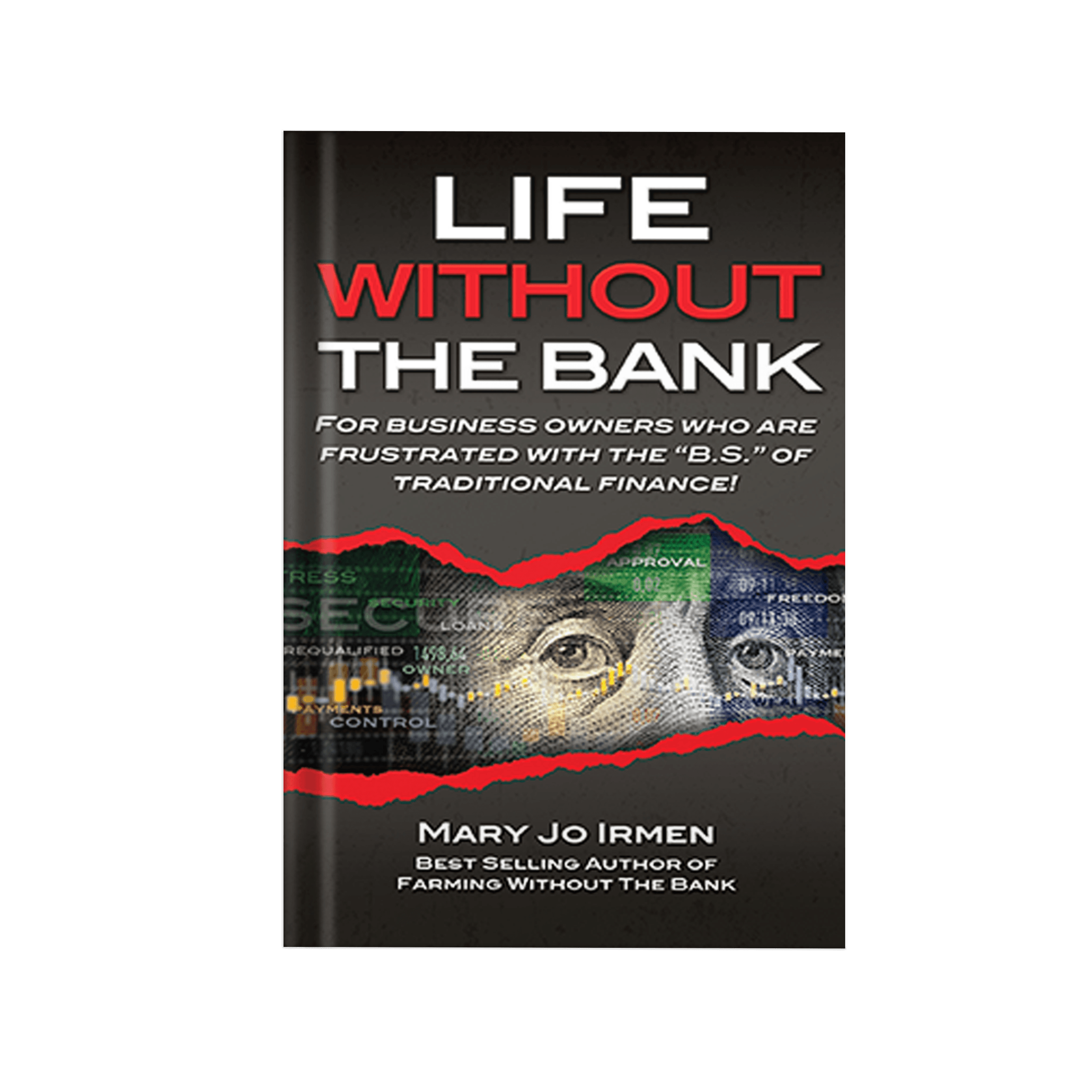
ready to start?
Your financial independence starts with one book.
Only one of three Americans can retire. Part of the fault is the conditioned belief that you must give up the use of your money when you’re young so you can have it later, assuming the stock market doesn’t collapse.