Podcast
EP. 291
You Can’t Do Infinite Banking If You Don’t Know Your Numbers (Ep. 291)
Oct 15, 2026 ·
17 min
0:00 / 17:24
EPISODE OVERVIEW
ABOUT THIS EPISODE
You can’t get away from the bank if you don’t know your numbers.
Mary Jo Irmen shares a business-owner to business-owner nudge for blue collar and small business owners.
Mary Jo breaks down what she’s seeing in her last 5 business-owner meetings: successful, hard-working owners making a lot of money, but with no P&L, no QuickBooks, no handle on depreciation, profit margins, or taxes. She explains why growth without profit is a trap, why relying only on your CPA to “pay less tax” can lead to bad equipment purchases, and why she won’t write an infinite banking policy without knowing your business structure, payroll, loans, cash flow, key people, and exit plan. Plus: DIY policies, working IN vs. ON your business, death benefit and estate planning, and what private equity buying up trades means for you.
📧 Email Mary Jo: maryjo@withoutthebank.com
Audio Production by Podsworth Media – podsworth.com
CHAPTER TIMESTAMPS
- 00:00Know Your Numbers
- 00:32Podcast Kickoff
- 01:24Missing Financial Basics
- 02:59Growth Versus Margins
- 04:35Fast Decisions Need Prep
- 05:02Why I Ask Everything
- 07:23DIY Policies Warning
- 08:46Work On The Business
- 11:52Be Ready With Financials
- 14:20Cash Flow And Funding
- 16:41Exit Plans And Protection
- 17:52Final Push And Next Steps
YOUTUBE EPISODE
TRANSCRIPTION
“We don’t know what’s going on with our finances, but we know we want to get away from the bank, so we read this book, it’s amazing.
But the only way to get away from the bank is to understand what’s happening in the business. We have to know what’s going on with the numbers. We have to know what our profits are. We have to know where money can be redirected from the business into the policy. And I am not going to just come in and be like, ‘Oh yeah, let’s just take $100,000.’
That would be great for me. That’d be absolutely fantastic. But how do I know that’s good for you?”
Hello, hello, and welcome back to the podcast. Thank you very much for being here. All right, today we are going to talk about… Oh, I’m, I’m gonna give you a little bit of a nudge. It’s more of a, “Hey, as a business owner to business owner, I want to just share a few things that I am seeing already in the blue-collar world,” and I’m having more and more business owner only meetings.
So I have had meetings with business owners for 16 years, but they’re usually associated with farming. They sometimes have some sort of farm stuff or whatever. Once in a while, I would get one that was just a business owner, we didn’t have anything to do with farming. And so I am seeing more and more of those, and I know I will continue to see more and more of those, especially as my next book comes out.
And so I want to address a couple of things that I have seen now five times in the last five meetings, and it is the fact that a lot of you small business owners, you don’t have your poop in a scoop, my friends. You don’t know your numbers. You don’t have a P&L. You may not even have QuickBooks, but yet you’re really successful, and you’re making a lot of money, and you are extremely hard workers.
And that’s great, and that is fantastic, and that is why you are where you’re at. But let me tell you, if you don’t have your numbers and you don’t know where your business is financially, how are we getting to the next step? I have talked to business owners that don’t know what depreciation is. They don’t know how long they’re depreciating a piece of equipment or a building.
They don’t understand how the tax part works, and what they’re doing is they’re relying on their CPA to just take care of it. And as long as we don’t pay taxes, or our taxes are very minimal, we think we’re okay. “Oh, they’re doing a good job. They’re fine.” But if you don’t understand how the numbers correlate to taxes, and you don’t understand what you’re buying and how taxes are saved on what you’re buying, are you making a smart purchase?
Or are you doing what my farmers are doing, and you’re just buying things to avoid taxes? You might look at your business and say, “We’re growing every single year. That’s absolutely fantastic, but I don’t know what my numbers are. We’re just growing every year.” Okay, so you’re growing every year, but is your profit margin staying the same?
Or are you growing with less profit? Because if you’re growing with less profit, does it make sense to grow? Or do you just have a bigger gross number, but you don’t have as much profit? It might actually make sense to back off or look at what’s happening and where are the efficiencies and where are the inefficiencies of the business. And how do I know all this stuff?
Because I was like that. I did not know my numbers. I did not pay attention to those things. And then when I started paying attention, and I started understanding how it all works for taxes, what are my profit margins? Just because I’ve sold more books and I’ve made more money this year, how much of that money came from new clients versus existing clients?
What are my expenses? Did they go up? Am I making the same profit margin or better, or is my profit margin going backwards? If my profit margin is going backwards because I’m doing X, Y, and Z, then I shouldn’t be doing X, Y, and Z. And I’m finding it interesting that we get into the meetings, and we can accomplish what we need accomplished, but I’m also getting into the meetings, and people are not prepared with numbers because, A, they don’t know numbers, or B, they just want information quickly, and this is also a small business issue.
If you guys don’t know what the Kolbe score is, just go out and look it up. But in the Kolbe score, it’s kind of a… it tells you how you make decisions. If you are a very quick decision-maker, you are going to come to that meeting and not be prepared. How do I know that? ’Cause I also am a very quick decision-maker.
Quick decision-makers are who are successful business owners in most cases, because we do not overthink things. We just go and do ’em. So you’re coming into this meeting, and you’re saying, “Okay, I want to know about infinite banking.” And then I can sense through your body language that you are ready to come through the screen and kill me because I have a lot of questions.
I want to know how old you are. I want to know what the kids are or how many kids you have. I want to know what your business does. I maybe want more details about the business so I can understand it. And you are coming in and saying, “Just tell me how infinite banking works.” If you don’t want to go over what your business does, how many employees you have, what your gross income is, who’s doing what in the business.
Are you taking payroll? Do you have an S corp? Do you have a C corp? How are you taxed? How often are you buying equipment? All the things. Like, I want to know all the things, and if it’s a business I’m not familiar with… I talked to a lady the other day that is building hotels, like national chain hotels.
Super interesting. She was so gracious and gave me all kinds of information that had nothing to do with infinite banking, but it was me asking about hotels. How do you do that? What is your franchise fee? What does all that stuff look like? And in that conversation, which to her had nothing to do with infinite banking, to me had everything to do with strategizing.
I am always in these meetings trying to figure out, who do we need to insure? For her, she has a business, she has a, not necessarily a business partner, but a capital investor. And so I’m like, do we need to insure that person, right? That needs to come up in conversation. Are the kids gonna be taking over the business?
If they’re not, what’s the exit plan? All these things, and I can just feel y’all wanting to jump out of your skin. If you don’t want to go over those things, then go find another agent. It’s really that simple. I am here to build a relationship with you, and I am here to help you. You should not expect your CPA to just say, “Hey, give me all your information, and we’re good.”
Your CPA should also want to know all of that information, because how do we make you a better business owner if we don’t know what’s going on? Now, there are people in this industry that would be more than happy for you to call them and say, “Hey, I want a policy for $20,000 a year.” Great. Fantastic.
They’ll sell you a policy for $20,000 a year. They won’t tell you how it’s structured. They won’t tell you how to use it. It’s kind of a DIY infinite banking policy. Okay. Great. DIY it. How is that gonna work? You are a professional in your business. What do you think about all those DIYers? If you’re a plumber, well, somebody can DIY that, and then you go in, they call you, and you go fix it.
I was actually listening to a podcast the other day, I don’t remember what the guy did, some blue-collar business owner, and it was funny ’cause he said, “I love DIYers because they mess it up, and then they call us, and then we get paid anyway to come fix it.” So he said, “I’m happy to tell them, like, if I run into them or I give them a bid, I’m happy to tell them how to do it on their own.”
And he’s like, “If they can do it on their own, great, fantastic. They might refer somebody else. If they can’t do it on their own, then I go back and fix it.” And that’s essentially what you’re doing with infinite banking. You’re saying, “Hey, I want a policy, but I don’t want you to ask me all these questions and sit here for an hour and a half because I have work to do.”
Yes, I know, and I also have work to do, and my job is to help you. And so if you are a business owner that is just so busy working, when are you running the business? If you have to be out there physically working and you cannot give me an hour and a half of your time, because you are also the same guy that has no time to go to the ER, you have no time to go get your hair cut, you have no time to do anything, I ask you, how is that business actually running?
How is that business going to run without you? I could take a week off tomorrow. I could take two weeks off tomorrow, and my business would be fine because I have staff that is trained and trained well. You guys have heard John. I have John that people can meet with. I have clients that can call John and get questions answered by John. I am working in my business as much as I’m working on my business, and I did not like…
Because remember, I was just like you. I did not like that feeling of un-organization. It drove me nuts. There is one thing that will just set me off faster than anything, and it is having to spend time looking for something because it was not put in the place it needed to be put in. Now, am I the most organized individual in the world?
Um, no. Absolutely not. Ask my assistants. They help keep me organized. They are amazing. But if I am in, let’s just use my husband’s shop, for example. If I am in his shop, and I can’t find something, oh, drives me nuts. Because if he doesn’t put it back in the same spot all the time, now I have to spend time looking for that.
The other day, we’re in the shop, and he’s looking for some bolt that he needed. He’s like, “Well, it looks like this. It’s this long,” blah, blah, blah. Nope, couldn’t find it. No idea where he put it, so we had to go buy a new one. What a waste of time. Now, that stuff happens, but when it’s happening in your business all the time, and all you’re doing is putting out fires and sitting around looking for things, how is that being productive and making you money?
If half of your day is searching for stuff, how much money did you actually lose because you couldn’t be productive during those hours? When you’re coming to me, and you can’t sit for an hour and a half, and you can’t have somebody not interrupt you… It’s amazing to me how many clients, potential clients I meet with, that they can’t even sit with me for an hour and a half, and there is a employee coming in, bugging them.
They don’t know their numbers, so they’re busy looking for their numbers on their P&L. They might not even know what the P&L is. They’re looking through their tax returns. They don’t know how to read tax returns. We are not working on our business. We’re so busy working in it that all of a sudden we don’t know what’s going on with our finances, but we know we want to get away from the bank, so we read this book, it’s amazing.
But the only way to get away from the bank is to understand what’s happening in the business. We have to know what’s going on with the numbers. We have to know what our profits are. We have to know where money can be redirected from the business into the policy. And I am not going to just come in and be like, “Oh yeah, let’s just take $100,000.”
That would be great for me. That’d be absolutely fantastic. But how do I know that’s good for you? How do I know that’s not gonna hurt you financially? You should be more than happy to have all of that information ready. And if that information isn’t ready, I’m not gonna treat you any differently than I treat my farmers.
If you schedule your appointment and you do not have that information ready, I will just end the meeting. Now, I have not done that, and I don’t have to do that often even for my farmers, because they have it ready or it’s readily available. But at the end of the day, that should be ready. If I say, “I need how much you owe on a loan. I need your payment. I need your interest.”
You’re not gonna know your payment. I don’t know what my payments are on my loans to the dollar amount. I’m lucky if I even know what they are, guesstimate. It’s coming out every month, and you’re busy working and making money. It’s being covered.
Just be ready. Understand there are so many people in the blue-collar world, in the small business world, preaching exactly what I’m saying. It does not matter who I look at that is a coach for business owners. This is the biggest problem. This is the biggest issue across the board, bigger issue than employees, because how do you scale your business correctly when you don’t actually know your numbers?
Or I will hear people say, “Oh, I read your email that you needed all that stuff,” because you get an email that shows what I’m gonna need, “but I just ignored it.” You ignored it? Then we can end this meeting right now. I, I’m not your agent. I’m not the person to have… I’m not the person to help you. The more I understand your business, the more you understand your business, game changer for success. How do we get money to put into the policy?
I don’t know. I have to look. Where are we spending it? Do we have an operating note? Are we using cash? The last handful of people that I have talked to, very successful, making a lot of money, but they’re either taking money as cash or they don’t have any cash held, like nothing in savings, nothing in IRAs.
No money held because you’re putting it back into the business and growing the business. So now we have cash infused into the business, and we have to look at how we use that cash and if that cash makes sense. So as much as you want to get away from the bank, and I’m here to help you get away from the bank so you can do business without the bank, I still need to make sure that I understand what you’re doing, and I understand what you’re looking at and how you work and who’s important, and are the kids taking over?
And if the kids aren’t taking over, what is the exit plan? Are we selling it to private equity? What are we doing? I just heard today, somebody in the blue-collar world told me that private equity is coming up and buying all the businesses that he’s in. And he said, “I don’t want to sell to private equity. I actually make money when private equity comes in and buys a business, because those clients, they’ll buy that business, those clients will leave and they’ll come to me.” He’s like, “So every single time a business changes hands, money is to be made because people are moving. The loyalty has stopped because the old business owner has left.” That was something new I had never heard of.
And so now I can file that in the back of my brain and go, “Okay, if we’re a plumber, electrician, if we’re HVAC, private equity is coming in and buying all those companies, lawn care businesses. How can we take advantage of that, and what do we need to do that? How… Do we need to market on Google? H… What is our marketing strategies, right?”
A lot of times I’m getting into that as well. I give a lot of business advice in those meetings based on what I’m seeing and what I’m hearing, and sometimes I don’t need to. The guy that I just met with, great business. He had never thought about, and maybe he had, but in his body language, it looked to me like he had never thought about the fact that death benefit is important.
What if he dies? Is his wife taking over the business? If his wife dies, she works in the business, is he gonna continue the business? If he dies, do one of the kids step in and take over the business? What does that look like? Do any of them wanna take over the business? We talked a lot about estate planning that you could kind of tell he didn’t have answers to, because he probably had never had that conversation before.
He’s too busy building. He’s not thinking exit strategy. And I’ve been listening to a podcast talking just about that, exit strategy. What is the exit strategy? We get into the business, we’re so busy building it, we never build it for the exit strategy. And a lot of people will say, “Well, what’s your exit strategy?”
I have one, right? It’s John. The moment it’s John, my kids are not gonna take over this business. I already know that. And so we’ve got John, I’ve got employees in place, we’ve got death benefit in place. Like, I’ve thought about that for myself, not just my clients. A little bit of German passion today, because I can’t help you if you don’t have your poop in a scoop, okay?
Have it ready, pay attention to the emails I send you, and then we can be extremely productive. All right, you guys, if you need anything, email, call, or email me, maryjo@withoutthebank.com. Don’t call me ’cause I won’t answer. Email John at john@withoutthebank.com. Schedule your appointment, get your book, read the book, and then let’s get started and figure out how we can get you to the next level.
But be ready for that meeting. All right, you have a fantastic rest of your day.
View MoreBut the only way to get away from the bank is to understand what’s happening in the business. We have to know what’s going on with the numbers. We have to know what our profits are. We have to know where money can be redirected from the business into the policy. And I am not going to just come in and be like, ‘Oh yeah, let’s just take $100,000.’
That would be great for me. That’d be absolutely fantastic. But how do I know that’s good for you?”
Hello, hello, and welcome back to the podcast. Thank you very much for being here. All right, today we are going to talk about… Oh, I’m, I’m gonna give you a little bit of a nudge. It’s more of a, “Hey, as a business owner to business owner, I want to just share a few things that I am seeing already in the blue-collar world,” and I’m having more and more business owner only meetings.
So I have had meetings with business owners for 16 years, but they’re usually associated with farming. They sometimes have some sort of farm stuff or whatever. Once in a while, I would get one that was just a business owner, we didn’t have anything to do with farming. And so I am seeing more and more of those, and I know I will continue to see more and more of those, especially as my next book comes out.
And so I want to address a couple of things that I have seen now five times in the last five meetings, and it is the fact that a lot of you small business owners, you don’t have your poop in a scoop, my friends. You don’t know your numbers. You don’t have a P&L. You may not even have QuickBooks, but yet you’re really successful, and you’re making a lot of money, and you are extremely hard workers.
And that’s great, and that is fantastic, and that is why you are where you’re at. But let me tell you, if you don’t have your numbers and you don’t know where your business is financially, how are we getting to the next step? I have talked to business owners that don’t know what depreciation is. They don’t know how long they’re depreciating a piece of equipment or a building.
They don’t understand how the tax part works, and what they’re doing is they’re relying on their CPA to just take care of it. And as long as we don’t pay taxes, or our taxes are very minimal, we think we’re okay. “Oh, they’re doing a good job. They’re fine.” But if you don’t understand how the numbers correlate to taxes, and you don’t understand what you’re buying and how taxes are saved on what you’re buying, are you making a smart purchase?
Or are you doing what my farmers are doing, and you’re just buying things to avoid taxes? You might look at your business and say, “We’re growing every single year. That’s absolutely fantastic, but I don’t know what my numbers are. We’re just growing every year.” Okay, so you’re growing every year, but is your profit margin staying the same?
Or are you growing with less profit? Because if you’re growing with less profit, does it make sense to grow? Or do you just have a bigger gross number, but you don’t have as much profit? It might actually make sense to back off or look at what’s happening and where are the efficiencies and where are the inefficiencies of the business. And how do I know all this stuff?
Because I was like that. I did not know my numbers. I did not pay attention to those things. And then when I started paying attention, and I started understanding how it all works for taxes, what are my profit margins? Just because I’ve sold more books and I’ve made more money this year, how much of that money came from new clients versus existing clients?
What are my expenses? Did they go up? Am I making the same profit margin or better, or is my profit margin going backwards? If my profit margin is going backwards because I’m doing X, Y, and Z, then I shouldn’t be doing X, Y, and Z. And I’m finding it interesting that we get into the meetings, and we can accomplish what we need accomplished, but I’m also getting into the meetings, and people are not prepared with numbers because, A, they don’t know numbers, or B, they just want information quickly, and this is also a small business issue.
If you guys don’t know what the Kolbe score is, just go out and look it up. But in the Kolbe score, it’s kind of a… it tells you how you make decisions. If you are a very quick decision-maker, you are going to come to that meeting and not be prepared. How do I know that? ’Cause I also am a very quick decision-maker.
Quick decision-makers are who are successful business owners in most cases, because we do not overthink things. We just go and do ’em. So you’re coming into this meeting, and you’re saying, “Okay, I want to know about infinite banking.” And then I can sense through your body language that you are ready to come through the screen and kill me because I have a lot of questions.
I want to know how old you are. I want to know what the kids are or how many kids you have. I want to know what your business does. I maybe want more details about the business so I can understand it. And you are coming in and saying, “Just tell me how infinite banking works.” If you don’t want to go over what your business does, how many employees you have, what your gross income is, who’s doing what in the business.
Are you taking payroll? Do you have an S corp? Do you have a C corp? How are you taxed? How often are you buying equipment? All the things. Like, I want to know all the things, and if it’s a business I’m not familiar with… I talked to a lady the other day that is building hotels, like national chain hotels.
Super interesting. She was so gracious and gave me all kinds of information that had nothing to do with infinite banking, but it was me asking about hotels. How do you do that? What is your franchise fee? What does all that stuff look like? And in that conversation, which to her had nothing to do with infinite banking, to me had everything to do with strategizing.
I am always in these meetings trying to figure out, who do we need to insure? For her, she has a business, she has a, not necessarily a business partner, but a capital investor. And so I’m like, do we need to insure that person, right? That needs to come up in conversation. Are the kids gonna be taking over the business?
If they’re not, what’s the exit plan? All these things, and I can just feel y’all wanting to jump out of your skin. If you don’t want to go over those things, then go find another agent. It’s really that simple. I am here to build a relationship with you, and I am here to help you. You should not expect your CPA to just say, “Hey, give me all your information, and we’re good.”
Your CPA should also want to know all of that information, because how do we make you a better business owner if we don’t know what’s going on? Now, there are people in this industry that would be more than happy for you to call them and say, “Hey, I want a policy for $20,000 a year.” Great. Fantastic.
They’ll sell you a policy for $20,000 a year. They won’t tell you how it’s structured. They won’t tell you how to use it. It’s kind of a DIY infinite banking policy. Okay. Great. DIY it. How is that gonna work? You are a professional in your business. What do you think about all those DIYers? If you’re a plumber, well, somebody can DIY that, and then you go in, they call you, and you go fix it.
I was actually listening to a podcast the other day, I don’t remember what the guy did, some blue-collar business owner, and it was funny ’cause he said, “I love DIYers because they mess it up, and then they call us, and then we get paid anyway to come fix it.” So he said, “I’m happy to tell them, like, if I run into them or I give them a bid, I’m happy to tell them how to do it on their own.”
And he’s like, “If they can do it on their own, great, fantastic. They might refer somebody else. If they can’t do it on their own, then I go back and fix it.” And that’s essentially what you’re doing with infinite banking. You’re saying, “Hey, I want a policy, but I don’t want you to ask me all these questions and sit here for an hour and a half because I have work to do.”
Yes, I know, and I also have work to do, and my job is to help you. And so if you are a business owner that is just so busy working, when are you running the business? If you have to be out there physically working and you cannot give me an hour and a half of your time, because you are also the same guy that has no time to go to the ER, you have no time to go get your hair cut, you have no time to do anything, I ask you, how is that business actually running?
How is that business going to run without you? I could take a week off tomorrow. I could take two weeks off tomorrow, and my business would be fine because I have staff that is trained and trained well. You guys have heard John. I have John that people can meet with. I have clients that can call John and get questions answered by John. I am working in my business as much as I’m working on my business, and I did not like…
Because remember, I was just like you. I did not like that feeling of un-organization. It drove me nuts. There is one thing that will just set me off faster than anything, and it is having to spend time looking for something because it was not put in the place it needed to be put in. Now, am I the most organized individual in the world?
Um, no. Absolutely not. Ask my assistants. They help keep me organized. They are amazing. But if I am in, let’s just use my husband’s shop, for example. If I am in his shop, and I can’t find something, oh, drives me nuts. Because if he doesn’t put it back in the same spot all the time, now I have to spend time looking for that.
The other day, we’re in the shop, and he’s looking for some bolt that he needed. He’s like, “Well, it looks like this. It’s this long,” blah, blah, blah. Nope, couldn’t find it. No idea where he put it, so we had to go buy a new one. What a waste of time. Now, that stuff happens, but when it’s happening in your business all the time, and all you’re doing is putting out fires and sitting around looking for things, how is that being productive and making you money?
If half of your day is searching for stuff, how much money did you actually lose because you couldn’t be productive during those hours? When you’re coming to me, and you can’t sit for an hour and a half, and you can’t have somebody not interrupt you… It’s amazing to me how many clients, potential clients I meet with, that they can’t even sit with me for an hour and a half, and there is a employee coming in, bugging them.
They don’t know their numbers, so they’re busy looking for their numbers on their P&L. They might not even know what the P&L is. They’re looking through their tax returns. They don’t know how to read tax returns. We are not working on our business. We’re so busy working in it that all of a sudden we don’t know what’s going on with our finances, but we know we want to get away from the bank, so we read this book, it’s amazing.
But the only way to get away from the bank is to understand what’s happening in the business. We have to know what’s going on with the numbers. We have to know what our profits are. We have to know where money can be redirected from the business into the policy. And I am not going to just come in and be like, “Oh yeah, let’s just take $100,000.”
That would be great for me. That’d be absolutely fantastic. But how do I know that’s good for you? How do I know that’s not gonna hurt you financially? You should be more than happy to have all of that information ready. And if that information isn’t ready, I’m not gonna treat you any differently than I treat my farmers.
If you schedule your appointment and you do not have that information ready, I will just end the meeting. Now, I have not done that, and I don’t have to do that often even for my farmers, because they have it ready or it’s readily available. But at the end of the day, that should be ready. If I say, “I need how much you owe on a loan. I need your payment. I need your interest.”
You’re not gonna know your payment. I don’t know what my payments are on my loans to the dollar amount. I’m lucky if I even know what they are, guesstimate. It’s coming out every month, and you’re busy working and making money. It’s being covered.
Just be ready. Understand there are so many people in the blue-collar world, in the small business world, preaching exactly what I’m saying. It does not matter who I look at that is a coach for business owners. This is the biggest problem. This is the biggest issue across the board, bigger issue than employees, because how do you scale your business correctly when you don’t actually know your numbers?
Or I will hear people say, “Oh, I read your email that you needed all that stuff,” because you get an email that shows what I’m gonna need, “but I just ignored it.” You ignored it? Then we can end this meeting right now. I, I’m not your agent. I’m not the person to have… I’m not the person to help you. The more I understand your business, the more you understand your business, game changer for success. How do we get money to put into the policy?
I don’t know. I have to look. Where are we spending it? Do we have an operating note? Are we using cash? The last handful of people that I have talked to, very successful, making a lot of money, but they’re either taking money as cash or they don’t have any cash held, like nothing in savings, nothing in IRAs.
No money held because you’re putting it back into the business and growing the business. So now we have cash infused into the business, and we have to look at how we use that cash and if that cash makes sense. So as much as you want to get away from the bank, and I’m here to help you get away from the bank so you can do business without the bank, I still need to make sure that I understand what you’re doing, and I understand what you’re looking at and how you work and who’s important, and are the kids taking over?
And if the kids aren’t taking over, what is the exit plan? Are we selling it to private equity? What are we doing? I just heard today, somebody in the blue-collar world told me that private equity is coming up and buying all the businesses that he’s in. And he said, “I don’t want to sell to private equity. I actually make money when private equity comes in and buys a business, because those clients, they’ll buy that business, those clients will leave and they’ll come to me.” He’s like, “So every single time a business changes hands, money is to be made because people are moving. The loyalty has stopped because the old business owner has left.” That was something new I had never heard of.
And so now I can file that in the back of my brain and go, “Okay, if we’re a plumber, electrician, if we’re HVAC, private equity is coming in and buying all those companies, lawn care businesses. How can we take advantage of that, and what do we need to do that? How… Do we need to market on Google? H… What is our marketing strategies, right?”
A lot of times I’m getting into that as well. I give a lot of business advice in those meetings based on what I’m seeing and what I’m hearing, and sometimes I don’t need to. The guy that I just met with, great business. He had never thought about, and maybe he had, but in his body language, it looked to me like he had never thought about the fact that death benefit is important.
What if he dies? Is his wife taking over the business? If his wife dies, she works in the business, is he gonna continue the business? If he dies, do one of the kids step in and take over the business? What does that look like? Do any of them wanna take over the business? We talked a lot about estate planning that you could kind of tell he didn’t have answers to, because he probably had never had that conversation before.
He’s too busy building. He’s not thinking exit strategy. And I’ve been listening to a podcast talking just about that, exit strategy. What is the exit strategy? We get into the business, we’re so busy building it, we never build it for the exit strategy. And a lot of people will say, “Well, what’s your exit strategy?”
I have one, right? It’s John. The moment it’s John, my kids are not gonna take over this business. I already know that. And so we’ve got John, I’ve got employees in place, we’ve got death benefit in place. Like, I’ve thought about that for myself, not just my clients. A little bit of German passion today, because I can’t help you if you don’t have your poop in a scoop, okay?
Have it ready, pay attention to the emails I send you, and then we can be extremely productive. All right, you guys, if you need anything, email, call, or email me, maryjo@withoutthebank.com. Don’t call me ’cause I won’t answer. Email John at john@withoutthebank.com. Schedule your appointment, get your book, read the book, and then let’s get started and figure out how we can get you to the next level.
But be ready for that meeting. All right, you have a fantastic rest of your day.



ready to start?
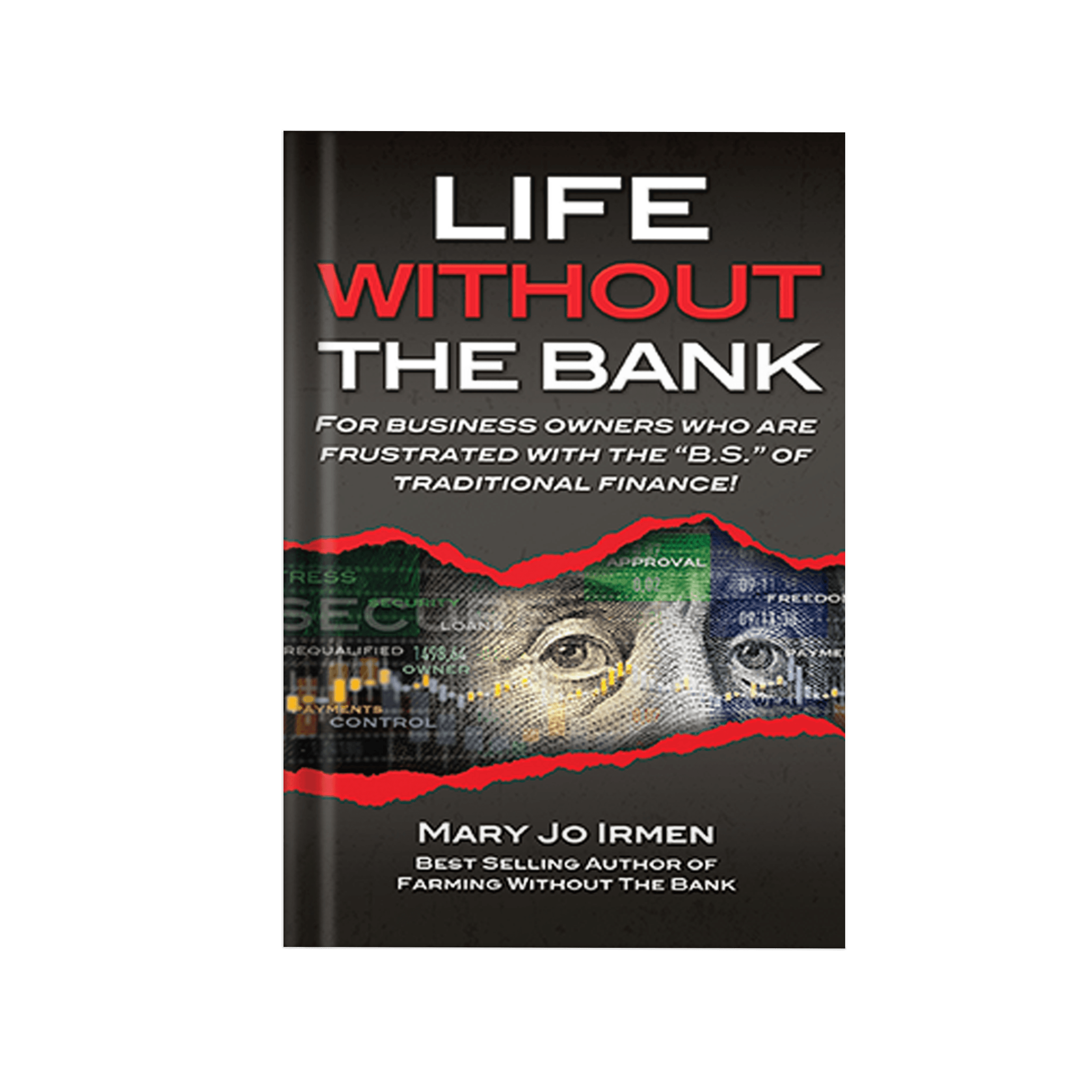
Your financial independence starts with one book.
Only one of three Americans can retire. Part of the fault is the conditioned belief that you must give up the use of your money when you’re young so you can have it later, assuming the stock market doesn’t collapse.