Podcast
EP. 267
Gross Income Is a Lie — Here’s What to Ask Instead (Ep. 267)
Apr 30, 2026 ·
20 min
0:00 / 20:18
EPISODE OVERVIEW
ABOUT THIS EPISODE
Gross income is a sales pitch. Net income is the truth. Here are the questions you need to ask.
Everybody's talking about how much money you CAN make. Nobody's talking about how much you actually KEEP. Let's fix that.
In this solo episode, Mary Jo breaks down the gross vs. net income trap that catches new and experienced business buyers alike. Using real-world examples — tote rental businesses, car washes, Jiffy Lube franchises, and Airbnb — she walks through the questions you MUST ask before you fall in love with a business opportunity.
Here's What You'll Learn
- ✅ Why most business owners quote gross — and why it's almost meaningless
- ✅ The "un-fudged" net income question that reveals the real picture
- ✅ How to factor in owner draws, distributions, and personal expenses run through the business
- ✅ Why a $100K/year tote business might not be worth your time when you calculate the hourly rate
- ✅ What a car wash owner told MJ that instantly killed her interest ("it's like having milk cows")
- ✅ The difference between buying a job and building an asset
If you're evaluating a business to buy, a side hustle, or a "passive income" opportunity — this episode is your due diligence checklist.
🔔 Subscribe for new weekly episodes. 👍 Share this episode with someone you love. 📧 Reach out with your questions or what you want to learn in future episodes.
- 📘 Get the book
- 📧 Email Mary Jo: maryjo@withoutthebank.com
- 🌐 withoutthebank.com
- ▶️ Subscribe on YouTube
CHAPTER TIMESTAMPS
- 0:00Intro and Welcome
- 0:45The Gross Income Trap
- 2:15Why Business Owners Quote Gross Numbers
- 4:30Real-World Example: Tote Rental Business
- 6:45The "Un-Fudged" Net Income Question
- 9:00Factoring in Owner Draws and Personal Expenses
- 11:15Car Wash and Franchise Examples
- 13:45Why a $100K Business Might Not Be Worth It
- 15:30The Difference Between a Job and an Asset
- 17:00Your Due Diligence Checklist
- 18:30Final Thoughts and How to Reach Mary Jo
YOUTUBE EPISODE
TRANSCRIPTION
"People like myself who see the shiny objects, who see opportunities everywhere, we tend to not think about the big picture. So I call my husband the Debbie Downer, because he is always busting my bubbles, man. I'll have a great idea, and I'm like, oh my gosh, this is gonna be so amazing. And then he is like, Mr. Reality, and he starts asking, whoa, what about this? What about this? What about this? Right? He has faster — I have discernment, but he has faster discernment than I do, because I am seeing, oh my gosh, this is a great opportunity. And then I have to sit back and go, whoa, he's not wrong. These are all the things that need to be considered in this scenario that are maybe not being considered."
Hello, hello, hello, and welcome back to the podcast. Thank you very much for being here. Flying solo again today. I just had something that I thought I should probably share, because I'm seeing a lot of talk, especially with all the podcasts that I listen to, about, oh, you can make this much money starting a business, and you can make this much money starting a business.
What is the real number for this shiny object syndrome that people are seeing? And so let's talk a little bit about gross numbers, net numbers, and look at truly what people are making in their business, or knowing what questions to ask. So when you do go buy a business, start a business, look at business opportunities, you kind of know what you're looking at.
So let me just start with an example. I was listening to a podcast and they were going over a business of tote rentals. So people buy these plastic totes — you know, where the covers kind of close in on themselves, not the snap covers, but the covers that kind of close in on themselves. They rent those to people that are moving.
So it's basically moving totes, and they rent those out and then they get 'em back, and they clean 'em and they deliver 'em and they pick 'em up and they do all the things. And it sounds like kind of a no-brainer business. Not a huge amount of money that you need to get started. You could probably do it with a credit card. It is gonna take you some money to have a website built.
They're talking on this podcast about how awesome this is. So I was like, well, you know, that's like a great little business. So I go investigate, and I'm doing my due diligence, and as I'm looking at the numbers — 'cause in my head, me, Mary Jo, being the opportunist where everything is an opportunity for me, I rarely see the downside of stuff right away.
And so I go, and I was like, well, this is a no-brainer. Like, this business is gonna make money. How could it not make money? Everybody's moving. You rent these totes out, you bring 'em back. Like, how many could possibly get broken? This is great.
So I attend this online — like, I listen to this online webinar. I jump in this group of these people that are doing this, and I'm looking at the numbers. I'm like, okay, that's a lot of work for a hundred thousand dollars a year. And it all has to be relative, right? If you're somebody making $30,000 a year and minimum wage, and you're having a hard time getting moving, it's a great stepping stone. You have to kind of put it all into perspective.
So I was looking at the numbers and I said, well, how long does it take you guys to clean these totes? How long does it take you to drop 'em off? How long does it take you to pick 'em up? You know, if you have totes over what will fit in your pickup box, you have to rent a trailer. If you don't have a pickup and you start this business, well, now you're renting something, or you're having to buy a pickup. And so I'm like, by the time you're done, what is your hourly rate?
And the people that have this little online course didn't figure it out really per hour. They weren't timing themselves to look at that. And I thought, well, you're doing a lot of work. Like, you would have to have — I don't even remember what the number was. It was an astronomical amount of totes rented out to make a hundred thousand dollars a year gross, right? So somebody can come in and say, oh, this is a great business, I'm making a hundred thousand dollars a year.
I talked to somebody yesterday that has some car washes. He's building a Jiffy Lube. It was a super exciting conversation, and I'm like, what are your expenses? How much payroll do you take from the company that actually makes that look like an expense on your books?
So when we start talking to people about their businesses and how well their business is doing — are they blowing smoke? Are you asking the right questions? What their overall gross number is? Who cares. Most business owners will talk about their gross number, because that's what makes them look good. A real business owner will say, well, this is my net.
And when you talk to people and they're giving you a gross number — yeah, that's great, their net might look really bad, because they may be running a lot of expenses, personal expenses through. But you need to ask that question: what is your net income?
And then when they give you their net income: are you pulling payroll out of your company? What are you taking for owner draws or distributions? How much of your personal stuff are you passing through that business? Because it is a business expense in the gray area, right? So a lot of business owners are running some personal stuff through so that it can look like a business expense. Like, oh, maybe I went out to eat and I talked about my business, so now there's a lot of food expenses on there.
So the real number at the end of the day is the un-fudged number. A lot of times I'm talking to business owners and I want the un-fudged number. Like, how much of that personal stuff are you putting through? Are you putting a family vacation through that, because you did a little bit of work while you were on family vacation? How much of that is real, true expenses in that business?
Because then that's going to give you an idea of if that's a good business — maybe if that's a good business to buy, if you're buying a business. If you're starting a business, well, how much time do you have in to working that business?
The gentleman that I talked to yesterday that has the car washes, it was a very eye-opening conversation for me, because I've looked at car washes. You guys have heard that it was a rabbit hole that I was down for a while. I was thinking, wow, this would really be a great avenue of income, right? Everybody's kind of washing their cars. It seems like the thing to do. I just don't know that — you kind of have to have the location and all that kind of stuff picked out.
And it was interesting when I talked to him, 'cause he said, it's about as bad as having milk cows. You're working seven days a week. And I thought, oh my God, that is horrible. I don't wanna work seven days a week at this stage in my life. No thank you. If I was in my twenties, game on. If I was working for somebody making 50, $60,000 a year and I could go do a car wash and make more than that for seven days a week, that would be more appealing. But where I'm at in this stage of my life, nope. That is not that appealing to me.
And so then we talked about the Jiffy Lube, and I said, okay, so you've got a Jiffy Lube, and so you now have employees to manage instead of dirty car wash stalls or equipment that's breaking down. I said, now you have people to manage. And he said, yeah, it's either manage people or have broken-down stuff that you're fixing all the time. He's like, it doesn't pay to own a car wash if you can't fix any of it, because by the time you get a tech in there and somebody to fix all that stuff, you're not making any money.
And so it was fun to hear the truth out of a business. Because you can listen to podcast after podcast after podcast and you don't always hear the truth. There is some stuff that I'm learning about selling businesses and trying to avoid some capital gains, and I'll share it at some point, but still, I'm in the investigation stage of all of that, doing my due diligence.
And it's interesting — the more podcasts I listen to, I get just little pieces of something the other ones didn't say. And you really have to look at all of the information and not just what somebody is trying to sell you through a podcast. Because passive income is not passive.
My Airbnb does great. We're busy. Fantastic. But it's not passive. Because even though I have a cleaning lady — which I can't even imagine having an Airbnb and cleaning that thing myself, can't even imagine it. You would never be able to go anywhere and do anything, because you would need to be there to make sure that it gets cleaned. And how much are you getting paid cleaning that? What are these other things that you could be doing, that maybe you could pay a cleaner to do them?
I just — the laundry. I don't like cleaning. If I had to clean it, I wouldn't have it. So yeah, that's fairly passive. My cleaner comes in, she cleans it, but she does not clean the grill. She doesn't clean up the patio. She does not clean the hot tub. And so there's still certain things that we are doing above and beyond.
The wind comes by and it blows all the patio cushions off, and you want those to look good. So you go back over and you put up all the cushions again, you know, just to have the wind come back and blow 'em all over. But at least when they arrive, it looks good. When it's winter, you're gonna have to have somebody shovel, and you're gonna have to make sure they shovel. If somebody has — the microwave doesn't work, all of a sudden that's happened. Now you're gonna have to go over right away and make sure, or send somebody over to make sure that your guest is happy.
And so it is definitely not a passive income to where people think, oh, I can have three, four, or five of these. No. Like, we can have one of them. It's totally manageable to have two of them, or to have three of them — oh my gosh, no way.
I have a client that we kind of share some of the management software, and he's got one, I've got one. And in the summertime both of 'em are getting messages, and sometimes it's just two, both of 'em in the same day. It's just issue after issue. You'll go forever with no issue, and then all of a sudden you have an issue. And when that happened to us last year, I was like, yeah, no, I am not having two of these things. That is not happening, because this would've been the worst weekend. I don't want to be that busy on the weekends, because I've done my time. I've worked weekends, I've worked holidays, I've done all that stuff. I don't wanna do it again.
And so when people are online talking about, oh, you can make this much money and this is so passive and I don't have to do anything — and really, you don't have to do anything? Or how long did it take you to get that business started, to get where you're at?
That's another thing that people don't look at, is when you start hearing people talk about businesses and how successful they are — how long did it take you to get there? So you're telling me this business is amazing and you're making a bunch of money, and you hear it might take them a year, two years, three years, five years to get there. They spent nights and weekends working. They basically didn't have an hourly rate that they were working for. They were sort of working for free. They left their job that had a steady income to have more time, but yet they don't have any more time, because they're having to put so much time into working the business.
And so, as I talk to people like myself who see the shiny objects, who see opportunities everywhere, we tend to not think about the big picture. So I call my husband the Debbie Downer, because he is always busting my bubbles, man. I'll have a great idea, and I'm like, oh my gosh, this is gonna be so amazing. And then he is like, Mr. Reality, and he starts asking, whoa, what about this? What about this? What about this? Right?
He has faster — I have discernment, but he has faster discernment than I do, because I am seeing, oh my gosh, this is a great opportunity. And then I have to sit back and go, whoa, he's not wrong. Like, these are all the things that need to be considered in this scenario and that are maybe not being considered.
Here's another example that I looked at recently, was Highlander cows. So there are the mini Highlanders, and now they have the micro minis. So they're like about knee height. They're super duper cute when they're little. Everybody wants a little Highlander cow. In fact, I just heard the other day some people are buying them and putting them in their apartments. Okay? They do grow, you know. 'Cause when they're a calf, they're just super tiny. They do get a little bit bigger.
And so I noticed online that there is a couple that are selling Highlander cattle, and they're selling these calves for up to 27,000 to $20,000 a calf, and I thought, that is crazy. We can go breed some Highlanders, right? Absolutely crazy.
Well, when you sit back and you do your due diligence — like, wow. These people have quite the operation, with quite the marketing they are doing. Every stitch of social media. They have a little Airbnb on their place. Those cattle are groomed on a daily basis. Videos are made on a daily basis. They have online auction stuff. The amount of work that they put into marketing and traveling — they just said they're gonna be taking their cattle from, I believe they're in Illinois, down to Texas to a sale. And then they're bringing them back. And you can pick 'em up at the farm if you want. How long are we gonna be in Texas?
Are they making money? Absolutely. Are they doing it with no effort? No. What is their net income? At the end of the day, this is their gross of 20,000 a calf or 7,000 a calf. But what is their net income?
We can get very blindsided by the gross, and that is what most people are talking about. So when you are looking at a business, or when you are talking to people, please just take that little bit of information they give you with a grain of salt, because it is not always what people are using. They're gonna put their best foot forward, right? They're gonna tell you what's going to be impressive. They may not tell you that at the end of the day they've overspent and they're actually negative and they don't have any money, that it was a losing proposition.
It happens. But there's not very many people out there that are entrepreneurs that have the ability to eat their ego and say, yeah, you know what? That was really kind of a bad decision to do this business. Or, we overbought here, we overspent here.
Because at the end of the day, most entrepreneurs — even ones that are on podcasts, when I really listen — they don't know their numbers. When they know they're gonna be on a podcast to go over their numbers, it's very interesting to me that they don't have solid numbers. "Oh, well, I think it was this. Well, it was about this. This is about what we make per month." You came on the podcast to talk about what you're doing for a living, and you don't have a P&L? You haven't broke that out monthly?
You need to do that, because all these other people are gonna go out and try to do what you're doing. They're gonna fail and say, no, that doesn't work, because they only got half the story.
That's kind of what happened with the totes. I got off track a little — surprise. It's kind of what happened with the totes. I looked at it and I was like, man, y'all gotta be working for minimum wage. Like, I am not seeing how this even makes sense. I wanted to ChatGPT and gave it the scenarios and said, how many totes do I need to rent to make a hundred thousand dollars a year?
Because if you take your hourly rate — and let's just use a beautician, for example, or a contractor. You know, a beautician is typically, in today's world, making over a hundred dollars an hour, or close to a hundred dollars an hour is what they're charging. And if you take a contractor, a contractor is going to charge — I know contractors that charge 130 to $150 an hour. And if you are going to start another business that you think is more passive, and you're making less than the hundred dollars an hour, why would you do that? Why wouldn't you just figure out how to keep this business going with less of your physical labor in it?
I don't think people think that way. And I was talking to my husband about it. I said, I don't know why they would quit their hundred dollars an hour job to do this, when they could have just figured out how to keep the hundred dollars an hour job and do it better and more efficiently. And he said, I just don't think people think like that.
Rightfully so. Maybe that's what we need to have a podcast on. Maybe somebody has to create a podcast on how we took our business from here to here, and how we scaled it by just being more efficient. Maybe being more efficient, looking at numbers. Maybe being more efficient about adding people that could do the job, and having more people doing the job.
I haven't come across those podcasts. If there are some, let me know what they are, 'cause I would absolutely love to hear them. Because I'm listening to all kinds of business podcasts, and I love 'em, and I love all the ideas. But you really have to have some due diligence before you just jump in and do something, because it all sounds rosy on the outside.
And if you're listening to my podcast, you're probably also listening to all those kind of same podcasts I am. You're thinking, oh, I could do this, and I could do this, and I could do this. And pretty soon we're a squirrel and we're everywhere, and it's shiny object syndrome, and we start a bunch of stuff and it doesn't work because we didn't actually do our due diligence first.
So that's my warning today. Look at the big picture of these numbers. What is the net? What are they paying themselves? Are they paying themselves, or are they saying, I make a hundred thousand dollars a year gross and I'm not even paying myself? They have no idea what they're making. Then that might not be the best person to listen to. Doesn't mean the business doesn't work, but might not be the best person to listen to.
So just keep digging and keep getting the information you need, so you kind of have an idea of where you're gonna go. Apparently Chat can do — ChatGPT can do a lot of that analyzing for you as well. So use that if you need to on certain businesses. I'm just starting to use it for that, not something I had thought about previously. And it's cutting business ideas out left and right, is basically what it's doing, because I have a pretty high standard of — okay, it's passive, but I want it to be quite passive.
'Cause I can sit here and do this all day long with you guys. This is what my passion is. This is what I'm good at. That's just another avenue of things to do. Is it gonna be fun, or is it gonna be a complete money drain? It better be fun, or I don't wanna do it. That's a position I'm in at this point in my life. If you're in a position where you are just a go-getter and you're in your twenties, and you don't really care, 'cause you'll put in the two to three years of hard work, then it's a whole different scenario. But you gotta still do your due diligence.
All right, you guys. I don't know that you found that beneficial. I hope that you did. I hope that you don't get taken by people that are talking big numbers, when actually that's not the number at the end of the day. So let me know if you have comments, questions, concerns. I am happy to answer those: maryjo@withoutthebank.com. And schedule your appointment with myself, John, Theresa, whoever you want to meet with, and we are happy to help you after you've read the book. You have a fantastic rest of your day.
View MoreHello, hello, hello, and welcome back to the podcast. Thank you very much for being here. Flying solo again today. I just had something that I thought I should probably share, because I'm seeing a lot of talk, especially with all the podcasts that I listen to, about, oh, you can make this much money starting a business, and you can make this much money starting a business.
What is the real number for this shiny object syndrome that people are seeing? And so let's talk a little bit about gross numbers, net numbers, and look at truly what people are making in their business, or knowing what questions to ask. So when you do go buy a business, start a business, look at business opportunities, you kind of know what you're looking at.
So let me just start with an example. I was listening to a podcast and they were going over a business of tote rentals. So people buy these plastic totes — you know, where the covers kind of close in on themselves, not the snap covers, but the covers that kind of close in on themselves. They rent those to people that are moving.
So it's basically moving totes, and they rent those out and then they get 'em back, and they clean 'em and they deliver 'em and they pick 'em up and they do all the things. And it sounds like kind of a no-brainer business. Not a huge amount of money that you need to get started. You could probably do it with a credit card. It is gonna take you some money to have a website built.
They're talking on this podcast about how awesome this is. So I was like, well, you know, that's like a great little business. So I go investigate, and I'm doing my due diligence, and as I'm looking at the numbers — 'cause in my head, me, Mary Jo, being the opportunist where everything is an opportunity for me, I rarely see the downside of stuff right away.
And so I go, and I was like, well, this is a no-brainer. Like, this business is gonna make money. How could it not make money? Everybody's moving. You rent these totes out, you bring 'em back. Like, how many could possibly get broken? This is great.
So I attend this online — like, I listen to this online webinar. I jump in this group of these people that are doing this, and I'm looking at the numbers. I'm like, okay, that's a lot of work for a hundred thousand dollars a year. And it all has to be relative, right? If you're somebody making $30,000 a year and minimum wage, and you're having a hard time getting moving, it's a great stepping stone. You have to kind of put it all into perspective.
So I was looking at the numbers and I said, well, how long does it take you guys to clean these totes? How long does it take you to drop 'em off? How long does it take you to pick 'em up? You know, if you have totes over what will fit in your pickup box, you have to rent a trailer. If you don't have a pickup and you start this business, well, now you're renting something, or you're having to buy a pickup. And so I'm like, by the time you're done, what is your hourly rate?
And the people that have this little online course didn't figure it out really per hour. They weren't timing themselves to look at that. And I thought, well, you're doing a lot of work. Like, you would have to have — I don't even remember what the number was. It was an astronomical amount of totes rented out to make a hundred thousand dollars a year gross, right? So somebody can come in and say, oh, this is a great business, I'm making a hundred thousand dollars a year.
I talked to somebody yesterday that has some car washes. He's building a Jiffy Lube. It was a super exciting conversation, and I'm like, what are your expenses? How much payroll do you take from the company that actually makes that look like an expense on your books?
So when we start talking to people about their businesses and how well their business is doing — are they blowing smoke? Are you asking the right questions? What their overall gross number is? Who cares. Most business owners will talk about their gross number, because that's what makes them look good. A real business owner will say, well, this is my net.
And when you talk to people and they're giving you a gross number — yeah, that's great, their net might look really bad, because they may be running a lot of expenses, personal expenses through. But you need to ask that question: what is your net income?
And then when they give you their net income: are you pulling payroll out of your company? What are you taking for owner draws or distributions? How much of your personal stuff are you passing through that business? Because it is a business expense in the gray area, right? So a lot of business owners are running some personal stuff through so that it can look like a business expense. Like, oh, maybe I went out to eat and I talked about my business, so now there's a lot of food expenses on there.
So the real number at the end of the day is the un-fudged number. A lot of times I'm talking to business owners and I want the un-fudged number. Like, how much of that personal stuff are you putting through? Are you putting a family vacation through that, because you did a little bit of work while you were on family vacation? How much of that is real, true expenses in that business?
Because then that's going to give you an idea of if that's a good business — maybe if that's a good business to buy, if you're buying a business. If you're starting a business, well, how much time do you have in to working that business?
The gentleman that I talked to yesterday that has the car washes, it was a very eye-opening conversation for me, because I've looked at car washes. You guys have heard that it was a rabbit hole that I was down for a while. I was thinking, wow, this would really be a great avenue of income, right? Everybody's kind of washing their cars. It seems like the thing to do. I just don't know that — you kind of have to have the location and all that kind of stuff picked out.
And it was interesting when I talked to him, 'cause he said, it's about as bad as having milk cows. You're working seven days a week. And I thought, oh my God, that is horrible. I don't wanna work seven days a week at this stage in my life. No thank you. If I was in my twenties, game on. If I was working for somebody making 50, $60,000 a year and I could go do a car wash and make more than that for seven days a week, that would be more appealing. But where I'm at in this stage of my life, nope. That is not that appealing to me.
And so then we talked about the Jiffy Lube, and I said, okay, so you've got a Jiffy Lube, and so you now have employees to manage instead of dirty car wash stalls or equipment that's breaking down. I said, now you have people to manage. And he said, yeah, it's either manage people or have broken-down stuff that you're fixing all the time. He's like, it doesn't pay to own a car wash if you can't fix any of it, because by the time you get a tech in there and somebody to fix all that stuff, you're not making any money.
And so it was fun to hear the truth out of a business. Because you can listen to podcast after podcast after podcast and you don't always hear the truth. There is some stuff that I'm learning about selling businesses and trying to avoid some capital gains, and I'll share it at some point, but still, I'm in the investigation stage of all of that, doing my due diligence.
And it's interesting — the more podcasts I listen to, I get just little pieces of something the other ones didn't say. And you really have to look at all of the information and not just what somebody is trying to sell you through a podcast. Because passive income is not passive.
My Airbnb does great. We're busy. Fantastic. But it's not passive. Because even though I have a cleaning lady — which I can't even imagine having an Airbnb and cleaning that thing myself, can't even imagine it. You would never be able to go anywhere and do anything, because you would need to be there to make sure that it gets cleaned. And how much are you getting paid cleaning that? What are these other things that you could be doing, that maybe you could pay a cleaner to do them?
I just — the laundry. I don't like cleaning. If I had to clean it, I wouldn't have it. So yeah, that's fairly passive. My cleaner comes in, she cleans it, but she does not clean the grill. She doesn't clean up the patio. She does not clean the hot tub. And so there's still certain things that we are doing above and beyond.
The wind comes by and it blows all the patio cushions off, and you want those to look good. So you go back over and you put up all the cushions again, you know, just to have the wind come back and blow 'em all over. But at least when they arrive, it looks good. When it's winter, you're gonna have to have somebody shovel, and you're gonna have to make sure they shovel. If somebody has — the microwave doesn't work, all of a sudden that's happened. Now you're gonna have to go over right away and make sure, or send somebody over to make sure that your guest is happy.
And so it is definitely not a passive income to where people think, oh, I can have three, four, or five of these. No. Like, we can have one of them. It's totally manageable to have two of them, or to have three of them — oh my gosh, no way.
I have a client that we kind of share some of the management software, and he's got one, I've got one. And in the summertime both of 'em are getting messages, and sometimes it's just two, both of 'em in the same day. It's just issue after issue. You'll go forever with no issue, and then all of a sudden you have an issue. And when that happened to us last year, I was like, yeah, no, I am not having two of these things. That is not happening, because this would've been the worst weekend. I don't want to be that busy on the weekends, because I've done my time. I've worked weekends, I've worked holidays, I've done all that stuff. I don't wanna do it again.
And so when people are online talking about, oh, you can make this much money and this is so passive and I don't have to do anything — and really, you don't have to do anything? Or how long did it take you to get that business started, to get where you're at?
That's another thing that people don't look at, is when you start hearing people talk about businesses and how successful they are — how long did it take you to get there? So you're telling me this business is amazing and you're making a bunch of money, and you hear it might take them a year, two years, three years, five years to get there. They spent nights and weekends working. They basically didn't have an hourly rate that they were working for. They were sort of working for free. They left their job that had a steady income to have more time, but yet they don't have any more time, because they're having to put so much time into working the business.
And so, as I talk to people like myself who see the shiny objects, who see opportunities everywhere, we tend to not think about the big picture. So I call my husband the Debbie Downer, because he is always busting my bubbles, man. I'll have a great idea, and I'm like, oh my gosh, this is gonna be so amazing. And then he is like, Mr. Reality, and he starts asking, whoa, what about this? What about this? What about this? Right?
He has faster — I have discernment, but he has faster discernment than I do, because I am seeing, oh my gosh, this is a great opportunity. And then I have to sit back and go, whoa, he's not wrong. Like, these are all the things that need to be considered in this scenario and that are maybe not being considered.
Here's another example that I looked at recently, was Highlander cows. So there are the mini Highlanders, and now they have the micro minis. So they're like about knee height. They're super duper cute when they're little. Everybody wants a little Highlander cow. In fact, I just heard the other day some people are buying them and putting them in their apartments. Okay? They do grow, you know. 'Cause when they're a calf, they're just super tiny. They do get a little bit bigger.
And so I noticed online that there is a couple that are selling Highlander cattle, and they're selling these calves for up to 27,000 to $20,000 a calf, and I thought, that is crazy. We can go breed some Highlanders, right? Absolutely crazy.
Well, when you sit back and you do your due diligence — like, wow. These people have quite the operation, with quite the marketing they are doing. Every stitch of social media. They have a little Airbnb on their place. Those cattle are groomed on a daily basis. Videos are made on a daily basis. They have online auction stuff. The amount of work that they put into marketing and traveling — they just said they're gonna be taking their cattle from, I believe they're in Illinois, down to Texas to a sale. And then they're bringing them back. And you can pick 'em up at the farm if you want. How long are we gonna be in Texas?
Are they making money? Absolutely. Are they doing it with no effort? No. What is their net income? At the end of the day, this is their gross of 20,000 a calf or 7,000 a calf. But what is their net income?
We can get very blindsided by the gross, and that is what most people are talking about. So when you are looking at a business, or when you are talking to people, please just take that little bit of information they give you with a grain of salt, because it is not always what people are using. They're gonna put their best foot forward, right? They're gonna tell you what's going to be impressive. They may not tell you that at the end of the day they've overspent and they're actually negative and they don't have any money, that it was a losing proposition.
It happens. But there's not very many people out there that are entrepreneurs that have the ability to eat their ego and say, yeah, you know what? That was really kind of a bad decision to do this business. Or, we overbought here, we overspent here.
Because at the end of the day, most entrepreneurs — even ones that are on podcasts, when I really listen — they don't know their numbers. When they know they're gonna be on a podcast to go over their numbers, it's very interesting to me that they don't have solid numbers. "Oh, well, I think it was this. Well, it was about this. This is about what we make per month." You came on the podcast to talk about what you're doing for a living, and you don't have a P&L? You haven't broke that out monthly?
You need to do that, because all these other people are gonna go out and try to do what you're doing. They're gonna fail and say, no, that doesn't work, because they only got half the story.
That's kind of what happened with the totes. I got off track a little — surprise. It's kind of what happened with the totes. I looked at it and I was like, man, y'all gotta be working for minimum wage. Like, I am not seeing how this even makes sense. I wanted to ChatGPT and gave it the scenarios and said, how many totes do I need to rent to make a hundred thousand dollars a year?
Because if you take your hourly rate — and let's just use a beautician, for example, or a contractor. You know, a beautician is typically, in today's world, making over a hundred dollars an hour, or close to a hundred dollars an hour is what they're charging. And if you take a contractor, a contractor is going to charge — I know contractors that charge 130 to $150 an hour. And if you are going to start another business that you think is more passive, and you're making less than the hundred dollars an hour, why would you do that? Why wouldn't you just figure out how to keep this business going with less of your physical labor in it?
I don't think people think that way. And I was talking to my husband about it. I said, I don't know why they would quit their hundred dollars an hour job to do this, when they could have just figured out how to keep the hundred dollars an hour job and do it better and more efficiently. And he said, I just don't think people think like that.
Rightfully so. Maybe that's what we need to have a podcast on. Maybe somebody has to create a podcast on how we took our business from here to here, and how we scaled it by just being more efficient. Maybe being more efficient, looking at numbers. Maybe being more efficient about adding people that could do the job, and having more people doing the job.
I haven't come across those podcasts. If there are some, let me know what they are, 'cause I would absolutely love to hear them. Because I'm listening to all kinds of business podcasts, and I love 'em, and I love all the ideas. But you really have to have some due diligence before you just jump in and do something, because it all sounds rosy on the outside.
And if you're listening to my podcast, you're probably also listening to all those kind of same podcasts I am. You're thinking, oh, I could do this, and I could do this, and I could do this. And pretty soon we're a squirrel and we're everywhere, and it's shiny object syndrome, and we start a bunch of stuff and it doesn't work because we didn't actually do our due diligence first.
So that's my warning today. Look at the big picture of these numbers. What is the net? What are they paying themselves? Are they paying themselves, or are they saying, I make a hundred thousand dollars a year gross and I'm not even paying myself? They have no idea what they're making. Then that might not be the best person to listen to. Doesn't mean the business doesn't work, but might not be the best person to listen to.
So just keep digging and keep getting the information you need, so you kind of have an idea of where you're gonna go. Apparently Chat can do — ChatGPT can do a lot of that analyzing for you as well. So use that if you need to on certain businesses. I'm just starting to use it for that, not something I had thought about previously. And it's cutting business ideas out left and right, is basically what it's doing, because I have a pretty high standard of — okay, it's passive, but I want it to be quite passive.
'Cause I can sit here and do this all day long with you guys. This is what my passion is. This is what I'm good at. That's just another avenue of things to do. Is it gonna be fun, or is it gonna be a complete money drain? It better be fun, or I don't wanna do it. That's a position I'm in at this point in my life. If you're in a position where you are just a go-getter and you're in your twenties, and you don't really care, 'cause you'll put in the two to three years of hard work, then it's a whole different scenario. But you gotta still do your due diligence.
All right, you guys. I don't know that you found that beneficial. I hope that you did. I hope that you don't get taken by people that are talking big numbers, when actually that's not the number at the end of the day. So let me know if you have comments, questions, concerns. I am happy to answer those: maryjo@withoutthebank.com. And schedule your appointment with myself, John, Theresa, whoever you want to meet with, and we are happy to help you after you've read the book. You have a fantastic rest of your day.



ready to start?
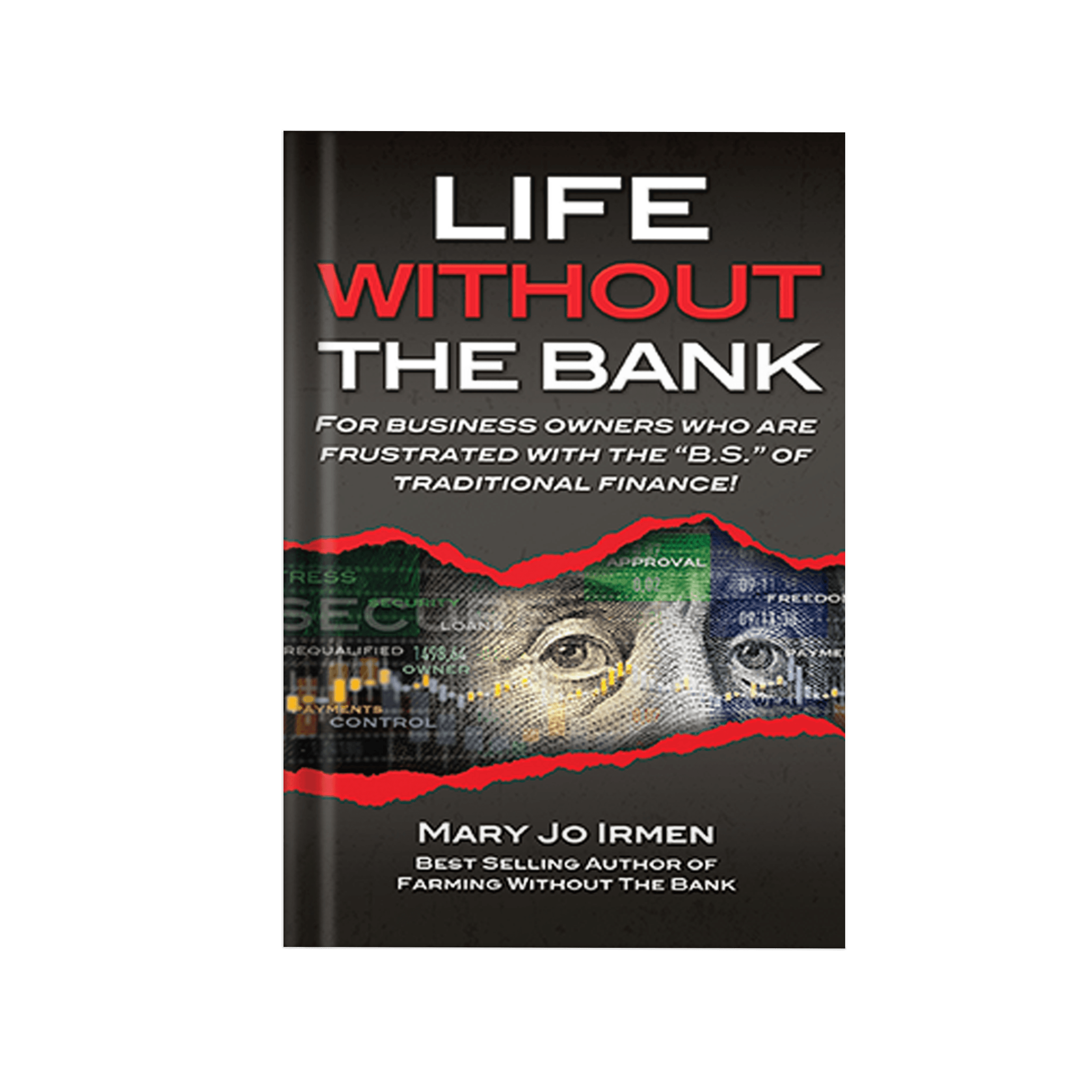
Your financial independence starts with one book.
Only one of three Americans can retire. Part of the fault is the conditioned belief that you must give up the use of your money when you’re young so you can have it later, assuming the stock market doesn’t collapse.