Podcast
EP. 241
Hard Times Built Infinite Banking — Here’s the Lesson You’re Missing (Ep. 241)
Oct 30, 2025 ·
21 min
0:00 / 20:32
EPISODE OVERVIEW
ABOUT THIS EPISODE
Starting an IBC policy when everything feels worst? That’s exactly how Nelson Nash discovered Infinite Banking, when bank rates hit 23% and leverage turned on him. Here’s what he did, why it worked, and how to avoid the same traps.
We continue our study of Becoming Your Own Banker and unpack how the Infinite Banking Concept started.
Using Nelson’s forestry analogy, we break down uninterrupted compounding, the dangers of overleveraging, why policy design matters (don’t chase fast cash value if it weakens the system), and the flexibility of policy loans, especially in bad times.
We also address the costly mistake of canceling in Year 5, when policies typically begin to truly cash flow.
Key Takeaways
- Plant the tree early: Compounding takes time; interrupting it sets you back years.
- Uninterrupted over interrupted compounding: Stop resetting the curve.
- Leverage cuts both ways: Gurus rarely explain when the lever flips.
- Policy loans = control: Flexible amortization; you set the payback schedule.
- Rates context: Banks at ~23% (early ’80s) vs. policy loans at ~5–8% in Nelson’s story.
- Design matters: Don’t chase extreme 10/90 if it risks MEC and weakens the base.
- Discipline wins: You’re the banker; operate your system soundly.
- Don’t quit in Year 5: Many cancel right before policies begin to outperform.
- 👍 Like this if you want more real talk on IBC beyond the hype.
- 🔔 Subscribe & hit the bell to follow our chapter-by-chapter study.
- 💬 Questions about policy design, MEC, or using loans? Drop them in the comments.
- 📚 Studying along? Bring your copy of Becoming Your Own Banker to the next episode.
Link Mentioned
CHAPTER TIMESTAMPS
- 00:00Start when times aren't perfect (cold open)
- 00:50Intro & setup—studying "How IBC Got Started"
- 01:11Forestry analogy & (un)interrupted compounding
- 03:33What interruption really costs you
- 04:28Policy design tradeoffs (10/90, MEC risk, strong base)
- 05:07The compounding curve: the most efficient year is the last
- 06:01"Leverage your way to wealth"? What gurus don't say
- 06:57Nelson's story: 8–9.5% to 23% prime shock ('81–'82)
- 08:46Low-rate era behavior: overbuying & false confidence
- 10:19Overpaying for homes/vehicles and today's price hangover
- 12:10Leverage risk, HELOC callable, and bad timing
- 12:57Risk mitigation vs assuming good times continue
- 13:25"Find a fool?" Why selling in bad times fails
- 14:454 a.m. prayer & the realization: the money is in your policies
- 15:10Policy loans at ~5–8% vs banks at 23%: why control matters
- 16:57You set the amortization—flexibility in downturns
- 18:03"How big a check?" = How much have you put in (premiums)
- 18:51Revising spending: fund policies first, then attack debt
- 19:54Start IBC in bad times, so you're skilled in good times
- 20:53The Year 5 mistake: canceling right before cash flow
- 22:09End of Life benefit = family protection while you bank
- 22:28Discipline: be the banker or break your own bank
- 23:18Wrap-up & next chapter invite
YOUTUBE EPISODE
TRANSCRIPTION
“He revised his spending habits and he put more money into policies. So 13 years to pay off the snakes and dragons, most people would have said, I don’t have the money to do that. But Nelson put it here first. So if we’re out there waiting on, oh, we’re going to start a policy when the timing is perfect. Why not start it when it’s not perfect? Start at the worst time, because then when times get good, you know what to do with that money. You know how to move it in through the system. But if you wait until times are good, we can start a policy for you. We can start teaching you the infinite banking concept. But then when times get bad, what are you going to do? You’re going to hop out of the system.”
Hello, hello, and welcome back to the podcast. Thank you very much for being here. All right. We are going to continue with studying Becoming Your Own Banker. And we are in how the infinite banking concept got started. So grab your book, study along. Remember, you were supposed to have read it already if you listened to the last podcast. Okay. Are you ready? We’re just going to go over kind of what we have highlighted, because not every paragraph in this chapter needs to be talked about.
So the first thing that I think is important is how Nelson talks about studying forestry like he was studying finance. And the fact that you’re dealing with compound interest over a long period of time with no taxation on the buildup. The reverse fact is that you must make an investment or you won’t see any results for that same long period. So, again, got to plant a tree and you got to wait for the tree to grow. And it’s going to take years and years and years for that tree to grow. Once the tree grows, you’re like, oh, geez, I’m glad I planted the tree. But a lot of people aren’t even going to plant trees because it’s not going to grow fast enough. Because it’s going to take time. Right.
And then you’ve got the uninterrupted compound interest of that. Like Nelson talks about compound interest, but he doesn’t ever talk about uninterrupted compound interest. And I think that that’s super important because you’re not interrupting it. If you’re going to interrupt interest, it’s going to hurt you. And we’ll go over that at some point, just so we can see what the difference between interrupted and uninterrupted compound interest is. But when you start here and you grow to here and you interrupt it, you come back down and then you go back up and then you come back down.
And with a tree, it’s very similar. If you cut the top of the tree off, it’s going to have to start growing again. You’ve hurt that tree. And we’re all like, oh, man, a storm came through and broke down our trees. Now we don’t have as many trees. Now we’re going to have to start over with a new tree and wait for that compound interest. How many years did that set us back because we interrupted? And that’s what we’re doing with investments is we’re putting our money in and we’re interrupting them. And so it seems silly that Nelson is talking about forestry. He loves his analogies. He does. It seems funny that we’re talking about forestry when we’re talking about money, but it very much is the same thing. It’s similar.
And we have trees around our place that are fast growing trees. And it’s funny because they’re weak. And so really, if you look at a lot of people are trying to do 10/90 policy and they’re trying to do a policy that has all this cash value. It’s a good policy, but it could be weak in the fact that it’s going to MEC. And then we don’t have the base to pay. We don’t have the dividends that are going to be larger. So do we want fast right away? And then we can plant a slower growing one that’s strong. Can we combine those two? Can we build a tree row that has those two things? And so we have this system of policies. I don’t think that there’s one perfect way to design a policy because it really determines the needs of the client. But there’s always a stronger way than a faster way. But ultimately, all of those trees have a lifespan. And they’re going to compound and they’re going to benefit. And that policy is going to benefit the longer we have it.
I like to show clients that when I meet with them. I like to go to the 25-year mark and then I’ll go back to like 50 or whenever they’re 85. So we barely doubled your money in the first 25 years. And then in the next 25 years, it probably tripled or quadrupled, which is crazy.
Well, it’s like the compounding curve, right?
Yeah.
The longer you have it, the more that line just starts to go straight up.
Right.
You know, so it’s like the most efficient year of the contract is the last year.
So don’t interrupt your money. I like Nelson’s analogies. I know for some people it’s a little like up here, but it was for me right away.
Yeah. I don’t know why trees and airplanes matter. It took me a little bit to get there, but I got…
Oh. He talks about the industry says, go to the bank, borrow money, leverage your money to go buy real estate. Because you either pay interest to somebody else or you lose interest on your money, which is what we also talked about from the key points. But he says, so the gurus say, borrow the bank’s money, leverage your dollar, go buy some real estate, and it’s all good. This is all true as long as things are going the way the financial gurus describe. But they never tell you what happens when the lever goes the other way. Never. Why does Nelson bring this up? That’s what happened to him.
Yes.
So if you keep reading, like a lot of people miss this in this book. The reason the infinite banking concept even exists is because he got caught with his pants down. And in 77, I think it was, he says there was no logical reason not to expand his real estate empire. Interest rates were 8%. That was prime. But you must pay one and a half over prime. Banks are not lending you money because you have real estate. They are doing it because they think you can make a payment. They don’t want your real estate. They don’t want the asset. They want the cash flow. Because the payment back to them is cash flow so they can what?
Resell it.
Yes. 10 times resell it. He said, I got accustomed to pay nine and a half and that was just normal. And then along came 81 and 82 and the prime rate rose and peaked at 21 and a half. And that was prime. And so he was paying one and a half over that. So he was paying 23% interest on a half a million dollars. That’s $67,000 of interest a year that I was not expecting to pay. And I think that one thing that he does not talk about in here, and I wish that he would have, he had a business partner that defaulted on his portion of the loan. So Nelson actually inherited another $300,000 at 23%.
Wow.
And so when we look at, we’ve had it really good with low interest rates. But this is proof that that can happen. And it just happened a couple of years ago again. We had this massive low interest rate environment, which should never happen. It’s great as a purchaser of things, but it is not good for investment. But we had this low interest rate environment and we couldn’t afford not to buy things and do things.
You’re silly, Tarisa. Go invest in real estate. Buy as much real estate as you can at 2% and 3%. You’re absolutely crazy not to leverage your dollar with the bank.
I did it, but I didn’t get to the point where I was so leveraged that I am having to sell things because interest rates went up.
Well, it’s interesting because people will use whatever reason they need to to justify their overspending. Right? It’s like we were talking about this in that time when interest rates were low, people still bought too much house. So there’s a lot of foreclosures or short sales coming up on the market because it’s like even if you can sustain that payment, if you can’t afford what it costs to fix that same home.
The other thing with leveraging, and I don’t have, I’ve never researched it to back this up, but I think it’s common sense and I will hear from you guys. You tell me. So the interest rates were 2%, 3%, 4%. So when people went out to buy a house, they were overpaying by $20,000, $30,000. So what happens with a low interest rate environment is we actually raise the price of homes. So we kind of cause our own housing issues. By raising the price of homes, we’re willing to pay more for a vehicle. We kind of did ourself in by saying, well, I can still afford that payment. So I’m not going to really worry about it. Should have we been more conservative and said, I’m not paying $100,000 for a vehicle. I’m not overpaying for that house.
Because now when interest rates are higher, we’re still having to pay that same baseline for the house. Interest rates went up. Our sellers want the same for the house. The buyers can’t afford the payment. And so now we’re stuck at this impasse. And the housing prices either have to come down or they’re going to stabilize where they shouldn’t even be really. Still, in today’s environment, they should not be where they’re at.
And so when we leverage ourselves too much, and I think we’re seeing it now. I have a couple of people on social media that I follow. And there was a mortgage officer that said he had forward bankruptcies for homes in the last month in Texas. And he’s like, we’re starting to see them. Because what happened is interest rates stayed the same. They overpaid for the house. So they went because interest rates were low, right? They were like, oh, I can always refinance or the economy is good or whatever. We’re good today. But we did not expect the inflation. We didn’t expect gas prices to go up, groceries to go up. Everything is going up to the point where we didn’t have a fudge factor built in what we purchased.
And so it doesn’t matter if it’s land. It doesn’t matter if it’s your business. If we are using the bank to leverage, the bank has the ultimate control of what they’re going to do with those interest rates. And if we lock it in, great, fantastic. But like we talked about earlier and in the last podcast, the HELOC is not set. They can call that. And so then what? Then we have to sell. Not an environment to sell. Nothing happens at the best time. Unless you’re really lucky and you know you have insider information, nothing is going to happen at the best time.
Right. You know? It’s like the whole saying, like everything’s perfect until it isn’t.
Yeah.
You know? And it’s like easy to be successful when all the factors are lining up for you. But how can you still mitigate risk when things aren’t going so well? And I really think that that’s what does people. And sometimes it’s like they just assume that everything’s going to continue the way it has been. And that’s just not.
Right. And they over leverage because of that, which is what Nelson did. And so I’m not over leveraging because I’m using Nelson’s experience as a teaching lesson for me. I don’t want to learn that myself. No, thank you.
So at this point in this chapter, Nelson is talking about what happened. But then comes the solution. He said the solution is to sell. Where do you find a fool that will buy it under those circumstances? Meaning, who’s the fool to buy the land at 23% interest? He would have to basically give it away, which is the same situation we’re in now. Who’s going to buy that house what you paid for it? Nobody. Who’s going to buy that land? Nobody. And Nelson had land that was developable.
Then he goes on to talk about he stood owing $500,000 under the circumstances, which was actually $800,000. When a number of bad things happen, this occurs in a fairly rapid succession. It can increase the quality of your prayer life. So before this, Nelson was talking about how their house got robbed and how his brother died at 52. Granddaughter was born. She had cancer and interest rates went up. Four things. And most people would fold. This is where we determine who is made. Who’s, how are you made? Right?
And he said, he was at four o’clock in the morning. He was kneeling in prayer. Lord, please show me a way out of this financial nightmare that I have created for myself. And he said that the answer came back. You are standing in the midst of everything it takes to get you out, but you don’t see it because you look at things like everyone else. You can get the money during these awful times at five to eight percent from three different life insurance policies. The only thing that limits how much you can get is the same thing they tell you at the bank when you ask them how big the check you can write. How much have you put in? This is so powerful. There’s like three sentences.
So good. Of so many answers.
Yeah, this is one of my favorites. Like the whole part where he’s saying you don’t see it because you look at things like everyone else. Like if that doesn’t encourage you to not look at things like everyone else, I don’t know what I will. You know, it’s like let’s challenge our thinking because everything we do in the financial world is comparative to what everyone else is doing. And what everyone else is doing is not effective is essentially what he’s saying.
Because he was doing what everybody else was doing. He was doing what all the wealthy people were doing. He was doing what all the gurus told him to do. I like the part where he says you can get to your money during these awful times at five to eight percent. So people will always ask us, well, how high can it go? How high can the interest rate be that the insurance company is charging you? Well, if interest rates were 23 percent and the life insurance companies were charging five to eight percent, in today’s environment, I’ve never seen it over 5.86. So will they ever charge over eight? I don’t know. And let’s say that they do. Let’s say that the interest rates do go to 15 percent. Would I rather have a 15 percent loan at the bank or a 15 percent loan in my policy?
Well, because let’s talk about the difference here because it’s helpful for people. With your policy loan, who gets to make the amortization schedule?
You do.
So you’re not going to have anyone breathing down your neck like, hey, Mary Jo, where’s my payment this month?
Right. Who’s in control? If you have to skip that payment, you can skip that payment in bad times. And so if I’m a business owner and I’m saying, hey, times have gotten really, really bad and I can’t make that payment to my life insurance policy because my business was shut down or people quit buying or the economy, blah, blah, blah. Then just don’t make the policy payment.
The loan repayment.
Right. Let me clarify. Just don’t make the loan repayment. Make interest only, but it’s okay. You can adjust that payment whenever you want. And so Nelson did just that. But five to eight percent. I know a lot of people miss that. Even people that have read this book several times that are clients have missed that because they come in and ask that question. How high can the interest go? How high did it go in the 80s? Five to eight percent.
Well, and the other part that I love here, because again, this I think challenges how people think about this concept. The only thing that limits how much you can get to is the same thing they tell you at the bank when you ask them how big of a check you can write. How much have you put in?
And then he goes on to say in the next paragraph, he said, if I had not been accustomed to paying very large premiums, it is doubtful that I would have seen the message. Hardship often helps us to see the things to be in the next step. How could I do both? I could revise my spending pattern. Particularly, everyone thought I was crazy. It was opposite to what the experts said. But an objective look at the facts of how life insurance worked, plus reason and logic, and continued sessions of intense prayer for guidance has proved that the system works.
And so he revised his spending habits and he put more money into policies first.
Yes.
Before he used it for what he was going to pay for.
Yes, because what he did, he doesn’t talk about it in here, but he always talked about it in his presentation. Is he paid premium and then he borrowed against it and paid down or paid off the snakes and dragons. Right. So when he was done paying them, which I think he took him 13 years, if I remember correctly. I think that’s what it’s in the book.
Yeah.
Yeah. So 13 years to pay off the snakes and dragons. Most people would have said, I don’t have the money to do that. But Nelson put it here first. So if we’re out there waiting on, oh, we’re going to start a policy when the timing is perfect. Why not start it when it’s not perfect? Start at the worst time. Because then when times get good, you know what to do with that money. You know how to move it in through the system. But if you wait until times are good, we can start a policy for you. We can start teaching you the infinite banking concept. But then when times get bad, what are you going to do? You’re going to hop out of the system.
And I just had a client do that last week. He was like, I know Mary Jo is not going to be happy. I’m canceling my policy because at this point we’re not using it and it feels like an expense. He was in year five. That’s when it starts to cash flow.
Right.
But he chooses not to talk to me. He chooses not to talk to the conversation. I don’t know what he’s doing because you won’t have a conversation. But you literally stopped right when you capitalized the policy. That’s when the life insurance companies make money because they didn’t have a death claim. And they didn’t have to give him all his money back because he hadn’t broke even yet. And so hang in there for a few more years and then understand how to use the policy. But times got tough. So immediately they look at this as an expense instead of an avenue of how to run money through. And you can just pay it back when times are good.
Nelson said, I had continued prayer. Right. I don’t care if it’s prayer. I don’t care if it’s talking to us. I don’t greatly care what it is. But you can’t just remove yourself from that equation. And we know which ones of our clients pay attention because they are calling all the time. They’re contacting us. They know what they want because they’re constantly listening to every podcast we put out. When you have to use it.
It’s like if you don’t wear a pair of shoes all year, you’re like, oh, I don’t need these. But it’s like when you fully understand this process, you’re engaging with it constantly. You should be because it allows you to have so much more flexibility in life, in the good times and in the bad. Like you mentioned before, like it was the least ideal time for Nelson to start this process. But he did it because he figured he saw more freedom inside of it for himself and his family, which is what’s available.
He could control it. And here’s the other thing. His brother died at 52. The more money Nelson was running through the policy, if something did happen, Mary would have been taken care of. And his family would have been taken care of because he would have had the death benefit to do so.
Right.
I just have one more thing in that chapter highlighted. It requires understanding and it requires discipline to implement the idea. But it can change your life dramatically, even beyond your fondest dreams. And so I think that that also is important to understand that. And we’ve talked about it in the last couple of podcasts, that it does require discipline because you are going to be the banker. And so you have to make sure you’re honest and pay yourself back. And you have to act like the banker. You have to operate it like a successful business.
And it’s like with freedom comes the responsibilities of making sure that you can maintain that.
It’s like Nelson says, this is the best business in the world. But depending on how you operate it, it could be the worst. You could make your bank financially unsound.
Right. And that’s on you.
Absolutely. Okay. Awesome. Well, we will be back again next week with the next chapter. So if you need us, you know where to find us. maryjo@withoutthebank.com. tarisa@withoutthebank.com. Grab your books. Study along. We’re inviting you to join us. Have fun. All right. Have a good rest of your day.
View MoreHello, hello, and welcome back to the podcast. Thank you very much for being here. All right. We are going to continue with studying Becoming Your Own Banker. And we are in how the infinite banking concept got started. So grab your book, study along. Remember, you were supposed to have read it already if you listened to the last podcast. Okay. Are you ready? We’re just going to go over kind of what we have highlighted, because not every paragraph in this chapter needs to be talked about.
So the first thing that I think is important is how Nelson talks about studying forestry like he was studying finance. And the fact that you’re dealing with compound interest over a long period of time with no taxation on the buildup. The reverse fact is that you must make an investment or you won’t see any results for that same long period. So, again, got to plant a tree and you got to wait for the tree to grow. And it’s going to take years and years and years for that tree to grow. Once the tree grows, you’re like, oh, geez, I’m glad I planted the tree. But a lot of people aren’t even going to plant trees because it’s not going to grow fast enough. Because it’s going to take time. Right.
And then you’ve got the uninterrupted compound interest of that. Like Nelson talks about compound interest, but he doesn’t ever talk about uninterrupted compound interest. And I think that that’s super important because you’re not interrupting it. If you’re going to interrupt interest, it’s going to hurt you. And we’ll go over that at some point, just so we can see what the difference between interrupted and uninterrupted compound interest is. But when you start here and you grow to here and you interrupt it, you come back down and then you go back up and then you come back down.
And with a tree, it’s very similar. If you cut the top of the tree off, it’s going to have to start growing again. You’ve hurt that tree. And we’re all like, oh, man, a storm came through and broke down our trees. Now we don’t have as many trees. Now we’re going to have to start over with a new tree and wait for that compound interest. How many years did that set us back because we interrupted? And that’s what we’re doing with investments is we’re putting our money in and we’re interrupting them. And so it seems silly that Nelson is talking about forestry. He loves his analogies. He does. It seems funny that we’re talking about forestry when we’re talking about money, but it very much is the same thing. It’s similar.
And we have trees around our place that are fast growing trees. And it’s funny because they’re weak. And so really, if you look at a lot of people are trying to do 10/90 policy and they’re trying to do a policy that has all this cash value. It’s a good policy, but it could be weak in the fact that it’s going to MEC. And then we don’t have the base to pay. We don’t have the dividends that are going to be larger. So do we want fast right away? And then we can plant a slower growing one that’s strong. Can we combine those two? Can we build a tree row that has those two things? And so we have this system of policies. I don’t think that there’s one perfect way to design a policy because it really determines the needs of the client. But there’s always a stronger way than a faster way. But ultimately, all of those trees have a lifespan. And they’re going to compound and they’re going to benefit. And that policy is going to benefit the longer we have it.
I like to show clients that when I meet with them. I like to go to the 25-year mark and then I’ll go back to like 50 or whenever they’re 85. So we barely doubled your money in the first 25 years. And then in the next 25 years, it probably tripled or quadrupled, which is crazy.
Well, it’s like the compounding curve, right?
Yeah.
The longer you have it, the more that line just starts to go straight up.
Right.
You know, so it’s like the most efficient year of the contract is the last year.
So don’t interrupt your money. I like Nelson’s analogies. I know for some people it’s a little like up here, but it was for me right away.
Yeah. I don’t know why trees and airplanes matter. It took me a little bit to get there, but I got…
Oh. He talks about the industry says, go to the bank, borrow money, leverage your money to go buy real estate. Because you either pay interest to somebody else or you lose interest on your money, which is what we also talked about from the key points. But he says, so the gurus say, borrow the bank’s money, leverage your dollar, go buy some real estate, and it’s all good. This is all true as long as things are going the way the financial gurus describe. But they never tell you what happens when the lever goes the other way. Never. Why does Nelson bring this up? That’s what happened to him.
Yes.
So if you keep reading, like a lot of people miss this in this book. The reason the infinite banking concept even exists is because he got caught with his pants down. And in 77, I think it was, he says there was no logical reason not to expand his real estate empire. Interest rates were 8%. That was prime. But you must pay one and a half over prime. Banks are not lending you money because you have real estate. They are doing it because they think you can make a payment. They don’t want your real estate. They don’t want the asset. They want the cash flow. Because the payment back to them is cash flow so they can what?
Resell it.
Yes. 10 times resell it. He said, I got accustomed to pay nine and a half and that was just normal. And then along came 81 and 82 and the prime rate rose and peaked at 21 and a half. And that was prime. And so he was paying one and a half over that. So he was paying 23% interest on a half a million dollars. That’s $67,000 of interest a year that I was not expecting to pay. And I think that one thing that he does not talk about in here, and I wish that he would have, he had a business partner that defaulted on his portion of the loan. So Nelson actually inherited another $300,000 at 23%.
Wow.
And so when we look at, we’ve had it really good with low interest rates. But this is proof that that can happen. And it just happened a couple of years ago again. We had this massive low interest rate environment, which should never happen. It’s great as a purchaser of things, but it is not good for investment. But we had this low interest rate environment and we couldn’t afford not to buy things and do things.
You’re silly, Tarisa. Go invest in real estate. Buy as much real estate as you can at 2% and 3%. You’re absolutely crazy not to leverage your dollar with the bank.
I did it, but I didn’t get to the point where I was so leveraged that I am having to sell things because interest rates went up.
Well, it’s interesting because people will use whatever reason they need to to justify their overspending. Right? It’s like we were talking about this in that time when interest rates were low, people still bought too much house. So there’s a lot of foreclosures or short sales coming up on the market because it’s like even if you can sustain that payment, if you can’t afford what it costs to fix that same home.
The other thing with leveraging, and I don’t have, I’ve never researched it to back this up, but I think it’s common sense and I will hear from you guys. You tell me. So the interest rates were 2%, 3%, 4%. So when people went out to buy a house, they were overpaying by $20,000, $30,000. So what happens with a low interest rate environment is we actually raise the price of homes. So we kind of cause our own housing issues. By raising the price of homes, we’re willing to pay more for a vehicle. We kind of did ourself in by saying, well, I can still afford that payment. So I’m not going to really worry about it. Should have we been more conservative and said, I’m not paying $100,000 for a vehicle. I’m not overpaying for that house.
Because now when interest rates are higher, we’re still having to pay that same baseline for the house. Interest rates went up. Our sellers want the same for the house. The buyers can’t afford the payment. And so now we’re stuck at this impasse. And the housing prices either have to come down or they’re going to stabilize where they shouldn’t even be really. Still, in today’s environment, they should not be where they’re at.
And so when we leverage ourselves too much, and I think we’re seeing it now. I have a couple of people on social media that I follow. And there was a mortgage officer that said he had forward bankruptcies for homes in the last month in Texas. And he’s like, we’re starting to see them. Because what happened is interest rates stayed the same. They overpaid for the house. So they went because interest rates were low, right? They were like, oh, I can always refinance or the economy is good or whatever. We’re good today. But we did not expect the inflation. We didn’t expect gas prices to go up, groceries to go up. Everything is going up to the point where we didn’t have a fudge factor built in what we purchased.
And so it doesn’t matter if it’s land. It doesn’t matter if it’s your business. If we are using the bank to leverage, the bank has the ultimate control of what they’re going to do with those interest rates. And if we lock it in, great, fantastic. But like we talked about earlier and in the last podcast, the HELOC is not set. They can call that. And so then what? Then we have to sell. Not an environment to sell. Nothing happens at the best time. Unless you’re really lucky and you know you have insider information, nothing is going to happen at the best time.
Right. You know? It’s like the whole saying, like everything’s perfect until it isn’t.
Yeah.
You know? And it’s like easy to be successful when all the factors are lining up for you. But how can you still mitigate risk when things aren’t going so well? And I really think that that’s what does people. And sometimes it’s like they just assume that everything’s going to continue the way it has been. And that’s just not.
Right. And they over leverage because of that, which is what Nelson did. And so I’m not over leveraging because I’m using Nelson’s experience as a teaching lesson for me. I don’t want to learn that myself. No, thank you.
So at this point in this chapter, Nelson is talking about what happened. But then comes the solution. He said the solution is to sell. Where do you find a fool that will buy it under those circumstances? Meaning, who’s the fool to buy the land at 23% interest? He would have to basically give it away, which is the same situation we’re in now. Who’s going to buy that house what you paid for it? Nobody. Who’s going to buy that land? Nobody. And Nelson had land that was developable.
Then he goes on to talk about he stood owing $500,000 under the circumstances, which was actually $800,000. When a number of bad things happen, this occurs in a fairly rapid succession. It can increase the quality of your prayer life. So before this, Nelson was talking about how their house got robbed and how his brother died at 52. Granddaughter was born. She had cancer and interest rates went up. Four things. And most people would fold. This is where we determine who is made. Who’s, how are you made? Right?
And he said, he was at four o’clock in the morning. He was kneeling in prayer. Lord, please show me a way out of this financial nightmare that I have created for myself. And he said that the answer came back. You are standing in the midst of everything it takes to get you out, but you don’t see it because you look at things like everyone else. You can get the money during these awful times at five to eight percent from three different life insurance policies. The only thing that limits how much you can get is the same thing they tell you at the bank when you ask them how big the check you can write. How much have you put in? This is so powerful. There’s like three sentences.
So good. Of so many answers.
Yeah, this is one of my favorites. Like the whole part where he’s saying you don’t see it because you look at things like everyone else. Like if that doesn’t encourage you to not look at things like everyone else, I don’t know what I will. You know, it’s like let’s challenge our thinking because everything we do in the financial world is comparative to what everyone else is doing. And what everyone else is doing is not effective is essentially what he’s saying.
Because he was doing what everybody else was doing. He was doing what all the wealthy people were doing. He was doing what all the gurus told him to do. I like the part where he says you can get to your money during these awful times at five to eight percent. So people will always ask us, well, how high can it go? How high can the interest rate be that the insurance company is charging you? Well, if interest rates were 23 percent and the life insurance companies were charging five to eight percent, in today’s environment, I’ve never seen it over 5.86. So will they ever charge over eight? I don’t know. And let’s say that they do. Let’s say that the interest rates do go to 15 percent. Would I rather have a 15 percent loan at the bank or a 15 percent loan in my policy?
Well, because let’s talk about the difference here because it’s helpful for people. With your policy loan, who gets to make the amortization schedule?
You do.
So you’re not going to have anyone breathing down your neck like, hey, Mary Jo, where’s my payment this month?
Right. Who’s in control? If you have to skip that payment, you can skip that payment in bad times. And so if I’m a business owner and I’m saying, hey, times have gotten really, really bad and I can’t make that payment to my life insurance policy because my business was shut down or people quit buying or the economy, blah, blah, blah. Then just don’t make the policy payment.
The loan repayment.
Right. Let me clarify. Just don’t make the loan repayment. Make interest only, but it’s okay. You can adjust that payment whenever you want. And so Nelson did just that. But five to eight percent. I know a lot of people miss that. Even people that have read this book several times that are clients have missed that because they come in and ask that question. How high can the interest go? How high did it go in the 80s? Five to eight percent.
Well, and the other part that I love here, because again, this I think challenges how people think about this concept. The only thing that limits how much you can get to is the same thing they tell you at the bank when you ask them how big of a check you can write. How much have you put in?
And then he goes on to say in the next paragraph, he said, if I had not been accustomed to paying very large premiums, it is doubtful that I would have seen the message. Hardship often helps us to see the things to be in the next step. How could I do both? I could revise my spending pattern. Particularly, everyone thought I was crazy. It was opposite to what the experts said. But an objective look at the facts of how life insurance worked, plus reason and logic, and continued sessions of intense prayer for guidance has proved that the system works.
And so he revised his spending habits and he put more money into policies first.
Yes.
Before he used it for what he was going to pay for.
Yes, because what he did, he doesn’t talk about it in here, but he always talked about it in his presentation. Is he paid premium and then he borrowed against it and paid down or paid off the snakes and dragons. Right. So when he was done paying them, which I think he took him 13 years, if I remember correctly. I think that’s what it’s in the book.
Yeah.
Yeah. So 13 years to pay off the snakes and dragons. Most people would have said, I don’t have the money to do that. But Nelson put it here first. So if we’re out there waiting on, oh, we’re going to start a policy when the timing is perfect. Why not start it when it’s not perfect? Start at the worst time. Because then when times get good, you know what to do with that money. You know how to move it in through the system. But if you wait until times are good, we can start a policy for you. We can start teaching you the infinite banking concept. But then when times get bad, what are you going to do? You’re going to hop out of the system.
And I just had a client do that last week. He was like, I know Mary Jo is not going to be happy. I’m canceling my policy because at this point we’re not using it and it feels like an expense. He was in year five. That’s when it starts to cash flow.
Right.
But he chooses not to talk to me. He chooses not to talk to the conversation. I don’t know what he’s doing because you won’t have a conversation. But you literally stopped right when you capitalized the policy. That’s when the life insurance companies make money because they didn’t have a death claim. And they didn’t have to give him all his money back because he hadn’t broke even yet. And so hang in there for a few more years and then understand how to use the policy. But times got tough. So immediately they look at this as an expense instead of an avenue of how to run money through. And you can just pay it back when times are good.
Nelson said, I had continued prayer. Right. I don’t care if it’s prayer. I don’t care if it’s talking to us. I don’t greatly care what it is. But you can’t just remove yourself from that equation. And we know which ones of our clients pay attention because they are calling all the time. They’re contacting us. They know what they want because they’re constantly listening to every podcast we put out. When you have to use it.
It’s like if you don’t wear a pair of shoes all year, you’re like, oh, I don’t need these. But it’s like when you fully understand this process, you’re engaging with it constantly. You should be because it allows you to have so much more flexibility in life, in the good times and in the bad. Like you mentioned before, like it was the least ideal time for Nelson to start this process. But he did it because he figured he saw more freedom inside of it for himself and his family, which is what’s available.
He could control it. And here’s the other thing. His brother died at 52. The more money Nelson was running through the policy, if something did happen, Mary would have been taken care of. And his family would have been taken care of because he would have had the death benefit to do so.
Right.
I just have one more thing in that chapter highlighted. It requires understanding and it requires discipline to implement the idea. But it can change your life dramatically, even beyond your fondest dreams. And so I think that that also is important to understand that. And we’ve talked about it in the last couple of podcasts, that it does require discipline because you are going to be the banker. And so you have to make sure you’re honest and pay yourself back. And you have to act like the banker. You have to operate it like a successful business.
And it’s like with freedom comes the responsibilities of making sure that you can maintain that.
It’s like Nelson says, this is the best business in the world. But depending on how you operate it, it could be the worst. You could make your bank financially unsound.
Right. And that’s on you.
Absolutely. Okay. Awesome. Well, we will be back again next week with the next chapter. So if you need us, you know where to find us. maryjo@withoutthebank.com. tarisa@withoutthebank.com. Grab your books. Study along. We’re inviting you to join us. Have fun. All right. Have a good rest of your day.



ready to start?
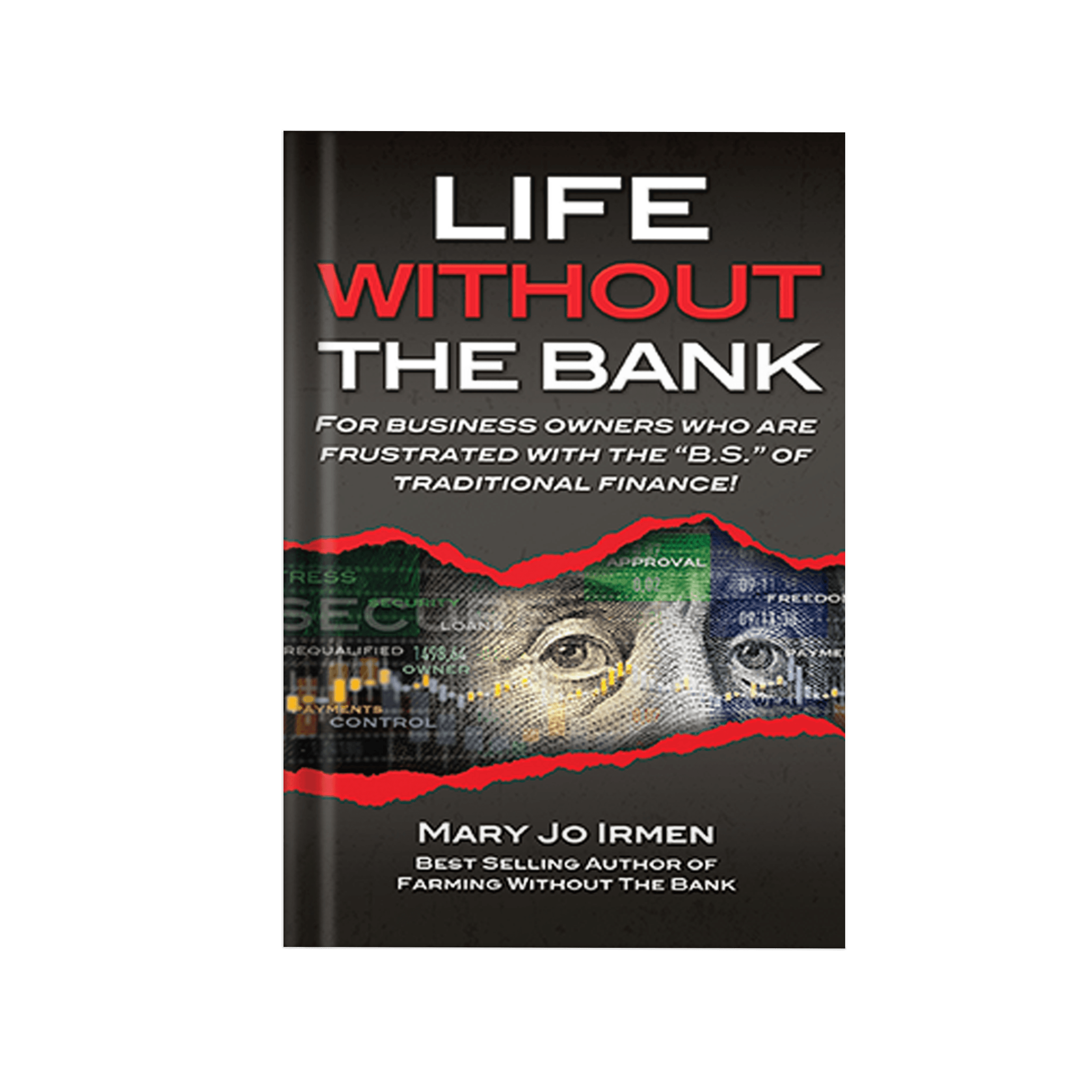
Your financial independence starts with one book.
Only one of three Americans can retire. Part of the fault is the conditioned belief that you must give up the use of your money when you’re young so you can have it later, assuming the stock market doesn’t collapse.