Podcast
EP. 274
Is Infinite Banking Too Good to Be True? Answering the Hardest IBC Questions (Ep. 274)
Jun 18, 2026 ·
15 min
0:00 / 15:02
EPISODE OVERVIEW
ABOUT THIS EPISODE
Is Infinite Banking too good to be true? We're answering the hardest IBC questions every entrepreneur asks.
In this episode of Without the Bank, Tarisa takes over the mic to tackle the most common (and controversial) questions about the Infinite Banking Concept. From "What's the rate of return?" to "Why is whole life so expensive?" and "Is my money actually safe?" — she breaks down what every business owner needs to know before starting IBC.
If you've ever wondered whether whole life insurance is worth it, how quickly you can access your cash value, or how IBC compares to keeping money in a bank, this episode has your answers.
CHAPTER TIMESTAMPS
- 00:00Intro & A Word from 80-Year-Old Tarisa
- 01:12What's the Rate of Return? It's a Formula, Not a Number
- 03:13Death Benefit vs. Cash Value Explained
- 04:08Why Is Whole Life So "Expensive"? (Term vs. Whole Life vs. IUL)
- 07:49How Long Do I Have to Pay Premiums?
- 08:45How Soon Can I Access My Cash Value?
- 09:43Is My Money Safe? Banks vs. Life Insurance Companies
- 13:51Mary Jo's Historic Milestone & Final Thoughts
YOUTUBE EPISODE
TRANSCRIPTION
"Just gonna give you guys a little, probably too much information into my brain, but I do this often. I'll have conversations with, like, 80-year-old Tarisa, and I'm like, 'Okay, wise lady, give me guidance here.' This kinda came to me the other night when I was having this conversation between my 80-year-old self and my 32-year-old self, and it was basically like, life is an adventure, and life is in the doing. Life is in the action, not in the thinking, right? So we kinda have to get out of our heads, and this is advice to myself as well, and take action on the things that we know will move the needle. And maybe it seems a little different or a little scary, but you don't get different results by doing the same thing as everyone else."
Hello, and welcome back to the podcast. I am excited to be here with you all today, and I thought it would be fun to go over some commonly asked questions, because I think it is normal when you are first getting into IBC where you're like, "How does this even work?" Or, "Is this too good to be true? What are the ins and outs? What are the pros and cons?" That's a normal thing to do when you're going through this process. So I thought, why not just go through some commonly asked questions, and we can go through this together.
Okay. So I know this one gets Mary Jo very fiery. What's the rate of return? Not only do I wanna go over these questions, but I also want to guide you guys in how to look at these questions.
So what's the rate of return? You know, Mary Jo always says it's a formula, and before I was on with Mary Jo, I kind of said the same thing that all life insurance people say, which is like, "Oh, it's a guaranteed rate of return, and this is what it is." However, she's right. It is a formula, and there is a guaranteed rate. However, it's also impacted by your health, your gender, and other things. So it's a formula, and if you're just thinking about what's the rate of return, you're kind of missing the big picture.
So let me paint this for you a little. We already kind of went over: you can have a positive rate of return and have negative dollars, essentially. We're so focused on rate of return because that's just the language that's used in the industry. It's normal, and that's okay. But the big picture of it is this is the only place that I know that you can put your money, earn a guaranteed rate, and have access to a majority of the cash value right away, so it's liquid.
You know, like if you have an annuity, that's great. It pays out for X amount of years, or however you have it set up. However, you don't have access to the full amount immediately. So life insurance is a really fantastic place to store money because you're earning on it no matter what. And even if you have a loan against it, you're not actually using your money, you're using the life insurance company's money, and you are paying them a rate of interest essentially to not interrupt the compounding of your own.
That's a big question we get all the time. What's the rate of return? And it's like, where can you put your money where you have access to the majority of it? It's growing uninterrupted compounding interest. You get a dividend. You have part ownership in the company as a policyholder, which is why you get a dividend, and you can use it to go get a higher rate of return elsewhere. That's pretty fantastic.
Another question that I get, or that comes up, is: how come I don't get the death benefit and cash value? So within the policy, you are agreeing to pay a premium for a certain amount of years. Usually it's till age 121. If you're a little bit older, maybe you're getting a 10-pay or something like that. But in any case, what you're doing is you are paying for death benefit, even though we do design these policies to hold cash value.
And how the contract works is kind of like when you're paying your mortgage and every single bit goes to reduce the principal, which means you increase your equity. It's similar in your contract. Every single time you pay a premium, your death benefit goes up, and so does your, quote-unquote, "equity" in the contract — your cash value. So it's kind of one and the same, is how to look at that. So when you're selling your house, you don't get the cash and the equity because they are the same thing, and your life insurance contract works similar to that. So every single time you pay a premium, you're increasing your equity in the contract.
Next question is, why is whole life so expensive? This is also one of my favorites. And if you're comparing it to, like, term insurance versus whole life insurance, it will seem pricier, and here's why. With term insurance — unless it's, like, convertible term, like maybe it's just until age 65 or whatever the case may be — you are essentially renting. You are renting a death benefit, and the company is banking on you to pass after that expiration date, meaning they don't really have to pay out the death benefit. And these companies have all of the actuarial data to say, "Hey, if this is your health currently, this is probably when you're going to die."
A lot of term insurance policies do not pay out. So when people are like, "Oh, whole life is so expensive," I'm like, "Compared to what?" Compared to term? Sure, but you're renting, right? It's like, okay, well, if you're paying more for a mortgage versus renting a house, well, you're paying for the cost of ownership, essentially.
Whereas in whole life insurance, yes, it's technically more expensive. However, it's because it's a better product. It's guaranteed to pay out. It has guaranteed growth. Income tax-free death benefit. It doesn't expire past age 65 or whatever. Basically, you're paying for the guarantee that your family is going to be taken care of, that they're not going to have to worry about how to pay the bills after you're gone.
So this is a really good way to understand that you're paying for something that's quality. You know, sometimes I think it's important to know what you're spending your money on and asking yourself: is it giving you the result that you want? Is it giving you the quality of life that you want? Is it giving you the peace of mind that you want? And whole life insurance for me has really given me so much peace of mind, knowing that my money is not at risk in the market and that I can use it to invest in other things.
And the other point to this is, like, why is whole life so expensive? If you compare it to, like, IUL or UL or VUL, whatever the case may be — if you're comparing it to those products, the cost of insurance is not guaranteed. Yes, you have cash value in those products; however, the company can always pull a lever and say, "Hey, we didn't do as great as a company as we thought we were going to, and so we're going to have to increase premiums on these products."
And so what does that mean as you get older? Well, it means that you could have a notice in the mail saying, "Hey, Bob, you have to pay $5,000 more in order to keep the same amount of death benefit," if that is important to you. And typically, those letters come at a time where it's not favorable. It's not favorable to receive that letter when you already are retired and maybe on a fixed income.
Just something to consider. And I remember I sat down with a friend, and her whole family had started with these policies. And I was like, "If you look at the guaranteed side of the contract, what you'll notice is the cash value goes to zero, and so does the death benefit. So what that means is this policy has effectively lapsed at this age." She was shocked. She was like, "If we would have known this, my..." You know, because her mom had signed her up. She's like, "We never would have signed up for this." And I think a lot of people have that same sentiment. It's like, "Okay, well, what are we paying money for?"
And in those products, it's similar to a term insurance. Maybe not as expensive compared to whole life, but what you're paying for in quality is less, in my personal humble opinion, which is why I don't sell that product. I don't want anyone calling me upset at the end of the day.
Let's move on to this next question. How long do I have to pay premium? And I think the better question is, how long do I get to pay? Because once you get these contracts out 20 years, 30 years, whatever you're paying is typically doubling at that time. So if you have a $20,000 policy and you pay $20,000, then it grows by 40. So it's like, if you have an asset that is spitting off that kind of money with no risk associated with it, why would you object to putting more money into it?
And Nelson says that a lot in his book. You know, it's like, if you knew that you could get everything back that you had put in and more, why would you ever object to putting more money in it? And I think that is a really great question, and it just means that we have to reframe our thinking. If I know that I can get more money out of paying my premium, then I should be excited to pay my premium. And if you're looking at it as an expense — yes, it is technically an expense. You have to plan for it. It is money that is coming out of your pocket, absolutely. And you have access to a majority of the cash value right up front.
So that's another question that comes up a lot: "Well, how soon do I have access to my money?" And the answer is, well, seven to 10 business days. If you have paid your premium and it has registered at the life insurance company, then you have that money right away, so you can take a loan against it pretty quickly — especially if you have your direct deposit form on file, which I would recommend if anyone has recently got it started, to make sure that you have that on file so that when you do go and take your policy loan, you already have that set up for you.
My best friend has a policy, and she took a loan against hers, and she was like, "Tarisa, I haven't received my money yet." And I was like, "Did you send in a direct deposit form?" She's like, "Oh, no." I was like, "Well, it's probably in your mail." And it was. So if you don't have that on file, you just get it in your mail.
And then the other question is, like, "Is my money safe?" And I think this is a very good question to ask, and the answer is yes, absolutely, and I would even argue safer than where you keep it at the bank, and here is why. Banks operate on a fractional reserve model. So that means for every dollar you have deposited, they can legally loan out 10x that. So if you have $10,000 in the bank, they can loan out $100,000 for every $10,000 in deposits they have. They're just basically creating money out of thin air, legally. If we did that, we would go to jail. So I would not recommend doing that — that could be probably serious jail time, or prison.
Okay. So that is how banks work. However, life insurance companies are held to a higher standard because they are in business for hundreds and hundreds of years, and we want them to be. So they have to operate on a more financially sound model. So for every dollar you deposit, they legally have to have a dollar to back it up, meaning they have to make sure that they can make their policyholders whole if they need to and pay the death benefits. That's really important.
And this came up in one of my client meetings. You know, they went like, "Well, what if the life insurance company goes under?" And I'm like, "Oh, man. You'd probably be better off to ask, what if the bank goes under?" But let's get into this question. If the life insurance company goes under, what happens before then typically is they get bought out by a larger company. And if that doesn't happen, then you have a guarantee by the state that you're in to make sure that they can satisfy what your policy is guaranteeing. Because they want to make sure that people know that life insurance is safe and that it's a good place to put money.
And this brings me to — I remember I was traveling Europe. I did a study abroad trip. I tried to do a solo trip by myself, and I think I was, like, 19 at the time. And my mom was like, "No, you should go." So my boyfriend went with me, which I wasn't super happy about at the time. And so I remember thinking, like, "When I go back to Europe, I'm going by myself." And so I did. I did do a solo trip in 2016, I think, maybe a couple years later.
It was kind of at the time when Greece's economy had gone under. All of these people were going to the bank to pull out their money, and essentially what the bank does, they just shut their doors. So all these people are trying to get their deposits out, but because their economy was not great and they knew that there was gonna be a run on the bank, they just shut their doors.
So I'm not saying that's what would happen here. However, it just kinda goes to show who actually has control over the money. Whereas a life insurance company — you just borrow against it. Doesn't matter what type of economic time we're in, and you get your policy loan money very quickly.
So I would say yes, your money is safe. I would say it's safer in your life insurance policy than it is in a bank. And we talk about this all the time, but you're getting a guarantee. It is guaranteed to be there for you. It is a guaranteed product, which is amazing. And even if it doesn't have the highest rate of return, it gives you so many other benefits that a lot of products just cannot.
Those are some of the commonly asked questions that I wanted to go over with you all today.
Before I go, I really wanna give a shout-out to Mary Jo, because she is amazing, and we just got back from Puerto Rico celebrating her. She is the number one producer and the first woman ever to do that on the independent life insurance side. So if you love Mary Jo and love listening to her, please send her a congratulations email, because, you know, we have to toot her horn.
She's so cool, and she really loves helping everybody here and is just such an inspiration — especially for me as a woman in the industry. You know, getting to know her when I was really young has been really instrumental just in my career trajectory. So give her a little shout-out if you have some time. Just say, "Congrats, Mary Jo."
Yeah, it was really nice to take some time and hang out. I got to meet her daughter, who is also amazing, and then her husband, Scott. He's funny — he's very quiet. So my husband was busy trying to make him laugh. So we had a good time. A little random story for you.
I will end this by saying: if you have a question that you want me to go over, or if you have, like, a hesitation — it's like, okay. Like for me, I know I'm a very analytical person, so I have to ask myself the question: what information do I need to know in order to move forward?
I'm just gonna give you guys a little, probably too much information into my brain, but I do this often. I'll have conversations with, like, 80-year-old Tarisa, and I'm like, "Okay, wise lady, give me guidance here." And this kinda came to me the other night when I was having this conversation between my 80-year-old self and — how old am I now? — my 32-year-old self, and it was basically like, life is an adventure, and life is in the doing. Life is in the action, not in the thinking, right? So we kinda have to get out of our heads, and this is advice to myself as well, and take action on the things that we know will move the needle. And maybe it seems a little different or a little scary, but you don't get different results by doing the same thing as everyone else.
So email me what questions you have. Book an appointment, read the book, answer that question for yourself: what information do I need to know in order to move forward? So that you can get started on this really exciting journey of infinite banking.
All right. That is all I have for you today. And I hope you guys have an amazing rest of your week. All right. Bye.
View MoreHello, and welcome back to the podcast. I am excited to be here with you all today, and I thought it would be fun to go over some commonly asked questions, because I think it is normal when you are first getting into IBC where you're like, "How does this even work?" Or, "Is this too good to be true? What are the ins and outs? What are the pros and cons?" That's a normal thing to do when you're going through this process. So I thought, why not just go through some commonly asked questions, and we can go through this together.
Okay. So I know this one gets Mary Jo very fiery. What's the rate of return? Not only do I wanna go over these questions, but I also want to guide you guys in how to look at these questions.
So what's the rate of return? You know, Mary Jo always says it's a formula, and before I was on with Mary Jo, I kind of said the same thing that all life insurance people say, which is like, "Oh, it's a guaranteed rate of return, and this is what it is." However, she's right. It is a formula, and there is a guaranteed rate. However, it's also impacted by your health, your gender, and other things. So it's a formula, and if you're just thinking about what's the rate of return, you're kind of missing the big picture.
So let me paint this for you a little. We already kind of went over: you can have a positive rate of return and have negative dollars, essentially. We're so focused on rate of return because that's just the language that's used in the industry. It's normal, and that's okay. But the big picture of it is this is the only place that I know that you can put your money, earn a guaranteed rate, and have access to a majority of the cash value right away, so it's liquid.
You know, like if you have an annuity, that's great. It pays out for X amount of years, or however you have it set up. However, you don't have access to the full amount immediately. So life insurance is a really fantastic place to store money because you're earning on it no matter what. And even if you have a loan against it, you're not actually using your money, you're using the life insurance company's money, and you are paying them a rate of interest essentially to not interrupt the compounding of your own.
That's a big question we get all the time. What's the rate of return? And it's like, where can you put your money where you have access to the majority of it? It's growing uninterrupted compounding interest. You get a dividend. You have part ownership in the company as a policyholder, which is why you get a dividend, and you can use it to go get a higher rate of return elsewhere. That's pretty fantastic.
Another question that I get, or that comes up, is: how come I don't get the death benefit and cash value? So within the policy, you are agreeing to pay a premium for a certain amount of years. Usually it's till age 121. If you're a little bit older, maybe you're getting a 10-pay or something like that. But in any case, what you're doing is you are paying for death benefit, even though we do design these policies to hold cash value.
And how the contract works is kind of like when you're paying your mortgage and every single bit goes to reduce the principal, which means you increase your equity. It's similar in your contract. Every single time you pay a premium, your death benefit goes up, and so does your, quote-unquote, "equity" in the contract — your cash value. So it's kind of one and the same, is how to look at that. So when you're selling your house, you don't get the cash and the equity because they are the same thing, and your life insurance contract works similar to that. So every single time you pay a premium, you're increasing your equity in the contract.
Next question is, why is whole life so expensive? This is also one of my favorites. And if you're comparing it to, like, term insurance versus whole life insurance, it will seem pricier, and here's why. With term insurance — unless it's, like, convertible term, like maybe it's just until age 65 or whatever the case may be — you are essentially renting. You are renting a death benefit, and the company is banking on you to pass after that expiration date, meaning they don't really have to pay out the death benefit. And these companies have all of the actuarial data to say, "Hey, if this is your health currently, this is probably when you're going to die."
A lot of term insurance policies do not pay out. So when people are like, "Oh, whole life is so expensive," I'm like, "Compared to what?" Compared to term? Sure, but you're renting, right? It's like, okay, well, if you're paying more for a mortgage versus renting a house, well, you're paying for the cost of ownership, essentially.
Whereas in whole life insurance, yes, it's technically more expensive. However, it's because it's a better product. It's guaranteed to pay out. It has guaranteed growth. Income tax-free death benefit. It doesn't expire past age 65 or whatever. Basically, you're paying for the guarantee that your family is going to be taken care of, that they're not going to have to worry about how to pay the bills after you're gone.
So this is a really good way to understand that you're paying for something that's quality. You know, sometimes I think it's important to know what you're spending your money on and asking yourself: is it giving you the result that you want? Is it giving you the quality of life that you want? Is it giving you the peace of mind that you want? And whole life insurance for me has really given me so much peace of mind, knowing that my money is not at risk in the market and that I can use it to invest in other things.
And the other point to this is, like, why is whole life so expensive? If you compare it to, like, IUL or UL or VUL, whatever the case may be — if you're comparing it to those products, the cost of insurance is not guaranteed. Yes, you have cash value in those products; however, the company can always pull a lever and say, "Hey, we didn't do as great as a company as we thought we were going to, and so we're going to have to increase premiums on these products."
And so what does that mean as you get older? Well, it means that you could have a notice in the mail saying, "Hey, Bob, you have to pay $5,000 more in order to keep the same amount of death benefit," if that is important to you. And typically, those letters come at a time where it's not favorable. It's not favorable to receive that letter when you already are retired and maybe on a fixed income.
Just something to consider. And I remember I sat down with a friend, and her whole family had started with these policies. And I was like, "If you look at the guaranteed side of the contract, what you'll notice is the cash value goes to zero, and so does the death benefit. So what that means is this policy has effectively lapsed at this age." She was shocked. She was like, "If we would have known this, my..." You know, because her mom had signed her up. She's like, "We never would have signed up for this." And I think a lot of people have that same sentiment. It's like, "Okay, well, what are we paying money for?"
And in those products, it's similar to a term insurance. Maybe not as expensive compared to whole life, but what you're paying for in quality is less, in my personal humble opinion, which is why I don't sell that product. I don't want anyone calling me upset at the end of the day.
Let's move on to this next question. How long do I have to pay premium? And I think the better question is, how long do I get to pay? Because once you get these contracts out 20 years, 30 years, whatever you're paying is typically doubling at that time. So if you have a $20,000 policy and you pay $20,000, then it grows by 40. So it's like, if you have an asset that is spitting off that kind of money with no risk associated with it, why would you object to putting more money into it?
And Nelson says that a lot in his book. You know, it's like, if you knew that you could get everything back that you had put in and more, why would you ever object to putting more money in it? And I think that is a really great question, and it just means that we have to reframe our thinking. If I know that I can get more money out of paying my premium, then I should be excited to pay my premium. And if you're looking at it as an expense — yes, it is technically an expense. You have to plan for it. It is money that is coming out of your pocket, absolutely. And you have access to a majority of the cash value right up front.
So that's another question that comes up a lot: "Well, how soon do I have access to my money?" And the answer is, well, seven to 10 business days. If you have paid your premium and it has registered at the life insurance company, then you have that money right away, so you can take a loan against it pretty quickly — especially if you have your direct deposit form on file, which I would recommend if anyone has recently got it started, to make sure that you have that on file so that when you do go and take your policy loan, you already have that set up for you.
My best friend has a policy, and she took a loan against hers, and she was like, "Tarisa, I haven't received my money yet." And I was like, "Did you send in a direct deposit form?" She's like, "Oh, no." I was like, "Well, it's probably in your mail." And it was. So if you don't have that on file, you just get it in your mail.
And then the other question is, like, "Is my money safe?" And I think this is a very good question to ask, and the answer is yes, absolutely, and I would even argue safer than where you keep it at the bank, and here is why. Banks operate on a fractional reserve model. So that means for every dollar you have deposited, they can legally loan out 10x that. So if you have $10,000 in the bank, they can loan out $100,000 for every $10,000 in deposits they have. They're just basically creating money out of thin air, legally. If we did that, we would go to jail. So I would not recommend doing that — that could be probably serious jail time, or prison.
Okay. So that is how banks work. However, life insurance companies are held to a higher standard because they are in business for hundreds and hundreds of years, and we want them to be. So they have to operate on a more financially sound model. So for every dollar you deposit, they legally have to have a dollar to back it up, meaning they have to make sure that they can make their policyholders whole if they need to and pay the death benefits. That's really important.
And this came up in one of my client meetings. You know, they went like, "Well, what if the life insurance company goes under?" And I'm like, "Oh, man. You'd probably be better off to ask, what if the bank goes under?" But let's get into this question. If the life insurance company goes under, what happens before then typically is they get bought out by a larger company. And if that doesn't happen, then you have a guarantee by the state that you're in to make sure that they can satisfy what your policy is guaranteeing. Because they want to make sure that people know that life insurance is safe and that it's a good place to put money.
And this brings me to — I remember I was traveling Europe. I did a study abroad trip. I tried to do a solo trip by myself, and I think I was, like, 19 at the time. And my mom was like, "No, you should go." So my boyfriend went with me, which I wasn't super happy about at the time. And so I remember thinking, like, "When I go back to Europe, I'm going by myself." And so I did. I did do a solo trip in 2016, I think, maybe a couple years later.
It was kind of at the time when Greece's economy had gone under. All of these people were going to the bank to pull out their money, and essentially what the bank does, they just shut their doors. So all these people are trying to get their deposits out, but because their economy was not great and they knew that there was gonna be a run on the bank, they just shut their doors.
So I'm not saying that's what would happen here. However, it just kinda goes to show who actually has control over the money. Whereas a life insurance company — you just borrow against it. Doesn't matter what type of economic time we're in, and you get your policy loan money very quickly.
So I would say yes, your money is safe. I would say it's safer in your life insurance policy than it is in a bank. And we talk about this all the time, but you're getting a guarantee. It is guaranteed to be there for you. It is a guaranteed product, which is amazing. And even if it doesn't have the highest rate of return, it gives you so many other benefits that a lot of products just cannot.
Those are some of the commonly asked questions that I wanted to go over with you all today.
Before I go, I really wanna give a shout-out to Mary Jo, because she is amazing, and we just got back from Puerto Rico celebrating her. She is the number one producer and the first woman ever to do that on the independent life insurance side. So if you love Mary Jo and love listening to her, please send her a congratulations email, because, you know, we have to toot her horn.
She's so cool, and she really loves helping everybody here and is just such an inspiration — especially for me as a woman in the industry. You know, getting to know her when I was really young has been really instrumental just in my career trajectory. So give her a little shout-out if you have some time. Just say, "Congrats, Mary Jo."
Yeah, it was really nice to take some time and hang out. I got to meet her daughter, who is also amazing, and then her husband, Scott. He's funny — he's very quiet. So my husband was busy trying to make him laugh. So we had a good time. A little random story for you.
I will end this by saying: if you have a question that you want me to go over, or if you have, like, a hesitation — it's like, okay. Like for me, I know I'm a very analytical person, so I have to ask myself the question: what information do I need to know in order to move forward?
I'm just gonna give you guys a little, probably too much information into my brain, but I do this often. I'll have conversations with, like, 80-year-old Tarisa, and I'm like, "Okay, wise lady, give me guidance here." And this kinda came to me the other night when I was having this conversation between my 80-year-old self and — how old am I now? — my 32-year-old self, and it was basically like, life is an adventure, and life is in the doing. Life is in the action, not in the thinking, right? So we kinda have to get out of our heads, and this is advice to myself as well, and take action on the things that we know will move the needle. And maybe it seems a little different or a little scary, but you don't get different results by doing the same thing as everyone else.
So email me what questions you have. Book an appointment, read the book, answer that question for yourself: what information do I need to know in order to move forward? So that you can get started on this really exciting journey of infinite banking.
All right. That is all I have for you today. And I hope you guys have an amazing rest of your week. All right. Bye.



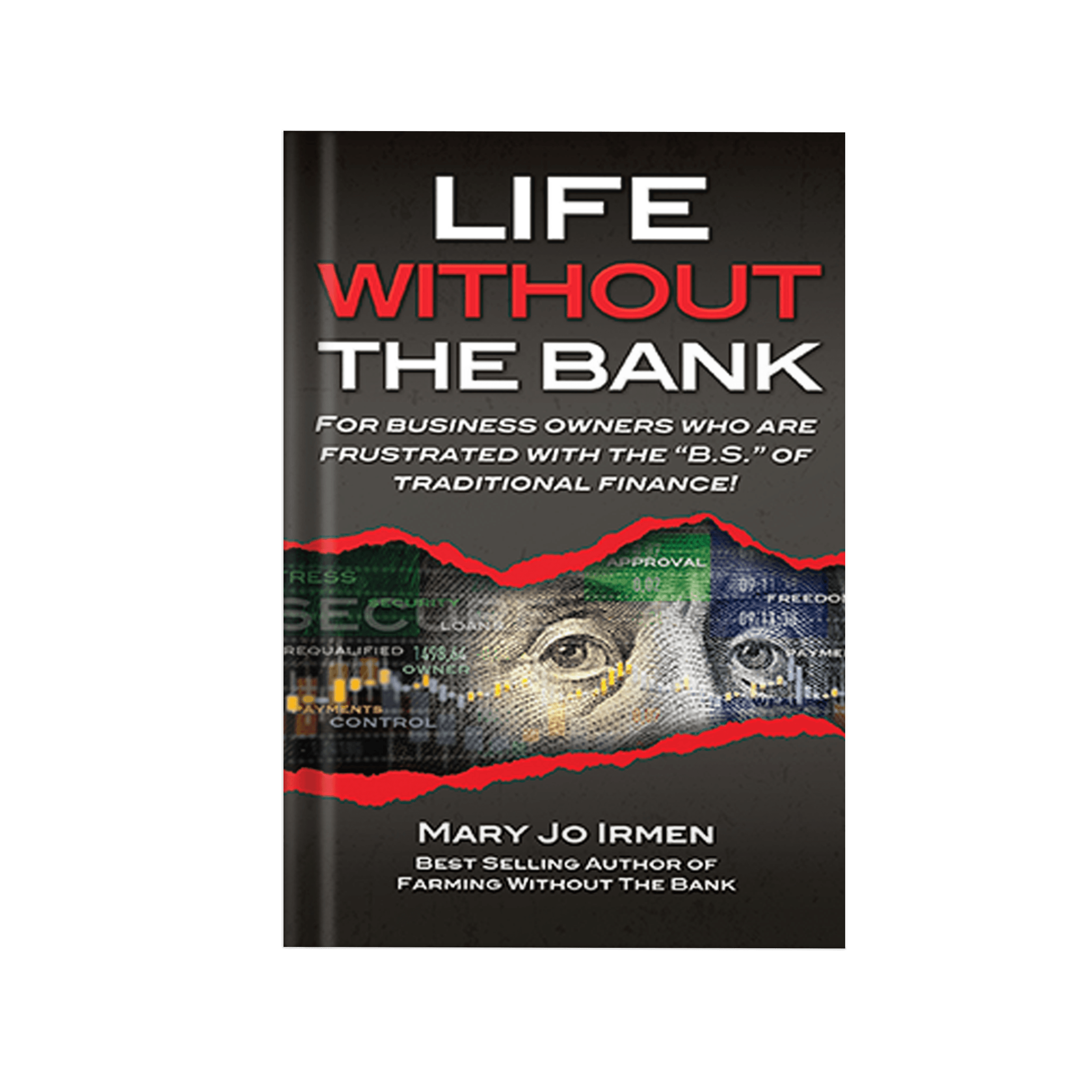
ready to start?
Your financial independence starts with one book.
Only one of three Americans can retire. Part of the fault is the conditioned belief that you must give up the use of your money when you’re young so you can have it later, assuming the stock market doesn’t collapse.