Podcast
EP. 272
It Sounds Like Free Money… But Is It? (Ep. 272)
Jun 4, 2026 ·
17 min
0:00 / 16:45
EPISODE OVERVIEW
ABOUT THIS EPISODE
Is your 401(k) employer match really free money? We break down how the match actually works and what nobody tells you.
We're diving into the critical topic of retirement planning, specifically addressing the volatility of investments like 401(k)s. If you're concerned about market dips impacting your retirement savings, we explore alternative strategies. It's about ensuring your financial planning prioritizes accessibility and security for your future and your family, considering options beyond traditional investing.
Welcome to the fifth and final installment in our 401(k) Half-Truths series. Today we're pulling back the curtain on the employer match — how it really works, what you're actually getting, and whether that "free money" is worth locking up your cash until age 59½ (or 73 for RMDs).
We Cover
- How automatic 401(k) enrollment quietly traps employees
- The real math behind employer matching (100% up to 6% isn't what you think)
- What to ask your employer instead of the 401(k) match
- The "bucket with holes" analogy — why your finances keep leaking
- The 4 bases of financial flow (home base = your policy)
- Why the match often gets eaten by management fees anyway
- Memory dividends vs. delayed life — the Die With Zero mindset
📖 Mentioned in This Episode
- Die With Zero by Bill Perkins
- Becoming Your Own Banker by Nelson Nash
CHAPTER TIMESTAMPS
- 00:00A 401k Is Not Guaranteed
- 00:50Automatic Enrollment: My Husband's Story
- 03:00Ask for the Match as a Bonus Instead
- 04:15How Employer Matching Actually Works (The Math)
- 05:45The Bucket With Holes Analogy
- 07:30Becoming an Honest Banker
- 10:14The 4 Bases of Financial Flow
- 13:30Die With Zero & Memory Dividends
- 15:15Make a Strategy Appointment
YOUTUBE EPISODE
TRANSCRIPTION
"And a 401(k) is just not guaranteed. It's not guaranteed, and I can't imagine having worked that hard and putting all that money aside just to have it go down by thirty percent or forty percent from a market dip. I think if you can't afford to lose whatever you have saved for retirement, then maybe you should consider putting it in a policy or in cash. It's just something that's accessible to you and your family."
Hello, welcome back to the Without the Bank Podcast. Today we are going over the fifth and final series of the 401(k) half-truths. So today, y'all, we are going to have some fun and learn about how the employer match really works so that you guys can have more information about it.
So I first wanna start out with: this didn't always used to be the case, and I think it's really interesting that now it is — people are automatically enrolled in their 401(k). The company that my husband works for got bought out by a larger one, so they essentially switched payroll and all sorts of things, benefits. Part of that was he was automatically enrolled in a 401(k), so you had to elect to not participate, and he didn't select whatever box he needed to, I guess.
And essentially he was like, "Oh, I have to cancel my 401(k)." We were having this conversation and I was like, "Did you enroll in it?" He's like, "Well, you're automatically enrolled." And because I've never had a 401(k), I just was surprised by that. So essentially he decided not to enroll, and then we got our $50 check back so we could put it in our policy.
And then the other story I have about this is when I got hired on as a production manager for an animation studio in DC — this was way back when. I mean, I'm not that old, but the years go by so fast. But in any case, when I got hired on, they offered a 401(k), and I remember just thinking, "Well, I already know I'm going to start this policy," 'cause at the time I hadn't started my first policy yet. And so I was like, "I'm curious if instead of contributing to the 401(k), if they would just give me that money as a bonus," because either way they could write it off.
So essentially I asked him — I was counter-offering — like, "This is what I would like for a salary, and instead of 401(k), I would like for you to bonus me that money so that I can do with it what I want." And he's like, "Yeah, sure, no problem." And that was the conversation. So if you're on the fence, or you're wanting to have your employer still give you that employer match, so to speak, it doesn't hurt to ask. You never know what they're gonna say. In my case it worked out, and maybe it will for you too.
Okay. Let's get into the match. So if you're contributing the maximum amount, your employer will typically match up to a certain percentage of your salary, usually up to six percent. So if your salary is a hundred thousand just for easy math, and you're contributing six thousand, your employer could match six thousand. Or if they do a fifty percent match, then they would contribute three thousand. So the rest of the money that is past the match obviously is up to your own individual contributions and/or growth in your 401(k) that you're electing to use for retirement.
So a lot of people feel like, "Okay, well, I don't wanna give up my employer match." And maybe they're open to giving you that money either way, you know, as a bonus. Then some people just reduce it down to the match, so then they're not losing out on that money that they're getting from their employer, and they're freeing up some cash that they have to put to work now in a place that's accessible — whether it's investing in yourself, maybe it's buying a business, maybe it's buying a property, whatever kind of floats your boat, whatever you're interested in.
But that's essentially how the match works. And like I said, I'm currently out of a 401(k), so I was kind of surprised when I was going through the math with you guys. One, how much the management fees end up eating the match anyways, depending on what your management fees are. And then I was also kind of surprised that it's — yes, it is definitely more than zero, the amount that they're matching. For whatever reason, I just thought it was going to be more than what it was.
If you didn't know how the match works, that's how it works. They just match up to a certain percentage. Sometimes it's a hundred percent up to six percent, and sometimes it's fifty, and each plan is different. So that's why I really encourage you all, if you are contributing to that sort of plan, to find out the details, because everyone's different. There's nuances to each plan, and that way you can have more information.
So this also begs the question: let's say you were to reduce your contribution down to the match. What would happen then? I would say you would have to have a plan of where to put that money to work. Because again, I have seen some people that stop contributing to their 401(k) that don't have good money habits. I don't think that that's a good idea. If you don't have good money habits, just keep with the 401(k) — like, it's fine.
But if you are someone that's more intentional and disciplined about where you're going in life and what you want your money to do for you, and you do reduce it down to the match or get rid of it altogether, whatever the case may be, make sure that you have a plan in place to make that money work for you and to get you closer to your goals.
I know Mary Jo talks about this a lot too, and we always have conversations back and forth. But she's like, you know, people are contributing to their 401(k) and they're in credit card debt. She's like, "If you just paid off that debt, you would get a higher return." Because if your credit card's at twenty-two percent, seventeen percent, and you're earning, quote unquote, on average — since we just went over that podcast — between five to eight percent in your 401(k), that is actually going to alleviate a lot of bleeding for you.
And a good way to think about this conceptually is like if you think of your finances as a bucket, and then you think about all the holes in the bucket that make that money go away. You know, your mortgage, it's braces. My son just came down with this crazy virus, and his fever was like a hundred and four, a hundred and five. Our kids are older, so they're twelve and thirteen — we got them when they were nine and ten. So we've never been through, like, the newborn parenting phase, if you will. And not that my son's a newborn now, he's almost two, but he's never been that sick before.
And it really freaked me out. We went to the ER, so maybe that's another hospital expense that you weren't expecting. Whatever the case is, it's like there's all these little holes in the bucket, and they just kind of erode momentum, so to speak. And it's good to plug those holes.
So I think that a policy is a great way to plug the holes, because what you're kind of doing is you're duplicating the bucket. Because you're not actually using your money, you're using the life insurance company's money, and then you're paying them a rate of interest in order to not have leaks in your bucket, if that makes sense.
I'm kind of an analogy gal, but that helps me, because it's like, okay, this is not actually my bucket. I'm putting money in the policy. I'm borrowing against it for the things that cause leaks in my bucket, or the things that will bring more money into my bucket, either way. And I don't have to interrupt the earning potential of these dollars as long as I live, and I just have to be an honest banker.
If you hadn't heard the "pay cash" episode — you know, you're losing over two million dollars by paying cash — I really recommend that you listen to that podcast, because it really goes to show how much opportunity cost is. And in a 401(k), like I said, you're getting the employer match, which is great, and you are still locking up your money until you're age sixty-five, or until you're age seventy-three, the minimum distribution age. And there's so much you could do with your money in that timeframe than just letting it sit there and collect dust and have other people making money off of it while maybe you're still paying off credit card debt.
Just things to think about. What are you doing with your money? Is it serving you? Is it getting you closer to your goals? Do you have access to it? Is it guaranteed?
The 401(k) is not guaranteed. It's not guaranteed. It's based off of market risk and performance. So I kind of equate it to, okay, well, maybe it'll work out. And it's like, am I confident enough in that maybe — in the market and the global economy and who's in office — in order to put my money in that place where it's subject to so much volatility? For me, that answer never made sense.
And my husband and I have a lot of conversations about this, and I was talking to him. I was like, "I just don't understand how people are so comfortable handing over that money that they work so hard for without asking really deep questions about it." And his answer to me was like, "Well, a lot of people just don't want to think about it. They don't want to think about what it means if it doesn't work out. They just wanna kind of set it and forget it."
And my point was like, yeah, but isn't that worse than asking the questions and making a pivot now, or deciding that it isn't for you? Because if you set it and forget it and it doesn't work out, you don't have the time to make up, to find better options. If you're in your 60s and you haven't thought about retirement, or you haven't thought about how you're going to retire, and you haven't even looked at your 401(k), those are all concerning things.
And the faster you can kind of get ahead of your financial trajectory in whatever you're doing, I think the better it is, because you can get a hold of it. It's like that saying: whatever gets measured gets managed. And I think it's true of money. I haven't always had the best money habits either. Like, I remember looking at my bank statement, I was like, "Oh my gosh, I spent this much money eating out?" And so what did I do? I started cooking at home a lot more. And so it's just little things like that, just paying attention to your habits and where it's getting you. Sometimes that's hard. It's hard to change human behavior.
And I know this podcast is about 401(k) matching, but I just think that it is beneficial to keep track of these things. So if you're a person that kind of questions authority anyways, or likes to have more freedom and control over whatever they're doing — does that mean that you will have more responsibility? Yes. But who usually has the most responsibility? Usually people in ownership, and they benefit heavily from that.
And within a policy, you have ownership over the environment, which I think is fantastic. And Nelson says that in his book. He's like, "If you read the contract closely enough, you will find that you own that contract. They are beholden to you as the policyholder to fulfill that contract to you."
So this is also kind of a little bit of a different topic, but I wanna talk to you guys about how I think of policies. I think so often you think of it as like an expense, and although it definitely is one, you also have access to the majority of that money as soon as you pay your premium. So you're kind of putting money from your left pocket into your right pocket.
And how I like to think about it is like a home base situation, like a baseball game. So to me, the policy is home base. Second base is the life insurance company's money, 'cause that's where your policy loan comes from. And then third base is your bank account, and then fourth base is whatever you're spending that money on.
So let's say I'm buying an investment property. One, I'm going to make sure that the down payment, closing costs, all that is in my policy so that I can earn in two places at once — in the policy and in my investment deal. I'm then going to request a loan from the life insurance company, and then they are going to send that check to my regular bank account. And then I'm gonna take that money that is now in my bank account and purchase the property. And when that property is cash flowing, it is then going to pay back my loan and pay back the interest that is due to One America for not interrupting the compounding interest of my money.
So the more players you can get across home base, the better, and it's kind of like a cycle. I view the policy as a before asset, and I want to spend the money that's in the before asset on a different asset that brings in income. And it just gives a lot of freedom.
My husband and I have been talking a lot about this book called Die With Zero, which is really good. I would encourage anyone to listen to it because it's fundamentally changed the way that I've thought about some things. One of those things was, you know, you're the youngest and healthiest you're ever going to be right now today. And so that means that you should be spending the time doing things that bring you joy — they call it memory dividends. So I thought that was fun. The policy pays dividends, and then, when you're intentional about your time and what you're doing with it and what brings you joy, you're creating a memory dividend.
And one of the things that we actually used our policies for created one of the best memory dividends. Like I said, we got our kids when they were nine and ten, and they had never been on a plane before, and we really wanted to take them to Hawaii. So we borrowed against our policy. We bought the plane tickets. We had a budget. We went to Hawaii, and we had the best time ever.
And my son the other day was like, "What do you think is your favorite family memory?" And I was like, "Honestly, I think going to Hawaii with all of you guys was so much fun." He's like, "Yeah, that was my favorite too." And it's just so neat that, one, we got to take that vacation, but two, that we also have the peace of mind knowing that that money is working for us in our policy, even though we borrowed against it to go pay for the trip in Hawaii, and now we're paying that back.
Just fun things to think about. Because we have policies, we have a lot more freedom and options than people that are putting money in a 401(k) that they can't really touch — or, I mean, maybe it's not contributing, but still that money is locked up.
And I know I shared this story before, but this hit home because this gentleman was older, and he was living in the neighborhood that I was at the time. This was during COVID, so, you know, all the neighbors were coming outside to talk to each other. And he was talking about his 401(k). He's like, "Yeah, my 401(k) just dropped three hundred thousand dollars." He was definitely in his late 50s, 60s. And I just remember thinking, "I can't imagine losing that amount of money just because of what's happening in the market." Like, nothing that I personally did. If I personally mess up, then fine, that's on me. But if where I'm putting my money is subject to so many things that are volatile, I'm just personally uncomfortable with that.
And I think that the more you know, the better decisions you can make — which is again why I wanted to do this series, and I hope that it was valuable for all of you.
But kind of back to that book that I was talking about, Die With Zero: it's about creating memories and living the life that you want to now, instead of just delaying life. And again, I think the policies are so great for that, because you're putting your money in a place where you have access to it no matter what, and the only thing that dictates how much you can borrow out is how much you're putting in. So maybe $5,000 is comfortable, maybe it's $10,000, maybe it's $50,000 — whatever that number is for you, just know that it's working for you no matter what. You have a bucket with no holes in it.
If you have not made a strategy appointment, I would highly recommend that, because you have to talk to the experts who know what they're doing, that can help you see what you can't see, and that's what we're here for. Maybe we sit down, and it's not the right time for you to start a policy, but you have action items of what you need to accomplish in order to get started. Or maybe it is a time to get started, and you just needed questions A, B, and C answered before you move forward.
I can always tell if people are a little — not shy, but just a little reserved, I guess is the word I'm looking for. I get it. It's like you're meeting someone that you heard on a podcast, but you don't know how they actually are as a person. And really, it's our job to just give you help, or give you the answers that you're looking for.
But I was sitting with this gentleman, and you can tell when people are not thinking about it in the wrong way, but they're just like, "Oh, how little can I pay?" sort of thing. And I'm like, "If you have money in your savings account and you're paying money out of that, you're losing so much opportunity cost over the course of your lifetime." I always say, "Put it in your policy first, borrow against it, and then just make sure that you're really diligent about your repayment schedule." Be an honest banker, as Nelson calls it.
But he had some really good questions. They were like, you know, "Well, what happens if the life insurance company goes under?" And I'm like, "Oh, that's a really good question." And I told him, I was like, "Well, what happens is, the life insurance company typically gets bought out by another one if it's not doing well. And if for whatever reason that doesn't happen, you're actually guaranteed by the state fund to make sure that you're taken care of in terms of your contract." You know? He probably didn't even know that that was a question or concern for him until we got on the call.
So read the book, make a strategy appointment, come talk to us. We don't bite. We're here to help. And I hope that you all have a beautiful rest of the week. All right. Bye.
View MoreHello, welcome back to the Without the Bank Podcast. Today we are going over the fifth and final series of the 401(k) half-truths. So today, y'all, we are going to have some fun and learn about how the employer match really works so that you guys can have more information about it.
So I first wanna start out with: this didn't always used to be the case, and I think it's really interesting that now it is — people are automatically enrolled in their 401(k). The company that my husband works for got bought out by a larger one, so they essentially switched payroll and all sorts of things, benefits. Part of that was he was automatically enrolled in a 401(k), so you had to elect to not participate, and he didn't select whatever box he needed to, I guess.
And essentially he was like, "Oh, I have to cancel my 401(k)." We were having this conversation and I was like, "Did you enroll in it?" He's like, "Well, you're automatically enrolled." And because I've never had a 401(k), I just was surprised by that. So essentially he decided not to enroll, and then we got our $50 check back so we could put it in our policy.
And then the other story I have about this is when I got hired on as a production manager for an animation studio in DC — this was way back when. I mean, I'm not that old, but the years go by so fast. But in any case, when I got hired on, they offered a 401(k), and I remember just thinking, "Well, I already know I'm going to start this policy," 'cause at the time I hadn't started my first policy yet. And so I was like, "I'm curious if instead of contributing to the 401(k), if they would just give me that money as a bonus," because either way they could write it off.
So essentially I asked him — I was counter-offering — like, "This is what I would like for a salary, and instead of 401(k), I would like for you to bonus me that money so that I can do with it what I want." And he's like, "Yeah, sure, no problem." And that was the conversation. So if you're on the fence, or you're wanting to have your employer still give you that employer match, so to speak, it doesn't hurt to ask. You never know what they're gonna say. In my case it worked out, and maybe it will for you too.
Okay. Let's get into the match. So if you're contributing the maximum amount, your employer will typically match up to a certain percentage of your salary, usually up to six percent. So if your salary is a hundred thousand just for easy math, and you're contributing six thousand, your employer could match six thousand. Or if they do a fifty percent match, then they would contribute three thousand. So the rest of the money that is past the match obviously is up to your own individual contributions and/or growth in your 401(k) that you're electing to use for retirement.
So a lot of people feel like, "Okay, well, I don't wanna give up my employer match." And maybe they're open to giving you that money either way, you know, as a bonus. Then some people just reduce it down to the match, so then they're not losing out on that money that they're getting from their employer, and they're freeing up some cash that they have to put to work now in a place that's accessible — whether it's investing in yourself, maybe it's buying a business, maybe it's buying a property, whatever kind of floats your boat, whatever you're interested in.
But that's essentially how the match works. And like I said, I'm currently out of a 401(k), so I was kind of surprised when I was going through the math with you guys. One, how much the management fees end up eating the match anyways, depending on what your management fees are. And then I was also kind of surprised that it's — yes, it is definitely more than zero, the amount that they're matching. For whatever reason, I just thought it was going to be more than what it was.
If you didn't know how the match works, that's how it works. They just match up to a certain percentage. Sometimes it's a hundred percent up to six percent, and sometimes it's fifty, and each plan is different. So that's why I really encourage you all, if you are contributing to that sort of plan, to find out the details, because everyone's different. There's nuances to each plan, and that way you can have more information.
So this also begs the question: let's say you were to reduce your contribution down to the match. What would happen then? I would say you would have to have a plan of where to put that money to work. Because again, I have seen some people that stop contributing to their 401(k) that don't have good money habits. I don't think that that's a good idea. If you don't have good money habits, just keep with the 401(k) — like, it's fine.
But if you are someone that's more intentional and disciplined about where you're going in life and what you want your money to do for you, and you do reduce it down to the match or get rid of it altogether, whatever the case may be, make sure that you have a plan in place to make that money work for you and to get you closer to your goals.
I know Mary Jo talks about this a lot too, and we always have conversations back and forth. But she's like, you know, people are contributing to their 401(k) and they're in credit card debt. She's like, "If you just paid off that debt, you would get a higher return." Because if your credit card's at twenty-two percent, seventeen percent, and you're earning, quote unquote, on average — since we just went over that podcast — between five to eight percent in your 401(k), that is actually going to alleviate a lot of bleeding for you.
And a good way to think about this conceptually is like if you think of your finances as a bucket, and then you think about all the holes in the bucket that make that money go away. You know, your mortgage, it's braces. My son just came down with this crazy virus, and his fever was like a hundred and four, a hundred and five. Our kids are older, so they're twelve and thirteen — we got them when they were nine and ten. So we've never been through, like, the newborn parenting phase, if you will. And not that my son's a newborn now, he's almost two, but he's never been that sick before.
And it really freaked me out. We went to the ER, so maybe that's another hospital expense that you weren't expecting. Whatever the case is, it's like there's all these little holes in the bucket, and they just kind of erode momentum, so to speak. And it's good to plug those holes.
So I think that a policy is a great way to plug the holes, because what you're kind of doing is you're duplicating the bucket. Because you're not actually using your money, you're using the life insurance company's money, and then you're paying them a rate of interest in order to not have leaks in your bucket, if that makes sense.
I'm kind of an analogy gal, but that helps me, because it's like, okay, this is not actually my bucket. I'm putting money in the policy. I'm borrowing against it for the things that cause leaks in my bucket, or the things that will bring more money into my bucket, either way. And I don't have to interrupt the earning potential of these dollars as long as I live, and I just have to be an honest banker.
If you hadn't heard the "pay cash" episode — you know, you're losing over two million dollars by paying cash — I really recommend that you listen to that podcast, because it really goes to show how much opportunity cost is. And in a 401(k), like I said, you're getting the employer match, which is great, and you are still locking up your money until you're age sixty-five, or until you're age seventy-three, the minimum distribution age. And there's so much you could do with your money in that timeframe than just letting it sit there and collect dust and have other people making money off of it while maybe you're still paying off credit card debt.
Just things to think about. What are you doing with your money? Is it serving you? Is it getting you closer to your goals? Do you have access to it? Is it guaranteed?
The 401(k) is not guaranteed. It's not guaranteed. It's based off of market risk and performance. So I kind of equate it to, okay, well, maybe it'll work out. And it's like, am I confident enough in that maybe — in the market and the global economy and who's in office — in order to put my money in that place where it's subject to so much volatility? For me, that answer never made sense.
And my husband and I have a lot of conversations about this, and I was talking to him. I was like, "I just don't understand how people are so comfortable handing over that money that they work so hard for without asking really deep questions about it." And his answer to me was like, "Well, a lot of people just don't want to think about it. They don't want to think about what it means if it doesn't work out. They just wanna kind of set it and forget it."
And my point was like, yeah, but isn't that worse than asking the questions and making a pivot now, or deciding that it isn't for you? Because if you set it and forget it and it doesn't work out, you don't have the time to make up, to find better options. If you're in your 60s and you haven't thought about retirement, or you haven't thought about how you're going to retire, and you haven't even looked at your 401(k), those are all concerning things.
And the faster you can kind of get ahead of your financial trajectory in whatever you're doing, I think the better it is, because you can get a hold of it. It's like that saying: whatever gets measured gets managed. And I think it's true of money. I haven't always had the best money habits either. Like, I remember looking at my bank statement, I was like, "Oh my gosh, I spent this much money eating out?" And so what did I do? I started cooking at home a lot more. And so it's just little things like that, just paying attention to your habits and where it's getting you. Sometimes that's hard. It's hard to change human behavior.
And I know this podcast is about 401(k) matching, but I just think that it is beneficial to keep track of these things. So if you're a person that kind of questions authority anyways, or likes to have more freedom and control over whatever they're doing — does that mean that you will have more responsibility? Yes. But who usually has the most responsibility? Usually people in ownership, and they benefit heavily from that.
And within a policy, you have ownership over the environment, which I think is fantastic. And Nelson says that in his book. He's like, "If you read the contract closely enough, you will find that you own that contract. They are beholden to you as the policyholder to fulfill that contract to you."
So this is also kind of a little bit of a different topic, but I wanna talk to you guys about how I think of policies. I think so often you think of it as like an expense, and although it definitely is one, you also have access to the majority of that money as soon as you pay your premium. So you're kind of putting money from your left pocket into your right pocket.
And how I like to think about it is like a home base situation, like a baseball game. So to me, the policy is home base. Second base is the life insurance company's money, 'cause that's where your policy loan comes from. And then third base is your bank account, and then fourth base is whatever you're spending that money on.
So let's say I'm buying an investment property. One, I'm going to make sure that the down payment, closing costs, all that is in my policy so that I can earn in two places at once — in the policy and in my investment deal. I'm then going to request a loan from the life insurance company, and then they are going to send that check to my regular bank account. And then I'm gonna take that money that is now in my bank account and purchase the property. And when that property is cash flowing, it is then going to pay back my loan and pay back the interest that is due to One America for not interrupting the compounding interest of my money.
So the more players you can get across home base, the better, and it's kind of like a cycle. I view the policy as a before asset, and I want to spend the money that's in the before asset on a different asset that brings in income. And it just gives a lot of freedom.
My husband and I have been talking a lot about this book called Die With Zero, which is really good. I would encourage anyone to listen to it because it's fundamentally changed the way that I've thought about some things. One of those things was, you know, you're the youngest and healthiest you're ever going to be right now today. And so that means that you should be spending the time doing things that bring you joy — they call it memory dividends. So I thought that was fun. The policy pays dividends, and then, when you're intentional about your time and what you're doing with it and what brings you joy, you're creating a memory dividend.
And one of the things that we actually used our policies for created one of the best memory dividends. Like I said, we got our kids when they were nine and ten, and they had never been on a plane before, and we really wanted to take them to Hawaii. So we borrowed against our policy. We bought the plane tickets. We had a budget. We went to Hawaii, and we had the best time ever.
And my son the other day was like, "What do you think is your favorite family memory?" And I was like, "Honestly, I think going to Hawaii with all of you guys was so much fun." He's like, "Yeah, that was my favorite too." And it's just so neat that, one, we got to take that vacation, but two, that we also have the peace of mind knowing that that money is working for us in our policy, even though we borrowed against it to go pay for the trip in Hawaii, and now we're paying that back.
Just fun things to think about. Because we have policies, we have a lot more freedom and options than people that are putting money in a 401(k) that they can't really touch — or, I mean, maybe it's not contributing, but still that money is locked up.
And I know I shared this story before, but this hit home because this gentleman was older, and he was living in the neighborhood that I was at the time. This was during COVID, so, you know, all the neighbors were coming outside to talk to each other. And he was talking about his 401(k). He's like, "Yeah, my 401(k) just dropped three hundred thousand dollars." He was definitely in his late 50s, 60s. And I just remember thinking, "I can't imagine losing that amount of money just because of what's happening in the market." Like, nothing that I personally did. If I personally mess up, then fine, that's on me. But if where I'm putting my money is subject to so many things that are volatile, I'm just personally uncomfortable with that.
And I think that the more you know, the better decisions you can make — which is again why I wanted to do this series, and I hope that it was valuable for all of you.
But kind of back to that book that I was talking about, Die With Zero: it's about creating memories and living the life that you want to now, instead of just delaying life. And again, I think the policies are so great for that, because you're putting your money in a place where you have access to it no matter what, and the only thing that dictates how much you can borrow out is how much you're putting in. So maybe $5,000 is comfortable, maybe it's $10,000, maybe it's $50,000 — whatever that number is for you, just know that it's working for you no matter what. You have a bucket with no holes in it.
If you have not made a strategy appointment, I would highly recommend that, because you have to talk to the experts who know what they're doing, that can help you see what you can't see, and that's what we're here for. Maybe we sit down, and it's not the right time for you to start a policy, but you have action items of what you need to accomplish in order to get started. Or maybe it is a time to get started, and you just needed questions A, B, and C answered before you move forward.
I can always tell if people are a little — not shy, but just a little reserved, I guess is the word I'm looking for. I get it. It's like you're meeting someone that you heard on a podcast, but you don't know how they actually are as a person. And really, it's our job to just give you help, or give you the answers that you're looking for.
But I was sitting with this gentleman, and you can tell when people are not thinking about it in the wrong way, but they're just like, "Oh, how little can I pay?" sort of thing. And I'm like, "If you have money in your savings account and you're paying money out of that, you're losing so much opportunity cost over the course of your lifetime." I always say, "Put it in your policy first, borrow against it, and then just make sure that you're really diligent about your repayment schedule." Be an honest banker, as Nelson calls it.
But he had some really good questions. They were like, you know, "Well, what happens if the life insurance company goes under?" And I'm like, "Oh, that's a really good question." And I told him, I was like, "Well, what happens is, the life insurance company typically gets bought out by another one if it's not doing well. And if for whatever reason that doesn't happen, you're actually guaranteed by the state fund to make sure that you're taken care of in terms of your contract." You know? He probably didn't even know that that was a question or concern for him until we got on the call.
So read the book, make a strategy appointment, come talk to us. We don't bite. We're here to help. And I hope that you all have a beautiful rest of the week. All right. Bye.



ready to start?
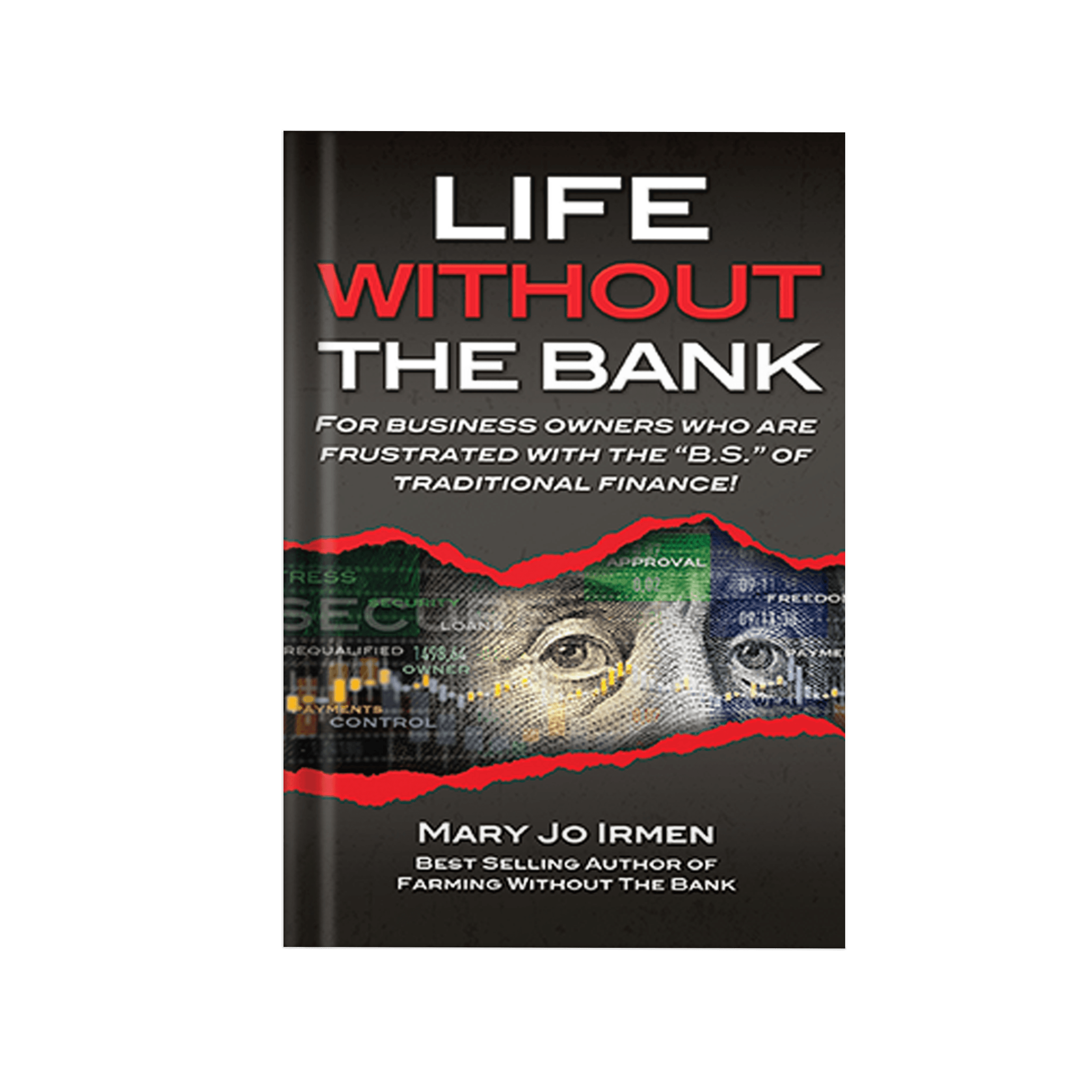
Your financial independence starts with one book.
Only one of three Americans can retire. Part of the fault is the conditioned belief that you must give up the use of your money when you’re young so you can have it later, assuming the stock market doesn’t collapse.