Podcast
EP. 242
Kyle Busch Lost $8.5M… But It’s Not What You Think (Ep. 242)
Nov 6, 2025 ·
19 min
0:00 / 19:07
EPISODE OVERVIEW
ABOUT THIS EPISODE
Kyle Busch just sued Pacific Life Insurance for $8.58 million, claiming he was misled by an Indexed Universal Life (IUL) policy. But what if this high-profile case proves everything Infinite Banking practitioners have warned about for years?
👉 Follow Mary Jo Here: https://www.youtube.com/channel/UCXYvzroUouEMsTGKFw5nJHQ
👉 Get the book: https://www.withoutthebank.com/book/
In this episode of Without the Bank, Mary Jo breaks down the Kyle Busch life insurance lawsuit, exposing how IULs are often mis-sold and why dividend-paying whole life insurance is still the gold standard for Infinite Banking.
She dives into:
◦ Why IULs, VULs, and ULs collapse faster than you think
◦ The truth behind “guaranteed” returns and hidden policy fees
◦ What Nelson Nash really meant by “dividend-paying whole life”
◦ How to read your own in-force illustration and spot red flags
If you own an Indexed Universal Life policy, or are thinking of buying one, this episode could save you thousands.
Key Takeaways
◦ Kyle Busch’s lawsuit highlights systemic problems in how IULs are sold.
◦ Whole life and IUL are not the same thing.
◦ Infinite Banking only works with dividend-paying whole life, not market-tied policies.
◦ Always request an in-force illustration at 4% to test your policy’s strength.
◦ Education beats marketing. Understand what you’re buying before you sign.
Chapters:
00:00 – The Problem with Bad Insurance Sales
01:21 – Kyle Busch’s $8.5M IUL Lawsuit Explained
03:34 – IUL vs Whole Life: What Agents Don’t Tell You
06:03 – Hidden Fees, Failing Policies, and False Promises
08:26 – Why This Case Proves Infinite Banking Works
12:19 – The Real Lesson from Becoming Your Own Banker
17:16 – How to Check (and Fix) Your Own Life Insurance
👉 Have an IUL or UL policy? Send your in-force illustration to Mary Jo for a review.
Email: maryjo@withoutthebank.com
👉 Subscribe for more episodes breaking down Infinite Banking truths and exposing insurance myths.
👍 Like, comment, and share this video if you believe in consumer protection and financial education!
🔗 Links Mentioned
📘 Books:
https://www.withoutthebank.com/book/
📅 Schedule an appointment:
https://www.withoutthebank.com/contact/
CHAPTER TIMESTAMPS
- 00:00The Problem with Bad Insurance Sales
- 01:21Kyle Busch's $8.5M IUL Lawsuit Explained
- 03:34IUL vs. Whole Life: What Agents Don't Tell You
- 06:03Hidden Fees, Failing Policies, and False Promises
- 08:26Why This Case Proves Infinite Banking Works
- 12:19The Real Lesson from Becoming Your Own Banker
- 17:16How to Check (and Fix) Your Own Life Insurance
YOUTUBE EPISODE
TRANSCRIPTION
“This is like home builders building a really crappy house that’s falling apart and they get sued and then they go change their business name and they continue to upgrade. This has got to stop because the majority of these policies out there are not being sold correctly. If they were, I would have seen more than five good ones in 16 years. But I didn’t and I’m not. There is a reason Nelson said dividend paying whole life. Whole life is not IUL, UL, VUL. I wanted to thank Kyle and his wife. Not that he will probably ever see this. If you guys know him, I would love to say thanks, Kyle, because he had the right idea. He was sold the right idea, but they used the wrong tool.”
Hello, hello, hello and welcome back to the podcast. Thank you very much for being here. Today, we’re going to talk about my favorite subject. The one that will get the German passion flowing. And that is universal life. And specifically today, we are talking about indexed universal life.
It’s making the news everywhere. You guys have probably seen it. Kyle Busch is suing Pacific Life for selling him an IUL that he apparently got scammed out of like $8.58 million. And I’m not going to say apparently 100%. This is most likely. I know it’s true. I know of the attorney that he has hired to sue Pacific Life.
I have talked about this before. We are seeing this massive, massive movement of all these IUL people, agents, saying, here’s your glorious rate of return. It’s going to be this amazing thing. And that’s exactly what happened to Kyle. He was sold something and said, oh, this is going to have this great income tax-free retirement for you. Who wouldn’t buy that, right? We talk about that with infinite banking.
Let me start by saying this. This is all spun off of infinite banking. What happened is Nelson wrote his book and then a bunch of people said, oh, shit, I can do better than Nelson. I can go chase a rate of return. So let me introduce you to universal life, variable life, IULs, and we’re going to just talk about rates of return. And it is going to blow Nelson’s illustrations out of the water. They missed. They missed a little piece. Just tiny little piece. It’s not about a rate of return, my friends. That’s not what this is about.
And so this is proof. I just want to come on here. I have an illustration to show you. But this is proof of everything that I have been saying. What’s really, really nice about these articles is I’ve yet to see anybody say whole life. They are very specific when they are talking about indexed universal life, which to me is absolutely the most fantastic thing ever.
Some people in this industry, I’ve seen a lot of other agents saying, oh, well, what’s going to happen to us? Nothing’s going to happen to us because we are selling dividend paying whole life. Everything we have been saying under the Nelson Nash Institute is exactly working like it’s supposed to because they don’t have all these fees and charges. And that’s exactly what Kyle Busch is saying is nobody told me about these fees and charges. Okay.
The crazy thing is, is that he is only 40. Somewhere within the article, it said that Kyle’s only 40. That means that he most likely bought that product 10 to 20 years ago, maybe, and it fell apart that quickly. My friends, I do not see that happen in any type of universal policy, typically until 75 to 85, right? Occasionally at 70, if it’s bad, sometimes it’ll go to 90 even. It just really depends if it’s universal, variable, indexed. They’re all very different. If you do not know the difference between them, then go back to some of my older podcasts. Maybe I’ll have to do another one where I actually draw it out for you guys. Maybe I can do it here. I don’t know. We’ll see how much.
But when we are looking at these IULs, there were a lot of changes just a few years ago, handful of years ago, that said you can’t sell these things at a 16% rate of return. Because that’s what was happening is agents were saying, oh, we’re going to have a 16% rate of return. It’s going to be glorious. And you got death benefit. You’re going to be able to retire income tax free. So regulations came in, changed all that, said, nope, you can’t do that. I think the limit now is like 7% or something. So then I was told they’re adding on some bonuses and they’re trying to manipulate numbers another way to say, oh, we can get this bigger rate of return.
So what happens is this rate of return is massive. So your premium is lower. The lower the rate of return, the higher the premium has to be, right? Because the rate of return is going to make up for what you’re not paying in premium. So whole life doesn’t have some market return to it. So it is going to be more expensive, as people would say, because of that. Because it’s guaranteed. They know exactly what they need to charge for cost of insurance.
In these IULs, not only is the cost of insurance on the outside and that can go up every year. So if an insurance company isn’t doing well and they’re not getting their rates of return, they’re like, I’ll just up your cost of insurance. You’re not going to know any better. We have the permission to do that. We wrote that in the policy. We’re going to have a bunch of fees. And so we’re going to charge you administration fees and we’re going to charge you service fees. And, you know, there’s lots of fees inside of these policies.
When you get your annual statement, if you have an IUL and you get an annual statement, a lot of times it’s going to outline the fees. It’s going to outline what the cost of insurance is. And so as you get older, that goes up. That’s typically when these things fall apart. So it’s very, very interesting to me that Kyle’s stuff fell apart at 40. It’s also very interesting to me that he lost such a massive quantity of money so quickly.
Now they say that’s to fees. So I’m assuming he had the cash value up front, but because the death benefit was so astronomically large that his fees were getting to the point where it was just grabbing cash value and gone. So now he probably put 10 or 11 million dollars into this thing and he’s only got two million dollars of cash value left. And so I hope to goodness, like I feel bad for Kyle. I wish this wouldn’t have happened to him. And FYI, he’s never been my NASCAR guy. So I still feel bad for him. Let’s not judge him based on who he was racing for. Okay.
But the good thing that has come out of this is that Kyle has gone public with it. He has been big enough. Him and his wife were big enough to say, you know what, we’re going to get an attorney and we’re going to go public. So nobody else has to go through this. There are not a lot of people in this country that will do that because that’s a mark on Kyle to say, hey, you made a bad decision. And he’s going to get judged for that. Some people are going to be happy as a lark that this happened to him. Right. But I commend him for doing that and bringing attention to that because we as agents are saying, hey, don’t buy these policies.
This attorney is suing. These people have been sued. Right. There is an agent in Arizona that has been sued by the same attorney. He has not won the case. I don’t know if it’s guilty, whatever. I’m not going to say that. But he has not won the case. And yet he holds his license. And yet he sells indexed universal life. And people are just have the shiny object syndrome. They’re not doing their due diligence.
And I’m so thankful that Kyle and his wife took the opportunity to share that because it is not what we do. It is not what infinite banking stands for. It is not what the Nelson Nash Institute stands for. Because Nelson said in his book, this is not universal life. This is not variable universal life. Indexed universal life was not really on the planes while Nelson was alive. It didn’t have this huge movement. And so that did not make the book. But hopefully this gives the IUL world some traction.
The downside is going to be you might have the talking heads of Dave Ramsey saying, see, I told you so. Whole life is bad. Now, let’s just say that that is said by talking heads. People that don’t like life insurance. They’re going to say, see, I told you whole life is bad. They’re not talking about whole life here. They’re talking about universal life. They even mentioned in the article permanent life insurance. I mean, kudos. It’s the same article amongst every single news outlet. And so I haven’t read every one of them yet, but I’ve read about four or five of them and they’re the same. They’re saying, hey, indexed universal life is a type of permanent insurance. And under permanent insurance, we have whole life, universal life, variable life, indexed universal life. They are different things.
And so if people and talking heads out there want to come by and say, oh, no, that’s why whole life is bad. No, that’s not why whole life is bad. That is why indexed universal life is bad. That is why universal life could be bad. Variable universal life tied directly to the stock market could be bad. So this is not whole life. It’s not dividend paying whole life. There’s a difference between dividend paying whole life and just whole life with a stock company. And so we have to be cognizant of that.
When we’re doing our due diligence, there is so much noise. And that is another thing that I feel very badly for the consumer for because they don’t know where to go. Right. It’s like me recently going on my better eating plan. Like what’s good? What’s not good? Oh, my God. The noise is ridiculous. I’m like, forget it. I’m just going to try whatever I want to try. And I’ll trudge through it as I go. Because you just don’t know what to believe. You don’t know who to believe.
And so it very much is similar to that. Like anything that we look at, oh, should we buy a John Deere tractor or Case IH tractor? Well, which one’s better? I don’t know. Let’s just put them all in the mix. And then this person says this, this person says that. I get into that same thing when I look at, oh, should I buy a GMC? Should I buy a Dodge? Should I be buying a Ford? Like everybody has their problems and you can get paralysis with all of that information. So you’re like, you know what? I’m not going to do anything.
And so if we just go back to Becoming Your Own Banker, if we go back to this book and we say, hey, this is the guy that knew, right? This is the guy that for 88 years of his life, he was using dividend paying whole life. He never sold universal life. He understood whole life insurance. Why are we messing with something that worked? Now, sometimes there are better things, but in this case, the insurance companies haven’t come up with anything better. That is guaranteed. This isn’t about a rate of return.
If you go over to Without the Bank, Tarisa and I are ripping this book apart. If you’ve been here, John and I are ripping this book apart. Now, yes, I’ve got my books and my books are a great introduction to Becoming Your Own Banker. But everything we need to know is in that book. Every objection that you might have is answered in that book.
Just today, I had a meeting with somebody that I had met with in 2017. He didn’t do a policy. We were doing a little refresher. And he was very stuck. He’s an accountant and he was very stuck on a rate of return. Well, I’m borrowing money at 5%. What am I earning in the policy? I don’t know that that makes sense. And he logically only wanted to think about a rate of return. Nelson said it’s not about a rate of return, right? It’s about liquidity, control, guarantees. And he just could not get his head around the fact that some of that is adding value that you can’t see.
I said, well, your land value is going up, but you’re paying 7% interest on it. Are you determining if the 7% is worth what the land value is going up? Oh, well, I bought land that I could improve. Yes, okay. Is it going to improve by the 7%? You’re not asking that question because we’re going to hold it forever. Yes, we’re also going to have our policy forever till the day we die. It’s long-term thinking.
And so we get into this like rate of return mode of that we can make more. And he was online looking at money markets. Well, in a money market, I could make X amount. You could. I said, so why not borrow from the cash value to put it in the money market and have your money working in both spots for you? Like the fact that it’s an and asset, we forget about that a lot of times. I just heard recently a colleague say it’s the before asset. You put the money here before you go put it in the market, before you go buy land, before you do all of those things. That is dividend paying whole life. That’s not indexed universal life.
Nowhere in infinite banking is there room for IULs. And there are so many agents out there that are not part of the Nelson Nash Institute selling IULs. And those people are not part of the Nelson Nash Institute because they can’t be. If you are going to sell a policy for the use of the infinite banking concept, you are not allowed to do that and be part of the Nelson Nash Institute. Some people don’t like that. Well, that is Nelson Nash Institute’s choice. That is their decision to say, you know what? We want this thing held close and we want it done how Nelson told us to do it. If you want to go do it your way, you can do that. But you are not putting infinite banking on that in any way, shape or form. And I am 100% behind NNI for doing that. Because there has to be a differentiation between what’s happening, what’s the good stuff and what’s the bad stuff. And this is a huge light on what is the bad stuff.
So I collect policies from people. I have an entire folder that says bad policies and I get to see them all. I have all types of universal lifes, indexed universal, variable universal. I have never seen one that bad. I did see one the other day. But for whatever reason, it was super bad because they sent me a 0% rate of return. That’s not likely within these policies. And so we have to use our brains, obviously. And we have to look at that stuff. But I don’t see good things. And it’s five good policies in 16 years. Five. I’m going to say five because I think it’s only been three. But let’s just say five. In 16 years of me teaching this concept. That’s not good. That’s not good. We need to look at what we’re purchasing.
If you have an IUL, a UL, VUL, if you have anything that does not say whole life, you need to call your agent today. Email them today and say, please send me an in-force illustration. Run at a 4% rate of return. The in-force illustration is going to show you the projections of numbers. It is going to take into account any expenses, any cost of insurance, any of that stuff. If we ever see cash value go to zero before we are likely to die, we should then become alarmed. Because if that thing cannot maintain itself at a 4% rate of return, which should be a pretty average rate of return, we need to be concerned.
The insurance industry needs to stop this stuff. People need to lose their licenses. This is like home builders building a really crappy house that’s falling apart and they get sued and then they go change their business name and they continue to upgrade. This has got to stop because the majority of these policies out there are not being sold correctly. If they were, I would have seen more than five good ones in 16 years. But I didn’t. And I’m not. There is a reason Nelson said dividend paying whole life. Whole life. Whole life is not IUL, UL, VUL. I’m not going to get on that tangent because I’ve gotten on that tangent before.
I wanted to make light of this. I wanted to thank Kyle and his wife. Not that he will probably ever see this. If you guys know him, take him. I would love to say thanks, Kyle. I’d love to thank him in person because he had the right idea. He was sold the right idea, but they used the wrong tool. Unfortunate, but fortunate that he has a voice and a platform to share with everyone else.
All right, let me know if you have an in-force illustration and you want me to look at it. Send it over because I am happy to look at it. I will give you my opinion about things maybe you should ask for, things maybe to do. The best thing, obviously, is to send it to me and then set up an appointment so we can talk through it. There is a lot to talk about when we’re looking at these policies. And so I want to make sure that that all gets covered and understood. Because if we don’t look at it and go through it and I’m just sending you some short emails, there’s a lot of misunderstanding that can happen. So schedule your appointment.
I will not ever tell somebody to cancel a life insurance policy if it does not make sense to do that. It is still life insurance. If you die, we need coverage. Okay? But in the cases like this, he would have been better off buying term and investing the difference. There I said it. Y’all can take that out of context however you like.
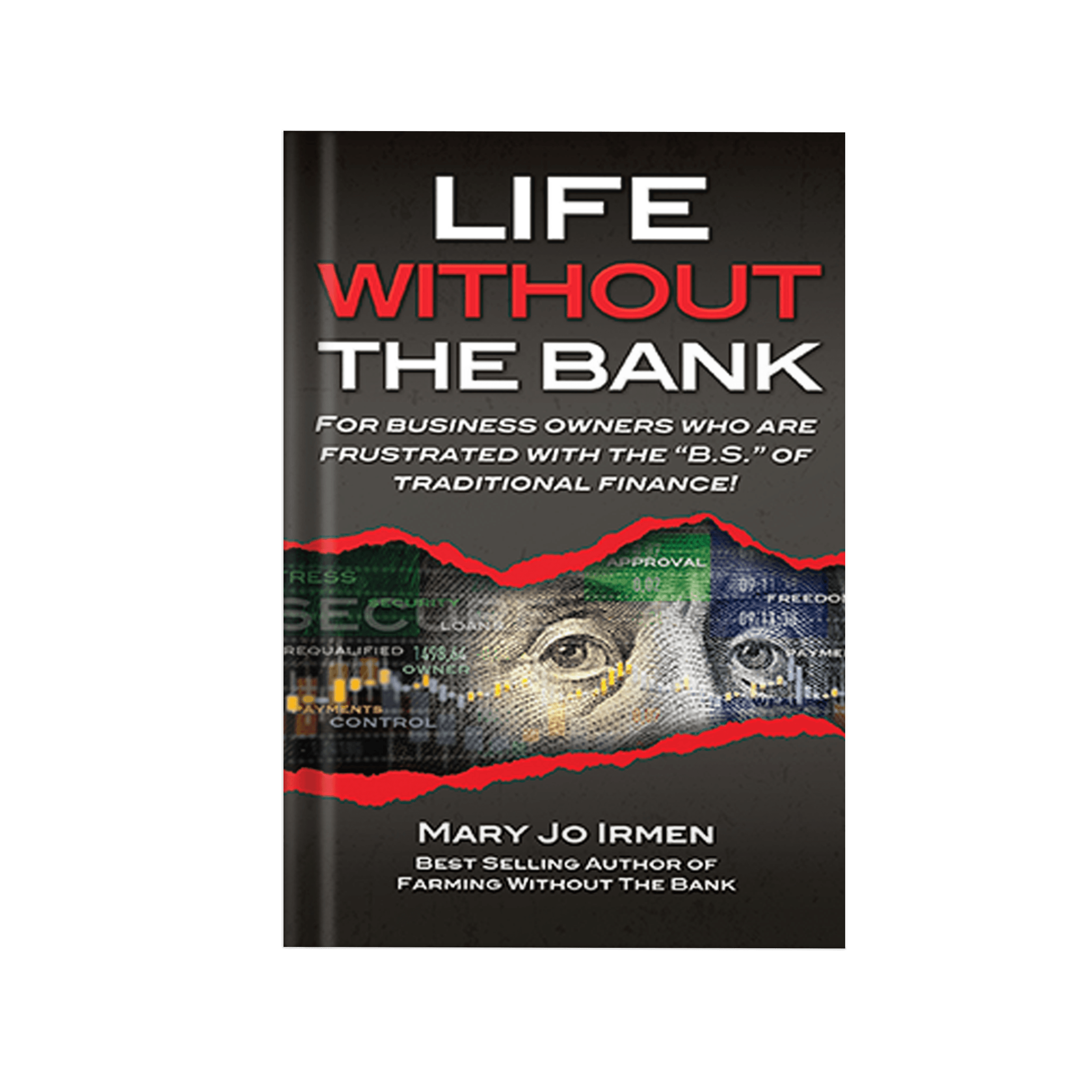
All right. Let me know if you have anything that I can help with. maryjo@withoutthebank.com. Grab these books. Okay? Grab all three of them if you need to. At least this one. Okay? These are all a bundle on our website. And you get them at a discounted price as a bundle. So go to farmingwithoutthebank.com or go to withoutthebank.com and grab them so that you have them and you can educate yourself and understand why we’re using the product that we’re using because it’s in your best interest. If I’m not going to sell it to my parents, I wouldn’t sell it to you. I know that probably doesn’t sound like much because people that are dishonest are going to screw their parents and not care. But I’m not one of those people. So anywho, let me know if you need anything. Otherwise, you guys have a fantastic rest of your day.
View MoreHello, hello, hello and welcome back to the podcast. Thank you very much for being here. Today, we’re going to talk about my favorite subject. The one that will get the German passion flowing. And that is universal life. And specifically today, we are talking about indexed universal life.
It’s making the news everywhere. You guys have probably seen it. Kyle Busch is suing Pacific Life for selling him an IUL that he apparently got scammed out of like $8.58 million. And I’m not going to say apparently 100%. This is most likely. I know it’s true. I know of the attorney that he has hired to sue Pacific Life.
I have talked about this before. We are seeing this massive, massive movement of all these IUL people, agents, saying, here’s your glorious rate of return. It’s going to be this amazing thing. And that’s exactly what happened to Kyle. He was sold something and said, oh, this is going to have this great income tax-free retirement for you. Who wouldn’t buy that, right? We talk about that with infinite banking.
Let me start by saying this. This is all spun off of infinite banking. What happened is Nelson wrote his book and then a bunch of people said, oh, shit, I can do better than Nelson. I can go chase a rate of return. So let me introduce you to universal life, variable life, IULs, and we’re going to just talk about rates of return. And it is going to blow Nelson’s illustrations out of the water. They missed. They missed a little piece. Just tiny little piece. It’s not about a rate of return, my friends. That’s not what this is about.
And so this is proof. I just want to come on here. I have an illustration to show you. But this is proof of everything that I have been saying. What’s really, really nice about these articles is I’ve yet to see anybody say whole life. They are very specific when they are talking about indexed universal life, which to me is absolutely the most fantastic thing ever.
Some people in this industry, I’ve seen a lot of other agents saying, oh, well, what’s going to happen to us? Nothing’s going to happen to us because we are selling dividend paying whole life. Everything we have been saying under the Nelson Nash Institute is exactly working like it’s supposed to because they don’t have all these fees and charges. And that’s exactly what Kyle Busch is saying is nobody told me about these fees and charges. Okay.
The crazy thing is, is that he is only 40. Somewhere within the article, it said that Kyle’s only 40. That means that he most likely bought that product 10 to 20 years ago, maybe, and it fell apart that quickly. My friends, I do not see that happen in any type of universal policy, typically until 75 to 85, right? Occasionally at 70, if it’s bad, sometimes it’ll go to 90 even. It just really depends if it’s universal, variable, indexed. They’re all very different. If you do not know the difference between them, then go back to some of my older podcasts. Maybe I’ll have to do another one where I actually draw it out for you guys. Maybe I can do it here. I don’t know. We’ll see how much.
But when we are looking at these IULs, there were a lot of changes just a few years ago, handful of years ago, that said you can’t sell these things at a 16% rate of return. Because that’s what was happening is agents were saying, oh, we’re going to have a 16% rate of return. It’s going to be glorious. And you got death benefit. You’re going to be able to retire income tax free. So regulations came in, changed all that, said, nope, you can’t do that. I think the limit now is like 7% or something. So then I was told they’re adding on some bonuses and they’re trying to manipulate numbers another way to say, oh, we can get this bigger rate of return.
So what happens is this rate of return is massive. So your premium is lower. The lower the rate of return, the higher the premium has to be, right? Because the rate of return is going to make up for what you’re not paying in premium. So whole life doesn’t have some market return to it. So it is going to be more expensive, as people would say, because of that. Because it’s guaranteed. They know exactly what they need to charge for cost of insurance.
In these IULs, not only is the cost of insurance on the outside and that can go up every year. So if an insurance company isn’t doing well and they’re not getting their rates of return, they’re like, I’ll just up your cost of insurance. You’re not going to know any better. We have the permission to do that. We wrote that in the policy. We’re going to have a bunch of fees. And so we’re going to charge you administration fees and we’re going to charge you service fees. And, you know, there’s lots of fees inside of these policies.
When you get your annual statement, if you have an IUL and you get an annual statement, a lot of times it’s going to outline the fees. It’s going to outline what the cost of insurance is. And so as you get older, that goes up. That’s typically when these things fall apart. So it’s very, very interesting to me that Kyle’s stuff fell apart at 40. It’s also very interesting to me that he lost such a massive quantity of money so quickly.
Now they say that’s to fees. So I’m assuming he had the cash value up front, but because the death benefit was so astronomically large that his fees were getting to the point where it was just grabbing cash value and gone. So now he probably put 10 or 11 million dollars into this thing and he’s only got two million dollars of cash value left. And so I hope to goodness, like I feel bad for Kyle. I wish this wouldn’t have happened to him. And FYI, he’s never been my NASCAR guy. So I still feel bad for him. Let’s not judge him based on who he was racing for. Okay.
But the good thing that has come out of this is that Kyle has gone public with it. He has been big enough. Him and his wife were big enough to say, you know what, we’re going to get an attorney and we’re going to go public. So nobody else has to go through this. There are not a lot of people in this country that will do that because that’s a mark on Kyle to say, hey, you made a bad decision. And he’s going to get judged for that. Some people are going to be happy as a lark that this happened to him. Right. But I commend him for doing that and bringing attention to that because we as agents are saying, hey, don’t buy these policies.
This attorney is suing. These people have been sued. Right. There is an agent in Arizona that has been sued by the same attorney. He has not won the case. I don’t know if it’s guilty, whatever. I’m not going to say that. But he has not won the case. And yet he holds his license. And yet he sells indexed universal life. And people are just have the shiny object syndrome. They’re not doing their due diligence.
And I’m so thankful that Kyle and his wife took the opportunity to share that because it is not what we do. It is not what infinite banking stands for. It is not what the Nelson Nash Institute stands for. Because Nelson said in his book, this is not universal life. This is not variable universal life. Indexed universal life was not really on the planes while Nelson was alive. It didn’t have this huge movement. And so that did not make the book. But hopefully this gives the IUL world some traction.
The downside is going to be you might have the talking heads of Dave Ramsey saying, see, I told you so. Whole life is bad. Now, let’s just say that that is said by talking heads. People that don’t like life insurance. They’re going to say, see, I told you whole life is bad. They’re not talking about whole life here. They’re talking about universal life. They even mentioned in the article permanent life insurance. I mean, kudos. It’s the same article amongst every single news outlet. And so I haven’t read every one of them yet, but I’ve read about four or five of them and they’re the same. They’re saying, hey, indexed universal life is a type of permanent insurance. And under permanent insurance, we have whole life, universal life, variable life, indexed universal life. They are different things.
And so if people and talking heads out there want to come by and say, oh, no, that’s why whole life is bad. No, that’s not why whole life is bad. That is why indexed universal life is bad. That is why universal life could be bad. Variable universal life tied directly to the stock market could be bad. So this is not whole life. It’s not dividend paying whole life. There’s a difference between dividend paying whole life and just whole life with a stock company. And so we have to be cognizant of that.
When we’re doing our due diligence, there is so much noise. And that is another thing that I feel very badly for the consumer for because they don’t know where to go. Right. It’s like me recently going on my better eating plan. Like what’s good? What’s not good? Oh, my God. The noise is ridiculous. I’m like, forget it. I’m just going to try whatever I want to try. And I’ll trudge through it as I go. Because you just don’t know what to believe. You don’t know who to believe.
And so it very much is similar to that. Like anything that we look at, oh, should we buy a John Deere tractor or Case IH tractor? Well, which one’s better? I don’t know. Let’s just put them all in the mix. And then this person says this, this person says that. I get into that same thing when I look at, oh, should I buy a GMC? Should I buy a Dodge? Should I be buying a Ford? Like everybody has their problems and you can get paralysis with all of that information. So you’re like, you know what? I’m not going to do anything.
And so if we just go back to Becoming Your Own Banker, if we go back to this book and we say, hey, this is the guy that knew, right? This is the guy that for 88 years of his life, he was using dividend paying whole life. He never sold universal life. He understood whole life insurance. Why are we messing with something that worked? Now, sometimes there are better things, but in this case, the insurance companies haven’t come up with anything better. That is guaranteed. This isn’t about a rate of return.
If you go over to Without the Bank, Tarisa and I are ripping this book apart. If you’ve been here, John and I are ripping this book apart. Now, yes, I’ve got my books and my books are a great introduction to Becoming Your Own Banker. But everything we need to know is in that book. Every objection that you might have is answered in that book.
Just today, I had a meeting with somebody that I had met with in 2017. He didn’t do a policy. We were doing a little refresher. And he was very stuck. He’s an accountant and he was very stuck on a rate of return. Well, I’m borrowing money at 5%. What am I earning in the policy? I don’t know that that makes sense. And he logically only wanted to think about a rate of return. Nelson said it’s not about a rate of return, right? It’s about liquidity, control, guarantees. And he just could not get his head around the fact that some of that is adding value that you can’t see.
I said, well, your land value is going up, but you’re paying 7% interest on it. Are you determining if the 7% is worth what the land value is going up? Oh, well, I bought land that I could improve. Yes, okay. Is it going to improve by the 7%? You’re not asking that question because we’re going to hold it forever. Yes, we’re also going to have our policy forever till the day we die. It’s long-term thinking.
And so we get into this like rate of return mode of that we can make more. And he was online looking at money markets. Well, in a money market, I could make X amount. You could. I said, so why not borrow from the cash value to put it in the money market and have your money working in both spots for you? Like the fact that it’s an and asset, we forget about that a lot of times. I just heard recently a colleague say it’s the before asset. You put the money here before you go put it in the market, before you go buy land, before you do all of those things. That is dividend paying whole life. That’s not indexed universal life.
Nowhere in infinite banking is there room for IULs. And there are so many agents out there that are not part of the Nelson Nash Institute selling IULs. And those people are not part of the Nelson Nash Institute because they can’t be. If you are going to sell a policy for the use of the infinite banking concept, you are not allowed to do that and be part of the Nelson Nash Institute. Some people don’t like that. Well, that is Nelson Nash Institute’s choice. That is their decision to say, you know what? We want this thing held close and we want it done how Nelson told us to do it. If you want to go do it your way, you can do that. But you are not putting infinite banking on that in any way, shape or form. And I am 100% behind NNI for doing that. Because there has to be a differentiation between what’s happening, what’s the good stuff and what’s the bad stuff. And this is a huge light on what is the bad stuff.
So I collect policies from people. I have an entire folder that says bad policies and I get to see them all. I have all types of universal lifes, indexed universal, variable universal. I have never seen one that bad. I did see one the other day. But for whatever reason, it was super bad because they sent me a 0% rate of return. That’s not likely within these policies. And so we have to use our brains, obviously. And we have to look at that stuff. But I don’t see good things. And it’s five good policies in 16 years. Five. I’m going to say five because I think it’s only been three. But let’s just say five. In 16 years of me teaching this concept. That’s not good. That’s not good. We need to look at what we’re purchasing.
If you have an IUL, a UL, VUL, if you have anything that does not say whole life, you need to call your agent today. Email them today and say, please send me an in-force illustration. Run at a 4% rate of return. The in-force illustration is going to show you the projections of numbers. It is going to take into account any expenses, any cost of insurance, any of that stuff. If we ever see cash value go to zero before we are likely to die, we should then become alarmed. Because if that thing cannot maintain itself at a 4% rate of return, which should be a pretty average rate of return, we need to be concerned.
The insurance industry needs to stop this stuff. People need to lose their licenses. This is like home builders building a really crappy house that’s falling apart and they get sued and then they go change their business name and they continue to upgrade. This has got to stop because the majority of these policies out there are not being sold correctly. If they were, I would have seen more than five good ones in 16 years. But I didn’t. And I’m not. There is a reason Nelson said dividend paying whole life. Whole life. Whole life is not IUL, UL, VUL. I’m not going to get on that tangent because I’ve gotten on that tangent before.
I wanted to make light of this. I wanted to thank Kyle and his wife. Not that he will probably ever see this. If you guys know him, take him. I would love to say thanks, Kyle. I’d love to thank him in person because he had the right idea. He was sold the right idea, but they used the wrong tool. Unfortunate, but fortunate that he has a voice and a platform to share with everyone else.
All right, let me know if you have an in-force illustration and you want me to look at it. Send it over because I am happy to look at it. I will give you my opinion about things maybe you should ask for, things maybe to do. The best thing, obviously, is to send it to me and then set up an appointment so we can talk through it. There is a lot to talk about when we’re looking at these policies. And so I want to make sure that that all gets covered and understood. Because if we don’t look at it and go through it and I’m just sending you some short emails, there’s a lot of misunderstanding that can happen. So schedule your appointment.
I will not ever tell somebody to cancel a life insurance policy if it does not make sense to do that. It is still life insurance. If you die, we need coverage. Okay? But in the cases like this, he would have been better off buying term and investing the difference. There I said it. Y’all can take that out of context however you like.
All right. Let me know if you have anything that I can help with. maryjo@withoutthebank.com. Grab these books. Okay? Grab all three of them if you need to. At least this one. Okay? These are all a bundle on our website. And you get them at a discounted price as a bundle. So go to farmingwithoutthebank.com or go to withoutthebank.com and grab them so that you have them and you can educate yourself and understand why we’re using the product that we’re using because it’s in your best interest. If I’m not going to sell it to my parents, I wouldn’t sell it to you. I know that probably doesn’t sound like much because people that are dishonest are going to screw their parents and not care. But I’m not one of those people. So anywho, let me know if you need anything. Otherwise, you guys have a fantastic rest of your day.



ready to start?
Your financial independence starts with one book.
Only one of three Americans can retire. Part of the fault is the conditioned belief that you must give up the use of your money when you’re young so you can have it later, assuming the stock market doesn’t collapse.