Podcast
EP. 257
Retirement Means “Taken Out Of Service” – And That’s The Problem (Ep. 257)
Feb 19, 2026 ·
18 min
0:00 / 18:02
EPISODE OVERVIEW
ABOUT THIS EPISODE
Is retirement really the dream… or is it a trap?
In this episode, we break down Part 5 of Becoming Your Own Banker and tackle two powerful ideas: capitalizing your system, and the truth about the retirement trap.
Nelson Nash warned decades ago about Social Security, tax-deferred retirement plans, and government-sponsored schemes — and many of his predictions are playing out today.
If you think tax-deferred means tax-free… or that retirement equals freedom… you'll want to hear this.
🔎 What We Cover
- Why desire is the starting point for Infinite Banking
- The importance of surrounding yourself with like-minded people
- Why retirement may actually shorten your life
- The hidden dangers of government-sponsored retirement plans
- What "tax-deferred" really means
- How losing control of your money changes everything
- Why purpose is more important than retirement
💡 Key Takeaways
- ✔ You must have a burning desire to escape the traditional financial system
- ✔ Infinite Banking is a lifetime commitment — not a quick fix
- ✔ Tax-deferred plans mean delayed taxation… not avoided taxation
- ✔ Government programs can change the rules anytime
- ✔ Retirement means "taken out of service" — and that's not the goal
- ✔ Purpose and continuous learning keep you young
If you're ready to rethink retirement and take control of your financial life, this episode is for you.
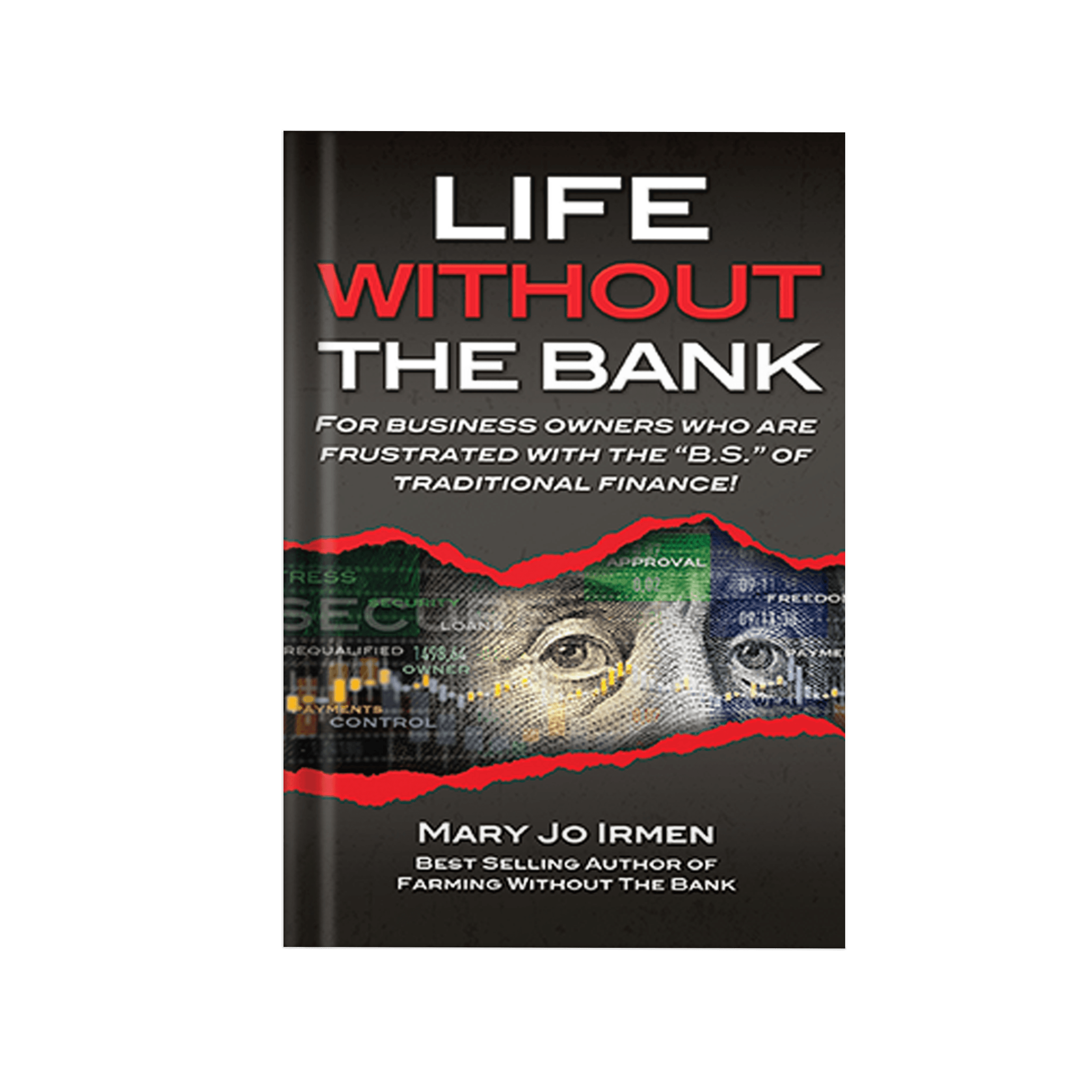
📘 Grab your copy of Becoming Your Own Banker.
📅 Read the book and schedule an appointment to get started. Every day you wait, you are probably losing some opportunity cost getting started and using the policy.
- 📘 Get the book
- 📧 Email Mary Jo: maryjo@withoutthebank.com
- 📧 Email Tarisa: tarisa@withoutthebank.com
- 🌐 withoutthebank.com
- ▶️ Subscribe on YouTube
CHAPTER TIMESTAMPS
- 00:00Staying Young vs. "Becoming Old"
- 00:48Capitalizing Your System Explained
- 02:11Why Desire Is Everything
- 07:30The Retirement Trap
- 10:36The Truth About Tax-Deferred Plans
- 14:41Why Retirement Isn't the Goal
- 18:12Lifelong Learning & Purpose
YOUTUBE EPISODE
TRANSCRIPTION
"Older people that have young grandkids are younger older people. They have a younger mentality. They're more active because their grandkids are younger. When you're old and you just sit at home and you don't do anything and you become an old person — then what? Like, Nelson traveled and he saw things, and he was always talking about things, and that made him kind of young. He didn't seem like he was 88. He would always talk about YouTubing. Well, don't you know, you can go YouTubing? Because it's like Googling, right? Y'all familiar with the YouTube? Go there and search up a video. Nelson loved YouTube."
Hello and welcome back to the podcast. Thank you for being here. Okay, today we are going over Part 5, capitalizing your system and implementation. And we're going to combine that with the retirement trap.
Okay. Capitalizing your system. That's a new word. I wonder what you could mean.
You know, it's been funny, because I've never batch recorded lessons for Nelson's book before — to really talk about every chapter within a two-day period of time. And I'm like, oh my gosh. No, you already said that. You already said that. And repetition, though, is obviously needed. And it's funny, because people read this book and they still won't get it. And it's so repetitive.
Do you have the arrival syndrome by the time you're done? Like, I already know that, Nelson.
Okay. Capitalizing your system. How do I get started? The most important word that comes to my mind is desire. Without it, you probably can't do it. Remember Parkinson's Law back in Part 2 — everyone is already spending all their financial resources on what they think is best.
And I would say, what they think is most important.
There has got to be some honest introspection at this point, and a commitment to get out of the financial prison must be a burning passion. It is going to require a change in priorities. Recognize that controlling the banking function personally is the most important thing that can be done in the financial world. I strongly recommend that you find a life insurance agent that is familiar with the Infinite Banking concept to act as your coach. Above all, you must be patient. It is going to take years to get started, and it needs to be a lifetime commitment.
And so there's a lot there in those two paragraphs about — it's just not that easy for some people. If it's not super important to you, you're just never going to get started. It's just that simple. Or if you do get started, you're not going to prioritize it in the way that you should for it to actually work out in your paper.
Yeah. The pain of staying where you're at has to be less than the pain of change. If change is less painful than where you're at, you're going to change. And so you really have to pick — what is the pain point? What is important to you?
Right. And I used to be quite critical of people that didn't want to do this, because money is a fun subject to me. It's not about a greed factor or anything. It's just truly a fun subject to me. And so I'm like, how do you not care?
But some of those same people are doing other things that I don't care about. And so I'm like, well, I don't care about those things. And they are staying there and being judgy and saying, why don't you care about that? Because I just don't care. So at some point, either they care or they just don't care. But if it's not a pain point to go to the bank, they're not going to care. If the bank has never told them no, they're not going to care.
I agree. I also like that he says, organize or join one that's already in existence — a wealth club that meets periodically. Here you have the support of others that are working their way out of darkness. Be sure to include members that already have a good track record in practicing the principles of the Infinite Banking concept.
And I would say that this is so true. I will never forget my first in-person think tank. I just remember being so surrounded by people that understood this at such a deep level and had been helping people out with it for a really long time. And it just was so refreshing to be around people that get it.
When I have my client summits, that's what I've heard — it's just awesome to be in a room of 100-plus people where everybody is doing Infinite Banking. And you're not getting whacked over the head and being told that you're an idiot. And you're getting ideas.
Nelson said it is important, because you need to surround yourself with others that are like-minded and understanding. And so it's no different than — I look at my client summits as well. The majority of my clients are farmers and ranchers. They walk into a room and they immediately connect. They immediately know that they like each other. It's loud, because everybody's talking, they're having fun, but it's like-minded people. And they're going to talk, because I know you're in the same industry as me.
The same thing happens when we go to think tank. We're all talking about clients and strategies and life insurance and all the things, because that's what we're there for. And you leave so inspired and motivated.
And I have clients that have created these little groups in their local towns with other people that do Infinite Banking. And so it's so important — if I have a client summit, it's important to come to that client summit to make connections, because you leave with phone numbers. And when you have questions, you can just talk to one another, you can text one another, email, call, whatever that looks like.
But you're connecting with other people besides just Tris and I on a day-to-day basis. Not that we don't want to connect with you, because obviously that's what we're here for, because we are your Infinite Banking coach. But sometimes it's nice to have somebody else at a different level.
Nelson says further on, we live in a time where many people know the price of everything but the value of nothing. This was again 25 years ago. I think that that's just getting worse — that we don't value the agent that maybe sold us the policy and the education that they went through. Instead, we're like, oh, we're just going to go to some other agent that didn't put the time and energy in.
This is all we do. Both of us. We eat, sleep and breathe Infinite Banking. We don't sell other types of insurance. We don't do anything else. And there's value to that, because we're staying in our lane. And so you can go to somebody else, but you're not going to get that same value as if you went to an agent that that's all they're doing.
And then he ends it with: above all, get started now. The longer you wait, the more you penalize yourself. If you know what is happening, you will know what to do.
Okay. Retirement trap. This one could be summed up pretty quickly. I have a lot of stuff highlighted because a lot of this is good, but it could be pretty quick.
Yeah. Like, it's a lie. My favorite line in this whole thing is, nowhere in the Bible did it say Moses retired and lived happily ever after.
That's what I was laughing at. Nowhere. Nowhere in the Bible did anybody retire. This is truly a trap.
And he talks about early in this chapter that on his birthday, he wrote down: Social Security will fail, as have all socialist programs since the beginning of time. Before it fails, they will attempt to prop it up. The source of funds that they will use is the reserves of private pension plans and other government-sanctioned schemes.
So we talked a lot about this already in previous podcasts, and how the government is in control. I forgot Nelson had this towards the back of the book, or we could have saved that commentary for later.
I know, right?
And he says there has been an accelerating realization that this is going to happen, that Social Security is going to fall. I doubt that I'll ever see it, but they're propping it up, and they keep propping it up. But he says, furthermore, they will always use the path of least resistance to accomplish whatever it is that they want to do. The easiest money that they can get to are the reserves on such plans. It's the largest block of securities that exist in the world.
This is a fun piece of Nelson, that he was so old. I mean, he was 88. He wasn't — like, people have lived longer, but he had lived for so long and paid attention to things for so long and watched it, that he said that people thought he was crazy. But within a year of him writing that down, they already were trying to go after the retirement plans.
And so he said it was doomed to fail from the start, because it was operating on a faulty premise, which we talked about before. But he is saying that, hey, if you're a doctor and you put $10,000 in your pension plan, the government is saying, you know, really that half of that is ours. It wasn't really your money.
Yeah. I'm going to let you believe it was your money. Half of that is really our money. Because when you pay taxes later, we're taking that back.
Right. We're giving it to you now. You can't even use it for cash flow. Like, we're going to give it to you now for good housekeeping measures. We're going to let you hold on to it and make you feel all warm and cozy. But it's not really yours.
I know they said you have done a good job of putting funds into your plan, but Social Security is in trouble. We need our half of your plan now to prop it up. There's not a thing you can do about it, because they created the scheme and they can and will change their minds.
So that's another thing that I think people don't think about. And I think that there's a really large misunderstanding of what tax-deferred means. Tax-deferred doesn't mean you're not going to pay taxes. It means you're going to pay taxes later, when you have typically less write-offs. The kids are gone. Your house is probably paid off. Your income — maybe it stayed the same, maybe went up, maybe went down. But if you have the majority of all the money you're supposed to live off of in an environment where you have no control over what the income tax is at that time, and you're forced to take it out at a certain age, that sounds so scary to me.
Government-sponsored programs will always accomplish the opposite of their stated intent. The most dangerous thing you can do with money is put it into government-sponsored schemes. When the government creates a problem and then turns around and creates an exception to the problem they created — aren't you just a little bit suspicious that you're being manipulated? That's the second time he has said that. And I think that we need to look at that.
He said — this is funny — down through all of history, mankind has indulged in some pretty stupid ideas. And it seems to take quite a number of years before one of them really returns to a course of collapse. Often it takes 70 or more years for reality to become apparent. I don't know when Social Security was started.
And then he said the same idea applies to wages. So he's talking about World War II and how wages were frozen. He said, under such an environment, how can you give someone a pay raise without giving a pay raise? Benefits, of course. This was the genius of retirement plans and health insurance plans.
So we never had all these other benefits. People were responsible to go get their own. So now we're going to give somebody a pay raise, call it a benefit, get Blue Cross Blue Shield involved. They go lobby and manipulate employers. Employers are paying for it. Employees quit paying attention to what's happening. Employers are too busy to pay attention to what's happening.
And there's a whole scam in the health insurance world. The amount of money we pay is absolutely ridiculous. When you look at people that go through the health share plans — it's crazy how much they pay in cash compared to if you're going to have insurance. If you can't see that, that is a massive scam.
And a lot of people are unfamiliar with the health sharing plans. And people need to talk to others who are using those plans, because it is typically half. If you pay in cash, it is half the cost of what an insurance company would pay. So if Blue Cross is willing to pay 50% more, but the doctor is willing to do the work for cash, half price — you can't tell me that that doctor is being paid more through Blue Cross Blue Shield. Blue Cross Blue Shield is keeping 50% of that, because they have people to pay and then they want to make money and put it into the same system that the life insurance company has their money in, right?
Because they took it out of our hands, we have lost control of it. Pensions used to be put into annuities. They were a guaranteed product. The government also took pensions out of the people's hands. And they put that back onto the employer and said, oh, Mr. Employer, you take care of your employees. The insurance company is not going to do it anymore. You do it.
Employers frankly don't care. They just want you to show up and do your job. They don't have time to be worrying about what your health coverage is. And then he goes on to talk about reading the pension idea book.
So retirement is a trap. 100%. It's a trap. It was a man-made thing to get people out of the working world. And in today's environment, they're living longer. They need to be working longer. And people probably wouldn't mind working longer if they actually worked and did something that they love doing. But so many people are just doing what they need to do to collect a paycheck, and they don't actually love what they're doing.
I would agree with that.
Any additional comments?
I like the 14 points that Deming went over that made him famous. So: create a constancy of purpose; adopt a new philosophy; end the practice of purchasing at the lowest prices; institute leadership; eliminate empty slogans; eliminate numerical quotas; institute on-the-job training; drive out fear; break down barriers between departments; take action to accomplish the transformation; improve constantly and forever the process of production and service; cease dependence on mass inspection; remove barriers to pride of workmanship; retrain vigorously.
And then there's seven deadly sins. Lack of consistency of purpose; emphasizing short-term profits and immediate dividends — these are Nelson's seven deadly sins — evaluation of performance, merit ranking and annual review; mobility of top management; running a company only on visible figures; excessive medical costs; and excessive costs of warranty. Oh, those are not Nelson's. Sorry. But those are the seven deadly sins, in addition to the 14 points.
Yeah, definitely. Like, a shorter chapter that we just broke down a little bit. But should we be retired? Retired means taken out of service. And when people retire, they die. Typically, they will die sooner, because they don't have a purpose anymore. And so instead of using the word retirement, how about we just refocus that to something else that maybe we love to do? Like, we're done doing the crappy stuff in life, and now we're going to do something we like.
Well, and if you ever noticed, people are like, oh, I just can't wait until I retire. And I always ask this question — I ask them, what do you plan to do when you retire? And most people don't have an answer. Because all they can really conceive is, I just can't wait until I don't have to work. But that's not a plan for what you're planning to do with all that free time.
Right. They just don't want to have to get up and punch a clock and be told what to do every day. And in fact, some people need that. Because some people may just sit on the couch all day and watch some shows and get nowhere.
So eventually you end up having this broken thought process, because you're so out of touch with what's going on. Like, I want to be in a position where I'm constantly up to speed.
Because there's people that have older people that have young grandkids — they're younger older people, right? They have a younger mentality. They're more active because their grandkids are younger. People that have kids older tend to live longer, because they have these kids younger or older. And so that keeps them young.
Well, when you're old and you just sit at home and you don't do anything and you become an old person — then what? Right? Like, Nelson traveled and he saw things, and he was always talking about things. And that made him kind of young. He didn't seem like he was 88. He would always talk about YouTubing. Well, don't you know, you can go to YouTubing? YouTube. Because it's like Googling, right? Y'all familiar with the YouTube? Go there and search up a video. Nelson loved YouTube.
Well, what's so neat about that is that he also seems like the person who is always learning and growing. And I think that there's so much emphasis on that when we're younger, like when we're kids, because the development of the brain is happening so rapidly. But as an adult, that's our choice to influence that. And so many people choose not to.
Yeah. We retire and we're like, we're done. We graduate high school and we're like, good, we're done, we don't have to read another book. We get to 65, we're like, good, we're done, we don't have to do anything else ever again.
Okay. That's not how I want to be. I may not be working as much at 65. I guarantee you I won't be working as much at 65, 70, because I'm tired now. But I'll be working. I'll be here. I'll still be going to stuff. I'll still be doing all those things, because it's fun and exciting. And I would go crazy if I didn't have people to talk to.
All right. Well, if you need us, if you have questions, comments on any of that, if you think Nelson's full of baloney, let us know. You know where to find us. Grab your book, schedule your appointment, and let us help you get started, because every day you wait, you're hurting yourself. Nelson just said it. All right, you guys have a fantastic rest of your day.
View MoreHello and welcome back to the podcast. Thank you for being here. Okay, today we are going over Part 5, capitalizing your system and implementation. And we're going to combine that with the retirement trap.
Okay. Capitalizing your system. That's a new word. I wonder what you could mean.
You know, it's been funny, because I've never batch recorded lessons for Nelson's book before — to really talk about every chapter within a two-day period of time. And I'm like, oh my gosh. No, you already said that. You already said that. And repetition, though, is obviously needed. And it's funny, because people read this book and they still won't get it. And it's so repetitive.
Do you have the arrival syndrome by the time you're done? Like, I already know that, Nelson.
Okay. Capitalizing your system. How do I get started? The most important word that comes to my mind is desire. Without it, you probably can't do it. Remember Parkinson's Law back in Part 2 — everyone is already spending all their financial resources on what they think is best.
And I would say, what they think is most important.
There has got to be some honest introspection at this point, and a commitment to get out of the financial prison must be a burning passion. It is going to require a change in priorities. Recognize that controlling the banking function personally is the most important thing that can be done in the financial world. I strongly recommend that you find a life insurance agent that is familiar with the Infinite Banking concept to act as your coach. Above all, you must be patient. It is going to take years to get started, and it needs to be a lifetime commitment.
And so there's a lot there in those two paragraphs about — it's just not that easy for some people. If it's not super important to you, you're just never going to get started. It's just that simple. Or if you do get started, you're not going to prioritize it in the way that you should for it to actually work out in your paper.
Yeah. The pain of staying where you're at has to be less than the pain of change. If change is less painful than where you're at, you're going to change. And so you really have to pick — what is the pain point? What is important to you?
Right. And I used to be quite critical of people that didn't want to do this, because money is a fun subject to me. It's not about a greed factor or anything. It's just truly a fun subject to me. And so I'm like, how do you not care?
But some of those same people are doing other things that I don't care about. And so I'm like, well, I don't care about those things. And they are staying there and being judgy and saying, why don't you care about that? Because I just don't care. So at some point, either they care or they just don't care. But if it's not a pain point to go to the bank, they're not going to care. If the bank has never told them no, they're not going to care.
I agree. I also like that he says, organize or join one that's already in existence — a wealth club that meets periodically. Here you have the support of others that are working their way out of darkness. Be sure to include members that already have a good track record in practicing the principles of the Infinite Banking concept.
And I would say that this is so true. I will never forget my first in-person think tank. I just remember being so surrounded by people that understood this at such a deep level and had been helping people out with it for a really long time. And it just was so refreshing to be around people that get it.
When I have my client summits, that's what I've heard — it's just awesome to be in a room of 100-plus people where everybody is doing Infinite Banking. And you're not getting whacked over the head and being told that you're an idiot. And you're getting ideas.
Nelson said it is important, because you need to surround yourself with others that are like-minded and understanding. And so it's no different than — I look at my client summits as well. The majority of my clients are farmers and ranchers. They walk into a room and they immediately connect. They immediately know that they like each other. It's loud, because everybody's talking, they're having fun, but it's like-minded people. And they're going to talk, because I know you're in the same industry as me.
The same thing happens when we go to think tank. We're all talking about clients and strategies and life insurance and all the things, because that's what we're there for. And you leave so inspired and motivated.
And I have clients that have created these little groups in their local towns with other people that do Infinite Banking. And so it's so important — if I have a client summit, it's important to come to that client summit to make connections, because you leave with phone numbers. And when you have questions, you can just talk to one another, you can text one another, email, call, whatever that looks like.
But you're connecting with other people besides just Tris and I on a day-to-day basis. Not that we don't want to connect with you, because obviously that's what we're here for, because we are your Infinite Banking coach. But sometimes it's nice to have somebody else at a different level.
Nelson says further on, we live in a time where many people know the price of everything but the value of nothing. This was again 25 years ago. I think that that's just getting worse — that we don't value the agent that maybe sold us the policy and the education that they went through. Instead, we're like, oh, we're just going to go to some other agent that didn't put the time and energy in.
This is all we do. Both of us. We eat, sleep and breathe Infinite Banking. We don't sell other types of insurance. We don't do anything else. And there's value to that, because we're staying in our lane. And so you can go to somebody else, but you're not going to get that same value as if you went to an agent that that's all they're doing.
And then he ends it with: above all, get started now. The longer you wait, the more you penalize yourself. If you know what is happening, you will know what to do.
Okay. Retirement trap. This one could be summed up pretty quickly. I have a lot of stuff highlighted because a lot of this is good, but it could be pretty quick.
Yeah. Like, it's a lie. My favorite line in this whole thing is, nowhere in the Bible did it say Moses retired and lived happily ever after.
That's what I was laughing at. Nowhere. Nowhere in the Bible did anybody retire. This is truly a trap.
And he talks about early in this chapter that on his birthday, he wrote down: Social Security will fail, as have all socialist programs since the beginning of time. Before it fails, they will attempt to prop it up. The source of funds that they will use is the reserves of private pension plans and other government-sanctioned schemes.
So we talked a lot about this already in previous podcasts, and how the government is in control. I forgot Nelson had this towards the back of the book, or we could have saved that commentary for later.
I know, right?
And he says there has been an accelerating realization that this is going to happen, that Social Security is going to fall. I doubt that I'll ever see it, but they're propping it up, and they keep propping it up. But he says, furthermore, they will always use the path of least resistance to accomplish whatever it is that they want to do. The easiest money that they can get to are the reserves on such plans. It's the largest block of securities that exist in the world.
This is a fun piece of Nelson, that he was so old. I mean, he was 88. He wasn't — like, people have lived longer, but he had lived for so long and paid attention to things for so long and watched it, that he said that people thought he was crazy. But within a year of him writing that down, they already were trying to go after the retirement plans.
And so he said it was doomed to fail from the start, because it was operating on a faulty premise, which we talked about before. But he is saying that, hey, if you're a doctor and you put $10,000 in your pension plan, the government is saying, you know, really that half of that is ours. It wasn't really your money.
Yeah. I'm going to let you believe it was your money. Half of that is really our money. Because when you pay taxes later, we're taking that back.
Right. We're giving it to you now. You can't even use it for cash flow. Like, we're going to give it to you now for good housekeeping measures. We're going to let you hold on to it and make you feel all warm and cozy. But it's not really yours.
I know they said you have done a good job of putting funds into your plan, but Social Security is in trouble. We need our half of your plan now to prop it up. There's not a thing you can do about it, because they created the scheme and they can and will change their minds.
So that's another thing that I think people don't think about. And I think that there's a really large misunderstanding of what tax-deferred means. Tax-deferred doesn't mean you're not going to pay taxes. It means you're going to pay taxes later, when you have typically less write-offs. The kids are gone. Your house is probably paid off. Your income — maybe it stayed the same, maybe went up, maybe went down. But if you have the majority of all the money you're supposed to live off of in an environment where you have no control over what the income tax is at that time, and you're forced to take it out at a certain age, that sounds so scary to me.
Government-sponsored programs will always accomplish the opposite of their stated intent. The most dangerous thing you can do with money is put it into government-sponsored schemes. When the government creates a problem and then turns around and creates an exception to the problem they created — aren't you just a little bit suspicious that you're being manipulated? That's the second time he has said that. And I think that we need to look at that.
He said — this is funny — down through all of history, mankind has indulged in some pretty stupid ideas. And it seems to take quite a number of years before one of them really returns to a course of collapse. Often it takes 70 or more years for reality to become apparent. I don't know when Social Security was started.
And then he said the same idea applies to wages. So he's talking about World War II and how wages were frozen. He said, under such an environment, how can you give someone a pay raise without giving a pay raise? Benefits, of course. This was the genius of retirement plans and health insurance plans.
So we never had all these other benefits. People were responsible to go get their own. So now we're going to give somebody a pay raise, call it a benefit, get Blue Cross Blue Shield involved. They go lobby and manipulate employers. Employers are paying for it. Employees quit paying attention to what's happening. Employers are too busy to pay attention to what's happening.
And there's a whole scam in the health insurance world. The amount of money we pay is absolutely ridiculous. When you look at people that go through the health share plans — it's crazy how much they pay in cash compared to if you're going to have insurance. If you can't see that, that is a massive scam.
And a lot of people are unfamiliar with the health sharing plans. And people need to talk to others who are using those plans, because it is typically half. If you pay in cash, it is half the cost of what an insurance company would pay. So if Blue Cross is willing to pay 50% more, but the doctor is willing to do the work for cash, half price — you can't tell me that that doctor is being paid more through Blue Cross Blue Shield. Blue Cross Blue Shield is keeping 50% of that, because they have people to pay and then they want to make money and put it into the same system that the life insurance company has their money in, right?
Because they took it out of our hands, we have lost control of it. Pensions used to be put into annuities. They were a guaranteed product. The government also took pensions out of the people's hands. And they put that back onto the employer and said, oh, Mr. Employer, you take care of your employees. The insurance company is not going to do it anymore. You do it.
Employers frankly don't care. They just want you to show up and do your job. They don't have time to be worrying about what your health coverage is. And then he goes on to talk about reading the pension idea book.
So retirement is a trap. 100%. It's a trap. It was a man-made thing to get people out of the working world. And in today's environment, they're living longer. They need to be working longer. And people probably wouldn't mind working longer if they actually worked and did something that they love doing. But so many people are just doing what they need to do to collect a paycheck, and they don't actually love what they're doing.
I would agree with that.
Any additional comments?
I like the 14 points that Deming went over that made him famous. So: create a constancy of purpose; adopt a new philosophy; end the practice of purchasing at the lowest prices; institute leadership; eliminate empty slogans; eliminate numerical quotas; institute on-the-job training; drive out fear; break down barriers between departments; take action to accomplish the transformation; improve constantly and forever the process of production and service; cease dependence on mass inspection; remove barriers to pride of workmanship; retrain vigorously.
And then there's seven deadly sins. Lack of consistency of purpose; emphasizing short-term profits and immediate dividends — these are Nelson's seven deadly sins — evaluation of performance, merit ranking and annual review; mobility of top management; running a company only on visible figures; excessive medical costs; and excessive costs of warranty. Oh, those are not Nelson's. Sorry. But those are the seven deadly sins, in addition to the 14 points.
Yeah, definitely. Like, a shorter chapter that we just broke down a little bit. But should we be retired? Retired means taken out of service. And when people retire, they die. Typically, they will die sooner, because they don't have a purpose anymore. And so instead of using the word retirement, how about we just refocus that to something else that maybe we love to do? Like, we're done doing the crappy stuff in life, and now we're going to do something we like.
Well, and if you ever noticed, people are like, oh, I just can't wait until I retire. And I always ask this question — I ask them, what do you plan to do when you retire? And most people don't have an answer. Because all they can really conceive is, I just can't wait until I don't have to work. But that's not a plan for what you're planning to do with all that free time.
Right. They just don't want to have to get up and punch a clock and be told what to do every day. And in fact, some people need that. Because some people may just sit on the couch all day and watch some shows and get nowhere.
So eventually you end up having this broken thought process, because you're so out of touch with what's going on. Like, I want to be in a position where I'm constantly up to speed.
Because there's people that have older people that have young grandkids — they're younger older people, right? They have a younger mentality. They're more active because their grandkids are younger. People that have kids older tend to live longer, because they have these kids younger or older. And so that keeps them young.
Well, when you're old and you just sit at home and you don't do anything and you become an old person — then what? Right? Like, Nelson traveled and he saw things, and he was always talking about things. And that made him kind of young. He didn't seem like he was 88. He would always talk about YouTubing. Well, don't you know, you can go to YouTubing? YouTube. Because it's like Googling, right? Y'all familiar with the YouTube? Go there and search up a video. Nelson loved YouTube.
Well, what's so neat about that is that he also seems like the person who is always learning and growing. And I think that there's so much emphasis on that when we're younger, like when we're kids, because the development of the brain is happening so rapidly. But as an adult, that's our choice to influence that. And so many people choose not to.
Yeah. We retire and we're like, we're done. We graduate high school and we're like, good, we're done, we don't have to read another book. We get to 65, we're like, good, we're done, we don't have to do anything else ever again.
Okay. That's not how I want to be. I may not be working as much at 65. I guarantee you I won't be working as much at 65, 70, because I'm tired now. But I'll be working. I'll be here. I'll still be going to stuff. I'll still be doing all those things, because it's fun and exciting. And I would go crazy if I didn't have people to talk to.
All right. Well, if you need us, if you have questions, comments on any of that, if you think Nelson's full of baloney, let us know. You know where to find us. Grab your book, schedule your appointment, and let us help you get started, because every day you wait, you're hurting yourself. Nelson just said it. All right, you guys have a fantastic rest of your day.



ready to start?
Your financial independence starts with one book.
Only one of three Americans can retire. Part of the fault is the conditioned belief that you must give up the use of your money when you’re young so you can have it later, assuming the stock market doesn’t collapse.