Podcast
EP. 264
The 401k Tax Bomb Nobody is Talking About (Ep. 264)
Apr 9, 2026 ·
16 min
0:00 / 16:07
EPISODE OVERVIEW
ABOUT THIS EPISODE
Your 401(k) could lose over HALF its value before you retire — and nobody's telling you this.
In Part 2 of our 401(k) Half-Truths series, we break down the one thing your financial advisor doesn't want you to think about: taxes you don't control yet.
Here's the uncomfortable truth. The U.S. national debt just hit $39 trillion — that's roughly $114,000 owed per every American citizen. Someone has to pay that back. And if you're parking your retirement savings in a tax-deferred account like a 401(k), you're betting your future on tax rates staying where they are. That's a gamble most people don't even know they're making.
We walk through a real case study: Joe, 35, with $100K salary, $50K already saved, and 30 years to grow his 401(k). On paper? A projected $3.2 million. After management fees? Down to $2 million. Add in future income taxes? He's actually looking at $1.3 million. That's not a typo — that's how much "tax-deferred" can cost you.
We Also Cover
- ➝ The difference between tax-deferred and tax-free (most people confuse them)
- ➝ Why the government incentivizes you to use a 401(k) — and who really benefits
- ➝ The history of income tax in America (it started as "temporary" in 1861)
- ➝ $48.1 trillion sitting in U.S. retirement plans — and what that means for lawmakers
- ➝ When a 401(k) actually does make sense for your situation
- ➝ Why access and control matter just as much as growth in retirement planning
Are you on track for the retirement you actually want — or the one you were sold?
🔔 Subscribe for more honest conversations about personal finance, retirement planning, and financial education that the mainstream doesn't cover. 👍 Share this episode with someone relying on a 401(k). 📧 Reach out with your questions for future episodes.
- 📘 Get the book
- 📧 Email Mary Jo: maryjo@withoutthebank.com
- 📧 Email Tarisa: tarisa@withoutthebank.com
- 🌐 withoutthebank.com
- ▶️ Subscribe on YouTube
CHAPTER TIMESTAMPS
- 00:00The Tax Question Most People Ignore
- 01:00National Debt & What It Means for You
- 02:30The History of Income Tax
- 04:00What Tax-Deferred Really Means
- 05:30Breaking Down the 401(k) Example
- 07:00Fees + Taxes = Major Reduction
- 08:30Control, Access, and Flexibility
- 10:00Who a 401(k) Might Work For
- 12:00Real-Life Examples & Missed Opportunities
- 14:00Know the Rules Before You Play
YOUTUBE EPISODE
TRANSCRIPTION
"So here's some questions that I want you to ask yourself. Do I feel comfortable with an unknown tax rate in the future, with where I'm storing my money? The other question is, do I have control over what the income tax rate is in the future? And if I don't, am I okay with that? Would I rather pay income taxes now or later?"
Hello, hello, and welcome back to the Without the Bank podcast. Today we're gonna go over Part 2 of 401(k) Half-Truths. It should be a four-letter word. It is not. But we are gonna be talking about taxes.
So before we jump into Joe — the story of Joe — I wanted to take you guys back to how taxes even came about, specifically income taxes.
I was, as you know, doing my research, and I got to thinking that the national debt right now is around $39 trillion. And so I was curious: okay, if that is our national debt, how many American citizens are there, and how much would each person have to pay in order to pay that off? So there are currently around 341 million US citizens. That means that each citizen would have to pay between $100,000 to $150,000 to pay off the national debt. And if you take those two numbers and divide them, it's around $114,000, I believe, for each person. So if you're a household of five, that is $500,000 that needs to go to the government currently to pay off the current debt — not what is occurring every single day. Just what it's at right now.
So the question that I have for you, and that I think everyone should ask themselves, is: what are taxes going to look like in the future, especially for the younger generation? There is a lot of information out there that essentially the younger people are going to have to foot this bill. This generation is spending it, but this generation is going to have to pay for it.
And if you think about what the government does, they're brilliant at incentivizing behaviors. This is true if you own a business — you have write-offs for owning a business. You get write-offs for providing jobs, for owning real estate, and even for having kids, you get a credit for that. If you think about it, the government is thinking, we need taxpayers to foot this bill. Each person that is born essentially is an investment for what will need to be paid in the future.
This also gets me thinking that a lot of people misunderstand what tax-deferred actually means. So a 401(k) plan is tax-deferred. That means that you are not taxed until you take it out.
And if we go way back to when income tax first started — it happened because we were funding the Civil War. Abraham Lincoln signed into existence the first federal income tax, and this happened on August 5th, 1861. A lot of people don't know this, and I actually just learned this recently, that this was meant to be temporary, to fund the war. The primary reason for the tax was to generate immediate revenue to pay the mounting costs of the Union war effort — so essentially to pay interest on the public debt, which is what our tax dollars go towards today. It was repealed, and then it was made into law in 1913.
So if you think about what's happening, just to kind of condense it: our US government is spending this money for all sorts of things — social programs, war efforts, whatever the case is. They're actively spending this money. How this is being paid off is by taxing the citizens. So tax-deferred means that you will be paying later. It doesn't mean that you're not paying taxes. It just means that you're kicking that can down the road. It might reduce your taxable liability in the current year, which helps in the meantime. But what that means is you will be taxed later on.
And so I got to thinking, well, how much money is in these retirement plans currently? As of 2025, $48.1 trillion is sitting in retirement plans. So if you're a government and you're thinking, hey, we may not be making this money now, but we know that we can have access to it at some point because these people will be paying taxes later — maybe they're okay with that.
And it reminded me of that part in the Becoming Your Own Banker book, where Nelson says, you know, when the government creates a problem and then turns around and offers a solution to the problem, aren't you just a little bit suspicious that you're being manipulated? Because if they didn't want us to pay taxes, then they would just make it so we don't have to pay taxes. But they're creating an exception to the rule.
And if you think about it, what you're doing is you're storing money in these plans. You're not paying taxes on it now, but as we discussed, that tax is going to be imposed on young people later. It's gonna be imposed later. There's no way that we can be paying off this debt without tax dollars.
So then the question is, okay, well, what does that mean for my family? What does that mean for my particular situation? And again, I am nerdy. So we're gonna work this out with a little bit of math, and I'm going to take you guys back to our qualified plan calculator.
But before we get into that — if you're a little bit new here, we're going over 401(k) Half-Truths, and we are going to use Joe. He is our case study gentleman here. He's 35. He's married. He has $50,000 in his 401(k). He makes $100,000 a year, and he's currently contributing $17,500 per year. He is receiving a match, so his employer matches up to 50% of the first 6% of his salary. That's a lot of numbers, but basically, if his salary is $100,000, 6% of that would be $6,000, and his employer matches up to 50% of $6,000, so that would be $3,000.
So we're gonna go into this here, and lemme share my screen. If you are driving, don't look. Please keep your eyes on the road.
So we've already gone over management fees. That was the first podcast — if you haven't listened to that one, go back and listen to it. So with just his contributions and his employer match, at the age of 65 he is at a net account value of $3.2 million.
And again, we're going over half-truths. So this is an exciting number to live into and be like, hey, I could just set this and forget it and not have to worry about it. And I think, unfortunately, a lot of people are misunderstanding how these plans play out in the future, and how little control you have over how this ends up for you.
So with the management fee, the net account value is at $2 million. So it decreased it by over $1.2 million. And now we're going to talk about taxes. When you add in the implications of income tax with 401(k) plans, we went from $2 million with a management fee to a net account value of $1.3 million, roughly. If you take 3.2 and you subtract 1.3, that's a big difference. That's a lot of the pie that is getting eaten up by taxes that are going to be paid at a later date, as well as management fees that you have paid along the way.
And the reason why I think this is so important is because if you are thinking about this type of plan as a "hey, I don't have to do anything else, I can just rely on this," you're sadly mistaken. If you consider all the things that our society is up against, it kind of seems like a lot. It is inflation, it's future taxation, it's combating government spending that you have control over, I guess, in who you vote into office. But other than that, they kind of have their own budgets that they're working with.
And the other thing is control. Joe was looking forward to the 3.2 number, and at the end of it he's at 1.3 — and that's if taxes stay pretty reasonable.
So this is a short Half-Truth podcast for you today, but I think that the impact of that number discrepancy is really large. And so if you are currently putting money in a 401(k), if it were me, I would be asking a lot of questions. What control do I have over this? Am I okay with not knowing what the tax rate is going to be when I'm 65, with the way that the government spending is going? What do I personally think that it's going to be? And am I okay with putting my money in this environment?
And again, caveat: I am not a financial advisor. So go talk to your HR person and your financial advisor, if you have one, and ask them these questions, because I think that it is important that when you have the information that you need in order to make a decision, you are empowered. And I want you to be empowered, no matter what journey you're along. Even if you're like, hey, I'm still really excited about my 401(k) plan — fantastic. But at least you've done your homework, right? At least you have the answers for yourself.
And I really think that going back to the history of it — the fact that this happened to fund a war, that's how it came to be, it was supposed to be temporary, and then they reenacted it as like it's going to be here forever in 1913 as an income tax — is super interesting, especially because of the situation that we're in currently, in terms of how much the government is spending to fund the war that is going on right now.
I also was doing some digging, and I realized that if you go back and look at the history of the US income tax rates, it fluctuates and correlates strongly with the US participating in wars. This is just a really interesting thing, and it makes sense — if you need money to fund something, things go up. That could potentially be the income tax rate at the time.
So here's some questions that I want you to ask yourself. Do I feel comfortable with an unknown tax rate in the future, with where I'm storing my money? The other question is, do I have control over what the income tax rate is in the future? And if I don't, am I okay with that? Would I rather pay income taxes now or later?
You guys know this already about me, but I've never participated in a 401(k), because it never personally made sense to me. I'm like, why do I wanna lock up my money and not have access to it? Because what if I have an opportunity that's going to make me more money than it would if it were in this environment, and in a place where I couldn't really touch it?
I have, along my journey, met a lot of people that have been like, hey, I don't know if I'm okay with putting my money in a place that I don't have a lot of control over it, and the access to it is limited. And as I mentioned before, I think that the 401(k) is really great for people that don't necessarily have money discipline, or who don't know exactly what they would do alternatively — because if you kind of just have extra money sitting around, the natural tendency is to spend it.
So I would say it's important to have really good money habits, number one. That's the most important thing in terms of looking at your finances. Because I tell my son this all the time. He's really excited about this Nintendo Switch, and he is like, yeah, it's only $500. And I'm like, that's a ridiculous amount of money for something for you to play on. It's like, you have a phone, you have a PS5, you have — I think he even has an Xbox. I'm like, what is this new gadget going to do that you can't do already on your other things? But he is super excited about it. He's like, it's a really good deal. And I'm like, yeah, it's a really good deal for you, for your money that you want to earn and spend money on it.
So he's been doing his lemonade stands. As soon as he gets a dollar, he loves to spend it. So I'm like, you need to do a really good job of putting your money in a place where you either can't touch it, or you need to be so dedicated to this goal that you have the discipline around it. He's 12, so he's figuring it out.
But my point is, he would be a great candidate for the 401(k). And I do think that some things fit some people better. And I think that if you're more entrepreneurial, and you're willing to invest in yourself and make sure that you are hedging against inflation in the future, and you're investing in things that are going to produce more money short term and long term — then I don't know, maybe it isn't the best environment for you. But I'm just walking you guys along my personal journey in terms of how I think about it.
I remember sitting down with one of my clients. He is a rehabilitation doctor, and he makes a really decent amount of income. And when I asked him what he enjoyed about where he was putting his money currently, he didn't have an answer for me. And he is like, you know, no one has ever asked me that question. And I'm like, well, it's your money. It's your money, so you should have the answer. Even if you come to me, or Mary Jo, or John, or whoever — you need to know your own answer, and you need to have the information in order to come up with that answer.
Sure, but you should have a full understanding of what it is that you're doing, and if it is allowing you to accomplish what you want to, in the timeframe that you want to. And so he ended up putting a large portion inside of policies, because he's like, you know, I want to have access to this in order to do real estate deals. He also likes the stock market, which is not really my thing, admittedly, but he enjoys it. So to him, what was important was having access instead of having it locked up.
And I think that that's really the question that you have to ask yourself: am I okay with this being locked up? And if not, what else could I be doing with this money that will allow me to have cash flow, to have access, to invest in my skills — whatever it is? I just think that it's really good to have that answer for yourself personally.
So now we know how taxes impact the 401(k) plan, and that tax-deferred means you're paying taxes later. And with government spending, we don't know how much that's going to be at that time.
Another way to describe this is: I'm going to make a deal with the audience that you give me your money every single month out of your paycheck until you're 65 — or let's say 70 — and I will tell you that you can participate in some of the earnings. You'll also participate in all of the losses, so that could be more than you've put in, it could be less than you put in. And I will also give you a small percentage of what you contribute and also add it to your plan. When it comes time for you to take the money out of the plan, I will tell you that now I'm going to tax you on this money that you're taking out. And I also don't know how much is going to be in there due to market performance. So are you okay with those rules?
Right. We talked about that really long game that I played with my best friend and her husband — I think it's called the Hand and Foot game. Oh my gosh, the rules to this game were so intense. And I was like, you know what, this game was really fun, but I don't know if I would've played this game if I would've known how long it was gonna take to go over the rules.
So — know the rules. Know the rules of where you're putting your money, why you're putting it there, and ask yourself really good questions. Because I think that when someone tells you something, it's kind of like you brush it off as, yeah, whatever. But if you ask yourself a question, and you have curiosity around what you're doing, and you're open-minded to looking into different things, it opens up so many doors and so many possibilities to be excited about, quite frankly.
I was also sitting — this is another story — with this woman I had gone to high school with. You know, she was earning really good income. She's like, you know, I really just would love to buy a house. And she was like, if I just had $30,000, I would be able to do that. And I was like, you know what, you actually do have $30,000, but it's sitting in your 401(k) plan. It's sitting in your qualified plan. And there are a lot of different rules in terms of how you can access that money. But I just thought it was interesting that it was so out of sight, out of mind for her, because it wasn't something that she could readily access.
So I hope those questions helped. If you guys have any other topics that you want me to cover, please let me know. Email me at tarisa@withoutthebank.com or maryjo@withoutthebank.com.
This has been a fun little series that I have enjoyed putting together and nerding out over, looking up the history of taxes. This is going to be a five-part series, so next time we're going over something different for the 401(k) plan. So make sure you tune in and listen to the next episode.
All right. With that being said, you guys have an amazing rest of your day, and thank you for being here with me. All right, bye.
View MoreHello, hello, and welcome back to the Without the Bank podcast. Today we're gonna go over Part 2 of 401(k) Half-Truths. It should be a four-letter word. It is not. But we are gonna be talking about taxes.
So before we jump into Joe — the story of Joe — I wanted to take you guys back to how taxes even came about, specifically income taxes.
I was, as you know, doing my research, and I got to thinking that the national debt right now is around $39 trillion. And so I was curious: okay, if that is our national debt, how many American citizens are there, and how much would each person have to pay in order to pay that off? So there are currently around 341 million US citizens. That means that each citizen would have to pay between $100,000 to $150,000 to pay off the national debt. And if you take those two numbers and divide them, it's around $114,000, I believe, for each person. So if you're a household of five, that is $500,000 that needs to go to the government currently to pay off the current debt — not what is occurring every single day. Just what it's at right now.
So the question that I have for you, and that I think everyone should ask themselves, is: what are taxes going to look like in the future, especially for the younger generation? There is a lot of information out there that essentially the younger people are going to have to foot this bill. This generation is spending it, but this generation is going to have to pay for it.
And if you think about what the government does, they're brilliant at incentivizing behaviors. This is true if you own a business — you have write-offs for owning a business. You get write-offs for providing jobs, for owning real estate, and even for having kids, you get a credit for that. If you think about it, the government is thinking, we need taxpayers to foot this bill. Each person that is born essentially is an investment for what will need to be paid in the future.
This also gets me thinking that a lot of people misunderstand what tax-deferred actually means. So a 401(k) plan is tax-deferred. That means that you are not taxed until you take it out.
And if we go way back to when income tax first started — it happened because we were funding the Civil War. Abraham Lincoln signed into existence the first federal income tax, and this happened on August 5th, 1861. A lot of people don't know this, and I actually just learned this recently, that this was meant to be temporary, to fund the war. The primary reason for the tax was to generate immediate revenue to pay the mounting costs of the Union war effort — so essentially to pay interest on the public debt, which is what our tax dollars go towards today. It was repealed, and then it was made into law in 1913.
So if you think about what's happening, just to kind of condense it: our US government is spending this money for all sorts of things — social programs, war efforts, whatever the case is. They're actively spending this money. How this is being paid off is by taxing the citizens. So tax-deferred means that you will be paying later. It doesn't mean that you're not paying taxes. It just means that you're kicking that can down the road. It might reduce your taxable liability in the current year, which helps in the meantime. But what that means is you will be taxed later on.
And so I got to thinking, well, how much money is in these retirement plans currently? As of 2025, $48.1 trillion is sitting in retirement plans. So if you're a government and you're thinking, hey, we may not be making this money now, but we know that we can have access to it at some point because these people will be paying taxes later — maybe they're okay with that.
And it reminded me of that part in the Becoming Your Own Banker book, where Nelson says, you know, when the government creates a problem and then turns around and offers a solution to the problem, aren't you just a little bit suspicious that you're being manipulated? Because if they didn't want us to pay taxes, then they would just make it so we don't have to pay taxes. But they're creating an exception to the rule.
And if you think about it, what you're doing is you're storing money in these plans. You're not paying taxes on it now, but as we discussed, that tax is going to be imposed on young people later. It's gonna be imposed later. There's no way that we can be paying off this debt without tax dollars.
So then the question is, okay, well, what does that mean for my family? What does that mean for my particular situation? And again, I am nerdy. So we're gonna work this out with a little bit of math, and I'm going to take you guys back to our qualified plan calculator.
But before we get into that — if you're a little bit new here, we're going over 401(k) Half-Truths, and we are going to use Joe. He is our case study gentleman here. He's 35. He's married. He has $50,000 in his 401(k). He makes $100,000 a year, and he's currently contributing $17,500 per year. He is receiving a match, so his employer matches up to 50% of the first 6% of his salary. That's a lot of numbers, but basically, if his salary is $100,000, 6% of that would be $6,000, and his employer matches up to 50% of $6,000, so that would be $3,000.
So we're gonna go into this here, and lemme share my screen. If you are driving, don't look. Please keep your eyes on the road.
So we've already gone over management fees. That was the first podcast — if you haven't listened to that one, go back and listen to it. So with just his contributions and his employer match, at the age of 65 he is at a net account value of $3.2 million.
And again, we're going over half-truths. So this is an exciting number to live into and be like, hey, I could just set this and forget it and not have to worry about it. And I think, unfortunately, a lot of people are misunderstanding how these plans play out in the future, and how little control you have over how this ends up for you.
So with the management fee, the net account value is at $2 million. So it decreased it by over $1.2 million. And now we're going to talk about taxes. When you add in the implications of income tax with 401(k) plans, we went from $2 million with a management fee to a net account value of $1.3 million, roughly. If you take 3.2 and you subtract 1.3, that's a big difference. That's a lot of the pie that is getting eaten up by taxes that are going to be paid at a later date, as well as management fees that you have paid along the way.
And the reason why I think this is so important is because if you are thinking about this type of plan as a "hey, I don't have to do anything else, I can just rely on this," you're sadly mistaken. If you consider all the things that our society is up against, it kind of seems like a lot. It is inflation, it's future taxation, it's combating government spending that you have control over, I guess, in who you vote into office. But other than that, they kind of have their own budgets that they're working with.
And the other thing is control. Joe was looking forward to the 3.2 number, and at the end of it he's at 1.3 — and that's if taxes stay pretty reasonable.
So this is a short Half-Truth podcast for you today, but I think that the impact of that number discrepancy is really large. And so if you are currently putting money in a 401(k), if it were me, I would be asking a lot of questions. What control do I have over this? Am I okay with not knowing what the tax rate is going to be when I'm 65, with the way that the government spending is going? What do I personally think that it's going to be? And am I okay with putting my money in this environment?
And again, caveat: I am not a financial advisor. So go talk to your HR person and your financial advisor, if you have one, and ask them these questions, because I think that it is important that when you have the information that you need in order to make a decision, you are empowered. And I want you to be empowered, no matter what journey you're along. Even if you're like, hey, I'm still really excited about my 401(k) plan — fantastic. But at least you've done your homework, right? At least you have the answers for yourself.
And I really think that going back to the history of it — the fact that this happened to fund a war, that's how it came to be, it was supposed to be temporary, and then they reenacted it as like it's going to be here forever in 1913 as an income tax — is super interesting, especially because of the situation that we're in currently, in terms of how much the government is spending to fund the war that is going on right now.
I also was doing some digging, and I realized that if you go back and look at the history of the US income tax rates, it fluctuates and correlates strongly with the US participating in wars. This is just a really interesting thing, and it makes sense — if you need money to fund something, things go up. That could potentially be the income tax rate at the time.
So here's some questions that I want you to ask yourself. Do I feel comfortable with an unknown tax rate in the future, with where I'm storing my money? The other question is, do I have control over what the income tax rate is in the future? And if I don't, am I okay with that? Would I rather pay income taxes now or later?
You guys know this already about me, but I've never participated in a 401(k), because it never personally made sense to me. I'm like, why do I wanna lock up my money and not have access to it? Because what if I have an opportunity that's going to make me more money than it would if it were in this environment, and in a place where I couldn't really touch it?
I have, along my journey, met a lot of people that have been like, hey, I don't know if I'm okay with putting my money in a place that I don't have a lot of control over it, and the access to it is limited. And as I mentioned before, I think that the 401(k) is really great for people that don't necessarily have money discipline, or who don't know exactly what they would do alternatively — because if you kind of just have extra money sitting around, the natural tendency is to spend it.
So I would say it's important to have really good money habits, number one. That's the most important thing in terms of looking at your finances. Because I tell my son this all the time. He's really excited about this Nintendo Switch, and he is like, yeah, it's only $500. And I'm like, that's a ridiculous amount of money for something for you to play on. It's like, you have a phone, you have a PS5, you have — I think he even has an Xbox. I'm like, what is this new gadget going to do that you can't do already on your other things? But he is super excited about it. He's like, it's a really good deal. And I'm like, yeah, it's a really good deal for you, for your money that you want to earn and spend money on it.
So he's been doing his lemonade stands. As soon as he gets a dollar, he loves to spend it. So I'm like, you need to do a really good job of putting your money in a place where you either can't touch it, or you need to be so dedicated to this goal that you have the discipline around it. He's 12, so he's figuring it out.
But my point is, he would be a great candidate for the 401(k). And I do think that some things fit some people better. And I think that if you're more entrepreneurial, and you're willing to invest in yourself and make sure that you are hedging against inflation in the future, and you're investing in things that are going to produce more money short term and long term — then I don't know, maybe it isn't the best environment for you. But I'm just walking you guys along my personal journey in terms of how I think about it.
I remember sitting down with one of my clients. He is a rehabilitation doctor, and he makes a really decent amount of income. And when I asked him what he enjoyed about where he was putting his money currently, he didn't have an answer for me. And he is like, you know, no one has ever asked me that question. And I'm like, well, it's your money. It's your money, so you should have the answer. Even if you come to me, or Mary Jo, or John, or whoever — you need to know your own answer, and you need to have the information in order to come up with that answer.
Sure, but you should have a full understanding of what it is that you're doing, and if it is allowing you to accomplish what you want to, in the timeframe that you want to. And so he ended up putting a large portion inside of policies, because he's like, you know, I want to have access to this in order to do real estate deals. He also likes the stock market, which is not really my thing, admittedly, but he enjoys it. So to him, what was important was having access instead of having it locked up.
And I think that that's really the question that you have to ask yourself: am I okay with this being locked up? And if not, what else could I be doing with this money that will allow me to have cash flow, to have access, to invest in my skills — whatever it is? I just think that it's really good to have that answer for yourself personally.
So now we know how taxes impact the 401(k) plan, and that tax-deferred means you're paying taxes later. And with government spending, we don't know how much that's going to be at that time.
Another way to describe this is: I'm going to make a deal with the audience that you give me your money every single month out of your paycheck until you're 65 — or let's say 70 — and I will tell you that you can participate in some of the earnings. You'll also participate in all of the losses, so that could be more than you've put in, it could be less than you put in. And I will also give you a small percentage of what you contribute and also add it to your plan. When it comes time for you to take the money out of the plan, I will tell you that now I'm going to tax you on this money that you're taking out. And I also don't know how much is going to be in there due to market performance. So are you okay with those rules?
Right. We talked about that really long game that I played with my best friend and her husband — I think it's called the Hand and Foot game. Oh my gosh, the rules to this game were so intense. And I was like, you know what, this game was really fun, but I don't know if I would've played this game if I would've known how long it was gonna take to go over the rules.
So — know the rules. Know the rules of where you're putting your money, why you're putting it there, and ask yourself really good questions. Because I think that when someone tells you something, it's kind of like you brush it off as, yeah, whatever. But if you ask yourself a question, and you have curiosity around what you're doing, and you're open-minded to looking into different things, it opens up so many doors and so many possibilities to be excited about, quite frankly.
I was also sitting — this is another story — with this woman I had gone to high school with. You know, she was earning really good income. She's like, you know, I really just would love to buy a house. And she was like, if I just had $30,000, I would be able to do that. And I was like, you know what, you actually do have $30,000, but it's sitting in your 401(k) plan. It's sitting in your qualified plan. And there are a lot of different rules in terms of how you can access that money. But I just thought it was interesting that it was so out of sight, out of mind for her, because it wasn't something that she could readily access.
So I hope those questions helped. If you guys have any other topics that you want me to cover, please let me know. Email me at tarisa@withoutthebank.com or maryjo@withoutthebank.com.
This has been a fun little series that I have enjoyed putting together and nerding out over, looking up the history of taxes. This is going to be a five-part series, so next time we're going over something different for the 401(k) plan. So make sure you tune in and listen to the next episode.
All right. With that being said, you guys have an amazing rest of your day, and thank you for being here with me. All right, bye.



ready to start?
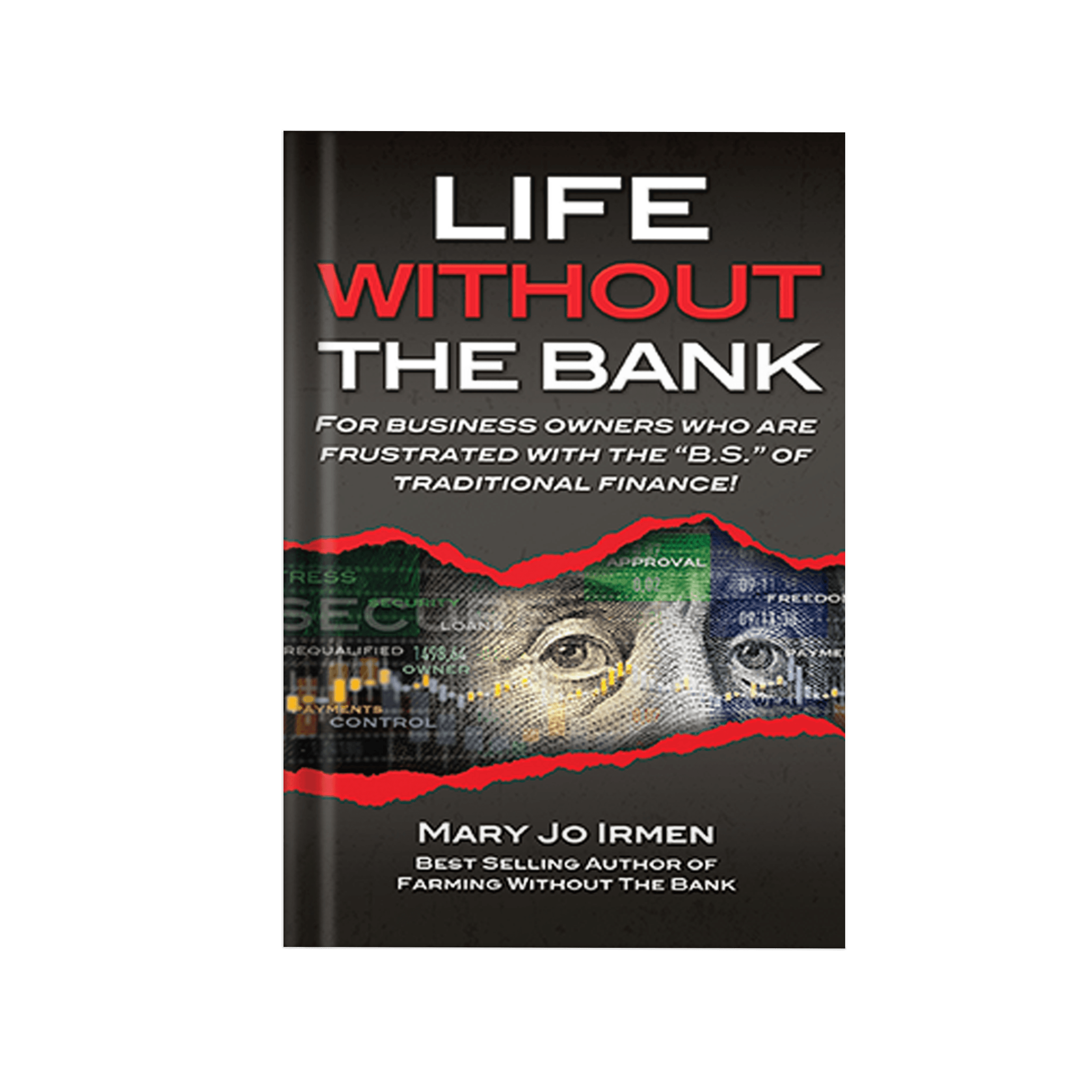
Your financial independence starts with one book.
Only one of three Americans can retire. Part of the fault is the conditioned belief that you must give up the use of your money when you’re young so you can have it later, assuming the stock market doesn’t collapse.