Podcast
EP. 273
The Dangerous Question Your Financial Agent Is Ignoring (Ep. 273)
Jun 11, 2026 ·
23 min
0:00 / 22:49
EPISODE OVERVIEW
ABOUT THIS EPISODE
The expertise of your financial advisor is paramount. A truly effective advisor asks insightful questions about your entire financial management journey, including your generational wealth planning. They should act as a coach, guiding you on how to create consistent cash flow and implement sound wealth building strategies for the long term. This personalized financial planning approach is key to securing your family's future.
Stop worrying about policy splits and company brands. Your agent is what actually matters. Mary Jo and Tarisa break down why these debates are a distraction — and why the single most important decision you'll make is who you choose as your agent.
In This Episode, We Cover
- Why policy structure debates are missing the point
- Whole life vs. universal life: what actually matters
- The Toyota/Honda analogy — and why how you drive beats what you drive
- Why One America works for farmers and blue collar families
- The widow story that proves why proper coverage matters
- How to spot an agent who will actually coach you
- 📘 Get the book
- 📧 Email Mary Jo: maryjo@withoutthebank.com
- ▶️ Subscribe on YouTube
CHAPTER TIMESTAMPS
- 00:00Intro: What really matters in infinite banking
- 01:13Why policy splits (10/90, 60/40) don't matter
- 04:14The best policy is the one you get started
- 06:03Whole life vs universal life explained
- 08:24Toyota vs Honda: why company brand isn't everything
- 10:50Why One America fits farmers & blue collar
- 14:28How you drive matters more than what you drive
- 16:30The widow story: why proper coverage matters
- 18:35Stop shopping for insurance — shop for the agent
- 21:10Don't just read — implement
- 22:42Final takeaway: find your coach
YOUTUBE EPISODE
TRANSCRIPTION
"Structure is not everything. What company is not everything. There's multiple good structures. There's multiple good companies. What matters is the agent that you're working with, and are they a fit for you? Are they asking good questions? Are they planning out your lifetime, your kids' lifetime, your grandkids' lifetime? Do we have estate or generational wealth planning? Are they helping you figure out how to create cash flow? Is that agent going to be your coach? That is what's most important for you."
Hello, hello, and welcome back to the podcast. Thank you very much for being here. All right. This is fun. Tarisa and I have timed up.
We made it together.
It has been crazy. We have not been able to get together.
I know. You've been a busy woman.
Well, so have you.
Yeah, that's true. You had a lot going on.
Yeah. All right. So I just got back from Coaching Academy. While we were at Coaching Academy for the Nelson Nash Institute, we talked a lot about policy structure, companies, all the stuff that's kind of floating around on social media, and what's right, what's wrong, and so I kind of thought it'd be a good topic today.
We're getting lost in the weeds is essentially what's happening. We hear a lot — and let's just take policy structure right away out of the gates. So we hear a lot about people talking about 10/90 policies, 60/40 policies, and they're talking about what we would call splits between base premium and paid-up additions, and how much goes to cash value and all that kind of stuff.
And it doesn't matter. I mean, it matters, but what matters more is that policy structured correctly for what the client needs. And you have come from another agency that did things very differently. And so we are sitting down an hour and a half, having a meeting, going through everything that you're doing, because we want to make sure that the policy design is perfect for what you need.
And so is it the same every single time? No. Is it similar? Yes. Can it be the same? Yes. But you can't just call us and say, "Hey, this is what I want." We want to know: how much money do you have? What does the cash flow look like? We need to know money mindset, about how you think about money.
Are you gonna be a good banker? Are you gonna borrow it and pay it back? Are you gonna do all the things that you need to do? And is there gonna be flexibility in that premium? If you set it up one way or another, what's the flexibility? What's the long-term premium gonna be? Because ideally, you're gonna pay this thing till you're 121. So what's that long-term premium gonna be?
So there's just a lot of things that we need to look at to say, "Oh, you have to do a 10/90, or you have to do a 25/75, or you have to do a 60/40." And to some of you out there, none of this makes any sense, and it doesn't need to make sense because it's not necessary. That's why we're here, to do the job that we do.
But your agent should be able to really go through and say, "Hey, this is what you need." Because just based on your experiences, Tarisa, of working with the other agency that you were with and how they kind of did a client meeting versus how you're doing client meetings now — are you finding more information now to make those long-term goals?
Yeah, absolutely. It's way more extensive. You know, there's so much background history that's involved in asking people what their current situation is, where do they want to go, what are their goals, where are they at currently. And it's kind of normal for people to be a little bit squeamish about giving their full details, but it really is so that we can suggest the best option for you moving forward, not because we're trying to sell you the biggest policy possible.
No, it's not that at all. And I remember — I can't remember when this was, it was years ago now — you were like, "Hey, why don't you just hop on and learn how I do my client meetings?" And I was blown away. I was like, "Oh my gosh, she really gets down to crossing all the T's, dotting all the I's." You know, I really took that to heart, because I was like, "Wow, she really cares about where that person is at, and she really cares about helping them where they need to go."
And in order to do that, we have to collect as much information as possible, so that we can recommend what policy split is best for you. Maybe it's a 10-pay if you're older. Maybe it's… You know, there's so many other options out there, and I think the best policy is the one that you got started.
Mm-hmm. That should be everyone's takeaway here today — it's like, no matter what the policy split is, don't get hung up on that, because if you do, you may not move forward, and that's worse than having a quote unquote "poorly designed" policy.
Yeah. And here's the thing. Some people will say a poorly designed policy is one that is old-fashioned, traditional whole life that takes 25 years to gain any cash value. I'm gonna say, no, it's not. It's just that you want your money today, and you don't want to wait for your money, so we're accelerating that. But those policies are good, and we've seen those policies be good, because we have seen them.
They are good policies 25, 30, 40 years down the road. It's just that nobody wants to wait that long. And so anything with a mutual company that pays dividends is a good policy, as long as it's not a universal life, an indexed universal, a variable universal. As long as it's straight-up whole life, it's a good policy.
Can every agent do what we do? No. But that's what we see when we have clients coming in — is asking them the good questions and saying, "What are you doing today?" Like, you had a client, for example — I'm just gonna pick on you for a sec. You had a client that we were talking about, and they had a disabled child. And I said, "Oh, did you put this specific rider on this policy so that they can make sure this child is taken care of when they pass away?" And you had forgotten to mention that.
I am looking for all of those things, because if you say, "I have a kid with Down syndrome," or, "I have a kid that has autism," then I wanna know at what level of autism. Are we functioning? Are we low functioning? If we have Down syndrome, do we have heart issues? Do we not have heart issues? What are the things, and who's gonna take care of these children? What kind of disability? Like, a lot of people aren't even gonna get to that. They're gonna have a very short meeting so they can sell a policy.
Mm-hmm. But it has to be structured for your family's needs, for your estate planning, and I feel like a lot of people don't think about that, because a lot of people just don't meet with farmers, where estate planning is such a big deal. But since I'm coming at it from another angle, I wanna know.
I don't care that you just have a house and a car — and you and I were just talking about that. I don't care that we just have a house and a car. The estate plan still needs to exist, because you have a house and a car. Because you have an estate of some sort, you know, that's gonna go through probate if it's not set up properly.
Yeah. Absolutely. I think that's a really good point. So what would you say was kind of your biggest takeaway from the policy splits thing at Coaching Academy?
Well, we just talked about it in this regard: that it's stupid to fight over it, and that there's no reason to be like, "This is what I want," or, "This is the right way, and this is the wrong way." Because right now in this industry, there's a lot of, "This is right. This is wrong," and in reality, what's right and wrong is dependent on what that client's needs are, and nobody is talking about client needs.
So we really hit home at Coaching Academy for the other agents: you better be asking those questions. And I put all of my questions on the screen of what I ask, and gave them an example. And some agents are doing a great job. They have six meetings. I don't do six meetings. I get everything I need in the first one. But everybody's coaching at a little bit different level. And so we really drove home the fact that stop worrying about what's right or wrong for policy structure and start worrying about what's right or wrong for the client's needs.
Mm. I think that's really important, because they're the one that's using the policy. To your point about policy structure or different companies, it's like, okay, you have a Toyota and a Honda. They're both really good vehicles. They're both gonna get you to your destination safely. They're gonna last for hundreds of thousands of miles.
But I think the thing that makes a difference, in my mind, are two things. One, do you have the guidance that is going to teach you how to use that vehicle properly? And that, I think, is having a good agent that can help you with strategy, that can ask those questions that no one's thinking about. To your point about the specific rider for people that have a special needs child, that was really insightful for me. And I got to thinking, "Oh, I might need that rider for myself." Not because I have special needs kids, but that's a really good rider.
Yep. You know, we even talked about, why don't we offer that on every client's policy.
Yeah. I remember having that conversation and being like, "Wow, I learned so much. It was awesome." And then the other thing that comes to mind when I'm thinking about what makes a difference in terms of your IBC journey is how you drive the vehicle. How do you treat your policy? Are you paying full premiums? Are you max funding the paid-up additions? Are you making sure you are paying back that loan? Are you paying the interest out of pocket? All of those things make a difference over time. And to be caught up in Toyota versus Honda — well, whatever. They're both pretty good options, you know?
Well, Nelson said you can have the exact same vehicle, and one person's is gonna go longer than the other's because of how you drive it. I look at it in that regard for companies too. We have the same problem with companies. "My company's better than your company. My dividends are higher than your dividends."
And that was something we did spend some time discussing, just as us coaches. Who cares? Because the non-guaranteed side of the contract is non-guaranteed. Those dividends don't have to be paid. And so some people are saying, "My company's better because we got higher dividends," but their contract rate of return is a point and a half lower.
Okay, so your guarantees are a point and a half lower, and you're looking at the non-guarantees. If a company is paying extremely high dividends, at what cost? People just don't think about that. A lot of times people are writing with a company so that they can sell more insurance. They're not looking at the actual security of the company.
We just recently, in the last, I don't know, five years, had a company demutualize. I never wrote with that company. My mentor early on did, but I never did, 'cause I would look at their financials and go, "Whoa, how come they can pay such high dividends? That doesn't even make sense when everybody else's dividends are lower."
But these mutual companies have been in business for 150 to 200 years, is the majority of them. Why are we fighting over companies and saying, "Oh, I need to go to company A, B, and C, and company D and E are terrible"? Are they terrible? They've been in business forever.
And so as an agent, and as a client talking to an agent — and it doesn't happen to me often, but it's funny when it does. The N company — there's two of them, but the one there's I like to pick on. So one of the N companies likes to be like, "Oh, we have an 8% rate of return." No, you don't, sweetie. You have not even a 4% guarantee, and then you're giving somebody a gross number. So people get into this rate of return business, and then they try to compete with the companies on that.
And at the end of the day, it's a mutual company. It's been in business forever. Who's their CEO? Do they like infinite banking? I'm not gonna write a life insurance policy with a company that does not like infinite banking. Just not happening. Because at what point are they gonna say, "You know, you can't have access to loans. You have to wait a year to take loans"?
That's happened in the past, where the CEO has said, "I don't like infinite banking," because people aren't paying their loans back, and they're not even paying interest. And so the CEO then says, "Nope, we're gonna change the rules, and you cannot take a loan until your policy is a year old. Then you can take a loan."
And so you want to make sure that they like infinite banking. But again, people are out here just trying to pin companies. What's the flexibility of that company? For us, we're using One America pretty much straight across the board. Why? Because there is not another company out there that allows the flexibility that farmers need, or that blue-collar businesses need, because they don't know when money's coming in.
They might not work at all in the wintertime, and then their business is gonna be super busy in the summertime. And so we need some flexibility on premium payments. We need some flexibility of putting extra money in, reducing it, being able to backfill — those kind of things that not all companies allow.
One company that I used to use in the past has this seven-year averaging thing. That does not work if your business is in a bad spurt because of some COVID crap or something that was happening, where now we've got three years of no income coming in, and we can't adjust for that. And then they're averaging it out.
So there's things that your agent needs to know, and you should be trusting your agent to put you with the right company. One America just hits all of those key points that no other company has been able to hit for me, 'cause I ask them the hard questions, and they just aren't there. But that doesn't mean the other companies aren't good for other people. It's just not good for my particular clientele.
Wow. Yeah, I think that that's a really good point. And you know, I have all of my policies with One America, and I love it. I love the experience as a client myself, right? Of the user experience, of the flexibility, of the paid-up additions. And I think the worst-designed policy is just one that you just don't start. To put anyone at ease — just get started, and make sure you're with the right person that can guide you, and just know that you're probably getting a Toyota or a Honda. Like, they're both gonna be okay, and how you drive it is going to make the big difference.
I had an email last week. Somebody said, "I'm shopping around for insurance," and so I wanted to set up an appointment, or I wanted to see what X, Y, and Z would cost. I'm like, "First of all, I don't answer questions about shopping for insurance, 'cause you're shopping for what? Your best cost of insurance, or are you shopping for the best agent?"
Because if you're shopping for insurance, I'm not your girl. You are going to be a banker. You need to think and act like a banker. You need to understand what that means. And so if you're just shopping for insurance, you have missed — and this person apparently read the book. I'm like, "I think you need to go back and reread the book," because you have missed the entire concept of what we're teaching.
And that is what is important. Find the agent that's going to be able to teach you the concept, and there is a number of us out there that are phenomenal. But if your meetings are a half an hour and less, and that's the only meeting you have before you've got a policy, you should run.
That is the important piece. And I've never had anybody that wants a short meeting, 'cause they just know that's not what they signed up for, I think. But my kids have had to sit through a full-on meeting just like anybody else does. Because your money is very serious.
You are not gonna be like, "Hey, I'm gonna buy that Honda or that Toyota, but I've never stepped foot in a car before." You probably are gonna find somebody to help you with lessons. You gotta get a license to drive.
You do. Right. So — do you have to do the three-point turn, or parallel parking?
You're just not… Think about the first time you drove your car. It was very awkward. You probably had a parent there teaching you how to do it. But yet, with life insurance, we're like, "Oh, we're just gonna buy this policy from anybody, willy-nilly," and we don't know if it's structured correctly. We don't know if it's the correct type of policy.
I think I just talked about this on the Without the Bank podcast, that in the last month I've seen three people that took my book to another agent, and all of them have bad policies, or they don't know how to use their policy, and they're fighting with the agent that sold them the policy because they told the agent how it needs to be structured. Ugh. Like, why would you even do that? Why not just go to the person that can help you from the get-go?
Yes, exactly. Also, because I think it's common, too, for someone that's just trying to make a sale to tell people just exactly what they want to hear. Or to just do it exactly the way that they're instructed to, and it's like, "No, no, no, no. We are the experts in this field. We have experienced, you know, mistakes and all the things that we want to help you avoid. And so we're not just gonna tell you what you want to hear. We're gonna tell you what's important. Do you have enough coverage for your family if something's to happen to you?"
That's also another thing that I think people lose sight of — is at the end of the day, we're selling life insurance. It's important for your family to have coverage in the event something's going to happen to you. I sat down with this family I think a couple years ago, and it was a son and a mom, and his dad had passed away, and he was the main income earner in their family, like making over six figures, and she was kind of staying at home, taking care of the kids. She had, like, a job at the school as admin.
But essentially they had built their lifestyle on over six figures, and then overnight it was gone, and his life insurance policy was only like $20,000, and that's it. And so now it's just put her in this predicament of, like, "Not only do I have to grieve my husband, I have to figure out income." And I think people lose sight of that. Like, yes, infinite banking is amazing because we can use cash value for today, but you also need to make sure the people that you love are covered if something happens to you.
Yep. Some agents aren't gonna talk about that. They're just gonna say, "Oh, I don't need to." But moral of the story, it all comes back to the agent. Is the agent asking good enough questions? Are they giving you good enough information and coaching you through using this?
Like, I had a client call this morning, and he's like, "You know, Mary Jo, you talk about the fact that people read the book once and they think they know everything." He's like, "I still don't know." I mean, I talked to him in… he's had a policy since 2020. Like, you're not supposed to know. That's what I'm here for as your agent, is to coach you through this and walk through these strategies of, "Okay, I might quit my job. I'm gonna have my 401(k). What do I do? What's going to create cash flow?"
How do we get that into a policy? And we talked about all those strategies this morning. That's the point of having us as an agent — not another agent who sells you the policy, and then where are you gonna get the strategies? Where are you gonna get the coaching? Where are you gonna get a little bit of the hand-holding that you might need?
And so we all just kind of determined that that's what needs to happen in this industry: people should be looking for the agent that's a good fit for them, not just saying, "What company and how much death benefit can I buy? And what does that look like?" And it's just not how we do it.
Yeah, and I like how we do this. Because I feel like it…
You are the lady that has done it the other way.
Yeah. Yes. Because it just is like, we put our clients first, and we're trying to make sure that they have everything that they need and that they're going to get out of this experience what they want.
I feel like we have a happy medium between, "Hey, we're gonna make sure you're taken care of. We're gonna make sure you know everything, but we're also gonna make you a little bit responsible, that you need to be the banker, you need to pay back your loans. We're not babysitting you." And so I feel like we have a good balance between that, where I did learn that there are agents that they'll have six meetings, and they basically go through the book with multiple meetings to get through their mindset and really get into the becoming your own banker piece of it, where I just wrap that all up into what you're doing so it makes sense with where you're at and where you want to go.
I just don't think that I need to learn anything that doesn't apply at the moment, 'cause I'm not gonna remember it. Like, I don't know why I need algebra. I don't know why I need to learn algebra when I'm not gonna ever use it, so can we just skip over that until I need it? And then that'll be handy. But we're just giving them so much information — is it going to be useful?
Okay, so the moral of the story for you guys is the takeaway. Structure is not everything. What company is not everything. There's multiple good structures. There's multiple good companies. What matters is the agent that you're working with, and are they a fit for you? Are they asking good questions? Are they planning out your lifetime, your kids' lifetime, your grandkids' lifetime? Do we have estate or generational wealth planning? Are they helping you figure out how to create cash flow? Is that agent going to be your coach?
That is what's most important for you, because that guy or that person, that lady, whatever, is going to be the one that you want to work with, and they will have done their due diligence on what is the best structure for you and what is the best company for you.
Okay, that's all I got today. Any final words from you, Tarisa?
If you haven't booked your strategy meeting, you should do that so that we can help you along the journey. And I always say this too, but we don't bite. We're here to help.
Yeah. So, you know, here's my two cents there, and I learned this at Coaching Academy. You can read for knowledge, or you can read for implementation. And if you're just reading for knowledge, you're never gonna get anywhere. Yeah, you got all this knowledge up there, but if you didn't actually implement what you learned, big deal.
And so if you're not gonna set up your strategy appointment with us, then at what point do you ever get started? You never do. And how do you know when and what is a good time to get started if you never talk to us? So you got the book. You've read the book. Call us, or go in the book — there's a link to the calendars in there — and schedule your appointment so that we can help you get started.
Even I don't bite. I tend to pretend to be a little bit meaner than I am. Big talk, little action over here. Okay, let us know if there's anything we can do to help. If you have not, go to withoutthebank.com, grab your books, preferably the bundle with Nelson's book, set up your appointment, and we'll visit with you then. You guys have a fantastic rest of your day.
View MoreHello, hello, and welcome back to the podcast. Thank you very much for being here. All right. This is fun. Tarisa and I have timed up.
We made it together.
It has been crazy. We have not been able to get together.
I know. You've been a busy woman.
Well, so have you.
Yeah, that's true. You had a lot going on.
Yeah. All right. So I just got back from Coaching Academy. While we were at Coaching Academy for the Nelson Nash Institute, we talked a lot about policy structure, companies, all the stuff that's kind of floating around on social media, and what's right, what's wrong, and so I kind of thought it'd be a good topic today.
We're getting lost in the weeds is essentially what's happening. We hear a lot — and let's just take policy structure right away out of the gates. So we hear a lot about people talking about 10/90 policies, 60/40 policies, and they're talking about what we would call splits between base premium and paid-up additions, and how much goes to cash value and all that kind of stuff.
And it doesn't matter. I mean, it matters, but what matters more is that policy structured correctly for what the client needs. And you have come from another agency that did things very differently. And so we are sitting down an hour and a half, having a meeting, going through everything that you're doing, because we want to make sure that the policy design is perfect for what you need.
And so is it the same every single time? No. Is it similar? Yes. Can it be the same? Yes. But you can't just call us and say, "Hey, this is what I want." We want to know: how much money do you have? What does the cash flow look like? We need to know money mindset, about how you think about money.
Are you gonna be a good banker? Are you gonna borrow it and pay it back? Are you gonna do all the things that you need to do? And is there gonna be flexibility in that premium? If you set it up one way or another, what's the flexibility? What's the long-term premium gonna be? Because ideally, you're gonna pay this thing till you're 121. So what's that long-term premium gonna be?
So there's just a lot of things that we need to look at to say, "Oh, you have to do a 10/90, or you have to do a 25/75, or you have to do a 60/40." And to some of you out there, none of this makes any sense, and it doesn't need to make sense because it's not necessary. That's why we're here, to do the job that we do.
But your agent should be able to really go through and say, "Hey, this is what you need." Because just based on your experiences, Tarisa, of working with the other agency that you were with and how they kind of did a client meeting versus how you're doing client meetings now — are you finding more information now to make those long-term goals?
Yeah, absolutely. It's way more extensive. You know, there's so much background history that's involved in asking people what their current situation is, where do they want to go, what are their goals, where are they at currently. And it's kind of normal for people to be a little bit squeamish about giving their full details, but it really is so that we can suggest the best option for you moving forward, not because we're trying to sell you the biggest policy possible.
No, it's not that at all. And I remember — I can't remember when this was, it was years ago now — you were like, "Hey, why don't you just hop on and learn how I do my client meetings?" And I was blown away. I was like, "Oh my gosh, she really gets down to crossing all the T's, dotting all the I's." You know, I really took that to heart, because I was like, "Wow, she really cares about where that person is at, and she really cares about helping them where they need to go."
And in order to do that, we have to collect as much information as possible, so that we can recommend what policy split is best for you. Maybe it's a 10-pay if you're older. Maybe it's… You know, there's so many other options out there, and I think the best policy is the one that you got started.
Mm-hmm. That should be everyone's takeaway here today — it's like, no matter what the policy split is, don't get hung up on that, because if you do, you may not move forward, and that's worse than having a quote unquote "poorly designed" policy.
Yeah. And here's the thing. Some people will say a poorly designed policy is one that is old-fashioned, traditional whole life that takes 25 years to gain any cash value. I'm gonna say, no, it's not. It's just that you want your money today, and you don't want to wait for your money, so we're accelerating that. But those policies are good, and we've seen those policies be good, because we have seen them.
They are good policies 25, 30, 40 years down the road. It's just that nobody wants to wait that long. And so anything with a mutual company that pays dividends is a good policy, as long as it's not a universal life, an indexed universal, a variable universal. As long as it's straight-up whole life, it's a good policy.
Can every agent do what we do? No. But that's what we see when we have clients coming in — is asking them the good questions and saying, "What are you doing today?" Like, you had a client, for example — I'm just gonna pick on you for a sec. You had a client that we were talking about, and they had a disabled child. And I said, "Oh, did you put this specific rider on this policy so that they can make sure this child is taken care of when they pass away?" And you had forgotten to mention that.
I am looking for all of those things, because if you say, "I have a kid with Down syndrome," or, "I have a kid that has autism," then I wanna know at what level of autism. Are we functioning? Are we low functioning? If we have Down syndrome, do we have heart issues? Do we not have heart issues? What are the things, and who's gonna take care of these children? What kind of disability? Like, a lot of people aren't even gonna get to that. They're gonna have a very short meeting so they can sell a policy.
Mm-hmm. But it has to be structured for your family's needs, for your estate planning, and I feel like a lot of people don't think about that, because a lot of people just don't meet with farmers, where estate planning is such a big deal. But since I'm coming at it from another angle, I wanna know.
I don't care that you just have a house and a car — and you and I were just talking about that. I don't care that we just have a house and a car. The estate plan still needs to exist, because you have a house and a car. Because you have an estate of some sort, you know, that's gonna go through probate if it's not set up properly.
Yeah. Absolutely. I think that's a really good point. So what would you say was kind of your biggest takeaway from the policy splits thing at Coaching Academy?
Well, we just talked about it in this regard: that it's stupid to fight over it, and that there's no reason to be like, "This is what I want," or, "This is the right way, and this is the wrong way." Because right now in this industry, there's a lot of, "This is right. This is wrong," and in reality, what's right and wrong is dependent on what that client's needs are, and nobody is talking about client needs.
So we really hit home at Coaching Academy for the other agents: you better be asking those questions. And I put all of my questions on the screen of what I ask, and gave them an example. And some agents are doing a great job. They have six meetings. I don't do six meetings. I get everything I need in the first one. But everybody's coaching at a little bit different level. And so we really drove home the fact that stop worrying about what's right or wrong for policy structure and start worrying about what's right or wrong for the client's needs.
Mm. I think that's really important, because they're the one that's using the policy. To your point about policy structure or different companies, it's like, okay, you have a Toyota and a Honda. They're both really good vehicles. They're both gonna get you to your destination safely. They're gonna last for hundreds of thousands of miles.
But I think the thing that makes a difference, in my mind, are two things. One, do you have the guidance that is going to teach you how to use that vehicle properly? And that, I think, is having a good agent that can help you with strategy, that can ask those questions that no one's thinking about. To your point about the specific rider for people that have a special needs child, that was really insightful for me. And I got to thinking, "Oh, I might need that rider for myself." Not because I have special needs kids, but that's a really good rider.
Yep. You know, we even talked about, why don't we offer that on every client's policy.
Yeah. I remember having that conversation and being like, "Wow, I learned so much. It was awesome." And then the other thing that comes to mind when I'm thinking about what makes a difference in terms of your IBC journey is how you drive the vehicle. How do you treat your policy? Are you paying full premiums? Are you max funding the paid-up additions? Are you making sure you are paying back that loan? Are you paying the interest out of pocket? All of those things make a difference over time. And to be caught up in Toyota versus Honda — well, whatever. They're both pretty good options, you know?
Well, Nelson said you can have the exact same vehicle, and one person's is gonna go longer than the other's because of how you drive it. I look at it in that regard for companies too. We have the same problem with companies. "My company's better than your company. My dividends are higher than your dividends."
And that was something we did spend some time discussing, just as us coaches. Who cares? Because the non-guaranteed side of the contract is non-guaranteed. Those dividends don't have to be paid. And so some people are saying, "My company's better because we got higher dividends," but their contract rate of return is a point and a half lower.
Okay, so your guarantees are a point and a half lower, and you're looking at the non-guarantees. If a company is paying extremely high dividends, at what cost? People just don't think about that. A lot of times people are writing with a company so that they can sell more insurance. They're not looking at the actual security of the company.
We just recently, in the last, I don't know, five years, had a company demutualize. I never wrote with that company. My mentor early on did, but I never did, 'cause I would look at their financials and go, "Whoa, how come they can pay such high dividends? That doesn't even make sense when everybody else's dividends are lower."
But these mutual companies have been in business for 150 to 200 years, is the majority of them. Why are we fighting over companies and saying, "Oh, I need to go to company A, B, and C, and company D and E are terrible"? Are they terrible? They've been in business forever.
And so as an agent, and as a client talking to an agent — and it doesn't happen to me often, but it's funny when it does. The N company — there's two of them, but the one there's I like to pick on. So one of the N companies likes to be like, "Oh, we have an 8% rate of return." No, you don't, sweetie. You have not even a 4% guarantee, and then you're giving somebody a gross number. So people get into this rate of return business, and then they try to compete with the companies on that.
And at the end of the day, it's a mutual company. It's been in business forever. Who's their CEO? Do they like infinite banking? I'm not gonna write a life insurance policy with a company that does not like infinite banking. Just not happening. Because at what point are they gonna say, "You know, you can't have access to loans. You have to wait a year to take loans"?
That's happened in the past, where the CEO has said, "I don't like infinite banking," because people aren't paying their loans back, and they're not even paying interest. And so the CEO then says, "Nope, we're gonna change the rules, and you cannot take a loan until your policy is a year old. Then you can take a loan."
And so you want to make sure that they like infinite banking. But again, people are out here just trying to pin companies. What's the flexibility of that company? For us, we're using One America pretty much straight across the board. Why? Because there is not another company out there that allows the flexibility that farmers need, or that blue-collar businesses need, because they don't know when money's coming in.
They might not work at all in the wintertime, and then their business is gonna be super busy in the summertime. And so we need some flexibility on premium payments. We need some flexibility of putting extra money in, reducing it, being able to backfill — those kind of things that not all companies allow.
One company that I used to use in the past has this seven-year averaging thing. That does not work if your business is in a bad spurt because of some COVID crap or something that was happening, where now we've got three years of no income coming in, and we can't adjust for that. And then they're averaging it out.
So there's things that your agent needs to know, and you should be trusting your agent to put you with the right company. One America just hits all of those key points that no other company has been able to hit for me, 'cause I ask them the hard questions, and they just aren't there. But that doesn't mean the other companies aren't good for other people. It's just not good for my particular clientele.
Wow. Yeah, I think that that's a really good point. And you know, I have all of my policies with One America, and I love it. I love the experience as a client myself, right? Of the user experience, of the flexibility, of the paid-up additions. And I think the worst-designed policy is just one that you just don't start. To put anyone at ease — just get started, and make sure you're with the right person that can guide you, and just know that you're probably getting a Toyota or a Honda. Like, they're both gonna be okay, and how you drive it is going to make the big difference.
I had an email last week. Somebody said, "I'm shopping around for insurance," and so I wanted to set up an appointment, or I wanted to see what X, Y, and Z would cost. I'm like, "First of all, I don't answer questions about shopping for insurance, 'cause you're shopping for what? Your best cost of insurance, or are you shopping for the best agent?"
Because if you're shopping for insurance, I'm not your girl. You are going to be a banker. You need to think and act like a banker. You need to understand what that means. And so if you're just shopping for insurance, you have missed — and this person apparently read the book. I'm like, "I think you need to go back and reread the book," because you have missed the entire concept of what we're teaching.
And that is what is important. Find the agent that's going to be able to teach you the concept, and there is a number of us out there that are phenomenal. But if your meetings are a half an hour and less, and that's the only meeting you have before you've got a policy, you should run.
That is the important piece. And I've never had anybody that wants a short meeting, 'cause they just know that's not what they signed up for, I think. But my kids have had to sit through a full-on meeting just like anybody else does. Because your money is very serious.
You are not gonna be like, "Hey, I'm gonna buy that Honda or that Toyota, but I've never stepped foot in a car before." You probably are gonna find somebody to help you with lessons. You gotta get a license to drive.
You do. Right. So — do you have to do the three-point turn, or parallel parking?
You're just not… Think about the first time you drove your car. It was very awkward. You probably had a parent there teaching you how to do it. But yet, with life insurance, we're like, "Oh, we're just gonna buy this policy from anybody, willy-nilly," and we don't know if it's structured correctly. We don't know if it's the correct type of policy.
I think I just talked about this on the Without the Bank podcast, that in the last month I've seen three people that took my book to another agent, and all of them have bad policies, or they don't know how to use their policy, and they're fighting with the agent that sold them the policy because they told the agent how it needs to be structured. Ugh. Like, why would you even do that? Why not just go to the person that can help you from the get-go?
Yes, exactly. Also, because I think it's common, too, for someone that's just trying to make a sale to tell people just exactly what they want to hear. Or to just do it exactly the way that they're instructed to, and it's like, "No, no, no, no. We are the experts in this field. We have experienced, you know, mistakes and all the things that we want to help you avoid. And so we're not just gonna tell you what you want to hear. We're gonna tell you what's important. Do you have enough coverage for your family if something's to happen to you?"
That's also another thing that I think people lose sight of — is at the end of the day, we're selling life insurance. It's important for your family to have coverage in the event something's going to happen to you. I sat down with this family I think a couple years ago, and it was a son and a mom, and his dad had passed away, and he was the main income earner in their family, like making over six figures, and she was kind of staying at home, taking care of the kids. She had, like, a job at the school as admin.
But essentially they had built their lifestyle on over six figures, and then overnight it was gone, and his life insurance policy was only like $20,000, and that's it. And so now it's just put her in this predicament of, like, "Not only do I have to grieve my husband, I have to figure out income." And I think people lose sight of that. Like, yes, infinite banking is amazing because we can use cash value for today, but you also need to make sure the people that you love are covered if something happens to you.
Yep. Some agents aren't gonna talk about that. They're just gonna say, "Oh, I don't need to." But moral of the story, it all comes back to the agent. Is the agent asking good enough questions? Are they giving you good enough information and coaching you through using this?
Like, I had a client call this morning, and he's like, "You know, Mary Jo, you talk about the fact that people read the book once and they think they know everything." He's like, "I still don't know." I mean, I talked to him in… he's had a policy since 2020. Like, you're not supposed to know. That's what I'm here for as your agent, is to coach you through this and walk through these strategies of, "Okay, I might quit my job. I'm gonna have my 401(k). What do I do? What's going to create cash flow?"
How do we get that into a policy? And we talked about all those strategies this morning. That's the point of having us as an agent — not another agent who sells you the policy, and then where are you gonna get the strategies? Where are you gonna get the coaching? Where are you gonna get a little bit of the hand-holding that you might need?
And so we all just kind of determined that that's what needs to happen in this industry: people should be looking for the agent that's a good fit for them, not just saying, "What company and how much death benefit can I buy? And what does that look like?" And it's just not how we do it.
Yeah, and I like how we do this. Because I feel like it…
You are the lady that has done it the other way.
Yeah. Yes. Because it just is like, we put our clients first, and we're trying to make sure that they have everything that they need and that they're going to get out of this experience what they want.
I feel like we have a happy medium between, "Hey, we're gonna make sure you're taken care of. We're gonna make sure you know everything, but we're also gonna make you a little bit responsible, that you need to be the banker, you need to pay back your loans. We're not babysitting you." And so I feel like we have a good balance between that, where I did learn that there are agents that they'll have six meetings, and they basically go through the book with multiple meetings to get through their mindset and really get into the becoming your own banker piece of it, where I just wrap that all up into what you're doing so it makes sense with where you're at and where you want to go.
I just don't think that I need to learn anything that doesn't apply at the moment, 'cause I'm not gonna remember it. Like, I don't know why I need algebra. I don't know why I need to learn algebra when I'm not gonna ever use it, so can we just skip over that until I need it? And then that'll be handy. But we're just giving them so much information — is it going to be useful?
Okay, so the moral of the story for you guys is the takeaway. Structure is not everything. What company is not everything. There's multiple good structures. There's multiple good companies. What matters is the agent that you're working with, and are they a fit for you? Are they asking good questions? Are they planning out your lifetime, your kids' lifetime, your grandkids' lifetime? Do we have estate or generational wealth planning? Are they helping you figure out how to create cash flow? Is that agent going to be your coach?
That is what's most important for you, because that guy or that person, that lady, whatever, is going to be the one that you want to work with, and they will have done their due diligence on what is the best structure for you and what is the best company for you.
Okay, that's all I got today. Any final words from you, Tarisa?
If you haven't booked your strategy meeting, you should do that so that we can help you along the journey. And I always say this too, but we don't bite. We're here to help.
Yeah. So, you know, here's my two cents there, and I learned this at Coaching Academy. You can read for knowledge, or you can read for implementation. And if you're just reading for knowledge, you're never gonna get anywhere. Yeah, you got all this knowledge up there, but if you didn't actually implement what you learned, big deal.
And so if you're not gonna set up your strategy appointment with us, then at what point do you ever get started? You never do. And how do you know when and what is a good time to get started if you never talk to us? So you got the book. You've read the book. Call us, or go in the book — there's a link to the calendars in there — and schedule your appointment so that we can help you get started.
Even I don't bite. I tend to pretend to be a little bit meaner than I am. Big talk, little action over here. Okay, let us know if there's anything we can do to help. If you have not, go to withoutthebank.com, grab your books, preferably the bundle with Nelson's book, set up your appointment, and we'll visit with you then. You guys have a fantastic rest of your day.



ready to start?
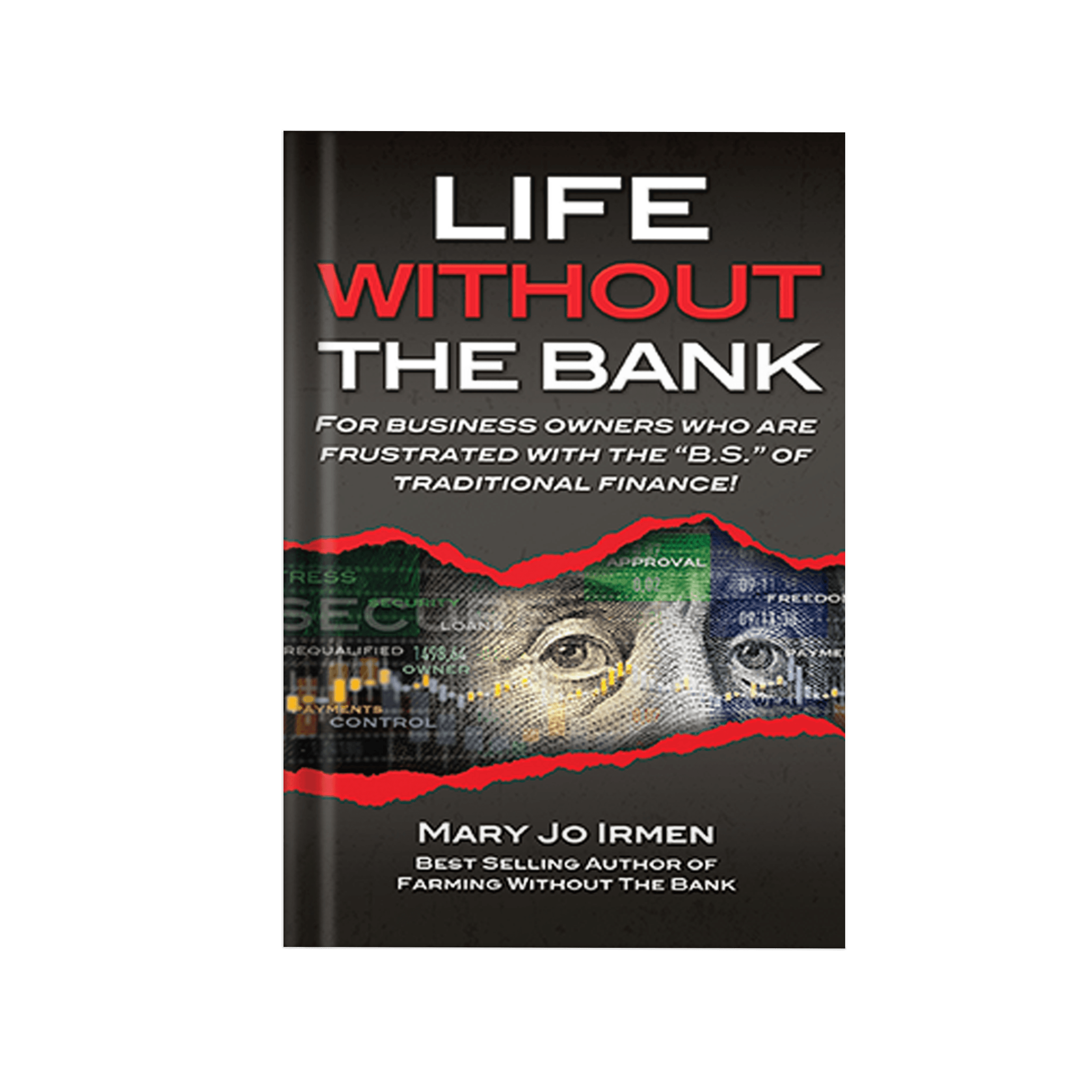
Your financial independence starts with one book.
Only one of three Americans can retire. Part of the fault is the conditioned belief that you must give up the use of your money when you’re young so you can have it later, assuming the stock market doesn’t collapse.