Podcast
EP. 269
Why the Wealthy Never Stop Buying Life Insurance (Ep. 269)
May 14, 2026 ·
21 min
0:00 / 21:06
EPISODE OVERVIEW
ABOUT THIS EPISODE
Paul Atkins owns 54 life insurance policies — and it reveals everything financial gurus miss.
The SEC Chairman's financial disclosure shocked professors at Florida State, Illinois State, and the University of Georgia. But for anyone who understands permanent life insurance, it made perfect sense.
In Episode 269 of Without the Bank, we break down exactly what the "experts" got wrong — and what Paul Atkins, the Rockefellers, and high-net-worth families have known for generations.
💡 Key Takeaways
- ✅ Why permanent life insurance is NOT just a death benefit
- ✅ How cash value grows tax-deferred and is accessed income-tax-free through loans
- ✅ How to use your policy as collateral while keeping your compound interest uninterrupted
- ✅ How life insurance is used for estate planning and generational wealth transfer
- ✅ Why the Infinite Banking Concept works — and why most financial media ignores it
- ✅ Why this strategy isn't just for the ultra-wealthy — it works for everyday people too
Paul Atkins holds $32.7 million in life insurance — roughly 10% of his $327 million net worth. When financial professors call that "confusing," it tells you everything about the gap between credentialed advice and real wealth strategy.
📘 Books Mentioned
- 📘 Get the books
- 📧 Email Mary Jo: maryjo@withoutthebank.com
- 🌐 withoutthebank.com
- ▶️ Subscribe on YouTube
CHAPTER TIMESTAMPS
- 00:00Paul Atkins' 54 Life Insurance Policies
- 01:00Who Is Paul Atkins?
- 03:00What Financial Professors Got Wrong
- 05:00The Truth About Cash Value vs. Death Benefit
- 07:00Is Life Insurance Only for the Wealthy?
- 09:30Estate Planning & Advanced Strategies
- 12:00Life Insurance as a Liquidity Tool
- 14:00The Rockefeller Wealth Strategy
- 16:30Why the Media Gets It Wrong
- 18:00Why Nobody Teaches This
- 20:30What You Should Do Next
YOUTUBE EPISODE
TRANSCRIPTION
"There's obviously power in multiple policies, 'cause he's building his warehouse of wealth. Regardless if that's what he's doing or not, he sees the value of life insurance. That's awesome and exciting to see — Mr. Atkins, who is gonna sit on the Securities and Exchange Commission, understands the value of life insurance. It is very unfortunate that the majority of the population doesn't understand this. I find it very fun information that when people in government have life insurance, it's always fun to see, because so many people think, 'Well, what happens if they change the rules on it?' Why would they, when they have it?"
Hello, hello, and welcome back to the podcast. Thank you very much for being here. All right, I wanted to record today because we have a hot topic going on out in the investment government world, and that is Paul Atkins. If you guys don't know Mr. Paul, he is a nominee to chair the Securities and Exchange Commission.
And there is an article on every financial network online everywhere. It's the same article everywhere, so I just wanna break it down, 'cause I think it's funny, and I think that we can learn a few things from the nominee of Paul.
So, when you are a nominee, you have to disclose all of your financials. In his financials, he has 54 life insurance policies. Oh my gosh, this has turned the gurus upside down. Because why? Why would he have 54 life insurance policies? So I have notes, y'all. Like, I got some notes we're gonna go over. And I'm just gonna kinda go through the article piece by piece, because it's just gonna be easier.
Okay, so this is an interesting little fact. That in 2023, there were just under 260 million active policies in the US — fewer than one on average for every American adult. That's crazy. That is just proof that we all need more life insurance. 'Cause, you know, not everybody has some, but we're all guaranteed to die.
Meanwhile, the 54 insurance policies represent 10% of Mr. Atkins' net worth. 10%. His net worth is $327 million. So he's got $32.7 million of life insurance policies as part of his net worth. I am assuming that they are counting the death benefit on those policies as net worth, not cash value.
They go on to say, "The decision by Atkins to amass dozens of life insurance policies flummoxes" — flummoxes? — "even some experts." Oh my gosh, why? Why would he have those?
James, a professor at the University of Georgia, said it would make no sense for an individual to have 20, 30, 40, let alone 50 universal policies on their own life. It would make no sense. Why would we do this?
So Timothy Harris, an economics professor at Illinois State, told Fortune, "Perhaps the incoming SEC chair's dozens of life insurance policies are a vehicle to reduce taxes. There are two main types of insurance." Here's where the lesson comes in, my friends. "Term and whole."
Okay, if those of you that listen to me know already what's wrong, kudos to you for listening. "Term policies are for a fixed period." Yeah, we know that. "The latter stay in effect for a policyholder's life. Each of the 54 policies are in the whole category, a variation of it known as universal."
So Mr. Tim Harris, economics professor at Illinois State, let me educate you on life insurance. I don't mean to be a Karen, but this is important here. So the two categories are term and permanent insurance. Permanent insurance has whole life, universal, variable, indexed universal, and a variety of all of those mixed together underneath the umbrella of permanent insurance. The umbrella is not titled whole life. Okay?
So this is disturbing to me, because this guy is a professor. He's writing for Fortune magazine — or not, he's not writing, I guess he's being interviewed for Fortune magazine. That is extremely disturbing.
But Mr. Atkins has universal life, which I'm assuming, because he is invested in so many companies and it's all about a rate of return, he's looking at the rate of return on the universal life. Which a universal life, in his defense, does have a guarantee. There are no guarantees on the fees, which is unfortunate. He's gonna see that as he gets older, that's gonna deplete his cash value. He might lose some policies. But he too is not a life insurance person, and he obviously hasn't found the right ones, in my opinion.
This professor also goes on to say whole life insurance combines a savings account with a death payout. It's called cash value, and the cash value is some of the death benefit they allow you to use while you're alive. It's not a savings account. Like, if he was a licensed life insurance agent, he'd probably get his life insurance license revoked.
He says policyholders deposit money into their account and receive tax-deferred interest. A hundred percent. The cash value is growing income tax-free. Tax-deferred. "When they die, beneficiaries receive the saved money, interest, and lump sum. It is less about insuring against premature death and more of an investment vehicle."
So let's rewind a sec. "When they die, the beneficiaries receive the saved money, interest, and lump sum." For the love of Pete. This guy is a professor. What was he a professor of? Economics. Okay. You don't get the cash value and the death benefit, if that's what he's trying to say. You just get the death benefit, because the cash value is a portion of that, like I just said, that you're able to use later.
Then he said, "Then it is less about insuring against premature death, and it is more of an investment vehicle." I'm assuming he's probably not using it as an investment vehicle, because it's not an investment. It's a life insurance policy. He's probably using it for the liquidity, so that he can use money to go invest in other things. I don't know. Not sure.
Then Mr. Harris continues to say, "Whole life is not the best investment. For high-income earners that have already exhausted all the benefits of a 401(k), you can turn to these whole or universal insurance policies to try and circumvent some of the taxes."
So the only people that shouldn't be paying taxes are the high-income earners? You mean the people that are putting money into 401(k)s and IRAs and just punching a clock, they shouldn't be told that they're gonna be taxed later, and be able to take money out or to access money with a tax advantage? They shouldn't be told that? Everybody should know exactly this, not just high-income earners.
This is not just for high-income earners. This is for everybody that has money and they want to avoid the tax. Because what is happening is people that are really good savers, maybe people that have invested well, have a bunch of money at retirement, and then they get to take that money out, and guess what? Medicaid goes up, they gotta pay in the higher tax bracket. They are taking more money out than what they need to live, because they also have to take enough out to pay for taxes. So the money is depleting faster.
That doesn't have to happen when we have whole life insurance, because it is tax-deferred, and when we borrow against it and use it correctly, it doesn't show up in our income taxes.
This gets better. You guys, I'm not done. Patricia Born, a professor at Florida State University College of Business, says this isn't a normal thing, but there may be an explanation beyond taxes. Okay? He is on a lot of boards because he invests in a lot of things. So he's on a lot of boards, and it would make sense to have policies written specifically to pay to each of those trusts.
So, oh, yeah, maybe — just maybe — he is doing some estate planning. Maybe he's passing on some generational wealth income tax-free. If he's got it in a trust, it could possibly go estate tax-free as well.
Then she goes on to say Mr. Atkins maybe has purchased the life insurance on other people's lives. So she goes on to talk about that. Those who want to dump their life insurance can sell it back to the company that issued it for a surrender value or a buyback price. It's the surrender value. It's the amount of cash you accumulated. The insurance company will give you that.
Or, she said, people will buy insurance on other people hoping that they will die soon, and then they will get the death benefit. This happens, okay? Where someone might come to an elderly person and say, "Oh, you need some cash. Well, let me buy your life insurance policy." Maybe they'll pay a little over surrender value, but what they want to do is make sure you're going to die sooner than later. Because then they're gonna take over those premiums, and then upon this person's death, they're going to get the death benefit.
There are people that do that. Maybe it's good for a reason. I don't know what that reason would be. Only because people don't know that they can actually borrow against their surrender value. They can borrow against their cash value. Universal life, indexed universal, variable universal — not just whole life. You can borrow against those other ones. Maybe not the best idea, but if I'm ill, and I know I'm probably gonna pass away in the next five to 10 years, which is typically what these people are looking for — a nice rate of return — so maybe then just borrow against it.
But what she's saying is maybe he owns that many policies because he's buying them on other people's lives. The guy clearly likes to have a big pool of varied investments, and I think these are investments. Okay? Life insurance is not an investment, people.
Is he probably there for some sort of rate of return, for some sort of generational wealth, for some sort of liquidity, for some sort of assurity against loans he might have, that he can use the policies as collateral? Maybe. Maybe he has met with one of the Rockefellers, and he has said, "You know what? This is actually a pretty good idea, to be buying some permanent life insurance." I don't know. I'm gonna be watching this to see what else comes out about it, because they have asked him to disclose that piece of it. Apparently he does not have to, is what I have read, but I don't know.
I find it funny, though, that we have all these gurus — that the guy that wrote this article is actually a Bitcoin guy. And so I just find it very comical that we have all these gurus in the financial industry that know everything about business. They know everything about economics. They're the ones that we're quoting in here, and they don't know about life insurance. They don't know how life insurance works, but yet these are the people that we have found to be interviewed.
Why are we not looking at that and going, "Whoa, that's amazing"? That guy knows the value of having life insurance, permanent life insurance, and clearly it's for some sort of an estate plan or liquidity. That's what I'm gonna look at. Or he's got it for collateral. So clearly he understands the power of that and the certainty of that, and we're not questioning how it works. We're questioning him as an investor. To me, it almost sounds like they think it's a bad thing, rather than going, "Whoa, why don't we sit back and look?"
This brings me to another topic of the Rockefellers. I had a very interesting meeting this week with a potential client who, when he was in college — like, he was probably in his early 20s, the way it sounded — he had a friend who knew one of the Rockefellers, and he said that during a Fourth of July event, the Rockefellers were having a gathering, and he went with to this event. And he said when he learned, when he read my book and he learned about infinite banking, a flashback came back to him. A memory that when he was at this event, all these old guys were sitting around smoking cigars, talking about money. He said, "I remember them saying stuff like this."
What I find interesting about that whole thing is not just that the Rockefellers were talking about it — because we've heard for many, many years the Rockefellers have life insurance, right? But what I found interesting about that comment is that the old guys were sitting around talking about money. We have people that don't talk about money.
They're gonna go to school for business. They don't learn anything about liquidity, control, guarantees. We have economists that don't know anything about life insurance, liquidity, control, guarantees, uninterrupted compound interest. They're economists. Those are the professionals.
Yet we have business owners — which Mr. Atkins is a business owner of many different businesses. He's a partner. He's got holdings in many different businesses. He knows how to use the tax code to his advantage by having life insurance that can grow income tax-free. He can use it during retirement income tax-free if he needs to. He can use it for collateral. He can use it for liquidity.
We as normal people do not sit around smoking cigars, talking about our money. We as normal people sit around smoking cigars, talking about how everybody's trying to screw us, what's going on in the world today. We're not surrounding ourselves with people that can make us better, and it doesn't matter what business we have. It doesn't matter what we're doing. Why are we not sitting around with individuals that can share insight, and we can genuinely want to learn from that?
I was interviewed probably two years ago now by Fortune magazine, and they were gonna do a whole article on the Infinite Banking Concept. And a gentleman reached out to me — he had reached out to somebody else that recommended me. That person is in the world of life insurance. That's all they do is analyze life insurance policies, and he recommended me because he said, "You're the only one I've heard speak that actually talks about it without making it some kind of gimmick."
So I was interviewed, and it was a great interview, and it was one of the very few times somebody that has been able to write an article actually contacts a source and an expert in that field to talk about it. And guess what? The article did not get published. I don't know why it didn't get published. I reached out to him later and, you know, I'm sure his editors just are like, "Yeah, it's not important enough to get published." But it would've most likely been done in the correct manner, because they came to somebody that is going to give correct information.
This is the kind of stuff that drives me a little bit crazy, is when we have people publishing things that are not correct 'cause they didn't go to the source. And it's happened to me before where I've seen stuff in the agriculture industry not written correctly because they couldn't just make a phone call and get the details. Instead, if you have the details and you have the knowledge, you can't spin it to make it sound crazy.
One of my colleagues, Tricia, made a comment that I thought was very funny. She said, "If these people that were quoted in this article would actually show up at the Nelson Nash Institute think tank, they would be in a room of people that had many policies each, not just one."
So there's obviously power in multiple policies, 'cause he's building his warehouse of wealth. Regardless if that's what he's doing or not, he sees the value of life insurance. That's awesome and exciting to see that Mr. Atkins, who is gonna sit on the Securities and Exchange Commission, understands the value of life insurance. It is very unfortunate that the majority of the population doesn't understand this.
And when people ask me — and I've had this question twice in the last week — people will say, "Well, Mary Jo, why doesn't anybody know about this? Like, this is just amazing. How can people… If this really works like this, and this isn't too good to be true, and this isn't some kind of a scam, how can it work like this?" And I'm like, "That's just how it works."
And people don't know about it because of things like this. Because our economists, our business teachers, the life insurance industry as a whole has not done a very good job of educating you on the tool of what it is and how it works. If somebody just educates you and you see it, and you're like, "Whoa" — what would happen if people were just educated on what they were buying instead of just being told what to buy?
It'd be a game changer. It would be a game changer. We would have people in this country that paid attention to their money. So I think it's a combination of a lot of things. Why don't people know, and why is this so alarming to those people that should know? Because it's a two-hundred-year-old product, we're not chasing rates of return, and it's not fancy. But they're not thinking of money the same way we think of money either. Proof. Proof that they don't.
Okay. I thought it was fun to share that. I'll be keeping an eye on it. If you guys see anything updated on it, send it to me. Let me know, so that I can see how this all plays out. But I find it very fun information that when people in government have life insurance, it's always fun to see, because so many people think, "Well, what happens if they change the rules on it?" Why would they, when they have it?
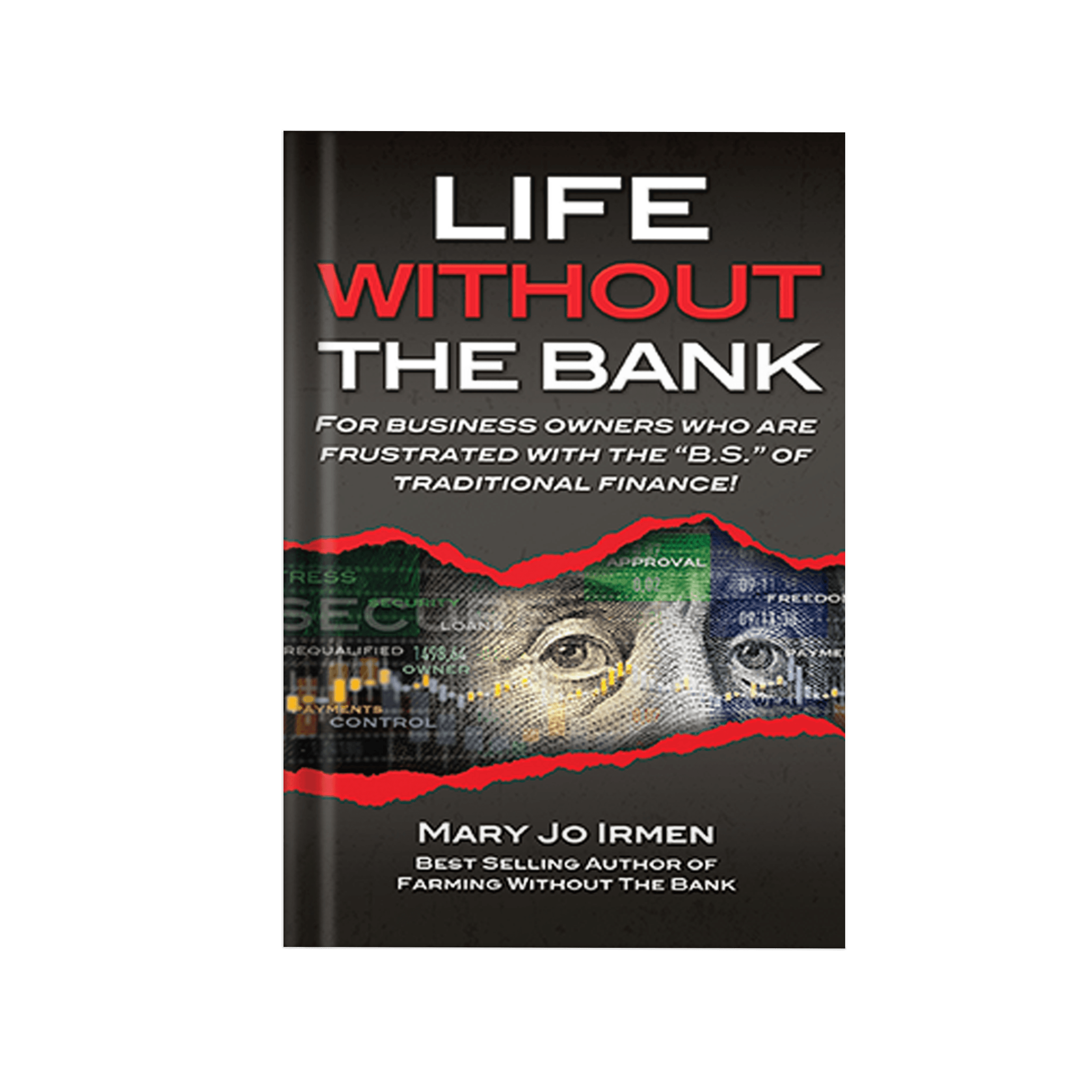
Okay. You guys know where to reach me: maryjo@withoutthebank.com. Email, call, whatever. Email. Don't call me, I'm never gonna answer the phone. Email me with anything. Go get your books. Life Without the Bank, Becoming Your Own Banker. Go to withoutthebank.com. Get your books and educate yourself on the very reason of why this guy most likely has life insurance. Not the right kind, in my opinion, but he does have permanent life insurance for this, probably the same reasons.
So if you've had questions, if you've been wondering about it, if you think it's a scam, and this convinces you that, "Hey, maybe that's not a scam — when somebody at his level has it, maybe I should look into it," go grab your book, set up your appointment, and we will visit with you.
Somebody just said to me today — I was talking to a potential client. He brought his sister in, that's an accountant, and she said, "This is amazing. I now need to set up an appointment for myself." She's like, "I just… Like, it just makes sense." Yes, it does make sense. It always makes sense, but you have to do the education piece first. And it makes sense when you see your numbers, is what she was also saying. It just makes it a lot easier when you can see it and have it explained to you for things that were not explained in the book.
All right, we'll see you in the next podcast, and you have a fantastic rest of your day.
View MoreHello, hello, and welcome back to the podcast. Thank you very much for being here. All right, I wanted to record today because we have a hot topic going on out in the investment government world, and that is Paul Atkins. If you guys don't know Mr. Paul, he is a nominee to chair the Securities and Exchange Commission.
And there is an article on every financial network online everywhere. It's the same article everywhere, so I just wanna break it down, 'cause I think it's funny, and I think that we can learn a few things from the nominee of Paul.
So, when you are a nominee, you have to disclose all of your financials. In his financials, he has 54 life insurance policies. Oh my gosh, this has turned the gurus upside down. Because why? Why would he have 54 life insurance policies? So I have notes, y'all. Like, I got some notes we're gonna go over. And I'm just gonna kinda go through the article piece by piece, because it's just gonna be easier.
Okay, so this is an interesting little fact. That in 2023, there were just under 260 million active policies in the US — fewer than one on average for every American adult. That's crazy. That is just proof that we all need more life insurance. 'Cause, you know, not everybody has some, but we're all guaranteed to die.
Meanwhile, the 54 insurance policies represent 10% of Mr. Atkins' net worth. 10%. His net worth is $327 million. So he's got $32.7 million of life insurance policies as part of his net worth. I am assuming that they are counting the death benefit on those policies as net worth, not cash value.
They go on to say, "The decision by Atkins to amass dozens of life insurance policies flummoxes" — flummoxes? — "even some experts." Oh my gosh, why? Why would he have those?
James, a professor at the University of Georgia, said it would make no sense for an individual to have 20, 30, 40, let alone 50 universal policies on their own life. It would make no sense. Why would we do this?
So Timothy Harris, an economics professor at Illinois State, told Fortune, "Perhaps the incoming SEC chair's dozens of life insurance policies are a vehicle to reduce taxes. There are two main types of insurance." Here's where the lesson comes in, my friends. "Term and whole."
Okay, if those of you that listen to me know already what's wrong, kudos to you for listening. "Term policies are for a fixed period." Yeah, we know that. "The latter stay in effect for a policyholder's life. Each of the 54 policies are in the whole category, a variation of it known as universal."
So Mr. Tim Harris, economics professor at Illinois State, let me educate you on life insurance. I don't mean to be a Karen, but this is important here. So the two categories are term and permanent insurance. Permanent insurance has whole life, universal, variable, indexed universal, and a variety of all of those mixed together underneath the umbrella of permanent insurance. The umbrella is not titled whole life. Okay?
So this is disturbing to me, because this guy is a professor. He's writing for Fortune magazine — or not, he's not writing, I guess he's being interviewed for Fortune magazine. That is extremely disturbing.
But Mr. Atkins has universal life, which I'm assuming, because he is invested in so many companies and it's all about a rate of return, he's looking at the rate of return on the universal life. Which a universal life, in his defense, does have a guarantee. There are no guarantees on the fees, which is unfortunate. He's gonna see that as he gets older, that's gonna deplete his cash value. He might lose some policies. But he too is not a life insurance person, and he obviously hasn't found the right ones, in my opinion.
This professor also goes on to say whole life insurance combines a savings account with a death payout. It's called cash value, and the cash value is some of the death benefit they allow you to use while you're alive. It's not a savings account. Like, if he was a licensed life insurance agent, he'd probably get his life insurance license revoked.
He says policyholders deposit money into their account and receive tax-deferred interest. A hundred percent. The cash value is growing income tax-free. Tax-deferred. "When they die, beneficiaries receive the saved money, interest, and lump sum. It is less about insuring against premature death and more of an investment vehicle."
So let's rewind a sec. "When they die, the beneficiaries receive the saved money, interest, and lump sum." For the love of Pete. This guy is a professor. What was he a professor of? Economics. Okay. You don't get the cash value and the death benefit, if that's what he's trying to say. You just get the death benefit, because the cash value is a portion of that, like I just said, that you're able to use later.
Then he said, "Then it is less about insuring against premature death, and it is more of an investment vehicle." I'm assuming he's probably not using it as an investment vehicle, because it's not an investment. It's a life insurance policy. He's probably using it for the liquidity, so that he can use money to go invest in other things. I don't know. Not sure.
Then Mr. Harris continues to say, "Whole life is not the best investment. For high-income earners that have already exhausted all the benefits of a 401(k), you can turn to these whole or universal insurance policies to try and circumvent some of the taxes."
So the only people that shouldn't be paying taxes are the high-income earners? You mean the people that are putting money into 401(k)s and IRAs and just punching a clock, they shouldn't be told that they're gonna be taxed later, and be able to take money out or to access money with a tax advantage? They shouldn't be told that? Everybody should know exactly this, not just high-income earners.
This is not just for high-income earners. This is for everybody that has money and they want to avoid the tax. Because what is happening is people that are really good savers, maybe people that have invested well, have a bunch of money at retirement, and then they get to take that money out, and guess what? Medicaid goes up, they gotta pay in the higher tax bracket. They are taking more money out than what they need to live, because they also have to take enough out to pay for taxes. So the money is depleting faster.
That doesn't have to happen when we have whole life insurance, because it is tax-deferred, and when we borrow against it and use it correctly, it doesn't show up in our income taxes.
This gets better. You guys, I'm not done. Patricia Born, a professor at Florida State University College of Business, says this isn't a normal thing, but there may be an explanation beyond taxes. Okay? He is on a lot of boards because he invests in a lot of things. So he's on a lot of boards, and it would make sense to have policies written specifically to pay to each of those trusts.
So, oh, yeah, maybe — just maybe — he is doing some estate planning. Maybe he's passing on some generational wealth income tax-free. If he's got it in a trust, it could possibly go estate tax-free as well.
Then she goes on to say Mr. Atkins maybe has purchased the life insurance on other people's lives. So she goes on to talk about that. Those who want to dump their life insurance can sell it back to the company that issued it for a surrender value or a buyback price. It's the surrender value. It's the amount of cash you accumulated. The insurance company will give you that.
Or, she said, people will buy insurance on other people hoping that they will die soon, and then they will get the death benefit. This happens, okay? Where someone might come to an elderly person and say, "Oh, you need some cash. Well, let me buy your life insurance policy." Maybe they'll pay a little over surrender value, but what they want to do is make sure you're going to die sooner than later. Because then they're gonna take over those premiums, and then upon this person's death, they're going to get the death benefit.
There are people that do that. Maybe it's good for a reason. I don't know what that reason would be. Only because people don't know that they can actually borrow against their surrender value. They can borrow against their cash value. Universal life, indexed universal, variable universal — not just whole life. You can borrow against those other ones. Maybe not the best idea, but if I'm ill, and I know I'm probably gonna pass away in the next five to 10 years, which is typically what these people are looking for — a nice rate of return — so maybe then just borrow against it.
But what she's saying is maybe he owns that many policies because he's buying them on other people's lives. The guy clearly likes to have a big pool of varied investments, and I think these are investments. Okay? Life insurance is not an investment, people.
Is he probably there for some sort of rate of return, for some sort of generational wealth, for some sort of liquidity, for some sort of assurity against loans he might have, that he can use the policies as collateral? Maybe. Maybe he has met with one of the Rockefellers, and he has said, "You know what? This is actually a pretty good idea, to be buying some permanent life insurance." I don't know. I'm gonna be watching this to see what else comes out about it, because they have asked him to disclose that piece of it. Apparently he does not have to, is what I have read, but I don't know.
I find it funny, though, that we have all these gurus — that the guy that wrote this article is actually a Bitcoin guy. And so I just find it very comical that we have all these gurus in the financial industry that know everything about business. They know everything about economics. They're the ones that we're quoting in here, and they don't know about life insurance. They don't know how life insurance works, but yet these are the people that we have found to be interviewed.
Why are we not looking at that and going, "Whoa, that's amazing"? That guy knows the value of having life insurance, permanent life insurance, and clearly it's for some sort of an estate plan or liquidity. That's what I'm gonna look at. Or he's got it for collateral. So clearly he understands the power of that and the certainty of that, and we're not questioning how it works. We're questioning him as an investor. To me, it almost sounds like they think it's a bad thing, rather than going, "Whoa, why don't we sit back and look?"
This brings me to another topic of the Rockefellers. I had a very interesting meeting this week with a potential client who, when he was in college — like, he was probably in his early 20s, the way it sounded — he had a friend who knew one of the Rockefellers, and he said that during a Fourth of July event, the Rockefellers were having a gathering, and he went with to this event. And he said when he learned, when he read my book and he learned about infinite banking, a flashback came back to him. A memory that when he was at this event, all these old guys were sitting around smoking cigars, talking about money. He said, "I remember them saying stuff like this."
What I find interesting about that whole thing is not just that the Rockefellers were talking about it — because we've heard for many, many years the Rockefellers have life insurance, right? But what I found interesting about that comment is that the old guys were sitting around talking about money. We have people that don't talk about money.
They're gonna go to school for business. They don't learn anything about liquidity, control, guarantees. We have economists that don't know anything about life insurance, liquidity, control, guarantees, uninterrupted compound interest. They're economists. Those are the professionals.
Yet we have business owners — which Mr. Atkins is a business owner of many different businesses. He's a partner. He's got holdings in many different businesses. He knows how to use the tax code to his advantage by having life insurance that can grow income tax-free. He can use it during retirement income tax-free if he needs to. He can use it for collateral. He can use it for liquidity.
We as normal people do not sit around smoking cigars, talking about our money. We as normal people sit around smoking cigars, talking about how everybody's trying to screw us, what's going on in the world today. We're not surrounding ourselves with people that can make us better, and it doesn't matter what business we have. It doesn't matter what we're doing. Why are we not sitting around with individuals that can share insight, and we can genuinely want to learn from that?
I was interviewed probably two years ago now by Fortune magazine, and they were gonna do a whole article on the Infinite Banking Concept. And a gentleman reached out to me — he had reached out to somebody else that recommended me. That person is in the world of life insurance. That's all they do is analyze life insurance policies, and he recommended me because he said, "You're the only one I've heard speak that actually talks about it without making it some kind of gimmick."
So I was interviewed, and it was a great interview, and it was one of the very few times somebody that has been able to write an article actually contacts a source and an expert in that field to talk about it. And guess what? The article did not get published. I don't know why it didn't get published. I reached out to him later and, you know, I'm sure his editors just are like, "Yeah, it's not important enough to get published." But it would've most likely been done in the correct manner, because they came to somebody that is going to give correct information.
This is the kind of stuff that drives me a little bit crazy, is when we have people publishing things that are not correct 'cause they didn't go to the source. And it's happened to me before where I've seen stuff in the agriculture industry not written correctly because they couldn't just make a phone call and get the details. Instead, if you have the details and you have the knowledge, you can't spin it to make it sound crazy.
One of my colleagues, Tricia, made a comment that I thought was very funny. She said, "If these people that were quoted in this article would actually show up at the Nelson Nash Institute think tank, they would be in a room of people that had many policies each, not just one."
So there's obviously power in multiple policies, 'cause he's building his warehouse of wealth. Regardless if that's what he's doing or not, he sees the value of life insurance. That's awesome and exciting to see that Mr. Atkins, who is gonna sit on the Securities and Exchange Commission, understands the value of life insurance. It is very unfortunate that the majority of the population doesn't understand this.
And when people ask me — and I've had this question twice in the last week — people will say, "Well, Mary Jo, why doesn't anybody know about this? Like, this is just amazing. How can people… If this really works like this, and this isn't too good to be true, and this isn't some kind of a scam, how can it work like this?" And I'm like, "That's just how it works."
And people don't know about it because of things like this. Because our economists, our business teachers, the life insurance industry as a whole has not done a very good job of educating you on the tool of what it is and how it works. If somebody just educates you and you see it, and you're like, "Whoa" — what would happen if people were just educated on what they were buying instead of just being told what to buy?
It'd be a game changer. It would be a game changer. We would have people in this country that paid attention to their money. So I think it's a combination of a lot of things. Why don't people know, and why is this so alarming to those people that should know? Because it's a two-hundred-year-old product, we're not chasing rates of return, and it's not fancy. But they're not thinking of money the same way we think of money either. Proof. Proof that they don't.
Okay. I thought it was fun to share that. I'll be keeping an eye on it. If you guys see anything updated on it, send it to me. Let me know, so that I can see how this all plays out. But I find it very fun information that when people in government have life insurance, it's always fun to see, because so many people think, "Well, what happens if they change the rules on it?" Why would they, when they have it?
Okay. You guys know where to reach me: maryjo@withoutthebank.com. Email, call, whatever. Email. Don't call me, I'm never gonna answer the phone. Email me with anything. Go get your books. Life Without the Bank, Becoming Your Own Banker. Go to withoutthebank.com. Get your books and educate yourself on the very reason of why this guy most likely has life insurance. Not the right kind, in my opinion, but he does have permanent life insurance for this, probably the same reasons.
So if you've had questions, if you've been wondering about it, if you think it's a scam, and this convinces you that, "Hey, maybe that's not a scam — when somebody at his level has it, maybe I should look into it," go grab your book, set up your appointment, and we will visit with you.
Somebody just said to me today — I was talking to a potential client. He brought his sister in, that's an accountant, and she said, "This is amazing. I now need to set up an appointment for myself." She's like, "I just… Like, it just makes sense." Yes, it does make sense. It always makes sense, but you have to do the education piece first. And it makes sense when you see your numbers, is what she was also saying. It just makes it a lot easier when you can see it and have it explained to you for things that were not explained in the book.
All right, we'll see you in the next podcast, and you have a fantastic rest of your day.



ready to start?
Your financial independence starts with one book.
Only one of three Americans can retire. Part of the fault is the conditioned belief that you must give up the use of your money when you’re young so you can have it later, assuming the stock market doesn’t collapse.