Podcast
EP. 244
Why Your Policy Fails: The Grocery Store Money Lesson (Ep. 244)
Nov 20, 2025 ·
20 min
0:00 / 20:00
EPISODE OVERVIEW
ABOUT THIS EPISODE
Most infinite banking policies don’t fail because of the insurance company… they fail because of human behavior. Are you quietly stealing the peas from your own grocery store?
In this episode, we continue through Nelson Nash’s Becoming Your Own Banker and dive into the Imagination chapter and the famous grocery store analogy.
We break down why imagination matters more than information, how to treat your policy like a real business, and why charging your own kids interest can actually build more wealth for them.
If you’ve ever wondered:
- “What can I really use my policy for?”
- “How much should I put in before I start using it?”
- “Is it wrong to charge family interest?”
…this conversation will clear up a lot of mental roadblocks.
💡 Key Takeaways
- Imagination over information: Infinite banking is an exercise in imagination, reason, logic, and prophecy. If you can’t imagine new uses for your capital, you’ll never unlock its full potential.
- Your policy is a business: The grocery store analogy shows why you must capitalize, stock the shelves, and keep restocking (paying back loans) if you want long-term success.
- Stealing the peas kills policies: Not repaying policy loans (or interest) is the fastest way to destroy your system, not the insurance company going under.
- Use your policy or it’s underfunded: If you’re still using your bank account for major purchases, you’re probably not putting enough premium into your policy.
- Charging family interest is not “mean”: When structured correctly, charging your kids interest can grow your system and ultimately send more wealth back to them via the death benefit.
- Terminology trips people up: “Loan repayment” inside a policy is functionally similar to a deposit, but the language makes people fear the process.
(Timestamps are from the video version. Audio-only edits are always shorter since they have had more fluff removed, so the timestamps are not accurate to this version.)
If this episode helped you see your policy differently:
- 👍 Like this video
- 💬 Comment: Let us know how you have been “Stealing The Peas” in your system.
- 🔔 Subscribe for more deep dives into infinite banking and Nelson’s book
- 📖 Grab the book and follow along with us chapter by chapter
📚 Resources & Links Mentioned
- 📘 Becoming Your Own Banker by R. Nelson Nash (paperback & Audible)
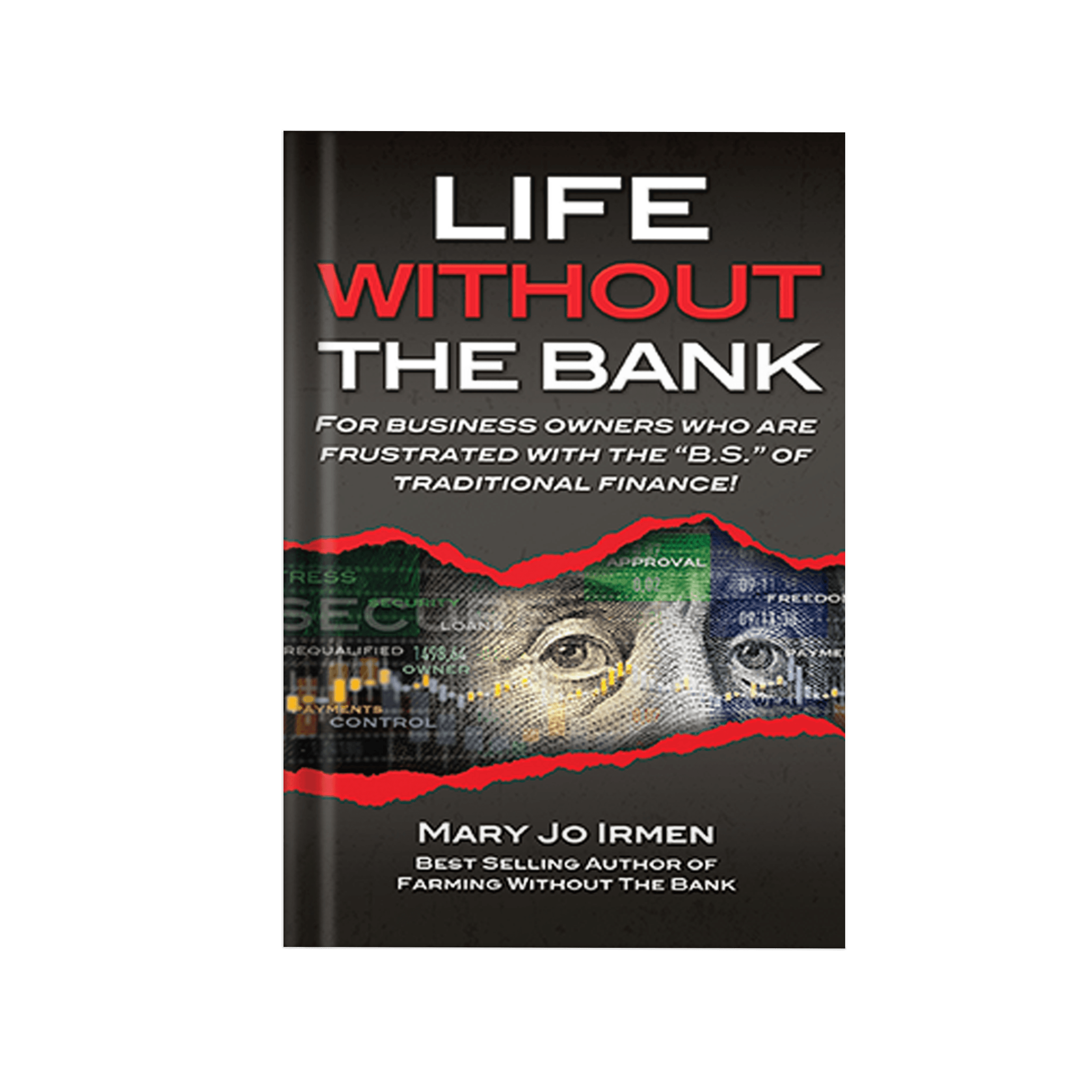
- 📗 Mary Jo’s book, Life Without the Bank
- 🎧 Audiobook option: great for listening while you study the concept
CHAPTER TIMESTAMPS
- 00:00How "Stealing the Peas" Destroys Policies Faster Than Insurers
- 01:27Imagination vs. Knowledge: Why People Ask for Permission to Use Their Policy
- 07:58Nelson's Grocery Store Analogy and What It Really Means
- 11:50Stocking the Shelves: Funding, Using, and Refilling Your Policy
- 17:05Human Nature, Discipline, and the Danger of the "Back Door"
- 19:38Charging Your Kids 9% Interest & Why Family Discounts Can Hurt Wealth
- 22:41Wrap-Up, Next Chapter Preview, and What to Do Next
YOUTUBE EPISODE
TRANSCRIPTION
“Probably more businesses have been destroyed or severely limited by this sort of behavior than anything else. This is very much in relation to if you don’t pay the policy back and pay interest or pay interest only, this is the fastest thing that will destroy your policy. People think, ‘Oh, my life insurance company’s going to go under.’ That is probably not going to happen. You and human nature is what is going to destroy it faster than anything else. This also relates to, hey, I’m going to lend money to family and I’m going to give them the wholesale discount and I’m not going to charge them interest. Oh yeah, you will. And you’re going to charge them 10% interest. People out on the interwebs get so mad at me because I charged my son 9% interest to borrow money to start his business. Why are you guys all mad? Think about it. I know what to do with the money. So, he’s going to give me 9%. I’m going to buy more life insurance with it. And then who gets the death benefit when I die? Him.”
Hello, hello, and welcome back to the podcast. Thank you very much for being here. All right, we are continuing BYOB. We are on Imagination, page 14. Grab your book quick. Pause us. Go get your book or get the Audible. It’s three hours.
Yeah, you really should have the paperback.
That too. Yes, Audible’s good. Paperback’s great. Okay.
Okay. Imagination. “Infinite banking concept is an exercise in imagination, reason, logic, and prophecy.” I only have, like, three things highlighted in this chapter. Um, that’s a big one, because when people say, “What can I use it for? What can I use it for? Can I use it for this? Can I use it for that?” It’s almost like they need permission. Yeah. Our… We have lost our imagination.
Mhm.
We have truly been so conditioned to not think and to not have the imagination behind it that we’re just like, “Oh, well, it’s, you know, it… I don’t think I can use it for that.” Yes, you can. Why couldn’t you? It doesn’t matter if you’re using it to buy a building, if you’re using it to buy cows, if you’re, if you’re using it to buy an apartment complex, if you’re using it for braces, it works the same for all of those avenues. But we very much have lost the imagination. And we’ve lost the reasoning and the logic.
Thinking.
Right? Yes. We’ve lost it all, which we talked about at lunch. We did.
All right. What do you have highlighted?
I have highlighted, I actually really love the quote that he starts out with, which is “Imagination is more important than knowledge,” by Albert Einstein. And I think what he’s saying here is that you can accomplish so much if you have a wild imagination, versus if you just have knowledge about something, that doesn’t necessarily mean you’re expanding your thinking, whereas imagination encourages you to expand your thinking. You have to, like, push the boundaries of information. It’s a, an enhancement to what you already know.
And that’s funny, because people with big imaginations are pooh-poohed.
Yeah. Right. “Oh, they’re just a dreamer.”
Or it’s, “Oh, that’s not realistic.” And it’s like, how do you think all the things got built that you get the luxury of experiencing today?
Right.
Not with someone that had a lot of information.
Someone that had an amazing imagination.
And then probably someone with knowledge implemented or, you know, had it come to reality. But…
Yeah, but imagination, reason, logic, it is the pillar of truly understanding this. But yeah, people with imagination, we really do go, “Ugh, they’re just dreamers. They’re not following the crowd.” I’ll be okay to be the black sheep, right? Like, and, like, even a lot of my clients, I have a, probably about a dozen clients that call because my imagination is quite lengthy. Like, I’m like, “What about this, and what about that?” And I don’t know if any of it works, but I’m pretty good at that kind of stuff. And so they’ll call just to brainstorm with me about their business, about, “Well, what about if I did this with the policy? What if I did that with the policy?” And sometimes you need that person that is a, a little far out there. Like, so not all my ideas work, but it’s up to us to then discern them. But so many people just don’t even have them.
I would agree with that, because they’ve taken the “this is how it is, this is how it’s always been…”
“…so nothing will change” approach.
And our school systems and our work environments don’t want that. Like, I was never a good employee because I always had suggestions, and that ticked every employer off. Like, they just always wanted to sail. They just always wanted to just do what they were doing. The schools didn’t like it. Right? “Quit asking me questions. I’m teaching. I’m lecturing. There’s no room for questioning.” And so we’re very much taught, I think there’s studies that have been done, um, well, I know there have been, I don’t know the exact statistics of it, that kids have a great imagination till about third or fourth grade.
I think it’s third or fourth grade, and they’ve already learned that they need to shut down because it’s not welcome in the classroom…
Environment. That makes sense.
He goes on to talk about a student that was doing good with math, and he said the student figured out how to do math very quickly. And Nelson puts in here, “He did not invent the fact, he discovered it.” Nelson didn’t invent IBC. He discovered what life insurance can do. The, the tools of the concept and the thought process and the utilization of money, that was all there already. All he did was put it on paper for us so that we can go out and share it with the world.
You know what I was thinking about while I was reading this book too, which is a little bit of an aside, is, like, how many lives are changed now because he decided to write this. Like, how many generations are going to be impacted positively because of…
And he didn’t say, “I’m not going to do it because it won’t happen in my lifetime.”
Mhm.
A lot of people will say, “Well, I’m not going to do this ’cause I won’t be out of the banking system in my lifetime.” Who says you had to? Who says you couldn’t start so generations to come are in a better position? You know that, I think we’re stuck on that too. Like, “Oh, we can’t start now. It’s too late.”
Mhm.
Oh, that’s silly. That is silly. He also says at the very end that they tried to change pi, the mathematical pi equation. And he said you can’t change it. They, it, it’s a fixed relationship. He said, “Therein lies the story of mankind since the time began.” And I just made myself a note: They’re trying to change something that works. It already works. The pi equation works. Why are we trying to change it? Life insurance, dividend-paying whole life insurance, already works. There’s no reason to change it. There’s no reason to use universal, indexed, variable, looking at rates of return, because it works.
Right? Why reinvent the wheel, right?
Okay. The grocery store. This is interesting because I actually have, I have it broke down to six different pieces. And in the beginning, he talks about the process of getting into a business which you both are the consumer and the seller of the same thing. Um, and that’s what he wants to examine in this chapter. Why do you think that, Tarisa? Why do you think Nelson wants to tell us about a grocery store?
I was thinking about this. I’m like, why would Nelson pick this? And I think it’s because you need to eat food every single day, just like you need to have cash every single day. So, it’s like two very fundamental needs, right? Like…
Mhm.
The process of starting this up comparatively to starting your own banking system, like, people need to eat.
Mhm.
And that is true of everyone…
Just like everyone needs capital.
Mhm. What do you think?
I would think it’s because… That’s good. I never thought of that. Um, I don’t think you’re wrong. My thought process went to, because it’s a business.
And if you’re going to start a business, these are the things you need to do. And so, they’re not any different, ’cause we’re starting a business with the life insurance policy. We are having to capitalize that system. It’s a business now ’cause it’s a bank. It is, it, it’s how we have to treat it. I like your, your take on it.
Okay. So, what were the, the six things?
So, number one, he says you start it all by studying. So, if you’re going to have a grocery store, you’re going to study how to start a grocery store. So, if you want to do the infinite banking concept, you should probably study it. You should probably not just come to Tarisa and I and be like, “Okay, teach me it all.” Right? Why do we make you read the book first?
We want you to be educated.
Yes, you need to study it. You need to understand why you’re coming to see us. Two, you must now find a good location for the business. So, we’re going to study the grocery store business. We’re going to understand who our vendors are, what we need to do, and then we’re going to find a good location for the business. Just like in our policy, we have to find a good location, a good company to be putting that money with. Absolutely. And so you can study those companies if you like, just like you’re going to study locations, but we’re going to have to find a location to store that money.
Three, you must construct a very nice-looking building on the property. Okay, so what are we going to do? Construct our policy, and we want a sturdy foundation. We want a, we want a building with a really good foundation. So if we have to have a policy with more base on the policy, more whole life piece of it, that’s great. Build it. Have a sturdy foundation. Have a great construction. Have a company that has a good foundation as well.
And then my fourth one is, now you must stock the store with groceries. You must put money into your policy. You can’t just build it and then be like, “I got a grocery store,” and there’s nothing on the shelves.
There’s nothing to sell.
“Come shop with me.”
Right? “Get all my empty shelves.”
Right? There’s nothing. If we don’t stock our shelf, there’s nothing to borrow from. So, we want to make sure that we’re stocking the entire shelf. We’re not going to just put a little bit on the shelf. We’re going to put as much as we can on the shelf, because if we just have a little bit on the shelf, we don’t have access to as much.
What did you say the other day that really stuck out to me? It’s like, if you are not using your policy, then you haven’t put enough in there.
Mhm.
Which I think is true.
Mhm.
Because it’s like, that should be the main source of where you store your capital.
Mhm.
And so if you’re just operating off your bank account for all major expenses or whatever, then you’re not putting enough in your policy. You’re…
You don’t have to go to your policy to borrow money. That means you’re using too much cash and you do not have enough money going into premium…
Because you haven’t gone there.
Just like my client that wants to cancel his policy, you are using it as a savings account. So, it looks like an expense because you can’t afford to put more money into savings. You’re not using it as a pass-through entity, and it should be used as a pass-through entity. And if you don’t have to do that, where is all this money going? You have a lot of cash that’s not being, that’s being spent in cash with lost opportunity cost, right?
Okay. Then we have number five. “You are going to have to restock the store room at your intervals to ensure that you have immediate access to bountiful supply of goods.” So if we’ve borrowed money, we need to pay it back so we can go access it again for something that we need. We don’t want to buy a vehicle with that money and then never repay it, and then we wear our vehicle out, and we don’t have any place to go to reborrow that money to buy another vehicle.
And I think the thing that people get hung up on is, like, the borrowing. It’s like, you are the banker in the situation and the consumer. So when you send that payment, you have access to that money all over again. But because we’re so used to borrowing and then giving it to the bank and never seeing it again, it has this, like, negative connotation to it, because people can’t see that they are both roles.
I think it’s terminology.
So when people take money from a savings account and then they go to the bank and deposit money every month, they’re like, “Oh, now I have access to it.” So when we borrow money from the policy and we pay it back, it’s accessible just like a deposit would have been. We call it a loan repayment. That’s called a deposit. And I think they act the same, because when I make a loan repayment back to the policy, I have access to that money in 10 days. And so I think that if it was called something different, which it can’t be, because it is a loan repayment…
Right.
I think that if it was called a deposit, people would feel warm and cozy about… Yeah.
But it’s not.
Yeah, I would agree with that. I think that’s a good point, the terminology.
Okay, number six. The sixth point on here is, he said, um, “Once you get this all set up and in operation, the difference between the back door and the front door is a very good living if you can turn the inventory enough times per year.” So, what he’s saying is, you don’t steal the peas. If you borrow, you pay back. It’s really that simple. If you, you can’t just not pay it back, because now you’re not going to have anything to borrow again. So, you’re not turning your money. You’re not letting that money flow like the bank. The bank is turning their money, right? And you’re not doing that.
This can also be a little misleading, because it sounds like, hey, you make money taking loans again.
Right? But you’re turning your money and paying extra interest. In everything Nelson teaches, you’re paying extra interest…
Which is, yes. Which you are making more money.
Yes. When you pay extra premium, you make more money.
Yes.
To be clear…
Not interest. I was confused about that when I first started learning about this.
And then he says you must turn the inventory 15 times just to break even. Isn’t that interesting? Insurance company is 13 to 15 years. And how we structure a policy, you’re breaking even between year 7, year 10. It could be year 15 at times. The way Nelson structured his policies, if we structured them more like a Nelson policy, it probably would be year 13 to year 15. So that’s what he’s talking about there. Um, but the more that you, and he says further down, “20 times per year and you can retire early. Something dramatic happens once you get over the hump.” And 20 times per year, think about it. “Oh, I’m using my money more. I’m paying more premium, which means I have more money for retirement.” Yeah, that’s exactly what that means.
It’s like you said, it’s not complicated. It’s really simple. The more you put in, the more you get out.
Exactly. Exactly.
Which is true, I think, of most things, right? The nicer you are to your spouse, probably the better your marriage gets.
Yep. And then he, he goes on to talk about stealing. And we call it stealing the peas, ’cause in this chapter he’s talking about taking peas off the shelf and not being able to resell them. And he said, “Probably more businesses have been destroyed or severely limited by this sort of behavior than anything else.” This is very much in relation to if you don’t pay the policy back and pay interest or pay interest only, this is the fastest thing that will destroy your policy. And so people think, “Oh, my life insurance company’s going to go under.” That is probably not going to happen. You and human nature is what is going to destroy it faster than anything else.
Yes, absolutely. Like, I can tell the difference, like, back then when some clients got started, when I should have told them to wait, and it’s because they didn’t have the discipline with their money, even though they’re making great incomes. Like, on paper, sure, they could have afforded a policy just fine, but they…
They had that mentality of stealing the peas.
It’s like, well, they’re not going to be treating that system in the way that it needs to, to be successful long term.
Mhm. I also have just underlined above, too, “The only problem that remains is the human instinct to want to use the back door,” which is what we just talked about.
Yeah, I have that one highlighted too.
And then he goes on to say, “You should realize that if you charge this cap… these captive customers wholesale prices, you have defeated the purpose of the business, to provide income for you and to build a business that you will eventually sell and use the proceeds for retirement. Why not charge these folks 62 cents for the can of peas? The extra two cents will go directly to additional capital to buy more cans of peas to sell to the other customers.” I’ve never actually caught that before. The extra 2 cents will go directly to additional capital, additional premium.
Right. Right. That we can have, we can go buy more cans of peas to sell more peas. But this also relates to, hey, I’m going to lend money to family and I’m going to give them the wholesale discount and I’m not going to charge them interest. Oh yeah, you will. And you’re going to charge them 10% interest.
You should.
Yes. People out on the interwebs get so mad at me because I charged my son 9% interest to borrow money to start his business. Why do y’all… Why are you guys all mad? I mean, really? Because think about it, I know what to do with the money. So, he’s going to give me 9%. I’m going to buy more life insurance with it. And then who gets the death benefit when I die? Him. He just created more wealth. Is he going to have to wait for it? Yes.
Well, also, like, how quick was he able to get approved for that loan going through you versus asking the bank for it?
Exactly.
So, it’s just like, okay, well, let’s actually compare. I would take the loan from Mary Jo as well and pay 9%, versus, like, going through all of the hoops and the paperwork and the…
You know, handing over the firstborn child to the bank in order to get approval for… You know, banks don’t take risk, they take collateral.
Yep. And in order, the only other option they had was to go get a HELOC. That was going to be 11%. So, I gave them a deal. Okay. Get off my back. I gave them a deal, and I allowed them to have that loan and not start paying me till spring. So, they had that loan the whole winter. Yes, they paid interest, but, and their interest was accumulating, but I didn’t require payments right away, ’cause I was like, “Well, you’re just starting your business. It’s winter. It’s a construction business. Like, they’re not going to have a lot of opportunity in the winter.” And so, they had the flexibility to do that. You know, it’s, it’s 9%. But people think, “Oh my gosh, it’s your kid. Give them a break.”
No. Why are we… That’s like if your friend says, and I love this, ’cause people will come up to me and be like, “Well, Mary Jo, like, I know you. Can I just get the book for free?” No, I am not a nonprofit. Okay? I had to pay to print that book. I had to pay somebody to put the book together. I had to pay a designer. I took months and months to write that book. And it should just be free? Your friends should never, friends and family should never be asking for a discount. They should want to support your business, and they should want to help.
Well, also, free, I think, is a lie, because it might be free to you, but someone else is actively, or has already, paid for it.
Yes.
Right. It’s not… Nothing is free.
No.
It just means maybe you didn’t pay for it, but someone else did.
Just like 0% interest isn’t 0% interest.
Right? They, they just inflate the cost, like the housing price.
You paid for it. 0% car is not 0%. We just paid for it. Yeah. Okay, that’s it. We’re going to go on to The Problem in the next one. So, stick around, listen to that one. Um, we’ll be back with that. But otherwise, if you have comments, questions, concerns, you need to reach out to us, you know how to do that. Get your books, study along, have a great rest of your day.
View MoreHello, hello, and welcome back to the podcast. Thank you very much for being here. All right, we are continuing BYOB. We are on Imagination, page 14. Grab your book quick. Pause us. Go get your book or get the Audible. It’s three hours.
Yeah, you really should have the paperback.
That too. Yes, Audible’s good. Paperback’s great. Okay.
Okay. Imagination. “Infinite banking concept is an exercise in imagination, reason, logic, and prophecy.” I only have, like, three things highlighted in this chapter. Um, that’s a big one, because when people say, “What can I use it for? What can I use it for? Can I use it for this? Can I use it for that?” It’s almost like they need permission. Yeah. Our… We have lost our imagination.
Mhm.
We have truly been so conditioned to not think and to not have the imagination behind it that we’re just like, “Oh, well, it’s, you know, it… I don’t think I can use it for that.” Yes, you can. Why couldn’t you? It doesn’t matter if you’re using it to buy a building, if you’re using it to buy cows, if you’re, if you’re using it to buy an apartment complex, if you’re using it for braces, it works the same for all of those avenues. But we very much have lost the imagination. And we’ve lost the reasoning and the logic.
Thinking.
Right? Yes. We’ve lost it all, which we talked about at lunch. We did.
All right. What do you have highlighted?
I have highlighted, I actually really love the quote that he starts out with, which is “Imagination is more important than knowledge,” by Albert Einstein. And I think what he’s saying here is that you can accomplish so much if you have a wild imagination, versus if you just have knowledge about something, that doesn’t necessarily mean you’re expanding your thinking, whereas imagination encourages you to expand your thinking. You have to, like, push the boundaries of information. It’s a, an enhancement to what you already know.
And that’s funny, because people with big imaginations are pooh-poohed.
Yeah. Right. “Oh, they’re just a dreamer.”
Or it’s, “Oh, that’s not realistic.” And it’s like, how do you think all the things got built that you get the luxury of experiencing today?
Right.
Not with someone that had a lot of information.
Someone that had an amazing imagination.
And then probably someone with knowledge implemented or, you know, had it come to reality. But…
Yeah, but imagination, reason, logic, it is the pillar of truly understanding this. But yeah, people with imagination, we really do go, “Ugh, they’re just dreamers. They’re not following the crowd.” I’ll be okay to be the black sheep, right? Like, and, like, even a lot of my clients, I have a, probably about a dozen clients that call because my imagination is quite lengthy. Like, I’m like, “What about this, and what about that?” And I don’t know if any of it works, but I’m pretty good at that kind of stuff. And so they’ll call just to brainstorm with me about their business, about, “Well, what about if I did this with the policy? What if I did that with the policy?” And sometimes you need that person that is a, a little far out there. Like, so not all my ideas work, but it’s up to us to then discern them. But so many people just don’t even have them.
I would agree with that, because they’ve taken the “this is how it is, this is how it’s always been…”
“…so nothing will change” approach.
And our school systems and our work environments don’t want that. Like, I was never a good employee because I always had suggestions, and that ticked every employer off. Like, they just always wanted to sail. They just always wanted to just do what they were doing. The schools didn’t like it. Right? “Quit asking me questions. I’m teaching. I’m lecturing. There’s no room for questioning.” And so we’re very much taught, I think there’s studies that have been done, um, well, I know there have been, I don’t know the exact statistics of it, that kids have a great imagination till about third or fourth grade.
I think it’s third or fourth grade, and they’ve already learned that they need to shut down because it’s not welcome in the classroom…
Environment. That makes sense.
He goes on to talk about a student that was doing good with math, and he said the student figured out how to do math very quickly. And Nelson puts in here, “He did not invent the fact, he discovered it.” Nelson didn’t invent IBC. He discovered what life insurance can do. The, the tools of the concept and the thought process and the utilization of money, that was all there already. All he did was put it on paper for us so that we can go out and share it with the world.
You know what I was thinking about while I was reading this book too, which is a little bit of an aside, is, like, how many lives are changed now because he decided to write this. Like, how many generations are going to be impacted positively because of…
And he didn’t say, “I’m not going to do it because it won’t happen in my lifetime.”
Mhm.
A lot of people will say, “Well, I’m not going to do this ’cause I won’t be out of the banking system in my lifetime.” Who says you had to? Who says you couldn’t start so generations to come are in a better position? You know that, I think we’re stuck on that too. Like, “Oh, we can’t start now. It’s too late.”
Mhm.
Oh, that’s silly. That is silly. He also says at the very end that they tried to change pi, the mathematical pi equation. And he said you can’t change it. They, it, it’s a fixed relationship. He said, “Therein lies the story of mankind since the time began.” And I just made myself a note: They’re trying to change something that works. It already works. The pi equation works. Why are we trying to change it? Life insurance, dividend-paying whole life insurance, already works. There’s no reason to change it. There’s no reason to use universal, indexed, variable, looking at rates of return, because it works.
Right? Why reinvent the wheel, right?
Okay. The grocery store. This is interesting because I actually have, I have it broke down to six different pieces. And in the beginning, he talks about the process of getting into a business which you both are the consumer and the seller of the same thing. Um, and that’s what he wants to examine in this chapter. Why do you think that, Tarisa? Why do you think Nelson wants to tell us about a grocery store?
I was thinking about this. I’m like, why would Nelson pick this? And I think it’s because you need to eat food every single day, just like you need to have cash every single day. So, it’s like two very fundamental needs, right? Like…
Mhm.
The process of starting this up comparatively to starting your own banking system, like, people need to eat.
Mhm.
And that is true of everyone…
Just like everyone needs capital.
Mhm. What do you think?
I would think it’s because… That’s good. I never thought of that. Um, I don’t think you’re wrong. My thought process went to, because it’s a business.
And if you’re going to start a business, these are the things you need to do. And so, they’re not any different, ’cause we’re starting a business with the life insurance policy. We are having to capitalize that system. It’s a business now ’cause it’s a bank. It is, it, it’s how we have to treat it. I like your, your take on it.
Okay. So, what were the, the six things?
So, number one, he says you start it all by studying. So, if you’re going to have a grocery store, you’re going to study how to start a grocery store. So, if you want to do the infinite banking concept, you should probably study it. You should probably not just come to Tarisa and I and be like, “Okay, teach me it all.” Right? Why do we make you read the book first?
We want you to be educated.
Yes, you need to study it. You need to understand why you’re coming to see us. Two, you must now find a good location for the business. So, we’re going to study the grocery store business. We’re going to understand who our vendors are, what we need to do, and then we’re going to find a good location for the business. Just like in our policy, we have to find a good location, a good company to be putting that money with. Absolutely. And so you can study those companies if you like, just like you’re going to study locations, but we’re going to have to find a location to store that money.
Three, you must construct a very nice-looking building on the property. Okay, so what are we going to do? Construct our policy, and we want a sturdy foundation. We want a, we want a building with a really good foundation. So if we have to have a policy with more base on the policy, more whole life piece of it, that’s great. Build it. Have a sturdy foundation. Have a great construction. Have a company that has a good foundation as well.
And then my fourth one is, now you must stock the store with groceries. You must put money into your policy. You can’t just build it and then be like, “I got a grocery store,” and there’s nothing on the shelves.
There’s nothing to sell.
“Come shop with me.”
Right? “Get all my empty shelves.”
Right? There’s nothing. If we don’t stock our shelf, there’s nothing to borrow from. So, we want to make sure that we’re stocking the entire shelf. We’re not going to just put a little bit on the shelf. We’re going to put as much as we can on the shelf, because if we just have a little bit on the shelf, we don’t have access to as much.
What did you say the other day that really stuck out to me? It’s like, if you are not using your policy, then you haven’t put enough in there.
Mhm.
Which I think is true.
Mhm.
Because it’s like, that should be the main source of where you store your capital.
Mhm.
And so if you’re just operating off your bank account for all major expenses or whatever, then you’re not putting enough in your policy. You’re…
You don’t have to go to your policy to borrow money. That means you’re using too much cash and you do not have enough money going into premium…
Because you haven’t gone there.
Just like my client that wants to cancel his policy, you are using it as a savings account. So, it looks like an expense because you can’t afford to put more money into savings. You’re not using it as a pass-through entity, and it should be used as a pass-through entity. And if you don’t have to do that, where is all this money going? You have a lot of cash that’s not being, that’s being spent in cash with lost opportunity cost, right?
Okay. Then we have number five. “You are going to have to restock the store room at your intervals to ensure that you have immediate access to bountiful supply of goods.” So if we’ve borrowed money, we need to pay it back so we can go access it again for something that we need. We don’t want to buy a vehicle with that money and then never repay it, and then we wear our vehicle out, and we don’t have any place to go to reborrow that money to buy another vehicle.
And I think the thing that people get hung up on is, like, the borrowing. It’s like, you are the banker in the situation and the consumer. So when you send that payment, you have access to that money all over again. But because we’re so used to borrowing and then giving it to the bank and never seeing it again, it has this, like, negative connotation to it, because people can’t see that they are both roles.
I think it’s terminology.
So when people take money from a savings account and then they go to the bank and deposit money every month, they’re like, “Oh, now I have access to it.” So when we borrow money from the policy and we pay it back, it’s accessible just like a deposit would have been. We call it a loan repayment. That’s called a deposit. And I think they act the same, because when I make a loan repayment back to the policy, I have access to that money in 10 days. And so I think that if it was called something different, which it can’t be, because it is a loan repayment…
Right.
I think that if it was called a deposit, people would feel warm and cozy about… Yeah.
But it’s not.
Yeah, I would agree with that. I think that’s a good point, the terminology.
Okay, number six. The sixth point on here is, he said, um, “Once you get this all set up and in operation, the difference between the back door and the front door is a very good living if you can turn the inventory enough times per year.” So, what he’s saying is, you don’t steal the peas. If you borrow, you pay back. It’s really that simple. If you, you can’t just not pay it back, because now you’re not going to have anything to borrow again. So, you’re not turning your money. You’re not letting that money flow like the bank. The bank is turning their money, right? And you’re not doing that.
This can also be a little misleading, because it sounds like, hey, you make money taking loans again.
Right? But you’re turning your money and paying extra interest. In everything Nelson teaches, you’re paying extra interest…
Which is, yes. Which you are making more money.
Yes. When you pay extra premium, you make more money.
Yes.
To be clear…
Not interest. I was confused about that when I first started learning about this.
And then he says you must turn the inventory 15 times just to break even. Isn’t that interesting? Insurance company is 13 to 15 years. And how we structure a policy, you’re breaking even between year 7, year 10. It could be year 15 at times. The way Nelson structured his policies, if we structured them more like a Nelson policy, it probably would be year 13 to year 15. So that’s what he’s talking about there. Um, but the more that you, and he says further down, “20 times per year and you can retire early. Something dramatic happens once you get over the hump.” And 20 times per year, think about it. “Oh, I’m using my money more. I’m paying more premium, which means I have more money for retirement.” Yeah, that’s exactly what that means.
It’s like you said, it’s not complicated. It’s really simple. The more you put in, the more you get out.
Exactly. Exactly.
Which is true, I think, of most things, right? The nicer you are to your spouse, probably the better your marriage gets.
Yep. And then he, he goes on to talk about stealing. And we call it stealing the peas, ’cause in this chapter he’s talking about taking peas off the shelf and not being able to resell them. And he said, “Probably more businesses have been destroyed or severely limited by this sort of behavior than anything else.” This is very much in relation to if you don’t pay the policy back and pay interest or pay interest only, this is the fastest thing that will destroy your policy. And so people think, “Oh, my life insurance company’s going to go under.” That is probably not going to happen. You and human nature is what is going to destroy it faster than anything else.
Yes, absolutely. Like, I can tell the difference, like, back then when some clients got started, when I should have told them to wait, and it’s because they didn’t have the discipline with their money, even though they’re making great incomes. Like, on paper, sure, they could have afforded a policy just fine, but they…
They had that mentality of stealing the peas.
It’s like, well, they’re not going to be treating that system in the way that it needs to, to be successful long term.
Mhm. I also have just underlined above, too, “The only problem that remains is the human instinct to want to use the back door,” which is what we just talked about.
Yeah, I have that one highlighted too.
And then he goes on to say, “You should realize that if you charge this cap… these captive customers wholesale prices, you have defeated the purpose of the business, to provide income for you and to build a business that you will eventually sell and use the proceeds for retirement. Why not charge these folks 62 cents for the can of peas? The extra two cents will go directly to additional capital to buy more cans of peas to sell to the other customers.” I’ve never actually caught that before. The extra 2 cents will go directly to additional capital, additional premium.
Right. Right. That we can have, we can go buy more cans of peas to sell more peas. But this also relates to, hey, I’m going to lend money to family and I’m going to give them the wholesale discount and I’m not going to charge them interest. Oh yeah, you will. And you’re going to charge them 10% interest.
You should.
Yes. People out on the interwebs get so mad at me because I charged my son 9% interest to borrow money to start his business. Why do y’all… Why are you guys all mad? I mean, really? Because think about it, I know what to do with the money. So, he’s going to give me 9%. I’m going to buy more life insurance with it. And then who gets the death benefit when I die? Him. He just created more wealth. Is he going to have to wait for it? Yes.
Well, also, like, how quick was he able to get approved for that loan going through you versus asking the bank for it?
Exactly.
So, it’s just like, okay, well, let’s actually compare. I would take the loan from Mary Jo as well and pay 9%, versus, like, going through all of the hoops and the paperwork and the…
You know, handing over the firstborn child to the bank in order to get approval for… You know, banks don’t take risk, they take collateral.
Yep. And in order, the only other option they had was to go get a HELOC. That was going to be 11%. So, I gave them a deal. Okay. Get off my back. I gave them a deal, and I allowed them to have that loan and not start paying me till spring. So, they had that loan the whole winter. Yes, they paid interest, but, and their interest was accumulating, but I didn’t require payments right away, ’cause I was like, “Well, you’re just starting your business. It’s winter. It’s a construction business. Like, they’re not going to have a lot of opportunity in the winter.” And so, they had the flexibility to do that. You know, it’s, it’s 9%. But people think, “Oh my gosh, it’s your kid. Give them a break.”
No. Why are we… That’s like if your friend says, and I love this, ’cause people will come up to me and be like, “Well, Mary Jo, like, I know you. Can I just get the book for free?” No, I am not a nonprofit. Okay? I had to pay to print that book. I had to pay somebody to put the book together. I had to pay a designer. I took months and months to write that book. And it should just be free? Your friends should never, friends and family should never be asking for a discount. They should want to support your business, and they should want to help.
Well, also, free, I think, is a lie, because it might be free to you, but someone else is actively, or has already, paid for it.
Yes.
Right. It’s not… Nothing is free.
No.
It just means maybe you didn’t pay for it, but someone else did.
Just like 0% interest isn’t 0% interest.
Right? They, they just inflate the cost, like the housing price.
You paid for it. 0% car is not 0%. We just paid for it. Yeah. Okay, that’s it. We’re going to go on to The Problem in the next one. So, stick around, listen to that one. Um, we’ll be back with that. But otherwise, if you have comments, questions, concerns, you need to reach out to us, you know how to do that. Get your books, study along, have a great rest of your day.



ready to start?
Your financial independence starts with one book.
Only one of three Americans can retire. Part of the fault is the conditioned belief that you must give up the use of your money when you’re young so you can have it later, assuming the stock market doesn’t collapse.