Podcast
EP. 252
You Already Know Enough (So Why Aren’t You Wealthy?) (Ep. 252)
Jan 15, 2026 ·
15 min
0:00 / 15:10
EPISODE OVERVIEW
ABOUT THIS EPISODE
Are you collecting financial knowledge… or actually using it?
In this episode of Without the Bank, we break down two of the most dangerous (and overlooked) chapters from Becoming Your Own Banker: Arrival Syndrome and Use It or Lose It.
These ideas explain why so many people stall out financially — even after reading the right books, watching the right videos, and “knowing” the Infinite Banking Concept.
The problem isn't lack of information. The problem is believing you've already arrived.
When people stop applying what they learn, their policies stagnate, their cash flow tightens, and Infinite Banking quietly turns into “just another savings account.” Nelson Nash warned us about this — and in this episode, we show exactly how it plays out in real life.
In This Episode, You'll Learn
- Why arrival syndrome is more dangerous than ignorance
- How “knowing enough” kills financial momentum
- Why Infinite Banking must become a way of life, not a tactic
- What “use it or lose it” really means for your policy and your mindset
- Why focusing on interest rates misses the point entirely
- Why liquidity and cash flow matter more than returns
- The silent mistake people make when they stop using their policy
Resources Mentioned
- Becoming Your Own Banker by Nelson Nash — get the book
- ▶️ Subscribe on YouTube
Already have the book? Use the link provided after purchase to schedule an appointment and get your questions answered.
If this episode made you rethink how you're using Infinite Banking, share it with someone who's still “learning” but not applying.
Apply what you know — or lose it.
CHAPTER TIMESTAMPS
- 00:00Knowledge vs. Implementation
- 01:05What Is Arrival Syndrome?
- 03:10The Illusion of Knowledge
- 05:20Use It or Lose It Explained
- 08:45Outgrowing Comfort Zones
- 11:30Common Infinite Banking Mistakes
- 14:00Why IBC Must Be a Way of Life
YOUTUBE EPISODE
TRANSCRIPTION
"People that want to read a bunch of books — oh, I'm going to read 50 books in a year. I don't frankly care if you read a book a day. Are you implementing what you learned? Why is my book completely demolished? Because I'm constantly in it and learning it. When I'm in it, I just relay the information better. But if I'm not in it, then I forget. And we see that a lot in this industry. Agents that aren't teaching from the book, instead they're teaching from an illustration and saying, hey, here, go buy this, create this savings account. We have colleagues that are doing these big, huge presentations and they're not even utilizing the information in the book. Why?"
Hello, hello, and welcome back to the podcast. Thank you very much for being here. Okay, we are back to BYOB and we are going to cover the arrival syndrome and use it or lose it. So we're going to go over page 34 and 35.
All right. So I love that he starts off by saying, "Now we turn our attention to probably the most devastating matter that we have examined thus far. I call it the arrival syndrome. This phenomenon probably limited the achievements of mankind more than anything else. When this thing infects us, we stop growing, stop learning. We rock. We turn off or tune out the ability to receive inspiration because we already know all there is to know."
Boom, done. Moving on to the next chapter.
We run into arrival syndrome a lot.
I was just going to say that it is very pervasive, I think, when people are kind of coming around to this concept, because you can tell when clients actually want to understand. They're asking questions to understand versus asking questions to prove themselves that this is not possible.
When we go to school and we think, okay, we learned everything that we're supposed to learn. So we're done now. We don't ever need to read another book.
I do think it's funny. As he goes on in this chapter, he was talking about Ed Deming, who was a business consultant, and he taught the Japanese the idea of quality. And the U.S. said, no, thank you. We are already doing that. No, they were not doing that. They were only taking a superficial look at what Ed was saying and jumping to the conclusion that they already understood all the ramifications of Ed's concept.
So then he went and taught the Japanese and came back and America was like, oh, well, we weren't doing that. And so I think that that's really funny because people will say, well, I'm already doing that with my IRA. I'm already doing that with my real estate. I'm already doing that with my universal life policy. And they're taking a superficial look. They're not actually understanding it.
And so it's just like every objection we get, everything we hear, we're like, oh, here's my comeback or here's my explanation for that. But Nelson already thought — like he had already heard about it all. And so we have to be careful if we say we already did that.
He says the greatest obstacle was discovering the shape of the earth, the continents and the oceans was not ignorance. It was illusion of knowledge. And he goes on to say a whole bunch of times in here that it's basically compared to saying, hey, the world is flat and they discovered the world is round. And we're like, no, no, no, no, no, it's not. I already know it's flat. Right. Because I know everything.
But what he's getting at there is —
I fell off the edge.
It requires an unlearning. It requires people to be open-minded and curious instead of just ending the thought of like, I already know everything there is to know. And some of us are just genuinely — you and I are genuinely very curious. I was asking you a ton of questions about farming last night. Like, well, what about this? And how does this work? And how about farm ground?
Yeah. Genuinely curious about how other industries work, which is what makes us really good life insurance agents when we are working with a client. We want to know everything. A lot of times I go down a rabbit hole and I will tell clients, this has nothing to do with infinite banking, but I want to understand your business. This is very fascinating to me. This is exciting. Like, I've never heard of this business before. I want to know what you're doing and how you're doing it and how in the world did you even think to do that, you know?
But we are never going — just like in the last podcast, when we talked about asking how. How can I do that? We have to not be in the arrival syndrome to be in the how can I do it mindset.
Right. If we already have given up and shut the door and said, grade 12, shutting that door, locking it, and throwing the key away. No more information. None. Just Netflix. From here on out.
Netflix and news.
Great comedy. Yeah. Yeah. Yeah.
Okay. Use it or lose it. This is really a fun chapter because I think it applies to so many things. You know, don't brush your teeth regularly and they will rot.
"The arrival syndrome produces a comfort zone that causes people to lapse in their old way of doing things. A lifetime of accumulated information that determines how one conducts oneself."
Basically, what he's saying is, if you don't use the things that have benefit to your life, you will lose it. If you are learning a second language and you don't speak it regularly, you're going to lose the ability. Same thing with infinite banking. Like, if you're not actively engaged with your policy, you're going to lose sight as to why you decided to do this in the first place. You have to use something for it to be useful to you. So, don't neglect the things that are useful to you.
And earlier, he says, "All human progress is predicated on this matter of human nature. It is not easy to conquer. It is absolutely necessary." So, he's not saying this is going to be easy. Understanding this concept and learning it and applying it — oh, this is going to be a cakewalk. No, it's not going to be a cakewalk.
Because he goes on to say after what you read, "The fact that this conclusion may be based on fallacious information is besides the point. I illustrate the point by telling people what I'm teaching you is equivalent to teaching you that the world is round when most folks think that it is flat."
So, we get in a comfort zone and we don't want to get out of that comfort zone. Because what are we then going to be thought of as we talk to our peers and they're like, well, geez, you're being overly positive, aren't you? That's crazy. You know, what happened to you?
Because we truly do, as we grow, we lose people. We leave people behind, not intentionally. They choose to stay where they're at. We choose to advance. And so, over the years as I've gotten more successful and had more businesses, people have been left behind because they chose to be there.
I remember I had a really, really, really good friend that I had actually stayed with and spent some time with when I moved to Bismarck. And when I started this business, she had told a mutual friend that she's like, yeah, all Mary Jo wants to do now is talk about her business. Yeah, because I had just found Infinite Banking and I thought it was like the best thing ever. Right?
But she didn't want to. They had apartment buildings and she's like, oh, they're too much work. We're getting rid of them. Even though her father-in-law has all this income from having apartments. He gifted them an apartment building. But it was so far out of her comfort zone and her husband's comfort zone that they just wanted to stay right where they're at. And I just so happened to run into her the other day. That's 16 years later. And they're still in the same spot they were 16 years ago. Right?
We can't feel bad about leaving those people behind. I have a friend that just started a business and I said, that is awesome. Super excited for her. Like, just beyond thrilled for her. And I'm like, whatever you need help with, let me know. Happy to help.
And I'm like, you do need a warning though. Your friends are not going to follow you. So all of these people that have been your friends for years and years as you've been an employee, do not expect them to be happy for you. And she's like, I've already encountered that. And I said, welcome to the new life. And she goes, where do I find people to talk to?
Like, you're going to have to put yourself around other business owners, around other people, which is what Nelson is saying. Find the other people that do infinite banking and surround yourself with them so that your mind is constantly open. Listen to the podcast. Listen to our podcast. Listen to James Neathery's podcast. Listen to other infinite banking practitioners' podcasts. They're all there.
Because the infinite banking concept is dealing with a total paradigm shift. This amounts to a personal monetary system.
And then he goes on to say — he's talking about EVA again, and the economic value added, which was in another chapter. But he said, "All the concept amounts to is a recognition of the fact that your own capital has a cost of money as well as that which has been borrowed from banks."
EVA works. But not if you make these common mistakes. You don't make it a way of life. Most managers try to implement EVA too fast. The boss lacks conviction. Managers fuss too much. Training gets short shrift.
So, a lot of people may just look at that and go, oh, okay, I'm just gonna not worry about those five things. Those five things are exactly what we're talking about.
They don't make it a way of life. They don't make EVA a way of life. You don't make your policy a way of life. You use it as a savings account, or you use it a little bit but you don't use it extensively.
Most managers try to implement it too fast. Maybe you have a policy that's too big and you're trying to put too much money into it, which is causing you heartache on the other side. So, be smart about it.
You lack conviction. You fuss too much. That one I think is funny, right? Like, if you're fussing about having to pay the interest to the insurance company, paying premium — oh my god, I have to go online and type out a form to access money. I have to wait 10 days to have access to my money. What do you mean it takes three to five days for it to be deposited? Really? That's what you're fussing about?
Right. And training. You need to have the training. You should have an agent that is there to help you train. You should not have an agent that just sells you a life insurance policy and walks away.
And one must develop new habits. He talks about this. That's a really big one because I think all too often people are just like, oh, you have to make it a way of life. Like, it has to be a priority for you because if it's not, you're going to lose it. You're going to lose sight of why you're even doing the thing in the first place.
I like that he says, "In talking with members of the Infinite Banking Concepts Think Tank, we continue to notice that many are still caught up in the posture of thinking that the matter is a function of interest rates. This is a fatal error. It has to do with recognizing where money is flowing to and the failure of charging interest to yourself for the things that you buy using your own banking system. Anytime that you can cut out the payment of interest to others and direct that same market rate of interest to an entity that you own and control, which is subject to minimal taxation, then you have improved your situation."
So the really important thing about this too is that the inputs are not changing. You're still making the same amount of money. You're changing how you utilize. Use it. Where are you putting it first? What environment is it flowing through? What residence are you selecting to house your capital? And is that the best environment for it to flow through?
Yeah. I like though — I don't think you emphasized enough. They're caught up in thinking this is about interest rates. This is a fatal error. Fatal. Because you are getting so caught up in a rate of return that you're giving up liquidity of the money and the flow of the money. And so it's so important to understand that all of your objections are in this book. They're solved. All of the questions and all of the answers are here.
And he closes this out with, "The infinite banking concept must become a way of life. You must use it or lose it."
It is with anything in life. If you don't use it, you lose it. Speaking a different language. If you're not using it, you lose it. I have a friend that has a four-year degree in Spanish and she doesn't know how to speak Spanish anymore because she has not used it in forever. Right?
It also goes to say, you can have the information, but if you don't use it, it goes nowhere. So you can know about infinite banking, you can know about what you're supposed to do, but if you don't do it, you're not getting anywhere. You're going to stay where you're at.
It almost makes the knowledge irrelevant. If you have all the knowledge but you're not taking any action, then what good is the knowledge? Just to make you feel good about yourself?
Right. For being in the same spot.
That's like people that want to read a bunch of books. Oh, I'm going to read 50 books in a year. I don't frankly care if you read a book a day. Are you implementing what you learned? Why is my book completely demolished? Because I'm constantly in it and learning it, and when I'm in it, I just relay the information better. But if I'm not in it, then I forget.
And we see that a lot in this industry. Agents that aren't teaching from the book, instead they're teaching from an illustration and saying, hey, here, go buy this, create this savings account, right? We have colleagues that are doing these big, huge presentations and they're not even utilizing the information in the book. Why? That is what we're teaching.
And so, when we need to come back to it and come back to it and come back to it and review it and review it and review it, because we don't have the arrival syndrome and I don't want to have the arrival syndrome. I actively try to not have the arrival syndrome. It's just safer for me to just assume that I don't know anything so that I can learn everything. Right. You know?
Right. Okay, I'll just like, act like I am just starting from a blank sheet of paper every single time.
Okay. That's those two chapters. If you haven't got your books, grab your books. If you have comments, questions, concerns, if you need to schedule an appointment with myself or Teresa, go to the link in the book or in your emails. After you purchase the book, you're getting links. Go to that. Schedule your appointment so that we can help you get everything set up and help you with your questions, because that's why we're studying it all the time is so that we can help you with questions.
So anyway, you guys have a fantastic rest of your day.
View MoreHello, hello, and welcome back to the podcast. Thank you very much for being here. Okay, we are back to BYOB and we are going to cover the arrival syndrome and use it or lose it. So we're going to go over page 34 and 35.
All right. So I love that he starts off by saying, "Now we turn our attention to probably the most devastating matter that we have examined thus far. I call it the arrival syndrome. This phenomenon probably limited the achievements of mankind more than anything else. When this thing infects us, we stop growing, stop learning. We rock. We turn off or tune out the ability to receive inspiration because we already know all there is to know."
Boom, done. Moving on to the next chapter.
We run into arrival syndrome a lot.
I was just going to say that it is very pervasive, I think, when people are kind of coming around to this concept, because you can tell when clients actually want to understand. They're asking questions to understand versus asking questions to prove themselves that this is not possible.
When we go to school and we think, okay, we learned everything that we're supposed to learn. So we're done now. We don't ever need to read another book.
I do think it's funny. As he goes on in this chapter, he was talking about Ed Deming, who was a business consultant, and he taught the Japanese the idea of quality. And the U.S. said, no, thank you. We are already doing that. No, they were not doing that. They were only taking a superficial look at what Ed was saying and jumping to the conclusion that they already understood all the ramifications of Ed's concept.
So then he went and taught the Japanese and came back and America was like, oh, well, we weren't doing that. And so I think that that's really funny because people will say, well, I'm already doing that with my IRA. I'm already doing that with my real estate. I'm already doing that with my universal life policy. And they're taking a superficial look. They're not actually understanding it.
And so it's just like every objection we get, everything we hear, we're like, oh, here's my comeback or here's my explanation for that. But Nelson already thought — like he had already heard about it all. And so we have to be careful if we say we already did that.
He says the greatest obstacle was discovering the shape of the earth, the continents and the oceans was not ignorance. It was illusion of knowledge. And he goes on to say a whole bunch of times in here that it's basically compared to saying, hey, the world is flat and they discovered the world is round. And we're like, no, no, no, no, no, it's not. I already know it's flat. Right. Because I know everything.
But what he's getting at there is —
I fell off the edge.
It requires an unlearning. It requires people to be open-minded and curious instead of just ending the thought of like, I already know everything there is to know. And some of us are just genuinely — you and I are genuinely very curious. I was asking you a ton of questions about farming last night. Like, well, what about this? And how does this work? And how about farm ground?
Yeah. Genuinely curious about how other industries work, which is what makes us really good life insurance agents when we are working with a client. We want to know everything. A lot of times I go down a rabbit hole and I will tell clients, this has nothing to do with infinite banking, but I want to understand your business. This is very fascinating to me. This is exciting. Like, I've never heard of this business before. I want to know what you're doing and how you're doing it and how in the world did you even think to do that, you know?
But we are never going — just like in the last podcast, when we talked about asking how. How can I do that? We have to not be in the arrival syndrome to be in the how can I do it mindset.
Right. If we already have given up and shut the door and said, grade 12, shutting that door, locking it, and throwing the key away. No more information. None. Just Netflix. From here on out.
Netflix and news.
Great comedy. Yeah. Yeah. Yeah.
Okay. Use it or lose it. This is really a fun chapter because I think it applies to so many things. You know, don't brush your teeth regularly and they will rot.
"The arrival syndrome produces a comfort zone that causes people to lapse in their old way of doing things. A lifetime of accumulated information that determines how one conducts oneself."
Basically, what he's saying is, if you don't use the things that have benefit to your life, you will lose it. If you are learning a second language and you don't speak it regularly, you're going to lose the ability. Same thing with infinite banking. Like, if you're not actively engaged with your policy, you're going to lose sight as to why you decided to do this in the first place. You have to use something for it to be useful to you. So, don't neglect the things that are useful to you.
And earlier, he says, "All human progress is predicated on this matter of human nature. It is not easy to conquer. It is absolutely necessary." So, he's not saying this is going to be easy. Understanding this concept and learning it and applying it — oh, this is going to be a cakewalk. No, it's not going to be a cakewalk.
Because he goes on to say after what you read, "The fact that this conclusion may be based on fallacious information is besides the point. I illustrate the point by telling people what I'm teaching you is equivalent to teaching you that the world is round when most folks think that it is flat."
So, we get in a comfort zone and we don't want to get out of that comfort zone. Because what are we then going to be thought of as we talk to our peers and they're like, well, geez, you're being overly positive, aren't you? That's crazy. You know, what happened to you?
Because we truly do, as we grow, we lose people. We leave people behind, not intentionally. They choose to stay where they're at. We choose to advance. And so, over the years as I've gotten more successful and had more businesses, people have been left behind because they chose to be there.
I remember I had a really, really, really good friend that I had actually stayed with and spent some time with when I moved to Bismarck. And when I started this business, she had told a mutual friend that she's like, yeah, all Mary Jo wants to do now is talk about her business. Yeah, because I had just found Infinite Banking and I thought it was like the best thing ever. Right?
But she didn't want to. They had apartment buildings and she's like, oh, they're too much work. We're getting rid of them. Even though her father-in-law has all this income from having apartments. He gifted them an apartment building. But it was so far out of her comfort zone and her husband's comfort zone that they just wanted to stay right where they're at. And I just so happened to run into her the other day. That's 16 years later. And they're still in the same spot they were 16 years ago. Right?
We can't feel bad about leaving those people behind. I have a friend that just started a business and I said, that is awesome. Super excited for her. Like, just beyond thrilled for her. And I'm like, whatever you need help with, let me know. Happy to help.
And I'm like, you do need a warning though. Your friends are not going to follow you. So all of these people that have been your friends for years and years as you've been an employee, do not expect them to be happy for you. And she's like, I've already encountered that. And I said, welcome to the new life. And she goes, where do I find people to talk to?
Like, you're going to have to put yourself around other business owners, around other people, which is what Nelson is saying. Find the other people that do infinite banking and surround yourself with them so that your mind is constantly open. Listen to the podcast. Listen to our podcast. Listen to James Neathery's podcast. Listen to other infinite banking practitioners' podcasts. They're all there.
Because the infinite banking concept is dealing with a total paradigm shift. This amounts to a personal monetary system.
And then he goes on to say — he's talking about EVA again, and the economic value added, which was in another chapter. But he said, "All the concept amounts to is a recognition of the fact that your own capital has a cost of money as well as that which has been borrowed from banks."
EVA works. But not if you make these common mistakes. You don't make it a way of life. Most managers try to implement EVA too fast. The boss lacks conviction. Managers fuss too much. Training gets short shrift.
So, a lot of people may just look at that and go, oh, okay, I'm just gonna not worry about those five things. Those five things are exactly what we're talking about.
They don't make it a way of life. They don't make EVA a way of life. You don't make your policy a way of life. You use it as a savings account, or you use it a little bit but you don't use it extensively.
Most managers try to implement it too fast. Maybe you have a policy that's too big and you're trying to put too much money into it, which is causing you heartache on the other side. So, be smart about it.
You lack conviction. You fuss too much. That one I think is funny, right? Like, if you're fussing about having to pay the interest to the insurance company, paying premium — oh my god, I have to go online and type out a form to access money. I have to wait 10 days to have access to my money. What do you mean it takes three to five days for it to be deposited? Really? That's what you're fussing about?
Right. And training. You need to have the training. You should have an agent that is there to help you train. You should not have an agent that just sells you a life insurance policy and walks away.
And one must develop new habits. He talks about this. That's a really big one because I think all too often people are just like, oh, you have to make it a way of life. Like, it has to be a priority for you because if it's not, you're going to lose it. You're going to lose sight of why you're even doing the thing in the first place.
I like that he says, "In talking with members of the Infinite Banking Concepts Think Tank, we continue to notice that many are still caught up in the posture of thinking that the matter is a function of interest rates. This is a fatal error. It has to do with recognizing where money is flowing to and the failure of charging interest to yourself for the things that you buy using your own banking system. Anytime that you can cut out the payment of interest to others and direct that same market rate of interest to an entity that you own and control, which is subject to minimal taxation, then you have improved your situation."
So the really important thing about this too is that the inputs are not changing. You're still making the same amount of money. You're changing how you utilize. Use it. Where are you putting it first? What environment is it flowing through? What residence are you selecting to house your capital? And is that the best environment for it to flow through?
Yeah. I like though — I don't think you emphasized enough. They're caught up in thinking this is about interest rates. This is a fatal error. Fatal. Because you are getting so caught up in a rate of return that you're giving up liquidity of the money and the flow of the money. And so it's so important to understand that all of your objections are in this book. They're solved. All of the questions and all of the answers are here.
And he closes this out with, "The infinite banking concept must become a way of life. You must use it or lose it."
It is with anything in life. If you don't use it, you lose it. Speaking a different language. If you're not using it, you lose it. I have a friend that has a four-year degree in Spanish and she doesn't know how to speak Spanish anymore because she has not used it in forever. Right?
It also goes to say, you can have the information, but if you don't use it, it goes nowhere. So you can know about infinite banking, you can know about what you're supposed to do, but if you don't do it, you're not getting anywhere. You're going to stay where you're at.
It almost makes the knowledge irrelevant. If you have all the knowledge but you're not taking any action, then what good is the knowledge? Just to make you feel good about yourself?
Right. For being in the same spot.
That's like people that want to read a bunch of books. Oh, I'm going to read 50 books in a year. I don't frankly care if you read a book a day. Are you implementing what you learned? Why is my book completely demolished? Because I'm constantly in it and learning it, and when I'm in it, I just relay the information better. But if I'm not in it, then I forget.
And we see that a lot in this industry. Agents that aren't teaching from the book, instead they're teaching from an illustration and saying, hey, here, go buy this, create this savings account, right? We have colleagues that are doing these big, huge presentations and they're not even utilizing the information in the book. Why? That is what we're teaching.
And so, when we need to come back to it and come back to it and come back to it and review it and review it and review it, because we don't have the arrival syndrome and I don't want to have the arrival syndrome. I actively try to not have the arrival syndrome. It's just safer for me to just assume that I don't know anything so that I can learn everything. Right. You know?
Right. Okay, I'll just like, act like I am just starting from a blank sheet of paper every single time.
Okay. That's those two chapters. If you haven't got your books, grab your books. If you have comments, questions, concerns, if you need to schedule an appointment with myself or Teresa, go to the link in the book or in your emails. After you purchase the book, you're getting links. Go to that. Schedule your appointment so that we can help you get everything set up and help you with your questions, because that's why we're studying it all the time is so that we can help you with questions.
So anyway, you guys have a fantastic rest of your day.



ready to start?
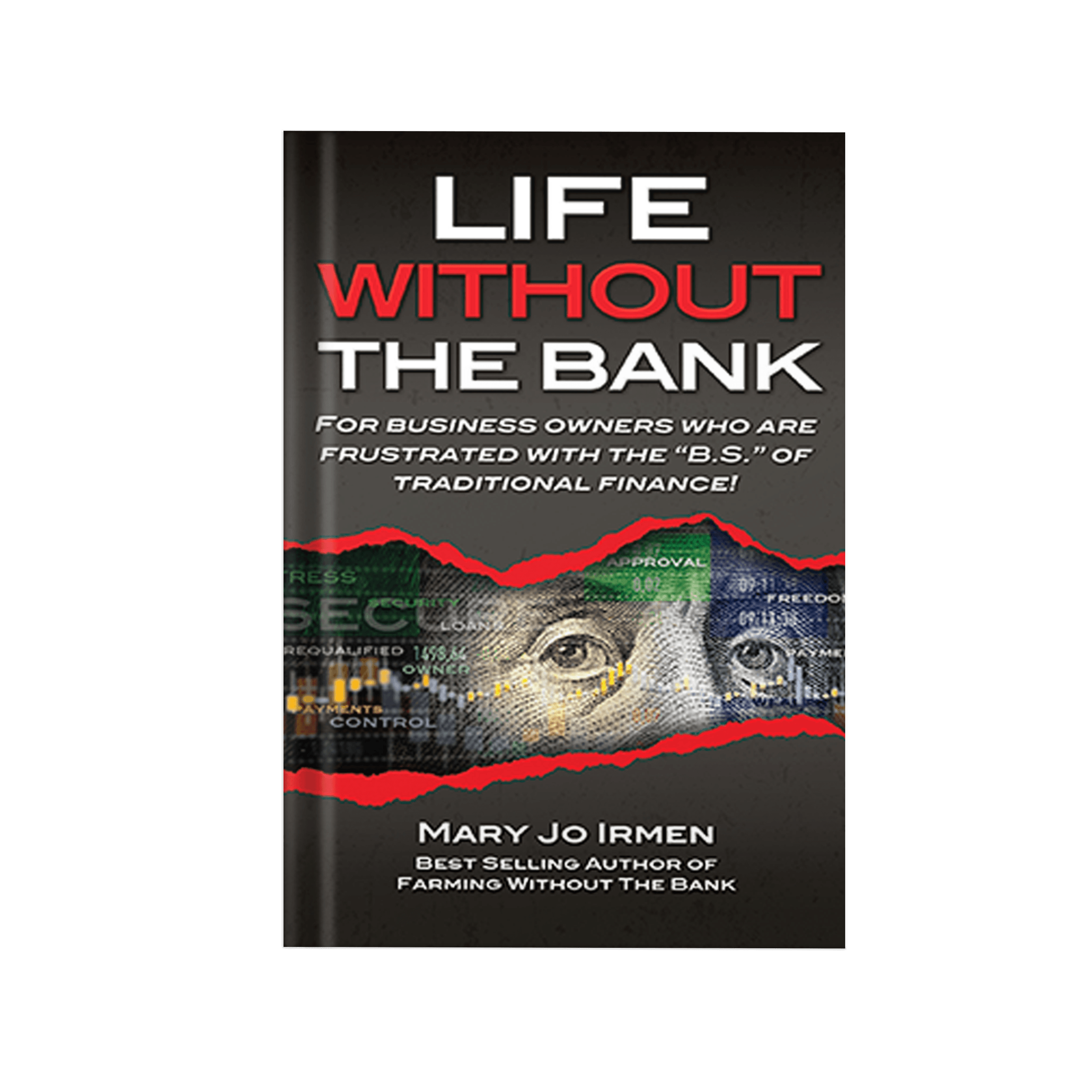
Your financial independence starts with one book.
Only one of three Americans can retire. Part of the fault is the conditioned belief that you must give up the use of your money when you’re young so you can have it later, assuming the stock market doesn’t collapse.