Podcast
EP. 250
Your Biggest Business Problem Isn’t What You Think (Ep. 250)
Jan 1, 2026 ·
27 min
0:00 / 26:55
EPISODE OVERVIEW
ABOUT THIS EPISODE
Most people think money problems are about income. They're wrong. It's about mindset, discipline, and who controls the capital. In this episode, we break down The Golden Rule: Those who have the gold make the rules, and why that changes everything.
Drawing from Becoming Your Own Banker by Nelson Nash, we explore why living for today destroys future opportunity, how capital attracts opportunity, and why disciplined thinkers consistently win, regardless of industry. This conversation connects real-world business stories, personal experiences, and powerful mindset shifts that separate people who struggle financially from those who thrive.
In This Episode
- Why mindset matters more than income
- How immediate gratification sacrifices your future
- The real meaning of "Those who have the gold make the rules"
- Why access to capital creates opportunity
- How disciplined thinkers play a completely different game
- Why becoming your own banker is about responsibility, not numbers
- How your belief system around money shapes your results
Resources
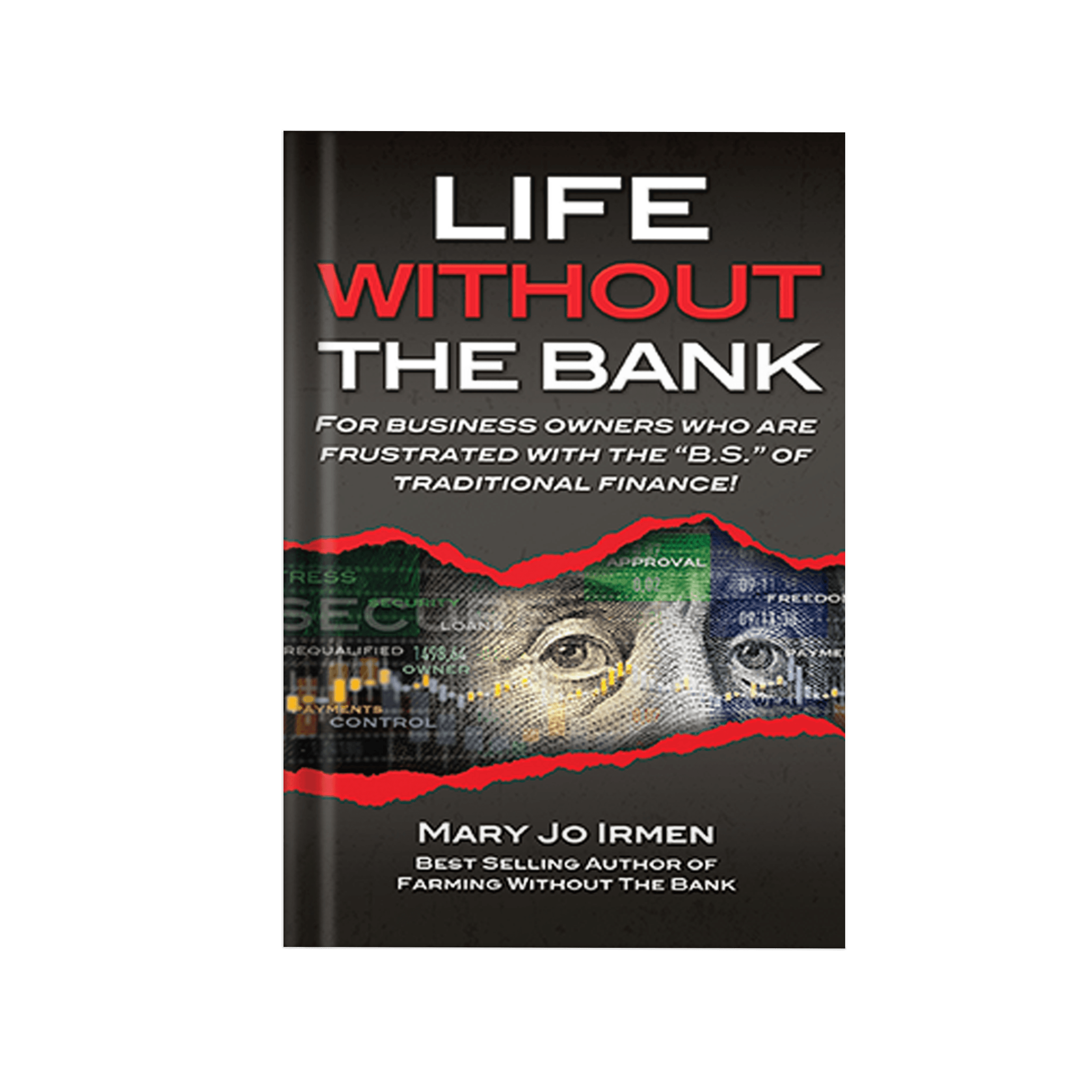
- Get the book
- Follow Mary Jo: youtube.com/@MaryJoIrmen
- Website: withoutthebank.com
CHAPTER TIMESTAMPS
- 00:00Mindset Is Everything (Why Every Successful Business Owner Talks Mindset First)
- 02:07The Golden Rule Explained (What "Those Who Have the Gold Make the Rules" Really Means)
- 04:29Living for Today vs. Owning Tomorrow (How Spending Habits Destroy Long-Term Freedom)
- 06:40Capital Creates Opportunity (Why Cash on Hand Changes the Game)
- 12:38Discipline Separates Winners (Why Infinite Banking Isn't for Everyone)
- 15:30Rewiring Your Money Beliefs (How Environment, Inputs, and Mindset Shape Results)
- 21:21Becoming the Bank (Why Most People Give Up the Banking Function, and Pay for It)
YOUTUBE EPISODE
TRANSCRIPTION
There's podcast after podcast after podcast. And when you start listening to podcasts of successful business owners, mindset, mindset, mindset, mindset, mindset, it does not matter. I don't care if you're in the farming world, if you're in blue collar business, if you're in just a small business owner, I don't care if you have no business.
It is all 100% mindset. And we have control of that. Hello, hello, and welcome back to the podcast.
Thank you very much for being here. Okay, we have moved on to the golden rule. Oh, look, Eleanor's joining us.
She's always here. Let's be honest. She's just normally off camera doing her thing.
Might see enough bloopers. Little bit gassed out in the last one. Okay.
Couldn't push through that one. All right. So let's talk about the golden rule.
It seems like I do want to add to if you guys have the book, which it's funny, like even Parkinson's law, if you look, it's not even a whole page. We spent like 20 minutes on it. Willie Sutton's was a page and a half.
The golden rule is very short as well. Two pages. There's a lot here.
It might seem like the Oh, it's a golden rule. Those who make the gold are those who have the gold make the rules. Yeah.
Okay. Moving along. It's really deeper than that.
And so it might seem crazy that we're spending so much time on this, but we're doing it for a reason. I mean, obviously, we're not just trying to fill time because we could be doing something like... You could be going to Medora. Yeah, apparently that's a cool place.
That's interesting. Charissa's just infatuated with grass. And so we could be outside. She could be watching the grass.
That's the grass dance. Yeah. Okay.
The golden rule, those who have the gold make the rules. And I found this interesting. Nelson goes on here to say, you know, another golden rule we learned was due unto others as we would have them do unto us.
He said, we have almost lost the concept what capitalism is about. The common man has become so infatuated with living for today, that the importance of savings or creating capital is all but a lost value. And that's pretty powerful.
Like I've read that a bunch of times. And not until I was preparing for us to go over this, did I really pay attention to that. And what he's saying is a common man is infatuated with living for today, meaning I want that.
So I'm going to give up the ability to save. I'm not going to beat Parkinson's law because my need to have this camper today is more important.
So I'm going to be out and I'm going to give up the ability to start my business because my need to go on a fancy cruise vacation with my family is more important than putting that money away so that I can have a business later. I looked it up because in here, he goes on to say the American savings rate is miserably low. It is 4.6% right now, which is quite high.
I thought it would be closer to like two or 3%. So that's good that people are saving. But yeah, we want so badly to have all the stuff that everybody else has.
And we're comparing ourselves to our peers. And then we're going to end up like our peers. We want to have to be instead of be to have.
Well, and what's interesting about that is like if you live for today, and you kind of give in to all those immediate gratification things, you're sacrificing your future. You know, whereas if you sacrifice for today, the future, in my opinion, typically only ever gets brighter and better because you're having the discipline that it requires to be that person. Yep.
100%. And then he goes on to say as a result, someone else must provide the capital that is necessary to sustain our way of life. Have those things today that he was talking about.
This strategy carries with it a very high cost. And in order to have that camper, in order to go on that vacation, that cruise, in order to have that brand new vehicle, we are going to pay really high interest rates. And those high interest rates are going to go to a lender, they're going to go to the bank, they're going to go to the credit card company, whatever that is.
And so we're paying the price for not being patient, and not having some kind of goal set. I'm not a person that needs to write goals down. But they're in my head, right? I can't have this today.
And it's funny because my kids used to call me Mr. Krabs. Because if there was a penny, I was going to pick it up. Right? If there's a quarter, I'm going to pick it up.
One of them asks, well, how did you get to where you're at? By being frugal, and not going out to drink, not having a beer with every meal, being super smart about what I'm doing. I even now, like there are programs and coaching programs and those sort of things I would like to go to.
But I do a lot of due diligence before I'm going to drop five or 10 grand for a coaching program.
Because what am I going to learn that I don't already know? And who am I going to be stuck around? I'm not going to just willy nilly, spend $5,000 and be in a room full of people that make less money than me or the same amount of money and have the same amount of success. I want to be in a room with people that have more. And I'm sure they're thinking the same thing.
But let me in. So I thought that that was pretty good. Well, I think one of the most important words here is must.
Someone else must provide the capital that is necessary to sustain your way of life. Like it's just a fact. And we are happy to pay for that and to even overpay for that.
And we're happy for them to make the rules. And it's like that you're making the banking business turn generation after generation because you have not taken the time or the discipline to do it for yourself. Yep.
Business is business, right? Yep. That's a really good point.
And that's why I'm so grateful for Mary Jo. Okay. And he does.
It's interesting because he says, history like nature travels in cycles. Both liberty and oppression contain the seeds of their own destruction. What are you watering? Are you watering oppression? Because then you're going to get oppression, right? Whatever the seed is, you water that.
That's what's going to grow. You don't plant corn and wheat comes up. What you plant and what you water is what's going to come up.
What you focus on expands. And I think here's the thing. Are there extenuating circumstances where it is harder for some people sometimes to do whatever? Sure, yes.
And all those things can be true. But still, the question remains, what are you going to do about it? Because you can sit there and feel sorry for yourself your whole life if you want to. But who does that impact? Just yourself.
So, even if all these things are other people's faults, how can you look at that and say, how do I want to grow from this situation? Things are going to be unfair all the time. Yeah. There's going to be circumstances that are not ideal all the time.
And do you really want to let that take you out? Because to me, I will get up and fight. Because I don't ever want to be a victim in my own story. I want to be the hero in my own story.
I want to say, hey, this was challenging. How can I grow from this? Because that is a path forward for me, right? Versus just being like, this is just how it is. To me, that is like beyond defeating.
And the question needs to be asked, how can I? Right. And I say that over and over and over, and I'm a broken record. And I could write it in every page of my book.
But the question becomes, how can I? It's not, oh, we can't do this. No. How can I do this? Because that's what I want to do. I've never said, oh, I can't do that business because people said it's not going to work.
Then why would I do it? There are so many options out there. I can just do something else. You have to kind of be the big thinkers. And Nelson goes on to say, let those feelings of jealousy well up within you and cause you to alert yourselves of the true condition. We have become a society of it's okay to be you.
It's okay to be where you're at. And it is if that's where you want to be. But if you want, he's saying be jealous, try to be better than who you are.
Try to go above and beyond and be competitive to some extent. Right? I am competitive amongst myself. I'm looking always at where have I come from? Where am I going? What does that look like? I don't look at the industry as a whole and go, oh, how am I compared to that guy? No, I don't care.
Because I know what I want. I'm not going to compete with you and say, oh, look, I need to do X, Y and Z because you make more money than me. You have more clients, you're more successful, you're traveling more, you're speaking more.
I don't frankly care. I look at you and go, kudos to you. You're on the road all the time.
Love that for you. Right? Like, I am not gonna do that. Because it's not what I'm into.
But that doesn't mean that I should just sit back and say, well, it's okay where I'm at. I'm going to be competitive amongst myself and say, why can't I do better? Where I'm at is okay. But it's not great.
Let's keep moving. There's always room for improvement. My mom says it's the greatest room in the world.
I love that. Biggest room in the world. I love that.
That is so awesome. Your mom has some good ones. She's a wise, wise lady.
Then he starts talking about Panasonic and how they moved a plant into Mexico because Panasonic thought, well, great. We're good business people. They're good workers.
We're going to move this plant into Mexico. He said, the typical Japanese strategy runs something like this. You put money into a business and you should expect to lose money for five years.
When you start making money, you should plow it back into the business for five more years. Only then should you be taking money out of the business. But the Mexican outlook on business is I demand bonuses from the very start.
He said, Can you tell what happened? Panasonic pulled out of Mexico. Panasonic had the gold and they made the rules. Capital is a responsibility and should be treated with great respect.
When you have a large amount of cash on one hand, all sorts of good opportunities will appear. And you can also negotiate very favorable purchase prices. So, it's funny because what did I just get done saying in the last podcast? That it took me five years to really get this business going.
Right? I have interviewed hundreds of business owners. And they have all said five years, five and six years was kind of the turning point of where everything really started to go positive. But the Japanese are saying, okay, the first five years, we don't expect to make any money because we have startup costs, we have infrastructure, we have training programs, we have to hire all these people. The next five years, we're going to make money, but we're going to put it back in the business so that everything is running smooth. We have a surplus of money, we can make payroll, we don't have to worry about borrowing money.
Right? They're still building this capital with the profits. And so, we see this happen a lot in the business world. People might come into the business world, it's a blue collar business, they're making money.
Fantastic. And all of a sudden, I'm starting to spend everything. I'm not putting it back in the business.
And then we're like, man, we're really tired. Like our back hurts. We can't get out of bed.
Our body is aching because it's a hard industry to be in. And we don't have anybody to cover for us. We can't even take a day off for vacation.
Because we need that money. Because we're spending it. Did we put it back in? Did we take it out right away? What did that look like? I also like the fact that he says, when you have a large amount of cash on hand, opportunities appear.
That's happened to me over and over and over and over. I used to think Nelson had lost his mind when he said that because I'm like, yeah, there's no opportunities. Well, I didn't have the money for the opportunity.
Now I do have the cash and I can name the price. And it was funny, we have our townhouse for sale. And our listing price is $290.
Some guy comes in $240. He's like, I'll give you $240 cash, close in five days. I'm like, dude, if you have $240 cash, I know you have $290 cash.
And I was like, $285 cash, close in five days. Didn't hear a word from him. Like, well, that's okay.
But what he didn't know is that he's playing the game with somebody that also has money and I don't have to sell. So he should have did his due diligence and said, who is the owner? How badly do they need to sell? Right? He's kind of halfway playing the game.
Like I research everything to see if I do have an opportunity there. How long has it been on the market? What have other people offered them? You can't just go in and take an opportunity without doing your due diligence. But people with money will always take those opportunities.
People will continue to make so much money off of your family, your business, your future. And if you just said, Hey, this flow of money is going to happen anyways. And if I take a portion of it to capitalize my system first, I will be so much further ahead than my comparatively to my peers because it'll be easier.
You don't have to ask for permission to get access to your money. You don't have to wait until you're 59 and a half. You're not penalized for it if you try to access it.
You can have it on your own terms. And I think that this concept works super well for people that have the discipline and people that are committed to being free. I think it works well for people that just ask, How can I be a bank? Nelson is saying here that we don't even wonder how.
We've just abdicated that to somebody else. We've just said, Hey, you're the bank. So we'll give that to you.
All right. Questions, comments, concerns, let us know. Otherwise, you guys have a fantastic day and we'll see you in the next podcast.
View MoreIt is all 100% mindset. And we have control of that. Hello, hello, and welcome back to the podcast.
Thank you very much for being here. Okay, we have moved on to the golden rule. Oh, look, Eleanor's joining us.
She's always here. Let's be honest. She's just normally off camera doing her thing.
Might see enough bloopers. Little bit gassed out in the last one. Okay.
Couldn't push through that one. All right. So let's talk about the golden rule.
It seems like I do want to add to if you guys have the book, which it's funny, like even Parkinson's law, if you look, it's not even a whole page. We spent like 20 minutes on it. Willie Sutton's was a page and a half.
The golden rule is very short as well. Two pages. There's a lot here.
It might seem like the Oh, it's a golden rule. Those who make the gold are those who have the gold make the rules. Yeah.
Okay. Moving along. It's really deeper than that.
And so it might seem crazy that we're spending so much time on this, but we're doing it for a reason. I mean, obviously, we're not just trying to fill time because we could be doing something like... You could be going to Medora. Yeah, apparently that's a cool place.
That's interesting. Charissa's just infatuated with grass. And so we could be outside. She could be watching the grass.
That's the grass dance. Yeah. Okay.
The golden rule, those who have the gold make the rules. And I found this interesting. Nelson goes on here to say, you know, another golden rule we learned was due unto others as we would have them do unto us.
He said, we have almost lost the concept what capitalism is about. The common man has become so infatuated with living for today, that the importance of savings or creating capital is all but a lost value. And that's pretty powerful.
Like I've read that a bunch of times. And not until I was preparing for us to go over this, did I really pay attention to that. And what he's saying is a common man is infatuated with living for today, meaning I want that.
So I'm going to give up the ability to save. I'm not going to beat Parkinson's law because my need to have this camper today is more important.
So I'm going to be out and I'm going to give up the ability to start my business because my need to go on a fancy cruise vacation with my family is more important than putting that money away so that I can have a business later. I looked it up because in here, he goes on to say the American savings rate is miserably low. It is 4.6% right now, which is quite high.
I thought it would be closer to like two or 3%. So that's good that people are saving. But yeah, we want so badly to have all the stuff that everybody else has.
And we're comparing ourselves to our peers. And then we're going to end up like our peers. We want to have to be instead of be to have.
Well, and what's interesting about that is like if you live for today, and you kind of give in to all those immediate gratification things, you're sacrificing your future. You know, whereas if you sacrifice for today, the future, in my opinion, typically only ever gets brighter and better because you're having the discipline that it requires to be that person. Yep.
100%. And then he goes on to say as a result, someone else must provide the capital that is necessary to sustain our way of life. Have those things today that he was talking about.
This strategy carries with it a very high cost. And in order to have that camper, in order to go on that vacation, that cruise, in order to have that brand new vehicle, we are going to pay really high interest rates. And those high interest rates are going to go to a lender, they're going to go to the bank, they're going to go to the credit card company, whatever that is.
And so we're paying the price for not being patient, and not having some kind of goal set. I'm not a person that needs to write goals down. But they're in my head, right? I can't have this today.
And it's funny because my kids used to call me Mr. Krabs. Because if there was a penny, I was going to pick it up. Right? If there's a quarter, I'm going to pick it up.
One of them asks, well, how did you get to where you're at? By being frugal, and not going out to drink, not having a beer with every meal, being super smart about what I'm doing. I even now, like there are programs and coaching programs and those sort of things I would like to go to.
But I do a lot of due diligence before I'm going to drop five or 10 grand for a coaching program.
Because what am I going to learn that I don't already know? And who am I going to be stuck around? I'm not going to just willy nilly, spend $5,000 and be in a room full of people that make less money than me or the same amount of money and have the same amount of success. I want to be in a room with people that have more. And I'm sure they're thinking the same thing.
But let me in. So I thought that that was pretty good. Well, I think one of the most important words here is must.
Someone else must provide the capital that is necessary to sustain your way of life. Like it's just a fact. And we are happy to pay for that and to even overpay for that.
And we're happy for them to make the rules. And it's like that you're making the banking business turn generation after generation because you have not taken the time or the discipline to do it for yourself. Yep.
Business is business, right? Yep. That's a really good point.
And that's why I'm so grateful for Mary Jo. Okay. And he does.
It's interesting because he says, history like nature travels in cycles. Both liberty and oppression contain the seeds of their own destruction. What are you watering? Are you watering oppression? Because then you're going to get oppression, right? Whatever the seed is, you water that.
That's what's going to grow. You don't plant corn and wheat comes up. What you plant and what you water is what's going to come up.
What you focus on expands. And I think here's the thing. Are there extenuating circumstances where it is harder for some people sometimes to do whatever? Sure, yes.
And all those things can be true. But still, the question remains, what are you going to do about it? Because you can sit there and feel sorry for yourself your whole life if you want to. But who does that impact? Just yourself.
So, even if all these things are other people's faults, how can you look at that and say, how do I want to grow from this situation? Things are going to be unfair all the time. Yeah. There's going to be circumstances that are not ideal all the time.
And do you really want to let that take you out? Because to me, I will get up and fight. Because I don't ever want to be a victim in my own story. I want to be the hero in my own story.
I want to say, hey, this was challenging. How can I grow from this? Because that is a path forward for me, right? Versus just being like, this is just how it is. To me, that is like beyond defeating.
And the question needs to be asked, how can I? Right. And I say that over and over and over, and I'm a broken record. And I could write it in every page of my book.
But the question becomes, how can I? It's not, oh, we can't do this. No. How can I do this? Because that's what I want to do. I've never said, oh, I can't do that business because people said it's not going to work.
Then why would I do it? There are so many options out there. I can just do something else. You have to kind of be the big thinkers. And Nelson goes on to say, let those feelings of jealousy well up within you and cause you to alert yourselves of the true condition. We have become a society of it's okay to be you.
It's okay to be where you're at. And it is if that's where you want to be. But if you want, he's saying be jealous, try to be better than who you are.
Try to go above and beyond and be competitive to some extent. Right? I am competitive amongst myself. I'm looking always at where have I come from? Where am I going? What does that look like? I don't look at the industry as a whole and go, oh, how am I compared to that guy? No, I don't care.
Because I know what I want. I'm not going to compete with you and say, oh, look, I need to do X, Y and Z because you make more money than me. You have more clients, you're more successful, you're traveling more, you're speaking more.
I don't frankly care. I look at you and go, kudos to you. You're on the road all the time.
Love that for you. Right? Like, I am not gonna do that. Because it's not what I'm into.
But that doesn't mean that I should just sit back and say, well, it's okay where I'm at. I'm going to be competitive amongst myself and say, why can't I do better? Where I'm at is okay. But it's not great.
Let's keep moving. There's always room for improvement. My mom says it's the greatest room in the world.
I love that. Biggest room in the world. I love that.
That is so awesome. Your mom has some good ones. She's a wise, wise lady.
Then he starts talking about Panasonic and how they moved a plant into Mexico because Panasonic thought, well, great. We're good business people. They're good workers.
We're going to move this plant into Mexico. He said, the typical Japanese strategy runs something like this. You put money into a business and you should expect to lose money for five years.
When you start making money, you should plow it back into the business for five more years. Only then should you be taking money out of the business. But the Mexican outlook on business is I demand bonuses from the very start.
He said, Can you tell what happened? Panasonic pulled out of Mexico. Panasonic had the gold and they made the rules. Capital is a responsibility and should be treated with great respect.
When you have a large amount of cash on one hand, all sorts of good opportunities will appear. And you can also negotiate very favorable purchase prices. So, it's funny because what did I just get done saying in the last podcast? That it took me five years to really get this business going.
Right? I have interviewed hundreds of business owners. And they have all said five years, five and six years was kind of the turning point of where everything really started to go positive. But the Japanese are saying, okay, the first five years, we don't expect to make any money because we have startup costs, we have infrastructure, we have training programs, we have to hire all these people. The next five years, we're going to make money, but we're going to put it back in the business so that everything is running smooth. We have a surplus of money, we can make payroll, we don't have to worry about borrowing money.
Right? They're still building this capital with the profits. And so, we see this happen a lot in the business world. People might come into the business world, it's a blue collar business, they're making money.
Fantastic. And all of a sudden, I'm starting to spend everything. I'm not putting it back in the business.
And then we're like, man, we're really tired. Like our back hurts. We can't get out of bed.
Our body is aching because it's a hard industry to be in. And we don't have anybody to cover for us. We can't even take a day off for vacation.
Because we need that money. Because we're spending it. Did we put it back in? Did we take it out right away? What did that look like? I also like the fact that he says, when you have a large amount of cash on hand, opportunities appear.
That's happened to me over and over and over and over. I used to think Nelson had lost his mind when he said that because I'm like, yeah, there's no opportunities. Well, I didn't have the money for the opportunity.
Now I do have the cash and I can name the price. And it was funny, we have our townhouse for sale. And our listing price is $290.
Some guy comes in $240. He's like, I'll give you $240 cash, close in five days. I'm like, dude, if you have $240 cash, I know you have $290 cash.
And I was like, $285 cash, close in five days. Didn't hear a word from him. Like, well, that's okay.
But what he didn't know is that he's playing the game with somebody that also has money and I don't have to sell. So he should have did his due diligence and said, who is the owner? How badly do they need to sell? Right? He's kind of halfway playing the game.
Like I research everything to see if I do have an opportunity there. How long has it been on the market? What have other people offered them? You can't just go in and take an opportunity without doing your due diligence. But people with money will always take those opportunities.
People will continue to make so much money off of your family, your business, your future. And if you just said, Hey, this flow of money is going to happen anyways. And if I take a portion of it to capitalize my system first, I will be so much further ahead than my comparatively to my peers because it'll be easier.
You don't have to ask for permission to get access to your money. You don't have to wait until you're 59 and a half. You're not penalized for it if you try to access it.
You can have it on your own terms. And I think that this concept works super well for people that have the discipline and people that are committed to being free. I think it works well for people that just ask, How can I be a bank? Nelson is saying here that we don't even wonder how.
We've just abdicated that to somebody else. We've just said, Hey, you're the bank. So we'll give that to you.
All right. Questions, comments, concerns, let us know. Otherwise, you guys have a fantastic day and we'll see you in the next podcast.



ready to start?
Your financial independence starts with one book.
Only one of three Americans can retire. Part of the fault is the conditioned belief that you must give up the use of your money when you’re young so you can have it later, assuming the stock market doesn’t collapse.