Podcast
EP. 279
Your Business Partner Won’t Discuss This? It’s a Massive Red Flag (Ep. 279)
Jul 23, 2026 ·
23 min
0:00 / 22:30
EPISODE OVERVIEW
ABOUT THIS EPISODE
What happens to your business if your partner dies tomorrow — and you never had a plan?
In Episode 279, Mary Jo breaks down the two most overlooked protection tools every business owner and entrepreneur needs from day one: Buy-Sell Agreements and Key Man (Key Person) Insurance Policies.
Whether you're launching a new partnership, running a business with your spouse, or have a single key employee your company can't live without — this episode is your wake-up call.
In This Episode, Mary Jo Covers
- Why choosing a business partner is essentially like a marriage (and why you need to treat it that way)
- What a Buy-Sell Agreement actually is — and why you need one before things go sideways
- How to use whole life insurance for partner buyouts using Infinite Banking
- Key Man insurance: what it is, who qualifies, and how it's valued
- Why your corporation should NOT own the policy (and the tax trap hiding inside)
- What happens to your business if a partner becomes uninsurable
- The "head in the sand" problem — why spouses must be financially aware
- Real-world example: how Mary Jo structured her own cattle partnership agreement using ChatGPT
📌 This episode also includes a personal update on the WTB team!
💡 If you're in a business partnership — or about to enter one — don't skip this episode.
📩 Ready to Learn More?
- 📅 Schedule your appointment: maryjo@withoutthebank.com
- ▶️ Subscribe on YouTube
CHAPTER TIMESTAMPS
- 00:00Life Insurance Red Flag
- 00:39Podcast Updates
- 01:34Why Partnerships Fail
- 04:25Contracts Save Friendships
- 06:48Marriage and Business Risks
- 08:25Buy Sell Basics
- 09:56Key Person Coverage
- 12:05Who Should Own Policies
- 16:27Family Must Stay Informed
- 19:10Do It Before Trouble
- 21:56Wrap Up and Next Steps
YOUTUBE EPISODE
TRANSCRIPTION
"If your partner says, 'No, we don't need life insurance,' I would question why I want to go into business with that person. They're okay just leaving me without anything. Hmm, interesting. Right? They don't want to understand infinite banking. Are we already at odds of how we're gonna handle our money? If that's the case, then we definitely need to say, 'Do we want to go into partnership?' Because this is just the beginning. If they are not wanting to be at the same level and understand the same way we do, are we going to have trouble down the road? It's essentially a marriage, you guys. And you need to pay attention to it as if you were gonna be lifelong partners."
Hello, hello, and welcome back to the podcast. Thank you very much for being here. All right, you guys, a little bit of not so much housekeeping, but an update on what's happening around here. I'm gonna be back full-time because our little lovely Tarisa is… got some other ventures that she is going to do that include leaving the country.
So she is going to leave us for a little while. I hope and pray that she will be back, but we never know. So, I'm excited, super-duper excited for her. But if she's gonna move out of the country, she cannot do life insurance from there. Whatever that looks like for her future. But maybe we can tune in time to time and get an update on what's happening with Tarisa. Let's all wish her the absolute best because we are excited for her, and she is amazing.
But today I want to talk about key man policies and buy-sell agreements. We have a lot of people that start businesses, right? You are gung ho. You are excited. It seems to be, I don't know if it's just 'cause I'm on that side of the algorithm, but it seems to be that a lot of people are wanting to start businesses of some kind. And it's kind of easy to do that in today's world, so it would make sense that people do that.
But when we do that, and we do it with partnerships, we need to be very smart about what we do. When you set up a business and you have partnerships or you have key employees, you really need to think long-term about when you're dead because guess what? You're not getting out alive. And so a lot of people think, "Oh, those partnerships are gonna last forever," or, "I'm gonna work until I die," or, "I'm gonna retire and all will be great in the land," and nobody thinks about the complicated part of that.
So let's say that we have a partnership, and I set up that partnership. Make sure that you're doing that with worst-case scenario in mind. Worst-case scenario is what happens if we don't like one another? Because a majority of partnerships — I think I saw a statistic recently that 70 to 80% of partnerships break up. And so what happens when and if we decide that we don't work well together, we don't agree on how to run the business, and we want to split?
Not all those splits are going to be bad splits, but what happens if they are? What happens if a partner dies? Do we want to go into business with the spouse? Do we want to go into business with the kids? What happens if we die? And does our partner want to go into business with our spouse? Did our spouse even want any part of this business to begin with?
And so there's a lot of those things that we need to look at and really think about now when the business is going okay and everybody likes one another. Because what happens is when you have it in writing, and this is the buyout, that's it.
I have friends that deal in this kind of stuff as well, and I have heard stories of when everything was good and we were starting and we liked one another, this is what we structured as a buyout. Well, when things went bad, that was not the agreement of the buyout, and so there was no way for one party to kind of screw the other party because there was an agreement in place already, and those things need to happen right away.
I am very adamant about this kind of stuff. So we bought cows, and we bought cattle with the guy that grazes our land. It's all fantastic and wonderful, and I said, "We need an agreement." Everything needs to be outlined and in an agreement because if something happens where we don't like one another, then the agreement's made. And I am absolutely thrilled that we did it, because there were a lot of things that I would have not thought about that obviously they were thinking about.
Stuff like, hey, when that cow has a calf, they want first dibs on the calf. They get to decide when the cows get culled and sold, and because they're running them. We don't have participation in that. I'm not out there calving them out, deciding all those things. And I know for some of you listening, all these farm analogies don't mean anything, but trust me, I'm not out with the cows.
I knew in that agreement that they have full control to say, "This cow gets sold. We wanna buy this calf. This is the price we're gonna give for this calf." I know that going in. Now, had we not had an agreement, that would've come by surprise to me, because I thought everything was getting sold at the sale barn. I had not gone down that road of thinking, oh, they're gonna wanna buy back our calves. Awesome.
Things like the vet. Who's hauling them to the vet? Well, they don't haul their cows to the vet. They have those cows doctored on premises, right? A vet will come out. And so there's just a lot of things that are not considered until you put it in writing.
And I actually used ChatGPT for this. I know you shouldn't… Like, you should run it by and have a legal contract and all this stuff. I went into chat, and chat gave me all sorts of North Dakota law suggestions of what we should think about. And between the two or three of us, we were able to think about a lot of stuff that needed to be put in the contract, and I am thrilled that it's there because at some point, if I'm mad, "Hey, there's a contract, Mary Jo." If they're mad, "Hey, there's a contract."
When you're starting some sort of a business, there needs to be a contract. Even if you are a husband and a wife and you are starting a business together. This is not for the faint of heart. Having a business will test your marriage like building a house will test your marriage.
And so if you have some sort of outlined agreement that says, "Should we get divorced, this is what's going to happen." I have a potential client who is amazing. She's fantastic. Her and her husband are going through a divorce, and they own a business together, and he is running that business into the ground and creating expenses and having people quit because they don't like working with him. Instead, they would work with her.
So there are a lot of those sorts of things that need to be considered even if you are a happily married spouse. You are happily married today, okay? You might wanna have some sort of a system of, how do we settle a disagreement? Because if we're a married spouse, are we going to take that disagreement home? Are we going to have a third party involved in settling a disagreement? Are we gonna have an accountant involved? Are we gonna have an attorney involved? Do we have a business coach? What does that look like? And what if one person wants to grow and the other person doesn't wanna grow? What does that look like? What does the spending look like?
It does not matter if you are married or if you're just buddies and you have a business together. It is extremely important that this is all laid out. Once this is laid out, then we also need to go to, okay, what happens if we want to sell? What happens if somebody dies?
Surprising to me when I say, "Okay, you're a partnership, what happens if one of you die?" And nobody has an answer because nobody's talked about it. This is where the life insurance piece comes into play.
So if the business and both partners understand that we can do infinite banking, we can have that money rolling through policies. But we also have death benefit on each party. So if you and I are in business together, I'm gonna have a policy on you and you're gonna have a policy on me. And if I die, my death benefit proceeds are gonna go to you because you own the policy on my life. You then get to use that money to buy out my husband, or you get to use that money to expand the business if you decide, "Hey, I wanna be in business with her husband still." It's going to give you options.
That is a buy-sell agreement, meaning if one of us dies, we have to buy the other one out, or if one of us retires, we have to buy the other one out. These are buy-sell agreements, okay? The buy-sell or key man is not a type of whole life, it is just why we're buying whole life. We need to know that. The insurance company needs to know that. It's not a special policy. It's a special reason for a policy.
On the key man stuff, if you're a sole proprietor, and you have a great company, and you own 100% of that company, but you have a key individual that's worked with you for a long time, or if that key individual dies, and there is money on the table, that because we're gonna lose money, then we can insure that person.
So like, for example, I have an assistant that's been with me for nearly a decade. She is amazing, okay? If something happened to her, my business would not stop, but it would significantly slow down for a period of time. I have insurable interest in her. Now, the insurance company gets to decide how much that is.
Just like the insurance company gets to decide on a buy-sell agreement. They're gonna wanna see what the valuation of the business is. They look at what her income is, and they use a factor of her income. So you can't just go buy any amount of life insurance on somebody that you want.
Now, I look at like a buy-sell, I also look at that as a, "Hey, we split. It was not amicable. The partnership dissolved," and somebody feels like they got the short end out of the stick — the short end of the stick. If that happens, and you have a life insurance policy on that person, then when that person passes away at some point, you're gonna get the death benefit. So I think of it as sort of a recovery plan as well. Like, I own it for the life of that person. So even if we split, and it was all okay, and it was amicable, and everybody was happy, I still own that policy on that person.
If I have a policy on myself as an owner or if I have a policy on other business owners, that can also be used as just a way to say, "Hey, you know what? You can have that policy, and that is your way of a retirement strategy." Or some sort of a buyout agreement. Because a policy has cash value, you could just give them the policy. Now, there are tax implications with some of those things, and so you have to be aware of that stuff. But those are the strategies to use.
The other thing is, is if I'm a sole proprietor, I need to have a policy on myself because that is where our money's coming from. So if I died, I need to make sure my family is protected.
Now, should the LLC or corporation own the policy? My opinion, because of accountants that have told me so, my opinion is no, you should not have a business own the policy. There are going to be certain circumstances where maybe you want to do that. Every accountant I have ever talked to has said no, because then it becomes an asset to the corporation, and upon somebody's death, they have to buy out the death benefit because the death benefit would roll back into the corporation.
If there's a partnership split, now that's an asset and that has to be bought out because now it becomes an asset of the company and it values the company higher. And you cannot deduct premium as an expense in a corporation. If you do — well, I shouldn't say you can't, you ideally don't want to. If you do, then the death benefit becomes taxable.
Somebody told me the other day that they are doing that, and I've yet to hear back what this little loophole is that the CPA found or is doing or if they're just not aware. I don't know. I'm sure there are some exceptions to those rules, so everything I say is not gospel, but it is there for you to take to your accountant and figure out.
But that is the main question I get is, "Hey, can I have my corporation pay for this? Hey, can my corporation deduct the premium?" No. I am going to pay my premium, and then I'm going to turn around and borrow that money to buy something for the business and create an expense.
So if I am a contractor and I need a piece of equipment, then I am going to pay my premium, borrow the cash value, use it to buy a piece of equipment for the business, and then that is my tax write-off. I'm actually going to borrow the money on my personal policy, lend it to the business, the business is gonna buy the piece of equipment, and then the business will pay me back. And so we're adding a tiny little step, and it is a little step, and it's a little bit of paperwork for you because you become the banker.
But when we're looking at corporations, these are the things that we're looking for. Have your stuff in order. And I know a lot of people don't have their yearly meeting minutes and all those sort of things. I myself slack on that. Preaching to the choir here. But there is one thing that I will always have, and if it's a partnership, we are going to have an agreement because I have seen so many partnerships go bad, and it all could have been solved with a simple agreement. Make sure that you have your agreement and make sure that you are insuring each other.
Oh my goodness, like I have seen scenarios where partnerships worked out and it's fantastic and they had term insurance on one another. Well now one of them is 65, 67, uninsurable, and they're still in business together. Now how's that gonna work? It's not gonna work because one of them is insurable and one of them isn't.
Not everything is gonna be equal and fair 'cause somebody's health is gonna be different than somebody else's. You might have an age gap with your partnership where one of you is 30 and the other one is 60, and so now the death benefit is significantly different for the same amount of premium. So there's some things that have to be considered when we're doing buy-sell agreements or key man stuff. However, it's just a couple of things that I am not going to ignore.
Now, in my example with my cattle, yes, we don't have like a true partnership. We have a contract that this is what they're gonna do, this is how they're gonna run the cattle, but we don't have a true partnership. So I have no insurable interest. If that guy dies then I can just go get my cows and I can sell them.
In our partnership we had though, what happens if Scott and I die? Where do the cows go? Who gets the cows? Who gets the proceeds of the cows? Or I — I don't actually know if we have it in there or if we just talked about it because it is important, 'cause our children, they don't know these people. So now you kind of have an awkward situation.
You need to think of that. Does your family know who you're in partnership with? Do they have a relationship with them? Do they know them so that when something happens they know who to go to, they know what to watch for, they know what kind of person they are? If they don't know those things then you should be building that relationship, just like I kind of need to build that relationship with our kids to the people with the cows.
Now it's not that big of a deal, there's not that many cows. It's not like we own land in partnership, and that is an extreme large amount of money. That's not the case. But when you are running a full-on business, you want to make sure that everybody kind of knows everybody.
I know a lot of times it's crazy to me that you'll have two men in partnership, and the wives have no idea. Like, they are so oblivious to what their husband does and how the business is run that they're just like, "Yeah, I'm good. I'm good not knowing." There's this comfort for some people to stick their head in the sand and just be like, "Yeah, he goes to work. He does his thing." No. No, no, no, no, no. I don't care what side of the equation it is, husband, wife, whatever. Do not stick your head in the sand. You need to be aware of what is happening.
My husband, he does not have his head in the sand. It is above the sand a hair, okay? He listens, he pays attention. He kind of knows what's happening. He knows all the people that I work with and I'm associated with. He is familiar with those things. He could call either one of my assistants, he would know them, right?
Now, does he know on a day-to-day basis every single thing I have going on? No. Do I need him to know? I don't think so. He just needs to know the key players and who he needs to call, and those key players know that what they're gonna have to do. We've had those conversations.
But it amazes me when I talk to people, and their wives have not a clue. Like, they don't even really know what their husbands do. Ladies, ladies, okay, like being taken care of is great, but that's a whole nother level. You need to know. You need to pay attention to finances, and your husband is not gonna make you do that, and vice versa. If the husband doesn't wanna do that, you need to at least know a little bit and pay attention so that you're not taken for a ride when your spouse is gone.
So there's a lot to business partnerships that people just miss because they go, "Oh my gosh, we got this business idea. We love each other. We're gonna start this business, and we're gonna do an amazing job, and we're gonna go out and conquer the world." And then something happens. And the rose-colored glasses come off after six months, and we're like, "Ugh, maybe we shouldn't have gone into business with this person. Maybe we should have had a contract and some things in place."
But now, how do we bring that up six months into the business and our relationship is just a hair rocky, or a year or two into the business and our relationship is a hair rocky? How do we bring that up? Or what if we've decided that we don't really like the spouse of our partner? And they're maybe a little bit abrasive, or they maybe just don't care at all, or whatever. And now we need to bring this up, and now we need to do some sort of a contract? Mm, it's a little bit awkward.
And so the sooner that you can get that done, the sooner you can talk about life insurance and buy-sells and key man stuff, the better. Don't wait until something goes south, because at that point, it's probably a little bit too late.
And be on the same page financially. Like, understand, are you both gonna be involved financially? Is one of you gonna be the worker and the other one is gonna be the finance guy? And if the finance guy is the finance guy, then the worker has to believe the finance guy. And the finance guy has to believe the worker that these are the things that he needs. And what happens is we get into the questioning mode, and we're just gonna question, question, question everybody, and we're not actually going to trust whoever we put in charge of whatever they're in charge of.
So yeah, it's a lot of generals. I like more factual type content, but hopefully that was a good reminder, 'cause I know I've talked about this before, but hopefully it was a good reminder that if you guys have partnerships, you're doing the right stuff and putting the right things in place right away.
If your partner says, "No, we don't need life insurance," I would question why I want to go into business with that person. They're okay just leaving me without anything. Hmm, interesting. Right? They don't want to understand infinite banking. Are we already at odds of how we're gonna handle our money? If that's the case, then we definitely need to say, "Do we want to go into partnership?" Because this is just the beginning. If they are not wanting to be at the same level and understand the same way we do, are we going to have trouble down the road?
It's essentially a marriage, you guys. And you need to pay attention to it as if you were gonna be lifelong partners. And sometimes it's okay. Like, we don't have to have a full-on partnership to work together. Doesn't mean that you guys can't help one another out, especially in the contracting world. There's a lot of, "Hey, I could just be a 1099 employee, and then I can use my money however I want to use my money." Some things to think about.
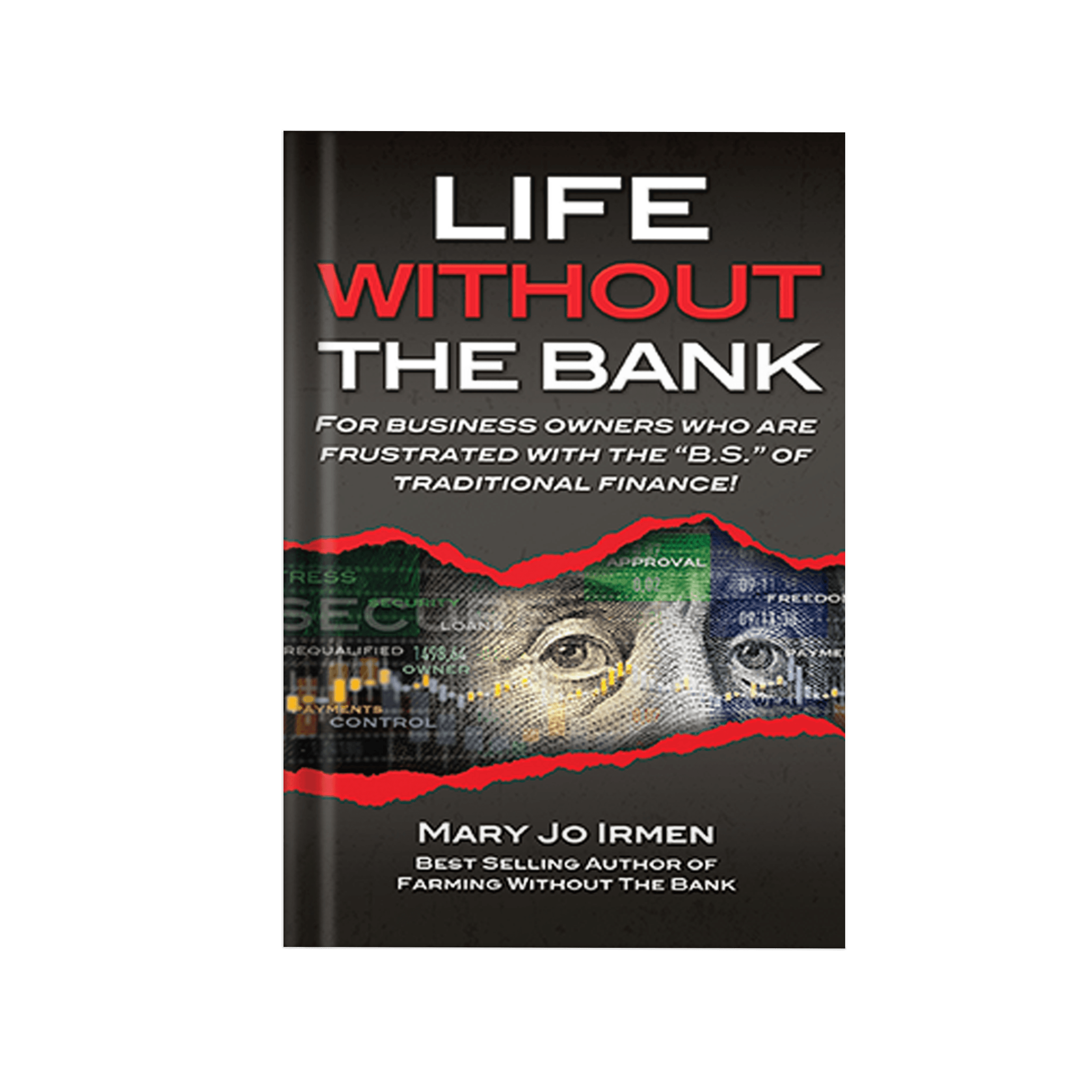
Let me know if you have comments, questions, concerns. I'm happy to answer those. If you have not gotten a Life Without the Bank book yet, grab that one, grab Nelson's, get the bundle, and then schedule your appointment, and we're here to help. John and I are here to help. John's still here. John'll always be here. I shouldn't say always, but pretty sure John's gonna stick around and not… I know John's not leaving the country. That I can tell you for certain.
So, let us know if there's anything that we can do to help. Otherwise, you have a fantastic rest of your day.
View MoreHello, hello, and welcome back to the podcast. Thank you very much for being here. All right, you guys, a little bit of not so much housekeeping, but an update on what's happening around here. I'm gonna be back full-time because our little lovely Tarisa is… got some other ventures that she is going to do that include leaving the country.
So she is going to leave us for a little while. I hope and pray that she will be back, but we never know. So, I'm excited, super-duper excited for her. But if she's gonna move out of the country, she cannot do life insurance from there. Whatever that looks like for her future. But maybe we can tune in time to time and get an update on what's happening with Tarisa. Let's all wish her the absolute best because we are excited for her, and she is amazing.
But today I want to talk about key man policies and buy-sell agreements. We have a lot of people that start businesses, right? You are gung ho. You are excited. It seems to be, I don't know if it's just 'cause I'm on that side of the algorithm, but it seems to be that a lot of people are wanting to start businesses of some kind. And it's kind of easy to do that in today's world, so it would make sense that people do that.
But when we do that, and we do it with partnerships, we need to be very smart about what we do. When you set up a business and you have partnerships or you have key employees, you really need to think long-term about when you're dead because guess what? You're not getting out alive. And so a lot of people think, "Oh, those partnerships are gonna last forever," or, "I'm gonna work until I die," or, "I'm gonna retire and all will be great in the land," and nobody thinks about the complicated part of that.
So let's say that we have a partnership, and I set up that partnership. Make sure that you're doing that with worst-case scenario in mind. Worst-case scenario is what happens if we don't like one another? Because a majority of partnerships — I think I saw a statistic recently that 70 to 80% of partnerships break up. And so what happens when and if we decide that we don't work well together, we don't agree on how to run the business, and we want to split?
Not all those splits are going to be bad splits, but what happens if they are? What happens if a partner dies? Do we want to go into business with the spouse? Do we want to go into business with the kids? What happens if we die? And does our partner want to go into business with our spouse? Did our spouse even want any part of this business to begin with?
And so there's a lot of those things that we need to look at and really think about now when the business is going okay and everybody likes one another. Because what happens is when you have it in writing, and this is the buyout, that's it.
I have friends that deal in this kind of stuff as well, and I have heard stories of when everything was good and we were starting and we liked one another, this is what we structured as a buyout. Well, when things went bad, that was not the agreement of the buyout, and so there was no way for one party to kind of screw the other party because there was an agreement in place already, and those things need to happen right away.
I am very adamant about this kind of stuff. So we bought cows, and we bought cattle with the guy that grazes our land. It's all fantastic and wonderful, and I said, "We need an agreement." Everything needs to be outlined and in an agreement because if something happens where we don't like one another, then the agreement's made. And I am absolutely thrilled that we did it, because there were a lot of things that I would have not thought about that obviously they were thinking about.
Stuff like, hey, when that cow has a calf, they want first dibs on the calf. They get to decide when the cows get culled and sold, and because they're running them. We don't have participation in that. I'm not out there calving them out, deciding all those things. And I know for some of you listening, all these farm analogies don't mean anything, but trust me, I'm not out with the cows.
I knew in that agreement that they have full control to say, "This cow gets sold. We wanna buy this calf. This is the price we're gonna give for this calf." I know that going in. Now, had we not had an agreement, that would've come by surprise to me, because I thought everything was getting sold at the sale barn. I had not gone down that road of thinking, oh, they're gonna wanna buy back our calves. Awesome.
Things like the vet. Who's hauling them to the vet? Well, they don't haul their cows to the vet. They have those cows doctored on premises, right? A vet will come out. And so there's just a lot of things that are not considered until you put it in writing.
And I actually used ChatGPT for this. I know you shouldn't… Like, you should run it by and have a legal contract and all this stuff. I went into chat, and chat gave me all sorts of North Dakota law suggestions of what we should think about. And between the two or three of us, we were able to think about a lot of stuff that needed to be put in the contract, and I am thrilled that it's there because at some point, if I'm mad, "Hey, there's a contract, Mary Jo." If they're mad, "Hey, there's a contract."
When you're starting some sort of a business, there needs to be a contract. Even if you are a husband and a wife and you are starting a business together. This is not for the faint of heart. Having a business will test your marriage like building a house will test your marriage.
And so if you have some sort of outlined agreement that says, "Should we get divorced, this is what's going to happen." I have a potential client who is amazing. She's fantastic. Her and her husband are going through a divorce, and they own a business together, and he is running that business into the ground and creating expenses and having people quit because they don't like working with him. Instead, they would work with her.
So there are a lot of those sorts of things that need to be considered even if you are a happily married spouse. You are happily married today, okay? You might wanna have some sort of a system of, how do we settle a disagreement? Because if we're a married spouse, are we going to take that disagreement home? Are we going to have a third party involved in settling a disagreement? Are we gonna have an accountant involved? Are we gonna have an attorney involved? Do we have a business coach? What does that look like? And what if one person wants to grow and the other person doesn't wanna grow? What does that look like? What does the spending look like?
It does not matter if you are married or if you're just buddies and you have a business together. It is extremely important that this is all laid out. Once this is laid out, then we also need to go to, okay, what happens if we want to sell? What happens if somebody dies?
Surprising to me when I say, "Okay, you're a partnership, what happens if one of you die?" And nobody has an answer because nobody's talked about it. This is where the life insurance piece comes into play.
So if the business and both partners understand that we can do infinite banking, we can have that money rolling through policies. But we also have death benefit on each party. So if you and I are in business together, I'm gonna have a policy on you and you're gonna have a policy on me. And if I die, my death benefit proceeds are gonna go to you because you own the policy on my life. You then get to use that money to buy out my husband, or you get to use that money to expand the business if you decide, "Hey, I wanna be in business with her husband still." It's going to give you options.
That is a buy-sell agreement, meaning if one of us dies, we have to buy the other one out, or if one of us retires, we have to buy the other one out. These are buy-sell agreements, okay? The buy-sell or key man is not a type of whole life, it is just why we're buying whole life. We need to know that. The insurance company needs to know that. It's not a special policy. It's a special reason for a policy.
On the key man stuff, if you're a sole proprietor, and you have a great company, and you own 100% of that company, but you have a key individual that's worked with you for a long time, or if that key individual dies, and there is money on the table, that because we're gonna lose money, then we can insure that person.
So like, for example, I have an assistant that's been with me for nearly a decade. She is amazing, okay? If something happened to her, my business would not stop, but it would significantly slow down for a period of time. I have insurable interest in her. Now, the insurance company gets to decide how much that is.
Just like the insurance company gets to decide on a buy-sell agreement. They're gonna wanna see what the valuation of the business is. They look at what her income is, and they use a factor of her income. So you can't just go buy any amount of life insurance on somebody that you want.
Now, I look at like a buy-sell, I also look at that as a, "Hey, we split. It was not amicable. The partnership dissolved," and somebody feels like they got the short end out of the stick — the short end of the stick. If that happens, and you have a life insurance policy on that person, then when that person passes away at some point, you're gonna get the death benefit. So I think of it as sort of a recovery plan as well. Like, I own it for the life of that person. So even if we split, and it was all okay, and it was amicable, and everybody was happy, I still own that policy on that person.
If I have a policy on myself as an owner or if I have a policy on other business owners, that can also be used as just a way to say, "Hey, you know what? You can have that policy, and that is your way of a retirement strategy." Or some sort of a buyout agreement. Because a policy has cash value, you could just give them the policy. Now, there are tax implications with some of those things, and so you have to be aware of that stuff. But those are the strategies to use.
The other thing is, is if I'm a sole proprietor, I need to have a policy on myself because that is where our money's coming from. So if I died, I need to make sure my family is protected.
Now, should the LLC or corporation own the policy? My opinion, because of accountants that have told me so, my opinion is no, you should not have a business own the policy. There are going to be certain circumstances where maybe you want to do that. Every accountant I have ever talked to has said no, because then it becomes an asset to the corporation, and upon somebody's death, they have to buy out the death benefit because the death benefit would roll back into the corporation.
If there's a partnership split, now that's an asset and that has to be bought out because now it becomes an asset of the company and it values the company higher. And you cannot deduct premium as an expense in a corporation. If you do — well, I shouldn't say you can't, you ideally don't want to. If you do, then the death benefit becomes taxable.
Somebody told me the other day that they are doing that, and I've yet to hear back what this little loophole is that the CPA found or is doing or if they're just not aware. I don't know. I'm sure there are some exceptions to those rules, so everything I say is not gospel, but it is there for you to take to your accountant and figure out.
But that is the main question I get is, "Hey, can I have my corporation pay for this? Hey, can my corporation deduct the premium?" No. I am going to pay my premium, and then I'm going to turn around and borrow that money to buy something for the business and create an expense.
So if I am a contractor and I need a piece of equipment, then I am going to pay my premium, borrow the cash value, use it to buy a piece of equipment for the business, and then that is my tax write-off. I'm actually going to borrow the money on my personal policy, lend it to the business, the business is gonna buy the piece of equipment, and then the business will pay me back. And so we're adding a tiny little step, and it is a little step, and it's a little bit of paperwork for you because you become the banker.
But when we're looking at corporations, these are the things that we're looking for. Have your stuff in order. And I know a lot of people don't have their yearly meeting minutes and all those sort of things. I myself slack on that. Preaching to the choir here. But there is one thing that I will always have, and if it's a partnership, we are going to have an agreement because I have seen so many partnerships go bad, and it all could have been solved with a simple agreement. Make sure that you have your agreement and make sure that you are insuring each other.
Oh my goodness, like I have seen scenarios where partnerships worked out and it's fantastic and they had term insurance on one another. Well now one of them is 65, 67, uninsurable, and they're still in business together. Now how's that gonna work? It's not gonna work because one of them is insurable and one of them isn't.
Not everything is gonna be equal and fair 'cause somebody's health is gonna be different than somebody else's. You might have an age gap with your partnership where one of you is 30 and the other one is 60, and so now the death benefit is significantly different for the same amount of premium. So there's some things that have to be considered when we're doing buy-sell agreements or key man stuff. However, it's just a couple of things that I am not going to ignore.
Now, in my example with my cattle, yes, we don't have like a true partnership. We have a contract that this is what they're gonna do, this is how they're gonna run the cattle, but we don't have a true partnership. So I have no insurable interest. If that guy dies then I can just go get my cows and I can sell them.
In our partnership we had though, what happens if Scott and I die? Where do the cows go? Who gets the cows? Who gets the proceeds of the cows? Or I — I don't actually know if we have it in there or if we just talked about it because it is important, 'cause our children, they don't know these people. So now you kind of have an awkward situation.
You need to think of that. Does your family know who you're in partnership with? Do they have a relationship with them? Do they know them so that when something happens they know who to go to, they know what to watch for, they know what kind of person they are? If they don't know those things then you should be building that relationship, just like I kind of need to build that relationship with our kids to the people with the cows.
Now it's not that big of a deal, there's not that many cows. It's not like we own land in partnership, and that is an extreme large amount of money. That's not the case. But when you are running a full-on business, you want to make sure that everybody kind of knows everybody.
I know a lot of times it's crazy to me that you'll have two men in partnership, and the wives have no idea. Like, they are so oblivious to what their husband does and how the business is run that they're just like, "Yeah, I'm good. I'm good not knowing." There's this comfort for some people to stick their head in the sand and just be like, "Yeah, he goes to work. He does his thing." No. No, no, no, no, no. I don't care what side of the equation it is, husband, wife, whatever. Do not stick your head in the sand. You need to be aware of what is happening.
My husband, he does not have his head in the sand. It is above the sand a hair, okay? He listens, he pays attention. He kind of knows what's happening. He knows all the people that I work with and I'm associated with. He is familiar with those things. He could call either one of my assistants, he would know them, right?
Now, does he know on a day-to-day basis every single thing I have going on? No. Do I need him to know? I don't think so. He just needs to know the key players and who he needs to call, and those key players know that what they're gonna have to do. We've had those conversations.
But it amazes me when I talk to people, and their wives have not a clue. Like, they don't even really know what their husbands do. Ladies, ladies, okay, like being taken care of is great, but that's a whole nother level. You need to know. You need to pay attention to finances, and your husband is not gonna make you do that, and vice versa. If the husband doesn't wanna do that, you need to at least know a little bit and pay attention so that you're not taken for a ride when your spouse is gone.
So there's a lot to business partnerships that people just miss because they go, "Oh my gosh, we got this business idea. We love each other. We're gonna start this business, and we're gonna do an amazing job, and we're gonna go out and conquer the world." And then something happens. And the rose-colored glasses come off after six months, and we're like, "Ugh, maybe we shouldn't have gone into business with this person. Maybe we should have had a contract and some things in place."
But now, how do we bring that up six months into the business and our relationship is just a hair rocky, or a year or two into the business and our relationship is a hair rocky? How do we bring that up? Or what if we've decided that we don't really like the spouse of our partner? And they're maybe a little bit abrasive, or they maybe just don't care at all, or whatever. And now we need to bring this up, and now we need to do some sort of a contract? Mm, it's a little bit awkward.
And so the sooner that you can get that done, the sooner you can talk about life insurance and buy-sells and key man stuff, the better. Don't wait until something goes south, because at that point, it's probably a little bit too late.
And be on the same page financially. Like, understand, are you both gonna be involved financially? Is one of you gonna be the worker and the other one is gonna be the finance guy? And if the finance guy is the finance guy, then the worker has to believe the finance guy. And the finance guy has to believe the worker that these are the things that he needs. And what happens is we get into the questioning mode, and we're just gonna question, question, question everybody, and we're not actually going to trust whoever we put in charge of whatever they're in charge of.
So yeah, it's a lot of generals. I like more factual type content, but hopefully that was a good reminder, 'cause I know I've talked about this before, but hopefully it was a good reminder that if you guys have partnerships, you're doing the right stuff and putting the right things in place right away.
If your partner says, "No, we don't need life insurance," I would question why I want to go into business with that person. They're okay just leaving me without anything. Hmm, interesting. Right? They don't want to understand infinite banking. Are we already at odds of how we're gonna handle our money? If that's the case, then we definitely need to say, "Do we want to go into partnership?" Because this is just the beginning. If they are not wanting to be at the same level and understand the same way we do, are we going to have trouble down the road?
It's essentially a marriage, you guys. And you need to pay attention to it as if you were gonna be lifelong partners. And sometimes it's okay. Like, we don't have to have a full-on partnership to work together. Doesn't mean that you guys can't help one another out, especially in the contracting world. There's a lot of, "Hey, I could just be a 1099 employee, and then I can use my money however I want to use my money." Some things to think about.
Let me know if you have comments, questions, concerns. I'm happy to answer those. If you have not gotten a Life Without the Bank book yet, grab that one, grab Nelson's, get the bundle, and then schedule your appointment, and we're here to help. John and I are here to help. John's still here. John'll always be here. I shouldn't say always, but pretty sure John's gonna stick around and not… I know John's not leaving the country. That I can tell you for certain.
So, let us know if there's anything that we can do to help. Otherwise, you have a fantastic rest of your day.



ready to start?
Your financial independence starts with one book.
Only one of three Americans can retire. Part of the fault is the conditioned belief that you must give up the use of your money when you’re young so you can have it later, assuming the stock market doesn’t collapse.