Podcast
EP. 251
Your Kids’ $1,000 Account Has a Catch | Here’s Why (Ep. 251)
Jan 8, 2026 ·
17 min
0:00 / 17:07
EPISODE OVERVIEW
ABOUT THIS EPISODE
Is the government really giving kids $1,000… or is there a bigger catch?
In this solo episode of Without the Bank (WTB), Mary Jo breaks down the Invest America Act (sometimes called the “Trump Account”) and explains why she believes it raises serious red flags, from misleading claims by politicians to hidden tax consequences and stock market manipulation.
After reviewing the actual bill, running the numbers, and even putting it through AI, Mary Jo explains why this account is not what it's being sold as — and why families should be asking tougher questions before celebrating “free money.”
🔍 What You'll Learn in This Episode
- Why the Invest America Act is not a Roth IRA
- The real tax consequences when kids withdraw the money
- Why capital gains taxes matter more than politicians admit
- How inflation destroys the “big numbers” being promised
- The hidden incentive to prop up the stock market
- Why education beats government-funded investing every time
💬 Join the Conversation
What do you think about the Invest America Act? Leave a comment below or email Mary Jo at maryjo@withoutthebank.com
👍 Like | 💬 Comment | 🔔 Subscribe for more honest money conversations
📚 Want a Better Alternative?
If you want to set money aside for your kids without capital gains taxes and without government control:
CHAPTER TIMESTAMPS
- 00:00Why this account immediately raised red flags
- 01:32What the Invest America Act actually says
- 03:44Debunking Ted Cruz’s claims
- 05:57Following the money: who really benefits
- 08:31Taxes, capital gains, and misleading projections
- 11:44Inflation, purchasing power, and the real math
- 15:07Why this doesn’t create “capitalists.”
YOUTUBE EPISODE
TRANSCRIPTION
"There's got to be an alternative reason that they are doing this. And the only reason that I can come up with is they want to collect taxes early and they want to prop up the stock market. Not happy about it. Think it's the stupidest thing I've ever heard. And if you listen to Ted Cruz talk, he had all kinds of stuff that was wrong. Like unbelievable. Unbelievable in his video. He made it sound like it was a Roth IRA. So I went through the bill and I was like, well, that's not what the bill says. So then I stuck it into AI because I thought, well, am I too stupid to understand this? So I stuck it into AI and AI said the same thing. No, Ted Cruz was misleading. He said some things that were not accurate. I guess that's how you sell stuff."
Hello, hello, and welcome back to the podcast. Thank you very much for being here. Solo episode today. I had something quickly I put together. So it's just me. I'm sorry that you're missing Teresa. But be on the lookout for Miss Teresa to do some of her own podcasts. I'm excited.
Have you guys seen the social media stuff that people are talking about? They get in front of the camera and they're like, my husband's going to talk and he's going to tell you about X, Y, and Z and you be nice to him. Well, when Teresa does her own podcast, you guys be nice to her. Okay. She's going to do a great job. But it's going to be something new for her. So she's facing her fears and I'm excited for her.
Okay. Today, I want to talk to you about the Invest America Act. Oh, they're — I don't know what they're calling it. The Trump account or something. I've actually had a couple of people message me about this and send me videos about this. And I think it's funny because y'all know I'm probably a little bit annoyed with it. So I did some homework today and I've got some information about why I'm suspicious of this account. And really, what is this going to do?
So if you have not heard, this Invest America account is going to give U.S. citizens under the age of 18, starting January 1st, 2026, $1,000. So anybody born in 2026 is automatically going to get $1,000 put into this account. Anybody born from 2019, I think. Some kids that were already born are going to get $1,000 as well. Some kids are going to get an extra $250 because Michael and Susan Dell are going to contribute.
But here's the thing. Here's what got me about this account is that I was sent a video and I've seen a couple of videos of Ted Cruz talking about how amazing this account is going to be. I'm going to be selling the whole thing as if it's the most amazing thing ever, right? So I'm going to pick on a couple of things here.
So the government is going to give every child born $1,000. Then the parents or grandparents, whoever, can contribute $5,000 a year, okay? So this is where it gets — God, Ted Cruz, like, has he lost all his marbles? Is he just being a typical politician and trying to sell something that's not real?
He said employers, parents, family, and employers can contribute up to $5,000 a year. Nowhere in the bill does it state employers can contribute $5,000 a year. So let's just, like, be real and think about that for five seconds. So an employer doesn't even contribute $5,000 a year on an employee's 401(k) at 3%. So they think that an employer is going to give another $5,000 to a part-time employee that's in high school. These kids can have these things forever, right? They can hold them till they're 59 and a half. And so $5,000 a year, the employer is going to contribute that? In what world, Teddy? In what world?
Then he said — God, this guy's out of touch with reality. I used to like Ted Cruz. Like, this is not good. This is not good. Then he said, even single moms waiting tables will be able to help their kids. They can contribute $5,000 a year and help their kids. Even single moms waiting tables.
Okay, let's just quit just using the single mom thing. How about single dads? How about dads paying child support that don't have an extra $5,000 per child to contribute? How about moms working their butts off? How about the average American who cannot contribute $5,000 to their own 401(k)? They can't save $5,000 a year. But, oh, our government thinks that this is going to be amazing because they can put $5,000 away per child.
So I did a little research. Less than 20% of parents today contribute to a 529 plan. So we think that they're going to put $5,000 into this for their kids. How about we teach them some financial literacy? How about that money go there?
Because I did a little more research, y'all. I got my numbers here. I thought, well, $1,000 per kid, right? 3.63 million kids are born in the U.S. every year. So that means we're going to be contributing $3.63 billion into this account. Hmm. Why would the government want to contribute $3.63 billion into account? Well, in my opinion, probably so they can get some more tax money.
So there's one of two things. Now, I'm going to think like Nelson here. And Nelson was not a pessimist, right? But he was an Austrian economist. And he was looking at, what are they doing? Nelson always said, when they give us money, we should be concerned. Right? So I'm now concerned. They're giving money. So I'm a little bit wondering why. What is this incentive? Is it because there won't be Social Security? So they're saying, well, we gave you this option. You didn't take it. So now that's your fault. So are they trying to create another Social Security program that they have access to? Huh.
So I said, what happens when these kids take this money out? Because the account — this is another thing Teddy said, the account is tax advantaged. It's not tax advantaged. It's going to grow income tax free every year. You're not going to have to pay tax on that. But when you take it out, when these people take this money out, it is going to be at a capital gains rate.
So I thought, well, that's very interesting. It's not at their income tax rate. It's at a capital gains rate. Much different. So right now, the capital gains rate is anywhere between — it's normally at about 15 or 20 percent, just depending on your income.
So let's say that these kids get to 18 and I figured it based on a thousand dollar deposit. They will not add the extra five thousand dollars a year. Okay, Ted said this money is going to grow at seven percent because they can put it in the S&P and a low cost indexed fund. So and the average on the S&P, he said, was seven percent. It's a little bit higher if we go back eight years. It's more like eight, I think it was. And so I'm just going to go with his seven because apparently he was being conservative.
And so I said, if they put a thousand, if we only ever put the thousand dollars in that the government put in, no further contributions, seven percent annual growth rate. And these kids are going to take this money out at 19. Okay, if they do that, they will have a whole whopping $4,147 in that account. Four thousand dollars, 147 dollars.
So these kids are going to say, well, I'm 19. Like, I don't need that money. Why is that four thousand dollars sitting there? I'm just going to cash it out. If they do that at 19 and they have to pay capital gains on that at 15 percent, the government will collect $603 million in taxes. Six hundred and three million. If it's at a 20 percent capital gains rate, they're going to collect $804 million in taxes.
Now, if these kids are at a zero percent income tax rate, meaning they don't make any money, then they're not going to have to pay any taxes on it. But it's very interesting to me that when we take money out of an IRA, when we take money out of a 401(k), when we take money out of a Roth, that all comes to us as ordinary income. So that is our normal income tax bracket. But this is coming at a capital gains rate, and capital gains can change.
So why are they taxing at a capital gains rate when they know that most young people, if they're going to withdraw this money, will be at a 12 or 14 percent income tax rate? So why are they taxing at a $1,000? So that we can collect taxes later? Because we know they're probably not going to keep it in there. I don't know. I mean, how many people are going to say, oh, it's $5,000 that I can stick in extra.
So Ted did the numbers and I reran his numbers and he wasn't — he was close, but he wasn't on. According to his numbers, if you add $1,000 a year by the time they're 18, they'll have $170,000. Okay. So I said, all right, from zero until 18 with a 4% inflation rate, what is my purchasing power on that $170,000? And it is $83,000. So in 18 years, $170,000 will only purchase what we are purchasing today for $83,000 because it's devalued, right?
So then he said, well, if they continue to contribute, then if they add $5,000 a year until they are 35, they'll have $700,000. Well, in 35 years, my purchasing power will be equivalent to $175,000 today. College in 18 years is going to be $40,000 to $60,000 a year with the current rate of inflation on college that we have today. Private school will be $100,000 to $150,000.
And the other thing he sold us on was that this is compound interest. We are going to be able to teach our kids compound interest. It is the eighth wonder of the world is what I saw one news person say. What about uninterrupted compound interest? What about that? Can we earn that somewhere? I wouldn't know where to put money to earn that.
This is the piece that sort of annoyed me the most is — I mean, it all annoyed me, let's be honest. But this piece, I just couldn't even believe this came out of his mouth. He said, this is going to create a new generation of capitalists. Kids will see how awesome companies are because they will have stock in these companies. They will be owners of these companies.
Well, that would mean that we're investing in the S&P with dividends, right? That would mean we are investing in stocks with dividends. That's not what he said. That is not what he said prior. He said we're investing in the S&P.
If you want kids to be capitalists, why would you not teach general society how to own a business? Why would you not teach people how to use the tax code to their advantage because they're business owners? Instead, let's put money in the S&P so that we can prop up the big companies that are already there. Let's give those big companies more money.
Are we doing this because the stock market is so unstable that we're doing buybacks on the stock market to make it look good? And we can no longer have companies doing that because they're financially hurting. And so we're going to put $3 billion — 3.6, right? It was like 3.6 billion or something. $3.63 billion into the stock market a year. Is that what we're doing here? Is we're saying we're going to help the stock market? The government's going to help the stock market?
Where does this $3.63 billion come from? You and I. The government does not make money. This is coming from us. To go to children who are not being taught anything about it. We're just putting it in an account to help out brokers, to help out banks and investment people.
How does this differ? When I look back at what Nelson taught us and what he lived through as 401(k)s and IRAs were created, how is this any different than that? This is just saying, hey, go put some more money in the market. But we're going to help you do that. We're going to prop up our own market. Let's not teach kids anything. Let's not teach parents anything. Let's just give them money.
And I actually, I went into ChatGPT to kind of summarize this bill. I put the bill into chat and then it summarized it for me. And I said, why aren't we using this money to teach kids and to teach people how to use it? And I didn't think chat was actually going to answer that because, you know, I figured it'd be a little biased. And it said, this is the money first versus education first approach. Can't say I've ever heard that before. So that was pretty interesting.
I just think we have to look at the big picture here of why are we not teaching families how to do what everyone else is doing that's wealthy. Instead, we're going to give kids $1,000 as if that's anything. Why don't you just give them a penny? It's not going to be worth any. It's not going to get them any. Where is $1,000 going to get anybody? I don't care if it's a newborn. And the parents can't take this money out. This money cannot be distributed before 18. So where is this going to get anywhere? Anyone? Nowhere.
So there's got to be an alternative reason that they are doing this. And the only reason that I can come up with is they want to collect taxes early and they want to prop up the stock market because that's where it has to go. It has to go in the stock market. You don't get the option. Okay. And it sounds like they're going to start one of these accounts. Even if the parents don't start it, it's going to be started on their behalf.
Not happy about it. Think it's the stupidest thing I've ever heard. And if you listen to Ted Cruz talk, he had all kinds of stuff that was wrong. Like unbelievable. Unbelievable in his video. Because he said that this grows — what did he say? With a tax. He made it sound like it was a Roth IRA.
So the bill itself is only like a page and a half. So I went through the bill and I was like, well, that's not what the bill says. So then I stuck it into AI because I thought, well, am I too stupid to understand this? So I stuck it into AI and AI said the same thing. No, Ted Cruz was misleading. He said some things that were not accurate. I guess that's how you sell stuff.
That's how you sell stuff that's not good for the people, right? That's how people sell IULs and VULs and all the things. But that's how you sell stuff that's not good for the people. And when we have politicians selling stuff that's not good for the people, we must ask the question as to why.
When government makes a rule and then they create an exception to the rule, we should be concerned is what Nelson said. And this has concern all over it for me.
So there you go. That's my opinion on that because several of you have sent it to me and asked me about it. I don't think it's amazing. Let me know what your thoughts are. Email me at maryjo@withoutthebank.com.
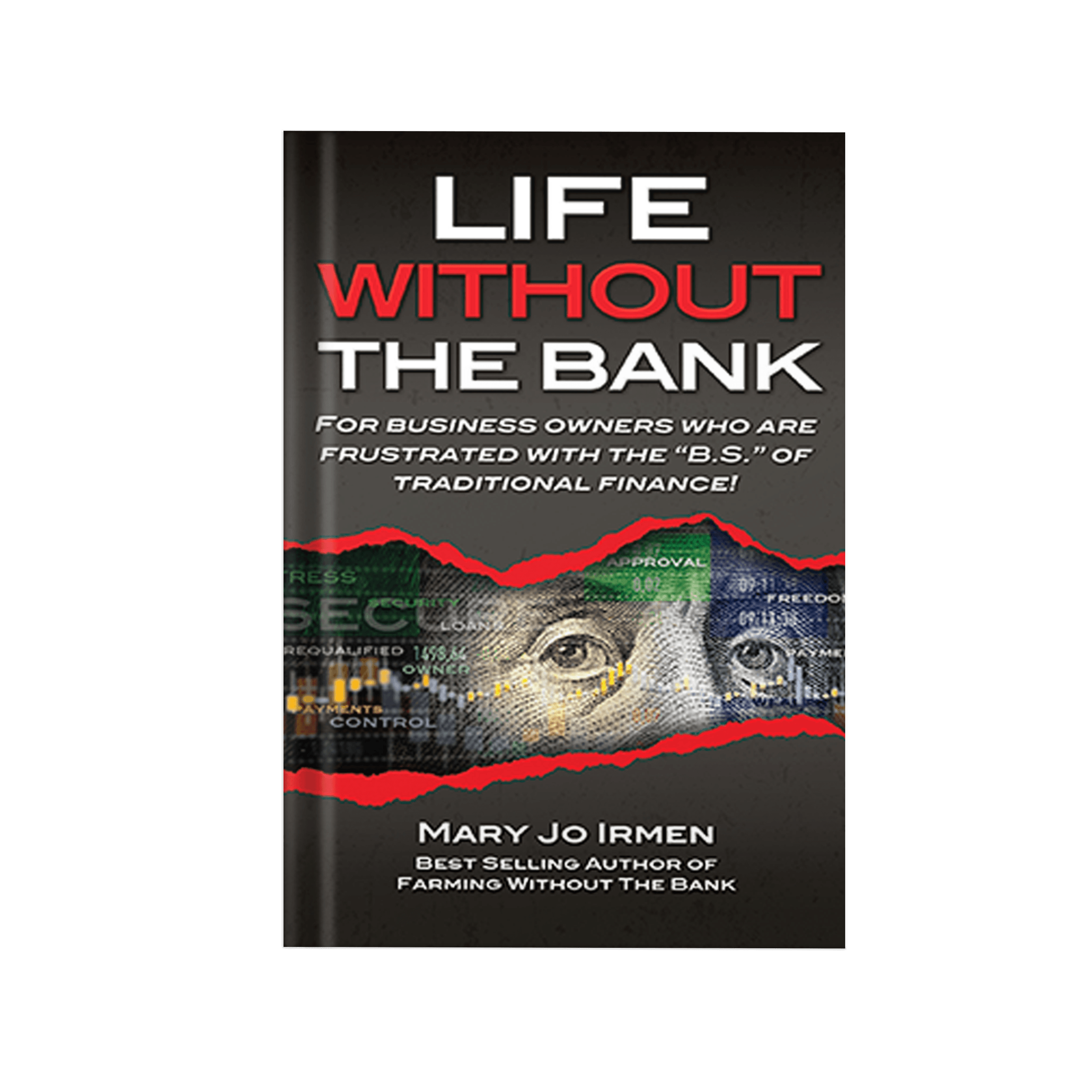
If you want to find a better way to put some money aside for your kids, that they can use it without having to pay capital gains on it, go to withoutthebank.com and grab your Life Without the Bank book. There's an alternative in there that keeps government out of our fingers.
All right, you guys, you have a fantastic rest of your day. Bye.
View MoreHello, hello, and welcome back to the podcast. Thank you very much for being here. Solo episode today. I had something quickly I put together. So it's just me. I'm sorry that you're missing Teresa. But be on the lookout for Miss Teresa to do some of her own podcasts. I'm excited.
Have you guys seen the social media stuff that people are talking about? They get in front of the camera and they're like, my husband's going to talk and he's going to tell you about X, Y, and Z and you be nice to him. Well, when Teresa does her own podcast, you guys be nice to her. Okay. She's going to do a great job. But it's going to be something new for her. So she's facing her fears and I'm excited for her.
Okay. Today, I want to talk to you about the Invest America Act. Oh, they're — I don't know what they're calling it. The Trump account or something. I've actually had a couple of people message me about this and send me videos about this. And I think it's funny because y'all know I'm probably a little bit annoyed with it. So I did some homework today and I've got some information about why I'm suspicious of this account. And really, what is this going to do?
So if you have not heard, this Invest America account is going to give U.S. citizens under the age of 18, starting January 1st, 2026, $1,000. So anybody born in 2026 is automatically going to get $1,000 put into this account. Anybody born from 2019, I think. Some kids that were already born are going to get $1,000 as well. Some kids are going to get an extra $250 because Michael and Susan Dell are going to contribute.
But here's the thing. Here's what got me about this account is that I was sent a video and I've seen a couple of videos of Ted Cruz talking about how amazing this account is going to be. I'm going to be selling the whole thing as if it's the most amazing thing ever, right? So I'm going to pick on a couple of things here.
So the government is going to give every child born $1,000. Then the parents or grandparents, whoever, can contribute $5,000 a year, okay? So this is where it gets — God, Ted Cruz, like, has he lost all his marbles? Is he just being a typical politician and trying to sell something that's not real?
He said employers, parents, family, and employers can contribute up to $5,000 a year. Nowhere in the bill does it state employers can contribute $5,000 a year. So let's just, like, be real and think about that for five seconds. So an employer doesn't even contribute $5,000 a year on an employee's 401(k) at 3%. So they think that an employer is going to give another $5,000 to a part-time employee that's in high school. These kids can have these things forever, right? They can hold them till they're 59 and a half. And so $5,000 a year, the employer is going to contribute that? In what world, Teddy? In what world?
Then he said — God, this guy's out of touch with reality. I used to like Ted Cruz. Like, this is not good. This is not good. Then he said, even single moms waiting tables will be able to help their kids. They can contribute $5,000 a year and help their kids. Even single moms waiting tables.
Okay, let's just quit just using the single mom thing. How about single dads? How about dads paying child support that don't have an extra $5,000 per child to contribute? How about moms working their butts off? How about the average American who cannot contribute $5,000 to their own 401(k)? They can't save $5,000 a year. But, oh, our government thinks that this is going to be amazing because they can put $5,000 away per child.
So I did a little research. Less than 20% of parents today contribute to a 529 plan. So we think that they're going to put $5,000 into this for their kids. How about we teach them some financial literacy? How about that money go there?
Because I did a little more research, y'all. I got my numbers here. I thought, well, $1,000 per kid, right? 3.63 million kids are born in the U.S. every year. So that means we're going to be contributing $3.63 billion into this account. Hmm. Why would the government want to contribute $3.63 billion into account? Well, in my opinion, probably so they can get some more tax money.
So there's one of two things. Now, I'm going to think like Nelson here. And Nelson was not a pessimist, right? But he was an Austrian economist. And he was looking at, what are they doing? Nelson always said, when they give us money, we should be concerned. Right? So I'm now concerned. They're giving money. So I'm a little bit wondering why. What is this incentive? Is it because there won't be Social Security? So they're saying, well, we gave you this option. You didn't take it. So now that's your fault. So are they trying to create another Social Security program that they have access to? Huh.
So I said, what happens when these kids take this money out? Because the account — this is another thing Teddy said, the account is tax advantaged. It's not tax advantaged. It's going to grow income tax free every year. You're not going to have to pay tax on that. But when you take it out, when these people take this money out, it is going to be at a capital gains rate.
So I thought, well, that's very interesting. It's not at their income tax rate. It's at a capital gains rate. Much different. So right now, the capital gains rate is anywhere between — it's normally at about 15 or 20 percent, just depending on your income.
So let's say that these kids get to 18 and I figured it based on a thousand dollar deposit. They will not add the extra five thousand dollars a year. Okay, Ted said this money is going to grow at seven percent because they can put it in the S&P and a low cost indexed fund. So and the average on the S&P, he said, was seven percent. It's a little bit higher if we go back eight years. It's more like eight, I think it was. And so I'm just going to go with his seven because apparently he was being conservative.
And so I said, if they put a thousand, if we only ever put the thousand dollars in that the government put in, no further contributions, seven percent annual growth rate. And these kids are going to take this money out at 19. Okay, if they do that, they will have a whole whopping $4,147 in that account. Four thousand dollars, 147 dollars.
So these kids are going to say, well, I'm 19. Like, I don't need that money. Why is that four thousand dollars sitting there? I'm just going to cash it out. If they do that at 19 and they have to pay capital gains on that at 15 percent, the government will collect $603 million in taxes. Six hundred and three million. If it's at a 20 percent capital gains rate, they're going to collect $804 million in taxes.
Now, if these kids are at a zero percent income tax rate, meaning they don't make any money, then they're not going to have to pay any taxes on it. But it's very interesting to me that when we take money out of an IRA, when we take money out of a 401(k), when we take money out of a Roth, that all comes to us as ordinary income. So that is our normal income tax bracket. But this is coming at a capital gains rate, and capital gains can change.
So why are they taxing at a capital gains rate when they know that most young people, if they're going to withdraw this money, will be at a 12 or 14 percent income tax rate? So why are they taxing at a $1,000? So that we can collect taxes later? Because we know they're probably not going to keep it in there. I don't know. I mean, how many people are going to say, oh, it's $5,000 that I can stick in extra.
So Ted did the numbers and I reran his numbers and he wasn't — he was close, but he wasn't on. According to his numbers, if you add $1,000 a year by the time they're 18, they'll have $170,000. Okay. So I said, all right, from zero until 18 with a 4% inflation rate, what is my purchasing power on that $170,000? And it is $83,000. So in 18 years, $170,000 will only purchase what we are purchasing today for $83,000 because it's devalued, right?
So then he said, well, if they continue to contribute, then if they add $5,000 a year until they are 35, they'll have $700,000. Well, in 35 years, my purchasing power will be equivalent to $175,000 today. College in 18 years is going to be $40,000 to $60,000 a year with the current rate of inflation on college that we have today. Private school will be $100,000 to $150,000.
And the other thing he sold us on was that this is compound interest. We are going to be able to teach our kids compound interest. It is the eighth wonder of the world is what I saw one news person say. What about uninterrupted compound interest? What about that? Can we earn that somewhere? I wouldn't know where to put money to earn that.
This is the piece that sort of annoyed me the most is — I mean, it all annoyed me, let's be honest. But this piece, I just couldn't even believe this came out of his mouth. He said, this is going to create a new generation of capitalists. Kids will see how awesome companies are because they will have stock in these companies. They will be owners of these companies.
Well, that would mean that we're investing in the S&P with dividends, right? That would mean we are investing in stocks with dividends. That's not what he said. That is not what he said prior. He said we're investing in the S&P.
If you want kids to be capitalists, why would you not teach general society how to own a business? Why would you not teach people how to use the tax code to their advantage because they're business owners? Instead, let's put money in the S&P so that we can prop up the big companies that are already there. Let's give those big companies more money.
Are we doing this because the stock market is so unstable that we're doing buybacks on the stock market to make it look good? And we can no longer have companies doing that because they're financially hurting. And so we're going to put $3 billion — 3.6, right? It was like 3.6 billion or something. $3.63 billion into the stock market a year. Is that what we're doing here? Is we're saying we're going to help the stock market? The government's going to help the stock market?
Where does this $3.63 billion come from? You and I. The government does not make money. This is coming from us. To go to children who are not being taught anything about it. We're just putting it in an account to help out brokers, to help out banks and investment people.
How does this differ? When I look back at what Nelson taught us and what he lived through as 401(k)s and IRAs were created, how is this any different than that? This is just saying, hey, go put some more money in the market. But we're going to help you do that. We're going to prop up our own market. Let's not teach kids anything. Let's not teach parents anything. Let's just give them money.
And I actually, I went into ChatGPT to kind of summarize this bill. I put the bill into chat and then it summarized it for me. And I said, why aren't we using this money to teach kids and to teach people how to use it? And I didn't think chat was actually going to answer that because, you know, I figured it'd be a little biased. And it said, this is the money first versus education first approach. Can't say I've ever heard that before. So that was pretty interesting.
I just think we have to look at the big picture here of why are we not teaching families how to do what everyone else is doing that's wealthy. Instead, we're going to give kids $1,000 as if that's anything. Why don't you just give them a penny? It's not going to be worth any. It's not going to get them any. Where is $1,000 going to get anybody? I don't care if it's a newborn. And the parents can't take this money out. This money cannot be distributed before 18. So where is this going to get anywhere? Anyone? Nowhere.
So there's got to be an alternative reason that they are doing this. And the only reason that I can come up with is they want to collect taxes early and they want to prop up the stock market because that's where it has to go. It has to go in the stock market. You don't get the option. Okay. And it sounds like they're going to start one of these accounts. Even if the parents don't start it, it's going to be started on their behalf.
Not happy about it. Think it's the stupidest thing I've ever heard. And if you listen to Ted Cruz talk, he had all kinds of stuff that was wrong. Like unbelievable. Unbelievable in his video. Because he said that this grows — what did he say? With a tax. He made it sound like it was a Roth IRA.
So the bill itself is only like a page and a half. So I went through the bill and I was like, well, that's not what the bill says. So then I stuck it into AI because I thought, well, am I too stupid to understand this? So I stuck it into AI and AI said the same thing. No, Ted Cruz was misleading. He said some things that were not accurate. I guess that's how you sell stuff.
That's how you sell stuff that's not good for the people, right? That's how people sell IULs and VULs and all the things. But that's how you sell stuff that's not good for the people. And when we have politicians selling stuff that's not good for the people, we must ask the question as to why.
When government makes a rule and then they create an exception to the rule, we should be concerned is what Nelson said. And this has concern all over it for me.
So there you go. That's my opinion on that because several of you have sent it to me and asked me about it. I don't think it's amazing. Let me know what your thoughts are. Email me at maryjo@withoutthebank.com.
If you want to find a better way to put some money aside for your kids, that they can use it without having to pay capital gains on it, go to withoutthebank.com and grab your Life Without the Bank book. There's an alternative in there that keeps government out of our fingers.
All right, you guys, you have a fantastic rest of your day. Bye.



ready to start?
Your financial independence starts with one book.
Only one of three Americans can retire. Part of the fault is the conditioned belief that you must give up the use of your money when you’re young so you can have it later, assuming the stock market doesn’t collapse.